
Where an investment sits may matter almost as much as what you own. In 2026, the basic pattern may still be simple: tax-efficient stock funds may fit in taxable, bond-heavy and income-heavy assets may fit in pre-tax IRA or 401(k) space, and higher-growth assets may fit in Roth space.
If I had to boil the whole article down into a few lines, it would be this:
- Taxable accounts may work well for index funds, ETFs, long-held stocks, and municipal bonds
- Pre-tax IRAs and 401(k)s may work well for taxable bonds, REITs, and high-turnover funds
- Roth accounts may be better used for assets with more upside potential
- Asset allocation comes first: account placement may matter, but the stock/bond mix may matter more
- A few cases may change the default: near-term cash needs, low-income years, large unrealized gains, and estate or charity plans
Research cited in the article suggests asset location may add around 0.2% to 0.6% per year in after-tax return for some diversified investors. That may sound small. Over many years, it may add up.
How to Implement Your Asset Location: A Practical Example
Quick Comparison
The short version: this article says the 2026 tax law changes may be a reason to review asset placement, not to throw out the old playbook. The defaults may still hold. The fine print may come from taxes, time horizon, and where you may need cash first.
2. How Taxable, Traditional IRA, and Roth Accounts Are Taxed
Getting clear on the tax rules for each account type is what makes asset location worth talking about. And once you line them up side by side, one thing stands out: the account itself may matter more than the investment label.
Taxable brokerage: flexibility, step-up potential, and annual tax cost
Taxable accounts offer the most flexibility. There are no contribution limits, no withdrawal rules, and no early-withdrawal penalties. That freedom may come with an annual tax drag.
Bond interest and most REIT distributions may be taxed at ordinary income rates in the year they’re paid, even if they’re automatically reinvested. Qualified dividends and long-term capital gains on assets held for more than one year may get lower tax rates - 0%, 15%, or 20%, depending on income.
Here’s a simple example. An investor in the 24% bracket with a $10,000 bond fund yielding 4% may owe about $96 per year in tax on that interest alone.
Taxable accounts may also offer a step-up in basis at death. For heirs, that may wipe out unrealized gains.
Traditional IRA: a good shelter for income taxed at ordinary rates
Inside a traditional IRA, there’s no annual tax on interest, dividends, or capital gains. That tax deferral may be the main appeal.
The tradeoff shows up later. Withdrawals are generally taxed as ordinary income, no matter what produced the return inside the account. A bond fund’s interest and a stock fund’s long-term gains may end up receiving the same treatment at withdrawal: taxation at the owner’s marginal rate, which may be as high as 37%.
Required minimum distributions starting at age 73 may add another layer to think through. Forced withdrawals may push taxable income into a higher bracket for some people.
Roth: limited space, best used deliberately
Roth accounts are funded with after-tax dollars. But qualified withdrawals of both contributions and earnings are tax-free. There are also no required minimum distributions during the original owner’s lifetime, and heirs may inherit Roth accounts on an income-tax-free basis for qualified distributions.
Because Roth IRA space may be limited in 2026, many investors treat it carefully. Some choose to place higher-growth assets there. Low-growth assets in a Roth don’t ruin the account, but they may leave part of that tax shelter less fully used.
Put simply:
- Tax-inefficient income may fit better where taxes are deferred
- Tax-efficient growth may fit better where it has more time to compound
Those tax differences are what shape the placement rules in the next section.
3. What Usually Belongs in Each Account Type
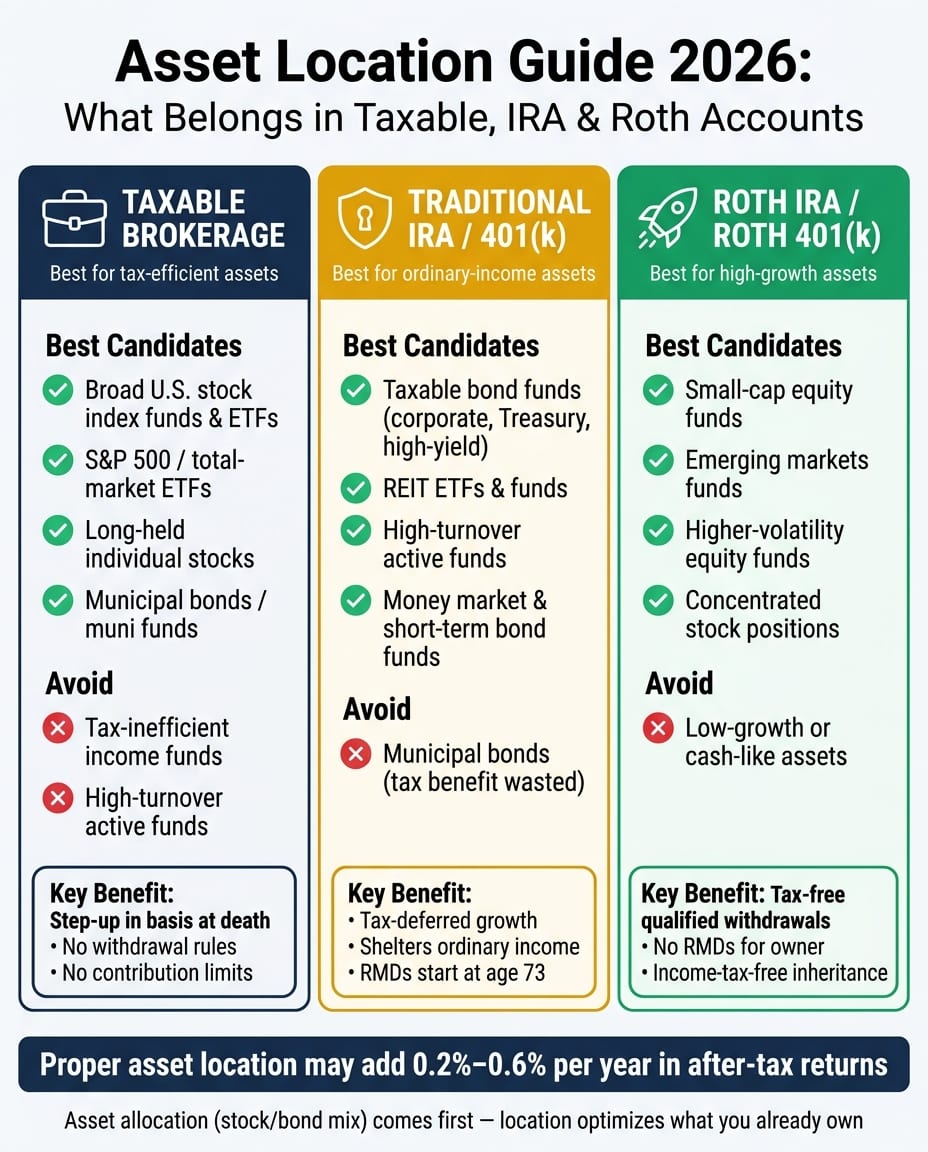
Section 2’s tax rules point to a simple default: tax-efficient assets may fit best in taxable accounts, ordinary-income assets may fit best in traditional IRAs, and higher-growth holdings may be stronger candidates for Roth accounts. Under the 2026 tax rules, that core logic still appears to hold. These are useful starting points. From there, it’s about matching each asset type to the account where it may make the most sense.
Taxable accounts: index funds, ETFs, individual stocks, and municipal bonds
Low-turnover U.S. index funds and ETFs - like a total-market ETF or an S&P 500 ETF - often work well in taxable accounts. They usually create relatively little annual tax drag.
Long-term individual stocks may also fit here. One reason is that investors control when gains are realized. Taxable accounts may also provide a step-up in basis at death.
Municipal bonds generally belong in taxable accounts because their interest is usually federal tax-free. Putting them in an IRA or Roth may reduce that tax feature.
Traditional IRAs: taxable bonds, REITs, and high-turnover funds
Traditional IRAs often line up with ordinary-income assets. Bonds, REITs, and high-turnover funds may fit here, since their income may compound before withdrawal tax applies.
Roth accounts: high-growth stocks and higher-volatility equity funds
Roth space is limited, so many investors reserve it for assets with the highest expected growth. That may include small-cap equity funds, higher-volatility equity funds, emerging markets exposure, and concentrated stock positions.
A simple fill order may look like this:
- Bonds and REITs in a traditional IRA
- Higher-growth equities in a Roth account
- Tax-efficient stock funds and municipal bonds in taxable accounts
If traditional IRA space runs out, some tax-inefficient assets may shift into Roth. Even so, higher-growth assets may still have the strongest claim on that space.
The table below turns those defaults into a quick account-by-account checklist.
Next, the placement rules get more specific for bonds, REITs, dividend stocks, and growth assets.
4. Where to Put Bonds, REITs, Dividend Stocks, and Growth Assets
Building on those default placements, this section gets into the situations where tax treatment may change the answer under the 2026 rules. Think of these as exceptions, not a whole new framework.
Bonds and money market funds and short-term bond funds
Bonds and short-term cash holdings may fit best in a traditional IRA. When those assets sit in a taxable brokerage account, the interest may be taxed as ordinary income. Putting them in a tax-deferred account may reduce yearly tax drag and may let that income compound before taxes apply.
If traditional IRA space is tight, a Roth may be the next-best spot. A taxable account may still make sense if you want easier access to cash or want to avoid early withdrawal penalties before age 59½.
Municipal bonds are the main exception. Their interest may be exempt from federal tax, so they may fit better in a taxable account. Putting them in an IRA may give up that tax break.
REITs and dividend-paying stocks
REITs are one of the clearer cases for IRA or Roth space. They must distribute at least 90% of taxable income, and most REIT payouts are ordinary dividends taxed at regular income rates instead of qualified-dividend rates. For many investors, a traditional IRA may be the first place to look. A Roth may also work well if you have room and want income and growth to compound without future tax on qualified withdrawals.
Dividend stocks are a little less straightforward than bonds or REITs. The key split is between funds that produce mostly qualified dividends and higher-yield strategies, covered-call funds, or high-turnover holdings that may throw off more ordinary income. That second group may fit better in a traditional IRA, or in a Roth if space is still available.
High-growth equities and concentrated upside
Roth space may be the place for growth, but diversification still matters if you want to stay invested through a drawdown. Since Roth room is limited, the strongest candidates may be assets with the highest expected appreciation: small-cap funds, emerging markets exposure, aggressive sector funds, and concentrated stock positions. In those cases, tax-free compounding may have more impact.
A simple setup may look like this: keep a core broad-market equity fund, then add higher-growth satellite positions around it. That may strike a workable balance between upside and diversification.
The table below brings that placement logic together across these asset classes. It may work as a default map, with changes only when liquidity needs, account limits, or withdrawal timing shift the tradeoffs.
5. Common Mistakes and a Simple 2026 Portfolio Review
When the default rules can fail
The default framework may fit many investors, but a few exceptions may change the answer. The account rules above may work as starting points. These cases may override them. Tax efficiency may matter, but cash needs, tax-bracket timing, and legacy goals may matter more in some cases.
Near-term spending needs: If you may need money from taxable within 3 to 5 years, it may make sense to keep short-term bonds or cash there instead of forcing stock sales during a downturn.
Low-income years: If your taxable income may drop sharply during a sabbatical, job gap, or the early years of retirement before RMDs, that lower-tax window may be used for Roth conversions or gain harvesting.
Large embedded gains: It may not make sense to sell appreciated holdings just to fine-tune asset location if the tax cost may outweigh the upside. Some investors instead use new contributions, dividends, and selective tax-loss harvesting to improve placement over time.
Legacy and charitable goals: Taxable may still be the right place for long-held stock if you may want to leave it to heirs or donate it to charity.
A simple 2026 review process
If none of those exceptions seem to apply, this four-step review may help clean up the rest.
Start with asset location by account, then by tax character. List every account: taxable brokerage, traditional IRA, Roth IRA, 401(k), and any spousal accounts. Note the balance in each on one date. Then tag each holding by tax character:
- ordinary income, such as bond funds, REITs, and high-yield funds
- qualified dividends or long-term gains, such as broad equity index funds
- tax-exempt, such as municipal bond funds
This step alone may show the issue. You may find bonds in taxable, or a Roth packed with bond funds.
Next, check whether the most tax-costly holdings sit in tax-sheltered accounts. Ordinary-income holdings may fit best in traditional IRAs and 401(k)s first. High-growth equities may be better candidates for Roth space. Tax-efficient index funds and muni bonds may fit better in taxable. Research suggests this kind of placement may generate roughly 0.2% to 0.6% per year in added after-tax return, depending on the portfolio.
A common mistake is holding the same balanced or target-date fund in every account. If you hold a 60/40 fund in taxable, a traditional IRA, and a Roth, you may end up with the same tax drag in every account instead of using each account type for its own tax treatment.
Last, confirm that your total stock/bond mix across all accounts still lines up with your target. Asset location changes where holdings sit, not the amount of risk in the full portfolio. Before making trades, recheck your total stock-bond mix. Some investors revisit this once a year, and again after a major income change, a move to a new state, or a shift in tax law.
FAQs
Should asset location change my overall asset allocation?
No. Asset location may not need to change your overall asset allocation.
A common approach starts with your target asset mix based on your goals, risk tolerance, and time horizon. After that, asset location may be used to place those same holdings in the accounts that may be more tax-efficient.
The idea is pretty simple: keep the portfolio mix the same, but decide where each holding sits. That setup may improve after-tax returns without changing the portfolio’s risk profile.
When is it worth moving holdings just to improve asset location?
It may make sense to move holdings when you're fixing clear tax drag from asset location mistakes, like keeping tax-inefficient assets in taxable accounts.
Instead of selling positions for small gains, some people focus on bigger triggers:
- changes in tax brackets
- large 401(k) or IRA rollovers
- getting close to retirement
In some cases, trades inside tax-advantaged accounts may reduce tax friction. Some investors also start by directing new contributions first, rather than moving existing holdings right away.
What if I need cash soon or expect a low-income year?
A low-income year may be a decent time for a Roth conversion. Moving money from traditional retirement accounts into a Roth IRA during that kind of year may mean paying tax at a lower marginal rate than you might in a higher-income year.
If you may need cash soon, a taxable brokerage account generally offers the most flexibility. You may withdraw money at any time without early-withdrawal penalties. And long-term capital gains tax rates may be lower in some cases - sometimes 0% - with tax-loss harvesting potentially reducing taxes further.
Disclosures:
- This content is for informational purposes only and does not constitute investment advice or a recommendation to buy or sell any security.
- Past performance is not indicative of future results. No guarantee of future performance or outcomes is implied.
- Savings and performance examples are hypothetical and for illustrative purposes only. Actual results will vary based on individual circumstances, portfolio composition, market conditions, and fees.