
Managing $1 million or more in investable assets requires careful attention to fees, taxes, and high-net-worth investing strategies. This guide compares three popular U.S. brokerage platforms - Charles Schwab, Fidelity Investments, and Interactive Brokers - to help affluent investors decide based on their unique needs.
Key Takeaways:
- Charles Schwab: Offers tailored services for various wealth tiers, advanced tools like thinkorswim, and tax-efficient strategies. Best for those who want integrated banking and advisory services.
- Fidelity Investments: Known for its tax-smart strategies, zero-fee policies, and diverse account options. Ideal for retirement planning and long-term investors.
- Interactive Brokers: Focuses on low costs, global trading, and institutional-grade tools. Suitable for experienced investors and frequent traders.
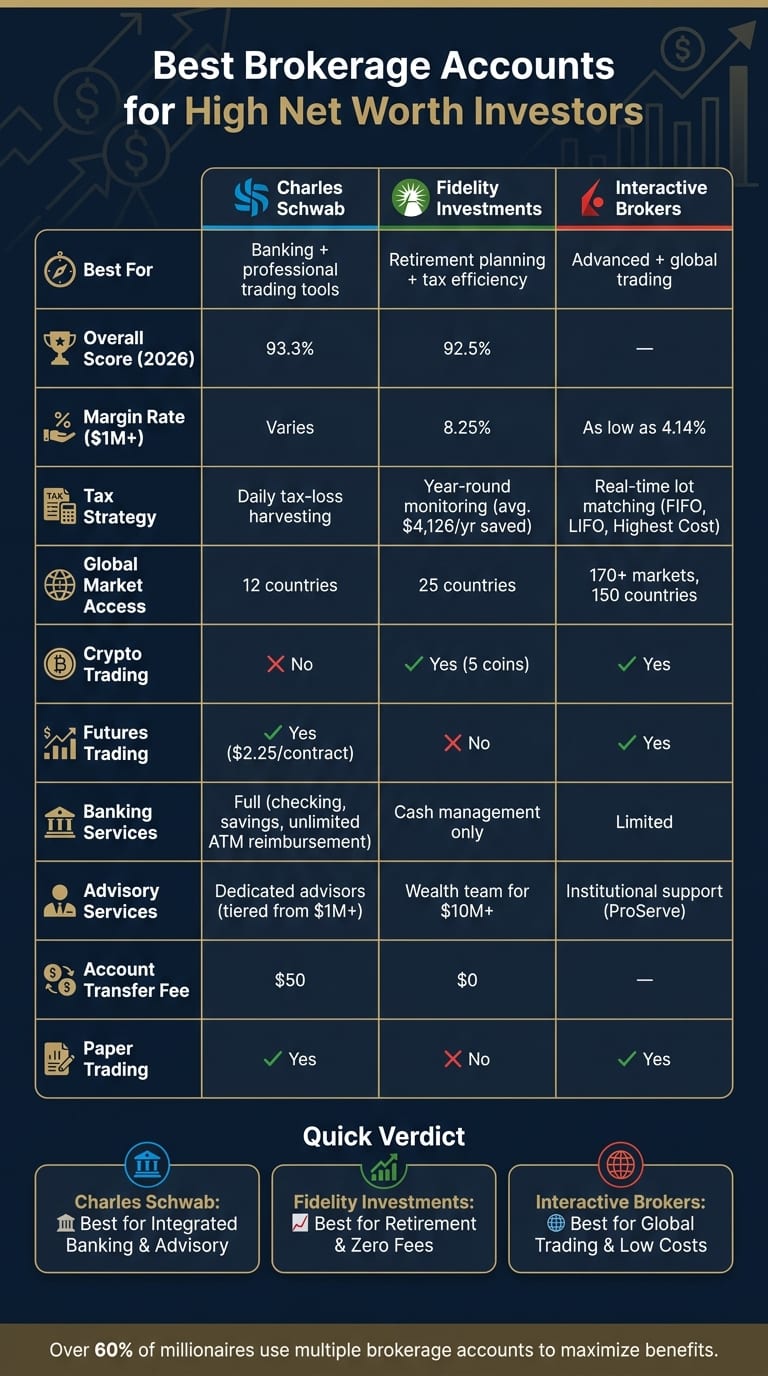
Quick Comparison:
Each platform has strengths tailored to different investor goals. Combining accounts across platforms may also help maximize benefits.
Brokerage Firms Fidelity, Schwab, Vanguard Which One Is Best?
1. Charles Schwab
Charles Schwab is the largest brokerage in the United States by total client assets, managing over $9.5 trillion as of May 2026. A significant portion of these assets - more than two-thirds - comes from high-net-worth (HNW) and ultra-high-net-worth (UHNW) clients.
Portfolio Management Tools
For HNW investors, Schwab offers Schwab Personalized Indexing, a direct indexing solution. This tool allows investors to hold individual stocks within an index instead of fund shares, enabling tailored exposure based on personal values or risk preferences. The service requires a $100,000 minimum investment, with fees starting at 0.40% for balances up to $2 million and dropping to 0.35% for larger accounts.
Active traders can take advantage of thinkorswim, a professional-grade platform integrated after Schwab's acquisition of TD Ameritrade. It includes over 400 technical studies, advanced options analysis, and the ability to create custom scripts. Many consider it the top free platform for professional-level trading tools.
These advanced management options also tie into Schwab's sophisticated tax strategies.
Tax Optimization
Schwab Personalized Indexing includes daily monitoring for tax-loss harvesting opportunities, which may help improve after-tax returns.
"Schwab Personalized Indexing is tax-efficient. Using a process called tax loss harvesting, it monitors each client's account daily to look for opportunities to lock in tax losses to offset gains." - Jeff Brown, Investment Portfolio Strategist, Charles Schwab
For accounts with balances of $50,000 or more, Schwab Intelligent Portfolios also offers automated tax-loss harvesting. In addition, Schwab's advisor-managed accounts feature the iRebal platform, which provides tax-aware rebalancing at the household level with customizable thresholds for losses.
Investment Access
Clients with household assets of $5 million or more gain access to Schwab Alternative Investments Select, which offers private equity, hedge funds, and other opportunities through iCapital technology. Notably, over 37% of advisors working with Schwab already use one of its alternative investment platforms.
Personalized Support
Schwab tailors its services to meet the needs of clients at different asset levels, offering a range of benefits as assets grow:
Clients with $10 million or more are automatically enrolled in Schwab Private Wealth Services at no additional cost. This level of service includes a dedicated Consultant and specialists in tax, estate planning, and equity compensation. For those managing $20 million or more, Schwab offers a "Family Office" experience through Schwab Advisor Services, which custodies $739 billion in UHNW assets.
"As our large and growing HNW and UHNW client base continues to turn to Schwab to meet a broad array of wealth, advice and investing needs, we are committed to continuing to expand our capabilities to serve their evolving needs and preferences." - Neesha Hathi, Head of Schwab Wealth & Advice Solutions
One potential drawback for HNW investors is the cash allocation in Schwab's robo-advisor accounts, which ranges from 6%–30%. This allocation could impact long-term returns compared to fully invested strategies. It’s an important factor to consider when evaluating Schwab’s various account options.
2. Fidelity Investments
Fidelity stands out as a top choice for high-net-worth investors, consistently earning high ratings in the industry. It caters to affluent clients with a blend of advanced trading tools, year-round tax management, and scalable wealth services.
Portfolio Management Tools
Fidelity's platforms are designed to support its wealth management offerings. Fidelity Trader+ provides advanced charting capabilities and supports multiple monitors across desktop, mobile, and web platforms. For those seeking personalized portfolio management, Separately Managed Accounts (SMAs) allow for tailored security selection. Advisory fees for SMAs range from 0.20% to 0.70% annually.
Tax Optimization
Fidelity takes a proactive approach to tax efficiency by monitoring positions year-round to identify tax-loss harvesting opportunities.
"Where some people look for ways to harvest tax losses at year end, our investment team is continually watching every position as part of our ongoing effort to create more tax-efficient portfolios for our clients." - Peter McMahon, Vice President, Financial Consultant
Fidelity’s Personalized Portfolios incorporate up to eight tax-smart strategies, which may result in notable tax savings. For example, clients saved an average of $4,126 annually from tax-loss harvesting alone, based on an average account balance of $687,877. Additionally, over 94% of Fidelity Managed FidFolios clients have seen their advisory fees offset entirely by the tax savings generated through direct indexing. This focus on tax efficiency plays a key role in improving after-tax performance - an important consideration for affluent investors.
Investment Access
Clients with assets exceeding $5 million qualify as "Qualified Purchasers", granting them access to private equity, private credit, and real assets. Through the Wealth Advisor Solutions program, Fidelity also connects eligible clients with independent third-party firms for specialized services like hedge funds, structured products, and cross-border planning. Importantly, there is no fee or obligation for the initial consultation. These options add an extra layer of customization to Fidelity’s offerings for high-net-worth clients.
Personalized Support
Fidelity’s wealth services are structured around clear asset thresholds, with progressively enhanced benefits at each level:
At the Private Wealth Management level, clients are supported by a dedicated team that includes specialists in investment, estate, and tax planning. Advisors work closely with external professionals, such as attorneys and accountants, and can manage accounts at the household level for families with multiple related accounts. Advisory fees for this tier range from 0.20% to 1.04%.
"My goal is to develop long-term relationships with my clients and their families that are built on trust, inspired by their personal experience and goals, and delivered through world-class financial and investing resources." - Dylan Sanders, VP, Fidelity Private Wealth Management
3. Interactive Brokers
Interactive Brokers offers institutional-grade tools, global market access, and competitive pricing tailored for experienced investors. Since its inclusion in the S&P 500 in August 2025, the platform has grown to manage over 5 million client accounts, with daily trading volumes exceeding 4 million trades.
Portfolio Management Tools
At the heart of Interactive Brokers' analytics is PortfolioAnalyst, a tool that consolidates data from linked brokerage, checking, savings, and credit card accounts to provide a comprehensive view of net worth. It monitors performance using 35+ metrics, such as Value at Risk (VaR), performance attribution, and projected income. For risk management, Risk Navigator delivers real-time tracking across multiple asset classes and global markets.
Interactive Brokers also incorporates AI-driven tools to enhance user experience. Features like Ask IBKR allow users to query in plain English, while an AI Commentary Generator provides report summaries. Additionally, integrations with ChatGPT and Claude assist with exposure analysis and trade drafting. These advanced tools integrate seamlessly with IBKR's tax management features, offering a streamlined experience.
Tax Reporting
Interactive Brokers excels in tax reporting with tools designed to give investors more control. The Tax Optimizer allows real-time adjustments to lot-matching methods, including FIFO, LIFO, Highest Cost, or Specific Lot, helping to manage capital gains outcomes before trade settlement. The Tax Loss Harvesting tool identifies unrealized losses at the lot level, even for positions showing an overall gain, while ensuring compliance with IRS wash-sale rules. For broader financial planning, the Tax Planner within PortfolioAnalyst estimates federal and state tax liabilities by integrating IBKR account data with external income sources like wages and bonuses.
"Interactive Brokers continues to set the benchmark for cost efficiency, offering margin rates and high yields on idle cash that consistently outperform the competition. For the active trader, these are not just perks - they are material contributors to the bottom line." - StockBrokers.com
Investment Access
Catering to affluent investors, IBKR provides trading opportunities across 170+ markets in 150 countries, supporting 29 different currencies. The platform offers access to over 1 million bonds with no markups, mutual funds from more than 500 fund families, and private hedge funds via the Investors' Marketplace, which is available to accredited investors and qualified purchasers.
High-net-worth clients can also benefit from the Stock Yield Enhancement Program, which generates additional income by lending out fully-paid shares.
Support Options
Interactive Brokers provides specialized support for affluent clients through IBKR ProServe and dedicated institutional sales contacts. Family offices and advisors managing client assets can take advantage of white branding to customize client statements, portals, and reports with their corporate identity. The platform charges no custodial or platform fees, offers margin rates starting as low as 4.14% (up to 55% below industry averages), and pays interest of up to 3.14% on uninvested USD cash.
Pros and Cons
Here's a quick comparison of what makes each platform stand out:
Each platform offers distinct benefits and trade-offs, especially for high net worth individuals.
Charles Schwab stands out for combining banking services with professional-grade trading tools. The thinkorswim platform is robust, and perks like unlimited worldwide ATM fee reimbursements are appealing for frequent travelers. However, drawbacks include no crypto trading, a $50 fee for full account transfers, and a $6.95 charge for OTC stocks.
Fidelity Investments is widely recognized for its zero-fee policies, including no charges for account transfers or robo-advisory services. Its comprehensive account offerings, such as HSAs and Solo 401(k)s, along with research access from 20+ third-party providers, make it a great choice for retirement planning. That said, its lack of futures trading and paper trading options may be a downside for more active traders.
Interactive Brokers appeals to seasoned investors who need global market access and advanced trading tools. Its low margin rates - starting at 4.14% for balances over $1,000,000 - may provide substantial cost savings. However, the platform's complexity and limited customer service could be challenging for those less familiar with advanced trading systems.
Choosing the right platform depends on how its features align with your trading habits, tax considerations, and overall wealth management goals.
Conclusion
From the comparisons outlined, it's clear that no single brokerage suits every high-net-worth investor. The best choice depends on what aligns with your individual priorities and financial goals.
Charles Schwab appeals to those seeking a comprehensive experience, offering integrated banking, access to dedicated advisors, and financial planning services all in one place. Fidelity, on the other hand, caters to investors who value robust research tools, retirement planning resources, and a variety of account options without additional fees. Meanwhile, Interactive Brokers is ideal for experienced, self-directed investors who trade frequently, want access to global markets, and aim to minimize costs, particularly on margin rates.
For high-net-worth investors, tax considerations play a big role. Using advanced tax-lot management and reporting tools may improve after-tax returns by 0.5%–1.5% annually, which can make a noticeable difference for portfolios worth millions.
Interestingly, over 60% of millionaires diversify their brokerage relationships. Many pair a planning-oriented account at Schwab or Fidelity with a trading-focused setup at Interactive Brokers to make the most of each platform's strengths.
Finally, before committing to any advisory service, take a close look at the costs. For instance, an advisory fee of 0.80% on a $2 million portfolio translates to $16,000 annually. Assess whether the services offered justify this expense based on your unique financial situation.
FAQs
How do I choose between Schwab, Fidelity, and Interactive Brokers for my goals?
When deciding, match your choice to your investment style and personal needs:
- Fidelity: A great option for long-term investors looking for an easy-to-use platform, extensive research tools, and the added benefit of Health Savings Account (HSA) integration.
- Schwab: Well-suited for active traders who value advanced tools (like thinkorswim) and the option for in-person customer service.
- Interactive Brokers: Designed for advanced or international investors who prioritize global market access and lower margin rates.
Think about what matters most to you, and don’t forget to adjust cash sweep settings to make the most of idle balances.
Which platform is best for minimizing taxes on a $1M+ portfolio?
Mezzi may be a strong option for those looking to reduce taxes on portfolios worth $1 million or more. It uses advanced AI-powered strategies to tackle tax efficiency. Traditional advisors often charge around 1% annually - equivalent to $10,000 on a $1 million portfolio. In contrast, Mezzi offers a flat annual fee starting at just $299.
The platform’s AI works continuously, monitoring accounts in real time. It’s designed to help avoid wash sales, improve asset location, and identify tax-loss harvesting opportunities. These features may result in annual returns increasing by 1% to 2%, depending on the portfolio and market conditions.
Should I split my assets across multiple brokerages?
You don’t have to scatter your assets across multiple brokerages to achieve diversification, nor do you need to merge everything into one account for easier management. Keeping accounts separate can sometimes create challenges, such as paying duplicate fees, holding overlapping investments, or accidentally triggering tax penalties from wash sales. Mezzi offers a solution: you can maintain your assets exactly where they are while benefiting from a unified dashboard. This dashboard provides real-time insights, tools for tax optimization, and a comprehensive view of risk across your entire portfolio.
Disclosures:
- This content is for informational purposes only and does not constitute investment advice or a recommendation to buy or sell any security.
- Past performance is not indicative of future results. No guarantee of future performance or outcomes is implied.
- Always consult with a qualified financial advisor before making investment or financial planning decisions.
Related Blog Posts
- High-Net-Worth investing strategies
- AI Rebalancing Tools for High Earners
- Best portfolio tracker for high net worth individuals
- Advanced Investment Strategies for High-Income Earners
When deciding, match your choice to your investment style and personal needs:
- Fidelity: A great option for long-term investors looking for an easy-to-use platform, extensive research tools, and the added benefit of Health Savings Account (HSA) integration.
- Schwab: Well-suited for active traders who value advanced tools (like thinkorswim) and the option for in-person customer service.
- Interactive Brokers: Designed for advanced or international investors who prioritize global market access and lower margin rates.
Think about what matters most to you, and don’t forget to adjust cash sweep settings to make the most of idle balances.
Mezzi may be a strong option for those looking to reduce taxes on portfolios worth $1 million or more. It uses advanced AI-powered strategies to tackle tax efficiency. Traditional advisors often charge around 1% annually - equivalent to $10,000 on a $1 million portfolio. In contrast, Mezzi offers a flat annual fee starting at just $299.
The platform’s AI works continuously, monitoring accounts in real time. It’s designed to help avoid wash sales, improve asset location, and identify tax-loss harvesting opportunities. These features may result in annual returns increasing by 1% to 2%, depending on the portfolio and market conditions.
You don’t have to scatter your assets across multiple brokerages to achieve diversification, nor do you need to merge everything into one account for easier management. Keeping accounts separate can sometimes create challenges, such as paying duplicate fees, holding overlapping investments, or accidentally triggering tax penalties from wash sales. Mezzi offers a solution: you can maintain your assets exactly where they are while benefiting from a unified dashboard. This dashboard provides real-time insights, tools for tax optimization, and a comprehensive view of risk across your entire portfolio.