
If you own rental property in an LLC, 100% bonus depreciation may let you deduct some asset costs in the same year instead of over 5, 15, 27.5, or 39 years. But that faster write-off may apply only to certain property, and the tax value may depend on passive loss rules, state law, timing, and sale recapture.
Here’s the short version:
- 100% bonus depreciation returned for qualified property acquired after January 19, 2025
- The building itself still may not qualify
- Items like appliances, flooring, furniture, and some land improvements may qualify
- Cost segregation may move part of a building’s basis into shorter-life classes
- The deduction may reduce current tax or may turn into suspended passive losses
- Some states, including California and New York, may not follow the federal rule
- A later sale may trigger depreciation recapture, which may cut into the near-term tax upside
A simple example: if a rental LLC places $30,000 of qualifying assets in service in 2026, the owner may deduct the full $30,000 in Year 1 under current federal rules, rather than spreading it over many years. But whether that turns into a current tax drop may depend on income limits, passive activity rules, and filing details.
New Bonus Depreciation Strategies for Real Estate Investors
Quick comparison
I’d sum it up this way: the tax rule changed, but the hard part may be proving which costs qualify and whether the deduction is usable this year. That’s the part most rental LLC owners may want to check before filing.
What changed and which property can qualify
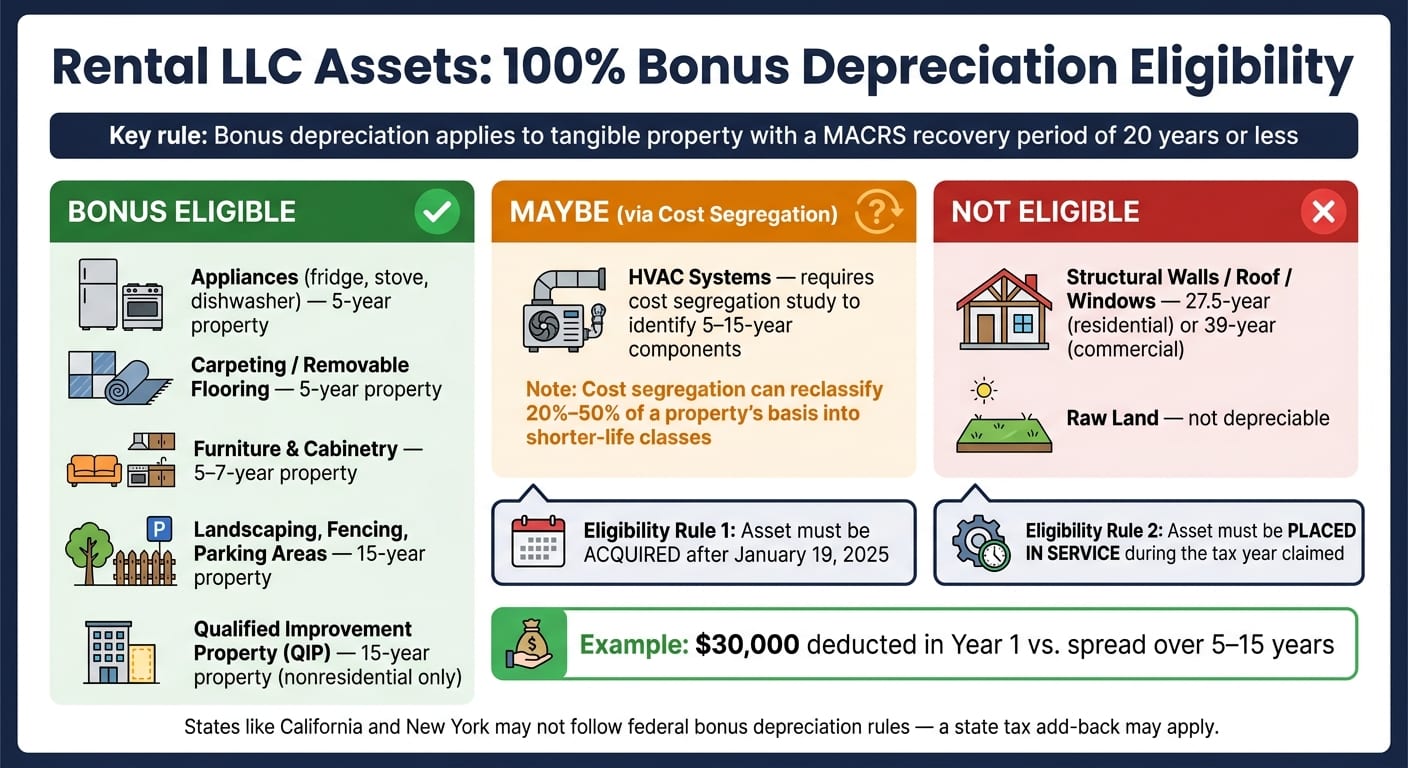
The main issue isn't whether bonus depreciation exists. It's which rental LLC assets may actually use it.
The OBBBA brought back 100% bonus depreciation for qualified property acquired after Jan. 19, 2025.
Two timing rules shape eligibility. First, the asset must be acquired after January 19, 2025. If a binding written contract was signed on or before that date, the property may fall under the older phase-down rates, even if delivery happened later. Second, the asset must be placed in service during the tax year the deduction is claimed. In plain English, that means the asset has to be ready and available for its specific business use.
After that, the real work starts: separating the building itself from the shorter-life assets inside or around it.
Assets that commonly qualify in a rental LLC
Bonus depreciation applies to tangible property depreciated over 20 years or less under MACRS. For rental LLC owners, that usually means looking for items that don't have to stay on the building's 27.5-year or 39-year depreciation schedule. Put simply, these are the parts that may wear out sooner than the building.
Items that generally qualify include appliances like refrigerators, stoves, and dishwashers. Carpeting and removable flooring may qualify too, along with furniture and cabinetry. Certain land improvements - such as fencing, paved parking areas, landscaping, and sidewalks - may also fit into bonus-eligible property classes. Qualified Improvement Property (QIP), which covers interior improvements to nonresidential buildings that aren't structural, may qualify as well.
HVAC is where things get a little messy. It usually counts as part of the building. But a cost segregation study may carve out shorter-life components that qualify for bonus depreciation. In many cases, that kind of study may reclassify 20% to 50% of a property's basis into shorter-life asset classes.
What usually does not qualify for 100% bonus depreciation
The building structure itself - walls, roof, windows, and floor joists - stays on the standard 27.5-year schedule for residential rentals or 39 years for commercial property. Since those recovery periods are longer than 20 years, the building itself does not qualify for bonus depreciation.
Renovations don't all get the same treatment either. If the costs relate to structural components, they generally stay on the longer depreciation schedule.
Common rental assets and likely bonus depreciation treatment
*HVAC systems are generally structural unless a cost segregation study identifies components that can be treated as shorter-life property.
Used property may qualify only if it was purchased from an unrelated party and you did not use it yourself before the purchase.
Once you know what may qualify, the next issue is whether the deduction may lower current tax or simply create passive losses.
How bonus depreciation affects taxes, passive losses, and cash flow
A 100% bonus deduction may help only if you’re able to use it in the current tax year. If not, the deduction may be suspended or carried forward.
When a larger deduction reduces current taxes
Bonus depreciation reduces taxable rental income dollar-for-dollar in the year the asset is placed in service. It may also create or increase a net operating loss (NOL).
When the deduction creates suspended passive losses
For many rental LLC owners, the bigger issue may be the passive activity rules. If bonus depreciation creates a loss larger than your rental income, that extra loss may be suspended and carried forward if you don’t have enough passive income to absorb it.
The $25,000 rental real estate loss allowance phases out as MAGI rises from $100,000 to $150,000 for single and joint filers, and from $50,000 to $75,000 for married filing separately. Real estate professionals may qualify under separate IRS tests.
That may make year-end timing and recordkeeping a big deal.
Hypothetical example: a $30,000 upgrade package
The following is a hypothetical illustration for educational purposes only. It does not represent a guaranteed tax outcome.
Suppose a rental LLC owner spends $30,000 in 2026 on a package of qualifying upgrades:
- new appliances ($8,000)
- flooring ($7,000)
- HVAC components identified through a cost segregation study ($15,000)
All assets are placed in service before December 31, 2026.
Under 100% bonus depreciation, the full $30,000 is deductible in Year 1 instead of being spread over 5 to 15 years. If the property generates $28,000 in net rental income, the deduction would reduce taxable rental income to a $2,000 loss. Whether that loss may offset current income or may get trapped as a passive loss depends on the owner’s MAGI and real estate professional status.
The tax effect may be temporary because depreciation may be recaptured when the property is sold.
Next comes the timing question: whether the property was placed in service in time to claim the deduction this year.
When claiming 100% bonus depreciation makes sense
Once you know an asset qualifies, three things may shape whether the deduction does much for you this year: timing, study cost, and sale-related limits.
Placed-in-service timing and year-end deadlines
The deduction only counts once the asset is installed and ready for use by Dec. 31. In a rental LLC, that may mean an appliance needs to be installed and available for tenant use. If it misses the in-service date, the deduction may shift to a later year.
There’s one timing wrinkle worth noting. A binding contract signed before Jan. 20, 2025 may still bring the asset under the older phase-down rules.
If the asset misses the deadline, the next issue may be whether a study shifts enough basis into shorter-life property to make the fee make sense.
When a cost segregation study is worth considering
A cost segregation study may make sense when the expected tax savings are higher than the fee. In many cases, cost segregation identifies 25% to 30% of a property’s value as components with a useful life under 20 years. Those components may qualify for 100% bonus depreciation.
The math usually comes down to two things:
- Your basis
- Your current-year tax liability
Study pricing varies quite a bit by property size and complexity:
- A desktop study often starts around $450 to $1,000 and may fit smaller properties under $500,000 of basis.
- Hybrid studies using remote engineering often run $1,500 to $3,000 for single-family rentals and short-term rentals in the $500,000 to $1.5 million range.
- Full engineering studies for larger or more complex properties often cost $5,000 to $15,000 or more.
Even if the numbers look good at first glance, state tax treatment and recapture may reduce the upside.
Key limits that can reduce the strategy's value
State tax rules may wipe out part of the federal tax break. States such as California and New York do not follow federal bonus depreciation rules and require a tax add-back. In that case, the deduction may lower federal taxes without lowering state taxes.
Sale timing may matter too. If you expect to sell within three to five years, depreciation recapture may change the picture. For short-life property found through cost segregation, recapture may be taxed at ordinary rates up to 37%, rather than the 25% rate tied to standard straight-line building depreciation.
That means a short-term tax deferral may not always offset the tax cost that may show up at sale.
What to gather before filing and how Mezzi can help you evaluate the tax impact
Once you know the deduction may matter, the next step is making sure you can show that the asset qualifies.
Records to collect now
Before filing, gather the records your preparer may need to verify bonus depreciation. At a minimum, that usually includes invoices, settlement statements, financing agreements, contractor breakdowns, fixed asset schedules, and records showing the asset was placed in service during the tax year. If you used a cost segregation study, keep that report with the rest of your file.
Those records may shape whether the deduction lowers this year's tax bill or mainly shifts the tax effect into a later year.
If you're replacing an existing component - like an HVAC system, roof, or flooring - make sure your fixed asset schedule is current enough to identify the old component's remaining basis. That may allow your preparer to claim a partial disposition instead of recording only the replacement asset.
How to tell whether the deduction will actually lower your tax bill
Qualifying for bonus depreciation is only one part of the picture. The bigger question may be whether the deduction reduces your tax bill this year or creates suspended passive losses.
With those records in hand, Mezzi may help you test the tax impact before filing. With read-only access to your connected accounts, Mezzi gives you a full view of rental cash flow, liquidity, debt, and estimated tax impact, so you may evaluate the deduction before year-end planning closes.
Conclusion: the 3 decisions that matter most
The decision usually comes down to three checks:
- Which assets qualify - generally shorter-life personal property and cost-segregation-identified components, not the building itself.
- Whether you may use the deduction this year - based on passive income, real estate professional status, and your full tax picture.
- Which records prove it - invoices, settlement statements, contractor breakdowns, fixed asset schedules, and placed-in-service documentation.
For some rental LLC owners, 100% bonus depreciation may improve after-tax cash flow. The tax effect may depend on timing, records, and whether the deduction is usable in the current tax situation.
FAQs
Do all rental LLC assets qualify?
No. 100% bonus depreciation generally may apply to tangible business property with a MACRS recovery period of 20 years or less. That may include machinery, equipment, computers, certain vehicles, and qualified improvement property.
Land never qualifies. Most commercial buildings with longer recovery periods are excluded. Intangible assets like goodwill and trademarks also aren't eligible.
The asset also must be placed in service and used for business purposes.
Will bonus depreciation lower my taxes now?
It may.
Bonus depreciation lets you deduct the full cost of qualifying assets - like appliances, furniture, and items found through a cost segregation study - in the year they’re placed in service.
For assets acquired after January 19, 2025, the 100% rate may create or increase a net operating loss. But for many rental owners, those losses may be treated as passive and suspended unless they qualify as a real estate professional or meet material participation rules.
Is a cost segregation study worth it?
It depends on the size of your investment and whether you may use the tax losses it creates. A cost segregation study may increase upfront tax savings by accelerating depreciation.
But those losses are generally passive. If you are not a Real Estate Professional (REPS) or do not have other passive income, the deductions may be suspended and carried forward. It also makes sense to weigh the study’s cost and any potential depreciation recapture on sale.
Disclosures:
- This content is for informational purposes only and does not constitute investment, legal, or tax advice. Please consult a qualified tax professional regarding your specific situation.
- Savings and performance examples are hypothetical and for illustrative purposes only. Actual results will vary based on individual circumstances, portfolio composition, market conditions, and applicable tax laws.
- Past performance is not indicative of future results. No guarantee of future performance or outcomes is implied.
Related Blog Posts
- Tax Implications of Short-Term vs. Long-Term Rentals
- Short-Term Rental Taxes: What Hosts Must Know
- Real Estate Tax Strategy: Cost Segregation, 1031s, and REPS
- Real Estate Professional Status: Deducting Passive Losses Against W-2
No. 100% bonus depreciation generally may apply to tangible business property with a MACRS recovery period of 20 years or less. That may include machinery, equipment, computers, certain vehicles, and qualified improvement property.
Land never qualifies. Most commercial buildings with longer recovery periods are excluded. Intangible assets like goodwill and trademarks also aren't eligible.
The asset also must be placed in service and used for business purposes.
It may.
Bonus depreciation lets you deduct the full cost of qualifying assets - like appliances, furniture, and items found through a cost segregation study - in the year they’re placed in service.
For assets acquired after January 19, 2025, the 100% rate may create or increase a net operating loss. But for many rental owners, those losses may be treated as passive and suspended unless they qualify as a real estate professional or meet material participation rules.
It depends on the size of your investment and whether you may use the tax losses it creates. A cost segregation study may increase upfront tax savings by accelerating depreciation.
But those losses are generally passive. If you are not a Real Estate Professional (REPS) or do not have other passive income, the deductions may be suspended and carried forward. It also makes sense to weigh the study’s cost and any potential depreciation recapture on sale.