
Short answer: neither model may “win” on math alone. With the same 60/40 mix, a $2.5 million starting portfolio, a $100,000 annual spending goal, and a 30-year time frame, the main gap may come from behavior, tax handling, and how easy the plan feels to run.
Here’s the simple version:
- Bucket strategy may feel calmer because near-term spending sits in cash and short-term bonds.
- Total-return may feel cleaner because all accounts work as one portfolio with one withdrawal plan.
- Research cited in the article suggests the two approaches may look very similar when allocation and rebalancing stay the same.
- The bigger issues may be:
withdrawal durability
- selling risk in bad markets
- tax drag
- DIY difficulty across taxable, IRA/401(k), and Roth accounts
If I boil the article down to one point, it’s this: the better model may be the one I’m more likely to follow when markets get rough.
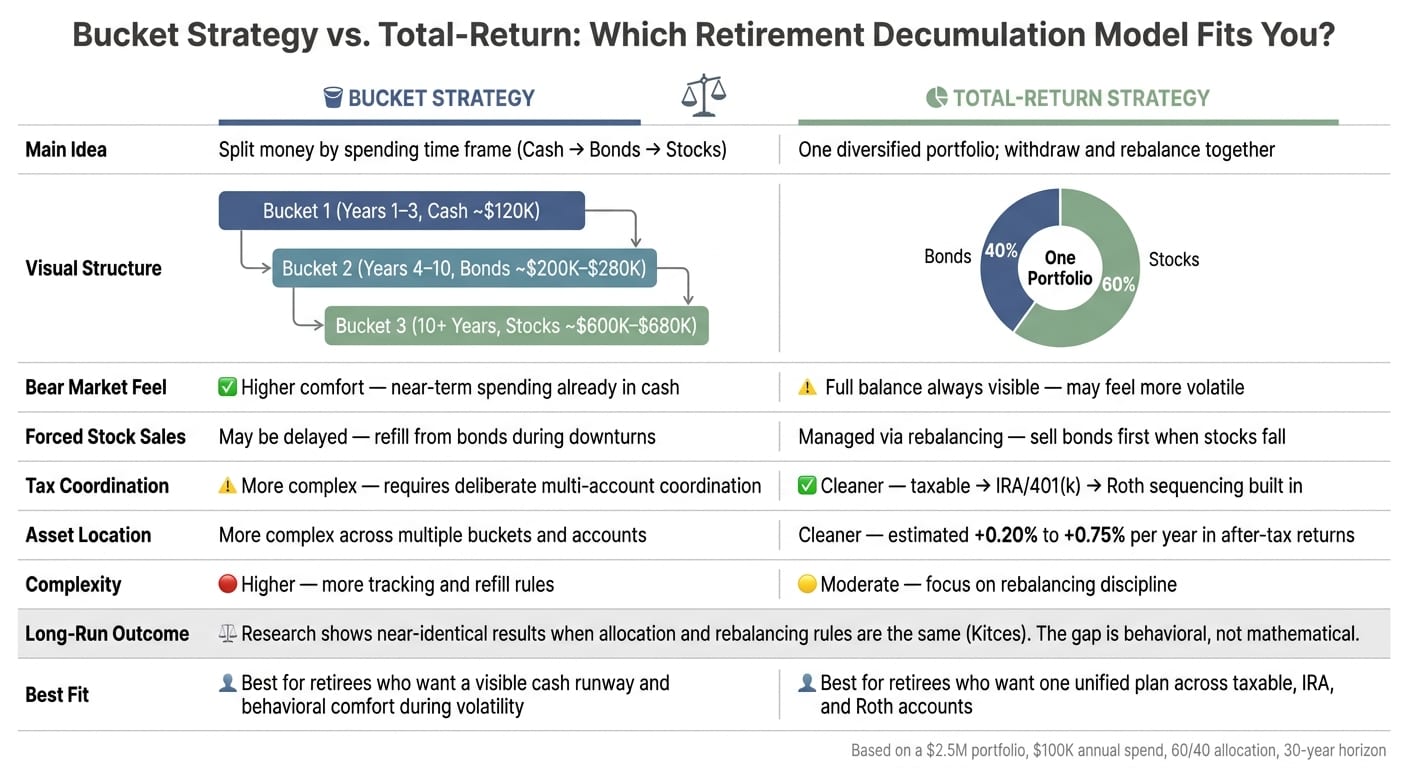
How to Withdraw Retirement Funds: Bucket Strategy vs. Total Return
Quick Comparison
For many retirees, this may not be a debate about returns. It may be a debate about clarity vs. simplicity.
Bucket Strategy: Keep Near-Term Spending Separate From Long-Term Growth
The bucket strategy sorts a portfolio by when money may be needed, not just by asset class. The idea is pretty simple: each bucket lines up with a different stretch of retirement spending.
How the buckets are typically built
A common three-bucket setup starts by subtracting guaranteed income from annual expenses. Then it sets aside 1–3 years of portfolio withdrawals in cash, several more years in high-quality bonds, and the rest in diversified equities. If $40,000 of annual spending may need to come from the portfolio after guaranteed income, one sample split looks like this:
Bucket sizes may shift based on guaranteed income. More Social Security, pensions, or annuities may reduce the amount that needs to come from the portfolio, which may shrink Buckets 1 and 2. Risk tolerance matters too. Some more conservative retirees may hold 4–5 years of spending in Bucket 1, even if the math may not call for it.
Once the buckets are funded, the next step is figuring out how withdrawals and refills may work day to day.
How withdrawals and bucket refills work in practice
Spending comes from Bucket 1. Monthly transfers - about $3,333 per month in the $40,000 example - move out of the cash account, and Bucket 1 gradually runs down through the year without selling bonds or stocks.
The refill decision is where things get more interesting. In a strong equity market, a retiree may sell appreciated stock funds from Bucket 3 to refill Bucket 1 and keep the bond mix in Bucket 2 in line. In a steep bear market, Bucket 1 may be refilled from Bucket 2 instead of selling stocks at lower prices. That's the main appeal of the bucket setup for many retirees. The bucket names may matter less than the refill discipline.
In households with more than one account, refill rules may also need to factor in taxes and required minimum distributions.
That setup may feel intuitive, but it depends on staying disciplined with refills. This is where the total-return model may take a different path.
Where bucket strategies help and where they fall short
Buckets may help investors stay invested during market swings, but they usually may not improve returns and may add cash drag that lowers long-term returns. They may make spending feel safer, but that comfort may come with less simplicity and less flexibility.
Total-Return Strategy: One Portfolio, One Withdrawal Plan
The total-return strategy skips bucketing altogether. Instead of setting aside a separate cash reserve, it uses one diversified portfolio to cover spending and handle rebalancing at the same time.
Using the article's $2.5 million household, withdrawals would come from the full portfolio, not from a standalone cash bucket. In practice, a retiree may hold one portfolio built from stock index funds and bond funds, then draw income through systematic withdrawals and periodic rebalancing.
How cash flow is generated from a total-return portfolio
When it's time to take a withdrawal, the investor sells assets in a way that may also move the portfolio back toward its target allocation. That’s the core idea: one transaction may fund spending and keep the mix of stocks and bonds in line.
Each withdrawal rule involves a tradeoff between steady income and flexibility:
A fixed-dollar approach may feel steady from month to month, but it may put more pressure on the portfolio during market declines. A percentage-based method does the opposite: income may vary, but withdrawals may adjust as the portfolio value changes. Guardrails and proportional methods sit somewhere in the middle, though they usually involve more moving parts.
How total-return handles downturns and sequence risk
This approach still involves selling assets during a bear market. The difference is that it aims to control how much gets sold and where the withdrawal comes from.
If stocks fall, rebalancing may allow more of the withdrawal to come from bonds. That may reduce the need to sell beaten-down stock positions right away and keeps the portfolio operating as one system instead of several separate buckets.
Sequence-of-returns risk is addressed through the withdrawal rule and the full asset mix, rather than by holding multiple years of cash in a separate bucket.
Why many self-directed investors prefer this model
For many self-directed investors, the appeal may come down to simpler execution: one portfolio, one allocation, one rebalancing rule.
For retirees managing taxable accounts, traditional accounts, and Roth accounts, this setup may also make tax-aware withdrawal sequencing easier. That simplicity is the main reason to compare it with buckets on taxes, cash flow, and day-to-day execution.
Bucket Strategy vs. Total-Return: Side-by-Side on Income, Risk, Taxes, and Complexity
At this point, the main issue isn't how each model works. It's which one you may find easier to run well for 20 or 30 years.
Both approaches draw from the same retirement savings. So the gap between them may have less to do with math and more to do with behavior and day-to-day execution. If the goal is to compare them on spending durability, forced selling, tax drag, and ease of use, the contrast gets sharper.
Cash flow, bear markets, and sequence-of-returns risk
In the baseline case, the difference comes down to how each model handles spending, drawdowns, taxes, and execution. A bucket plan keeps near-term spending in cash and short-term bonds, then refills from higher-risk assets when markets allow. A total-return portfolio covers that same spending from the full portfolio mix through withdrawals and rebalancing.
Research by Michael Kitces found that, with the same allocation and rebalancing, bucket and total-return results may be identical. That's a big point. A bucket setup may not add extra portfolio protection by itself. What it may do, though, is make that protection feel more tangible, which may make it easier for some retirees to stay invested during a rough stretch.
Cash flow is only one part of the picture. In actual retirement planning, taxes and account coordination may end up being the tie-breaker.
Rebalancing, taxes, and multi-account execution
Once taxable, traditional, and Roth accounts enter the mix, the mechanics may get complicated fast.
In a bucket setup, retirees often assign different time horizons to different accounts, then choose which account to draw from when Bucket 1 needs a refill. That may work well from a tax angle if the refill plan is handled with care. But it may also create more ordinary income or capital gains than needed if the accounts aren't coordinated closely.
A total-return approach treats all accounts as one portfolio and uses a steady withdrawal sequence: taxable first, then traditional IRA/401(k), then Roth last. It may also make asset location easier to manage. Tax-inefficient assets may stay in tax-deferred accounts, while tax-efficient index funds may stay in taxable accounts or Roth accounts. Research suggests that asset placement may add roughly 0.20%–0.75% per year in after-tax returns.
Pros, cons, and the real tradeoff behind each approach
This gets to the heart of it: behavioral clarity versus structural simplicity.
Neither strategy appears to win on math alone. Bucket strategies may stand out for behavioral clarity. Total-return strategies may stand out for a simpler setup and easier tax coordination. Over the long run, sustainability may depend more on withdrawal rate, asset allocation, and discipline than on the name of the system.
Which Strategy Fits Which Retiree, and the Bottom Line
After comparing how each approach works, the main question is simpler than it sounds: which system may you follow with consistency?
When the bucket strategy is the better fit
The bucket strategy may fit retirees who want a clear cash reserve they can see. That visual buffer may matter more than spreadsheets do. If markets drop hard, knowing that near-term spending may already sit in cash or short-term bonds may make it easier to stay invested instead of selling in a rough stretch.
There’s also the issue of day-to-day management. Some retirees may prefer a setup that feels more concrete, even if it comes with more moving parts.
When total-return is the better fit
The total-return approach may fit retirees who want one plan across the whole household and feel comfortable managing withdrawals from a single allocation. If you already think in terms of your full mix across a taxable brokerage account, a traditional IRA, and a Roth IRA, this setup may keep tax-aware coordination cleaner and may cut down on the number of rules you need to track.
At that point, execution may become the deciding factor.
The winner is the strategy you can stick with and run well
Total-return may have the cleaner setup. Bucket strategies may be more useful when a visible cash reserve is what keeps someone invested during market stress.
So the better fit may be the one that lines up with your behavior, your account mix, and your willingness to maintain the system over 20 or 30 years.
Mezzi may support either approach by showing all accounts in one view and helping with rebalancing and withdrawal sequencing.
FAQs
How many years of cash should I keep in a bucket strategy?
Typically, the first bucket may hold 1 to 2 years of living expenses in cash or short-term bonds for near-term needs.
This liquid reserve may make it less likely that someone would need to sell investments at lower prices during a market downturn, which may reduce sequence-of-returns risk. Some guidelines use 6 to 12 months, but 1 to 2 years may be the standard for this model.
Can I combine a bucket strategy with total-return rebalancing?
Yes. Some investors combine both approaches by keeping a bucket system for near-term liquidity and peace of mind, while using total-return rebalancing across the rest of the portfolio.
In practice, buckets may be refilled with:
- new contributions
- dividends
- withdrawals from overweighted assets
That setup may make near-term cash flow easier to manage, while the broader portfolio may stay aligned with long-term goals and target risk.
Which withdrawal rule works best with a total-return portfolio?
A percentage-based withdrawal rule may fit a total-return portfolio better because it moves with the portfolio’s performance.
If the portfolio falls, taking the same percentage each year may lower the dollar amount you withdraw. That may help preserve savings and may reduce sequence-of-returns risk. The tradeoff: income may be less predictable than it would be with a fixed-dollar method.
Disclosures:
- This content is for informational purposes only and does not constitute investment advice or a recommendation to buy or sell any security.
- Past performance is not indicative of future results. No guarantee of future performance or outcomes is implied.
Related Blog Posts
- How does my annual return compare to a balanced model portfolio?
- What portfolio value and withdrawal strategy would generate a specific monthly after-tax income?
- Sequence-of-Returns Risk: Why the First Five Years Decide Everything
- Guardrails Withdrawals: How to Spend 5%+ Without Running Out
Typically, the first bucket may hold 1 to 2 years of living expenses in cash or short-term bonds for near-term needs.
This liquid reserve may make it less likely that someone would need to sell investments at lower prices during a market downturn, which may reduce sequence-of-returns risk. Some guidelines use 6 to 12 months, but 1 to 2 years may be the standard for this model.
Yes. Some investors combine both approaches by keeping a bucket system for near-term liquidity and peace of mind, while using total-return rebalancing across the rest of the portfolio.
In practice, buckets may be refilled with:
- new contributions
- dividends
- withdrawals from overweighted assets
That setup may make near-term cash flow easier to manage, while the broader portfolio may stay aligned with long-term goals and target risk.
A percentage-based withdrawal rule may fit a total-return portfolio better because it moves with the portfolio’s performance.
If the portfolio falls, taking the same percentage each year may lower the dollar amount you withdraw. That may help preserve savings and may reduce sequence-of-returns risk. The tradeoff: income may be less predictable than it would be with a fixed-dollar method.