
A CRT may let me move an appreciated asset into an irrevocable trust, take a partial tax deduction now, and receive income later - while charity gets what remains at the end.
If I’m sitting on low-basis stock or real estate, a direct sale may trigger taxes right away. A charitable remainder trust may shift that timing instead: the trust may sell without immediate capital gains tax at the trust level, keep more pre-tax proceeds invested, and pay income over life or up to 20 years. The tradeoff is simple: I may gain tax timing and income planning, but I give up control of the asset and the remainder may go to charity.
Here’s the short version:
- Deduction now: I may get a partial income tax deduction based on the charity’s projected remainder interest.
- Income later: The trust may pay me or another beneficiary each year.
- Two main types: CRAT pays a fixed dollar amount; CRUT pays a fixed percentage of assets revalued each year.
- Payout limits: Annual payouts generally must be between 5% and 50%.
- Remainder test: The charity’s remainder interest generally must equal at least 10% of the contributed asset value.
- Tax timing: Gain may be deferred, not erased. Distributions may later be taxed under a four-tier system.
- Asset limits: S-corp stock may not work for a CRT.
- Costs: Setup and annual administration may make more sense when the asset value is at least $100,000+.
- Risk: A CRT is irrevocable, so the transferred assets may not be taken back.
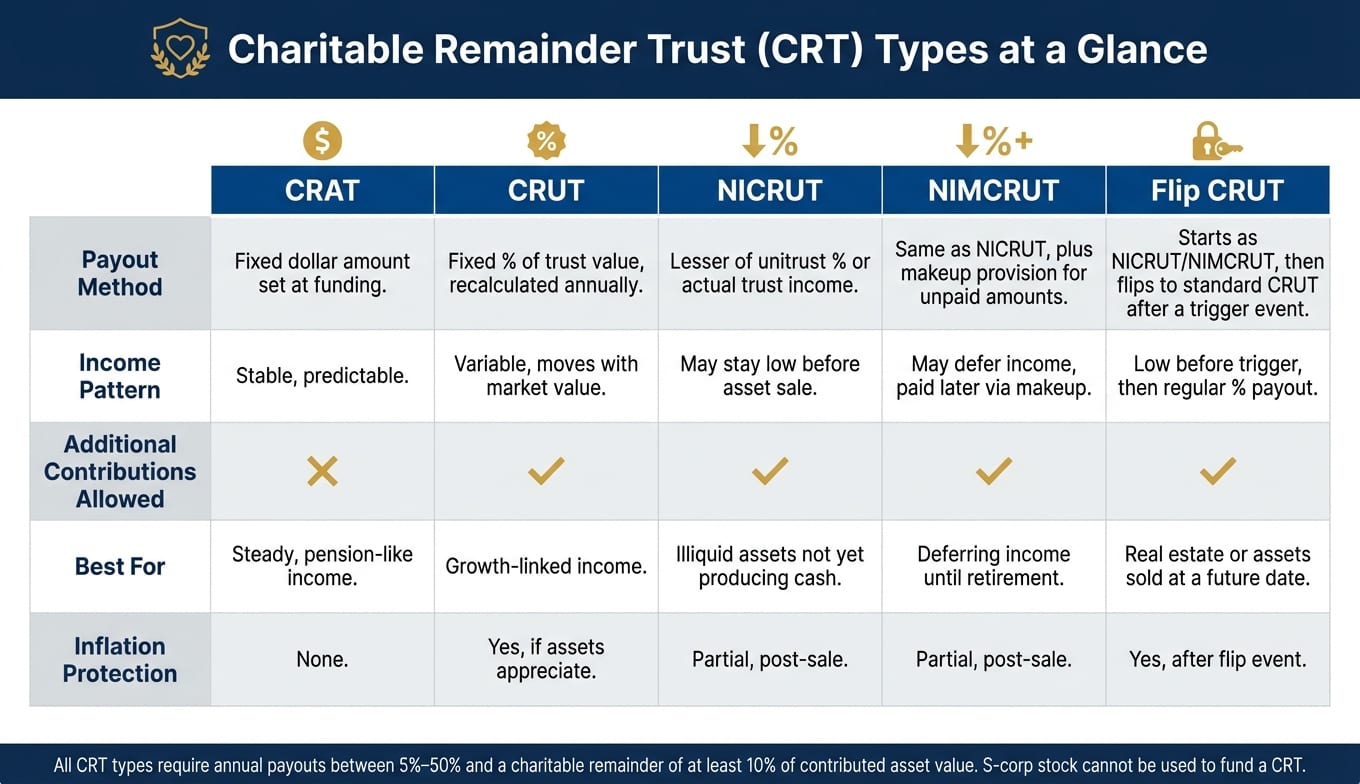
A few special versions may matter too. A NICRUT may limit payouts to trust income before an illiquid asset is sold. A Flip CRUT may switch payout methods after a sale event. A NIMCRUT may delay part of the income and track amounts for later makeup payments.
Step-by-step breakdown of how a Charitable Remainder Unitrust works to avoid capital gains tax
Quick Comparison
The core question isn’t just tax savings. It may be whether the mix of deduction, deferred gain recognition, retirement income, charitable intent, fees, and loss of control fits my situation at all.
How charitable remainder trusts work
A CRT is an irrevocable trust. Once it's funded, it holds the assets, manages them, and generally may not be revoked. The trustee then sells the assets inside the trust, and the sale proceeds stay in the trust to be reinvested for future payouts. Because a CRT is a tax-exempt entity under IRC Section 664(c), that sale may occur without immediate capital gains tax at the trust level.
There are guardrails, too. CRT payouts must fall between 5% and 50% each year, and the charitable remainder must equal at least 10% of the contributed property's value.
That sets up the next piece: how the deduction may be calculated, and when capital gains may be recognized.
CRAT vs. CRUT: fixed dollars or a fixed percentage
There are two main setups, and the core difference comes down to how the annual payout is figured.
A CRAT pays a fixed dollar amount set when the trust is funded. For example, a $1,000,000 CRAT with a 5% payout would pay $50,000 per year. That may appeal to people who want steadier income. But there's a tradeoff: no inflation adjustment, and no option to add more assets later.
A CRUT pays a fixed percentage of the trust's value, recalculated each year. If the trust value goes up, the payout may go up too. If the value drops, income may drop as well. A CRUT also allows added contributions after the initial funding, which a CRAT does not.
So the payout method may shape income stability, growth upside, and how the trust fits into retirement cash flow.
Why appreciated stock and real estate are common CRT assets
Appreciated stock and real estate often come up in CRT planning because the trustee may sell them inside the trust and reinvest the full proceeds. For low-basis assets, that may differ from a direct sale outside the trust.
When beneficiaries receive distributions, the tax treatment follows a tiered order: ordinary income first, then capital gains, then tax-exempt income, and finally return of principal. In plain English, a CRT may change when tax is paid, but not whether tax may apply.
One more rule matters up front: S-corp stock cannot fund a CRT, so the ownership type needs to be checked before funding.
These asset choices often matter most when someone wants to turn an appreciated holding into retirement income without an immediate tax hit from a direct sale. The next section covers how the charitable deduction may be figured, how capital gains timing may work, and how beneficiaries may be taxed on distributions.
Tax deductions and capital gains timing
A CRT’s tax angle mostly comes down to timing: you may get a deduction now, while tax on distributions may show up later.
Once the trust is funded, the next issue is pretty simple on paper but a bit technical in practice: how the deduction is measured and when tax may actually be paid.
How the charitable deduction is calculated
The deduction depends on a few moving parts:
- the asset’s value
- the payout rate
- the trust term or the beneficiary’s age
- the Section 7520 rate for the month of contribution
Higher Section 7520 rates generally produce a larger charitable deduction, especially for CRATs. The payout rate moves the other way. If the payout rate is higher, less may remain for the charity, and the deduction may shrink.
Under Section 7520(a), you may elect to use the discount rate from the month of contribution or either of the two prior months, whichever produces the better deduction. For long-term capital gain property, the deduction is generally limited to 30% of AGI and may carry forward for five years.
Those rules shape how much value may stay in the trust to support income payments later.
How a CRT can reduce or defer immediate capital gains exposure
If you sell an appreciated asset directly, capital gains tax may be due in the year of sale. With a CRT, the trust may sell the asset without immediate trust-level capital gains tax. That may leave more money inside the trust to support future payouts.
Here’s the side-by-side view:
There’s one timing rule that tends to matter a lot: the transfer generally needs to happen before the sale becomes legally binding. If someone agrees to sell first and then tries to move the asset into a CRT, the IRS assignment-of-income doctrine may still treat the gain as that person’s income.
So yes, the trust may defer gain at the trust level. But that doesn’t mean tax disappears. It just shifts to the distribution stage.
How beneficiaries are taxed on CRT distributions
CRT distributions follow a four-tier order: ordinary income, capital gains, tax-exempt income, then principal.
In other words, tax may be deferred, but it may not be eliminated. Each year, the beneficiary may receive a Schedule K-1 (Form 1041) showing how much of the distribution falls into each category. For higher-income taxpayers, the 3.8% NIIT may also apply to ordinary income and capital gain distributions.
Income strategies: turning an appreciated asset into retirement cash flow
Once you understand how CRT distributions may be taxed, the next step may be more practical: how might you set up the income stream so it lines up with retirement needs? The payout structure chosen at the start shapes each payment for the life of the trust.
Matching payout structure to retirement income needs
Your payout choice determines whether CRT income may stay fixed or move over time.
A CRAT pays a fixed dollar amount for the life of the trust, a bit like pension income. That steady payout may put pressure on a CRAT if returns do not keep up with distributions.
A CRUT pays a fixed percentage of assets revalued each year. That means payments may move with the trust’s value, which may lower the chance of running through the trust too early.
The investment policy inside the trust matters just as much as the payout type. For a CRUT, if the portfolio grows faster than the annual distribution percentage, both income and the eventual charitable remainder may increase. On the other hand, higher payout rates may reduce the remainder and may increase the chance that the trust runs down before the term ends.
That decision may matter even more when the asset is hard to sell or when cash flow needs to start later.
Using a CRT after a stock windfall or real estate sale
At $2,000,000, a 5% CRUT funded with highly appreciated stock may produce a roughly $680,000 charitable deduction while keeping the full contribution invested inside the trust. That starting base may be larger from day one than what might remain after an upfront capital gains bill. The idea is not only the tax treatment at sale. It may also be about keeping a larger base in place for income.
Special CRT designs for illiquid assets or delayed cash flow
When liquidity is delayed, the trust design needs to match the asset’s sale timing.
A Net Income CRUT (NICRUT) limits distributions to actual trust income until the asset is sold. A Flip CRUT switches after the triggering event - often a real estate sale - to a standard percentage payout on the full reinvested proceeds. A NIMCRUT records unpaid income that may be made up later, which some people may find useful if they want to defer most income until retirement.
Fit, limitations, and how to evaluate a CRT with Mezzi
Who is a good fit and who probably is not
After payout design, the next step may be deciding whether a CRT fits your balance sheet and your charitable goals.
A CRT may fit best for people with $100,000+ of appreciated stock, real estate, or a business interest who want both retirement income and charitable giving. Below that range, setup and annual administration costs may outweigh the upside. Those costs are roughly $3,500 to establish and about $1,200 per year in trustee and tax preparation fees.
A CRT may not be a good fit if you have no real charitable intent, want to keep full control of the asset, or may need access to the principal for medical or family emergencies.
If future liquidity feels uncertain, one middle path may be to place part of the position into the CRT and sell the rest directly. That may leave some capital accessible while still allowing part of the position to receive the CRT's tax and income treatment.
Key tradeoffs before you sign an irrevocable trust
A CRT is irrevocable. Once assets are transferred, they may not be reclaimed, and the remainder passes to charity.
Here are the main tradeoffs to weigh before moving assets into an irrevocable structure.
One restriction deserves close attention: S-corporation shares cannot be transferred to a CRT. Doing so immediately terminates the company's S-election and may create major tax consequences.
There’s another catch too. Holdings that generate Unrelated Business Taxable Income (UBTI) trigger a 100% excise tax on that income inside the trust. That’s the kind of rule that may turn a good-looking plan on paper into a poor fit in practice.
Conclusion: A decision framework for a CRT
Before committing to a CRT, it may help to walk through a short set of questions.
- How large is the unrealized gain, and what may a direct sale cost in taxes?
- Is there a real charitable goal, or is the plan mainly tax-driven?
- What retirement income may be needed, when may it need to start, and for how long?
- Does the CRT improve income and tax efficiency enough to justify giving up control and inheritance?
Mezzi may help you test those tradeoffs against your full portfolio before you commit. With read-only access to your linked accounts, Mezzi may show how a CRT income stream might interact with your current retirement cash flow, concentration risk, and future tax brackets - before you sign anything irrevocable.
FAQs
How much income can a CRT pay me?
A Charitable Remainder Trust (CRT) may pay annual income based on a percentage of the trust’s value, often somewhere between 5% and 50%. The amount may depend on whether the trust is set up as a CRAT or CRUT.
A CRAT pays a fixed dollar amount each year based on the trust’s initial value. A CRUT pays a fixed percentage of the trust’s value, recalculated each year, so income may rise or fall with the trust’s performance.
What assets should I avoid putting in a CRT?
Avoid assets that may create major tax or administrative issues.
That may include S corporation stock, since holding it in a CRT may terminate the S election. It may also include assets that generate unrelated business income, such as debt-financed property or interests in an active business.
A CRT may also be a poor fit if you do not genuinely plan to support charity. That’s because the remaining assets must irrevocably go to a qualified charity.
Can I use a CRT if I still need access to the money?
Yes, a charitable remainder trust may provide an income stream, but you may not access the principal.
Because the trust is irrevocable, assets moved into it may not be taken back for personal use. You may receive regular distributions for a set term or for life, but the original capital stays in the trust and ultimately goes to your chosen charity.
Disclosures:
- This content is for informational purposes only and does not constitute investment, tax, or legal advice. Consult your tax, legal, and financial advisors before implementing any charitable giving strategy.
- Past performance is not indicative of future results. No guarantee of future performance or outcomes is implied.
Related Blog Posts
- 5 Ways to Donate Equity Compensation Tax-Efficiently
- Capital Gains Tax Strategies For Real Estate Investors
- Tax-Efficient Giving: CRUTs, CLATs, and Private Foundations
- Intentionally Defective Grantor Trusts (IDGTs): Advanced Estate Planning
A Charitable Remainder Trust (CRT) may pay annual income based on a percentage of the trust’s value, often somewhere between 5% and 50%. The amount may depend on whether the trust is set up as a CRAT or CRUT.
A CRAT pays a fixed dollar amount each year based on the trust’s initial value. A CRUT pays a fixed percentage of the trust’s value, recalculated each year, so income may rise or fall with the trust’s performance.
Avoid assets that may create major tax or administrative issues.
That may include S corporation stock, since holding it in a CRT may terminate the S election. It may also include assets that generate unrelated business income, such as debt-financed property or interests in an active business.
A CRT may also be a poor fit if you do not genuinely plan to support charity. That’s because the remaining assets must irrevocably go to a qualified charity.
Yes, a charitable remainder trust may provide an income stream, but you may not access the principal.
Because the trust is irrevocable, assets moved into it may not be taken back for personal use. You may receive regular distributions for a set term or for life, but the original capital stays in the trust and ultimately goes to your chosen charity.