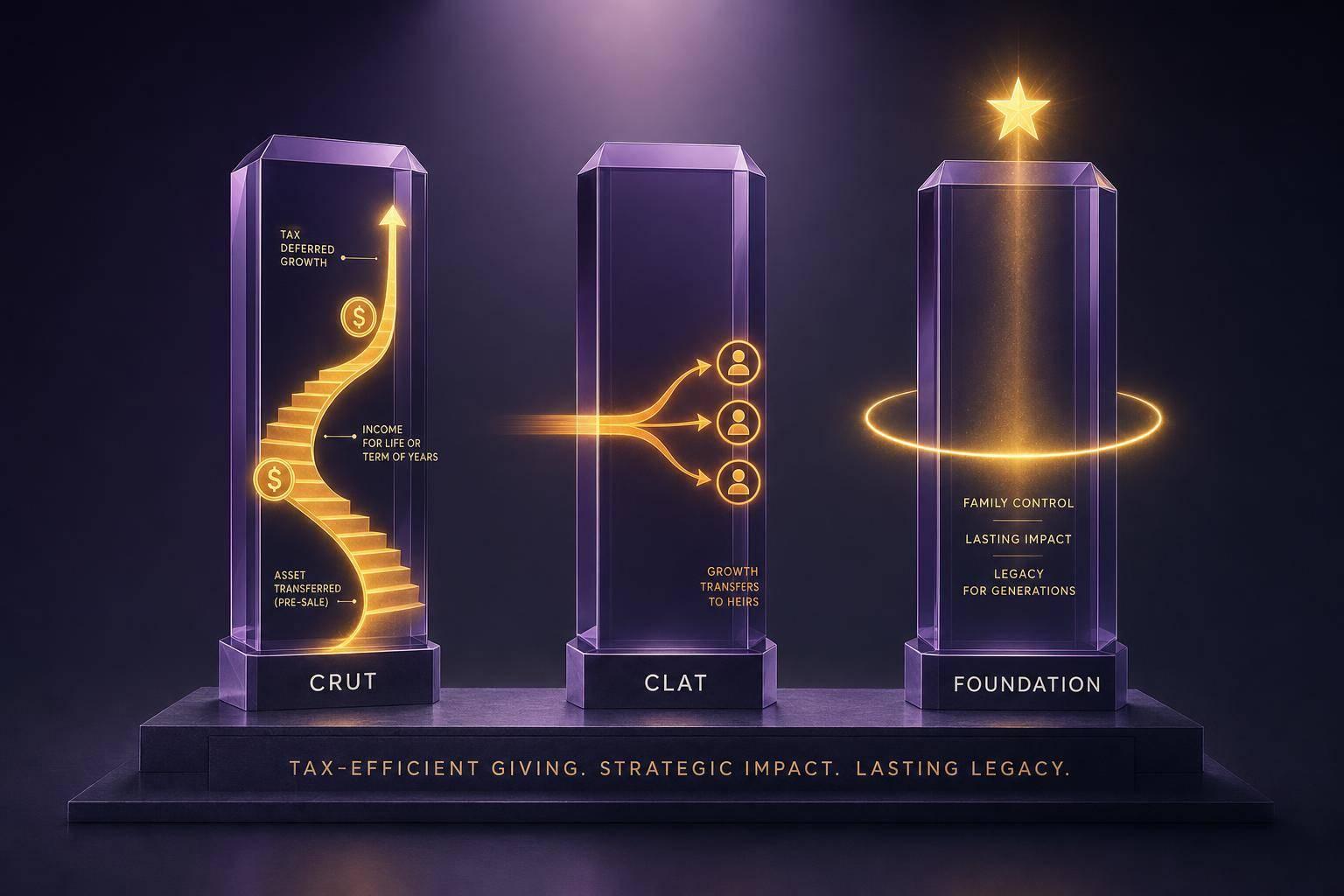
If I’m weighing CRUTs, CLATs, and private foundations, the main split may be simple: a CRUT may fit pre-sale appreciated assets and income needs, a CLAT may fit wealth transfer to heirs, and a private foundation may fit family control over giving.
At higher wealth levels, small structure choices may shift millions of dollars between taxes, heirs, and charity. This article points to a $15 million estate and gift tax exemption per person in 2026 and a 0.5% AGI floor for charitable deductions as factors that may affect the math.
Here’s the short version:
- CRUT: may let me place appreciated assets into a tax-exempt trust, sell without immediate capital gains tax inside the trust, and receive a variable income stream
- CLAT: may pay charity first for a set term, with any growth above the Section 7520 rate potentially passing to heirs at a lower transfer-tax cost
- Private foundation: may give my family direct control over grants, investing, and legacy, but with more filing, rules, and public disclosure
The tradeoff usually comes down to tax treatment, payout design, control, and compliance.
How to Set Up Charitable Trusts for Income Tax Benefits: DAFs v. CLATs v. CRUTs
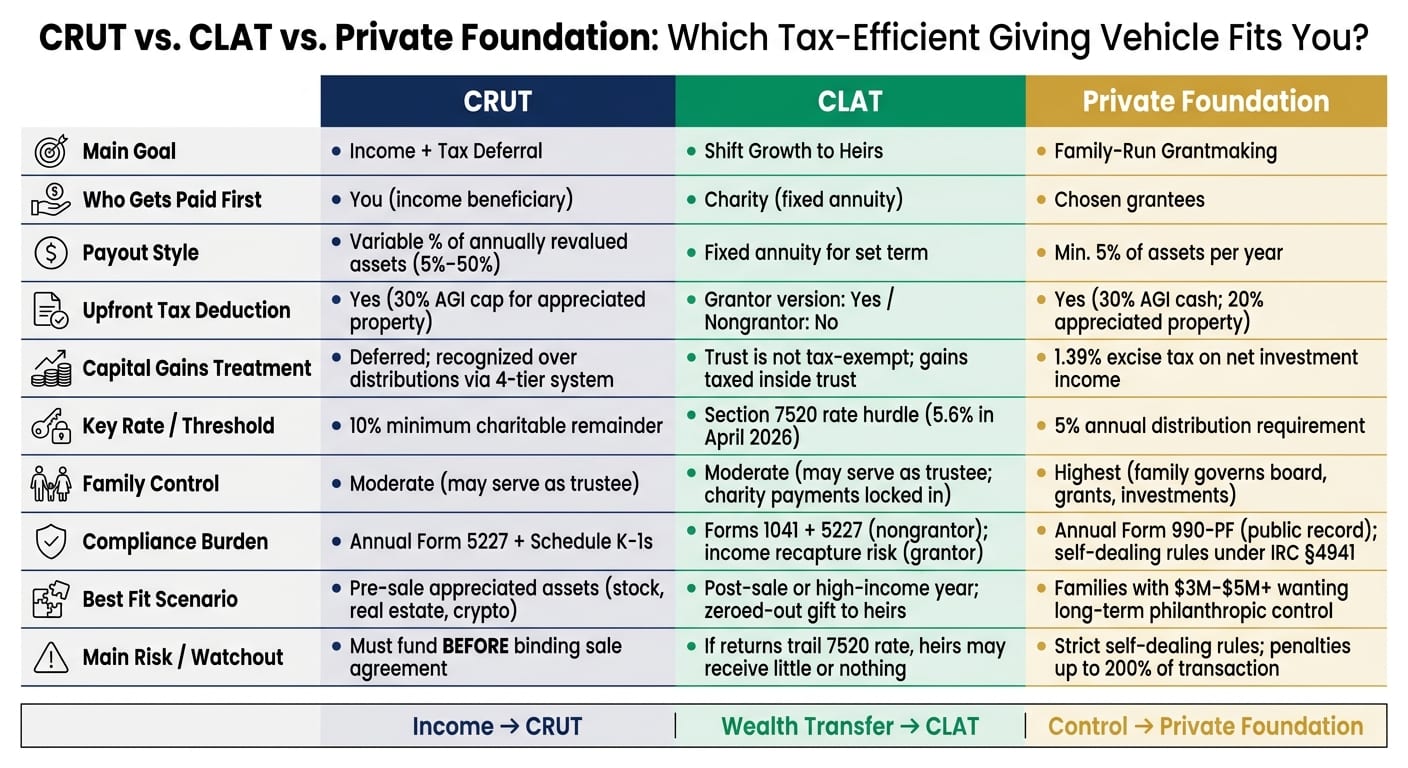
Quick Comparison
Put another way: income may point to a CRUT, transfer may point to a CLAT, and control may point to a private foundation.
That’s the lens I’d use for the rest of the piece.
1. Charitable Remainder Unitrusts (CRUTs)
For readers with concentrated appreciated assets, CRUTs may fit best when income replacement matters about as much as tax deferral. A CRUT is an irrevocable trust that pays you, or another named beneficiary, annual payments for life or for a term of up to 20 years, with the remainder going to charity at the end. In plain English: you may move highly appreciated assets - stock, real estate, or crypto - into a tax-exempt trust under IRC §664(c) that may sell them without immediate capital gains tax. The gains are generally taxed later, as payments are made, under the trust’s four-tier distribution order.
Tax impact
A CRUT may generate an upfront income tax deduction because you are giving away the charitable remainder. That deduction is based on the present value of the remainder interest, and the charitable remainder must equal at least 10% of the initial net fair market value of the contribution. For appreciated long-term capital gain property given to public charities, deductions are generally capped at 30% of AGI. Any unused deduction may typically be carried forward for up to five years.
Distributions from a CRUT are taxed under the four-tier order in Section 664(b):
Payout design
Each year, the trust is revalued, and you receive a fixed percentage of the trust’s annually revalued assets, usually 5% to 50%. That means the payout may move up if the portfolio grows and may move down if it shrinks. Unlike some other charitable structures, a CRUT may also accept additional contributions over time.
A Flip-CRUT may work well for illiquid assets. It may begin as a net-income-only trust and then convert after a liquidity event, such as an IPO or sale.
Control
You may often act as trustee, which may give you direct say over investment decisions inside the trust. At the same time, the remainder is irrevocably committed to charity. For illiquid assets such as real estate or closely held stock, an independent trustee may be required for annual valuation purposes.
One practical note matters here: the trust must be funded before any binding sale agreement is in place. If that timing slips, the IRS may apply the assignment of income doctrine.
Compliance burden
CRUTs require annual Form 5227 reporting and Schedule K-1s to beneficiaries so distributions may be reported across the four tiers. Compared with a private foundation, the compliance load may be lighter, though professional administration may still help when assets are complex or illiquid.
Next, CLATs reverse the timing: charity gets paid first, and the remaining value may pass to heirs.
2. Charitable Lead Annuity Trusts (CLATs)
A CLAT flips the CRUT setup. Instead of paying you first and leaving what remains to charity, a CLAT pays charity first through a fixed annuity for a set term. Whatever is left at the end may pass to your heirs. This setup may fit people who care more about shifting future asset growth to heirs than drawing income from the trust. So the big difference from a CRUT comes down to when the payout happens.
Tax impact
The tax side depends on whether the CLAT is set up as grantor or nongrantor.
In a grantor CLAT, you may receive an upfront income tax deduction equal to the present value of the charitable lead interest. The tradeoff is less friendly: you may still owe tax on the trust's earnings even while the cash is going to charity. That usually means you may need liquidity outside the trust. Because of that, this structure may be more closely tied to estate management strategies than to handling a single-year tax bill.
A nongrantor CLAT does not provide an upfront deduction. Instead, the trust pays its own tax and deducts its annuity payments under IRC §642(c).
Payout design
The annuity is fixed from day one. That's different from a CRUT, where the payout may change with asset value.
The Section 7520 rate acts as the hurdle rate, and for April 2026, that rate was reported at 5.6%. If the trust assets perform above the Section 7520 rate, the excess may pass to heirs with little or no transfer tax.
A "zeroed-out" CLAT pushes that idea further. The annuity is sized so the present value of all charitable payments equals 100% of the initial gift, which may reduce the taxable gift to heirs to $0.
Assets with higher expected upside are often discussed in this context, including:
- private equity
- startup stock
- high-growth real estate
Those assets may be a fit when they are expected to outperform the hurdle rate by a wide margin.
Control
Donors may often serve as trustee, but the trust still remains irrevocable. Once funded, the charity's annuity payments are locked in. Some donors direct those annuity payments to a DAF so annual grantmaking may stay flexible.
That may matter more when the aim is family philanthropy, not only estate transfer. And, as with CRUTs, the trust may need to be funded before any binding sale agreement.
Compliance burden
CLATs are not tax-exempt entities. Nongrantor CLATs file Forms 1041 and 5227, and grantor CLATs may trigger income-tax recapture at death.
Private foundations shift the focus from trust-based transfer to direct family control.
3. Private Foundations
Where CLATs move assets through charity first, private foundations keep philanthropy under family direction. The emphasis shifts from transfer planning to family-run grantmaking. That setup may appeal to donors who want long-term say over grants, investments, and family participation.
Tax impact
The tradeoff is pretty direct: less deduction up front, more control later. Private foundations come with lower deduction limits than public charities - 30% of AGI for cash and 20% for appreciated property. For appreciated non-public assets, the deduction generally may be limited to cost basis instead of fair market value. The main exception is publicly traded stock held longer than one year, which may still qualify for a full FMV deduction.
The foundation also pays a flat 1.39% excise tax on net investment income, including interest, dividends, rents, royalties, and net capital gains. That rate replaced the prior two-tier system in 2020.
Payout design
Under Section 4942, foundations must distribute at least 5% of the average fair market value of their non-charitable-use assets each year. Qualifying distributions include grants and charitable operating expenses.
Miss that threshold, and the penalty may be steep. An initial 30% excise tax applies to the shortfall, and if the issue is not corrected, the tax may rise to 100%.
Control
This is where private foundations stand out. A family may govern the board, set investment policy, hire staff, and choose grants. A foundation may also fund scholarships, disaster relief, and direct charitable programs with IRS approval.
Most advisors recommend a nonprofit corporation structure over a charitable trust for living donors, since it may be easier to amend and may offer clearer fiduciary rules for board members.
One major check on that control is self-dealing. IRC §4941 bars nearly any financial transaction between the foundation and disqualified persons - such as you, your family members, or foundation managers - even if the deal takes place at fair market value. Penalties may reach 200% of the amount involved.
Compliance burden
Running a private foundation brings annual filing and governance work. The foundation must file Form 990-PF each year, and that filing becomes a public record showing grants, compensation, and investment holdings. For calendar-year foundations, the return is due by May 15 each year.
Setup and annual administration may be expensive, and costs may climb as the foundation becomes more complex. In practice, the economics may work better when the foundation holds several million dollars in assets. That tradeoff may make private foundations a better fit for donors who want long-term governance, rather than the highest level of tax efficiency.
Pros and Cons of Each Strategy
Each vehicle is built for a different job.
CRUTs center on income and tax deferral. CLATs are more about moving wealth to heirs. Private foundations tend to appeal to families who want control and a long-term charitable presence.
So the choice may come down to one main priority: income, transfer, or control.
The Section 7520 rate affects the deduction math for both CRUTs and CLATs. Here’s the core tradeoff for each option:
For CLATs, the investment risk falls on the heirs. If returns do not clear the 7520 rate, the transfer to heirs may end up small or even zero.
For private foundations, the tradeoff is often cost and upkeep. The legal, tax, and filing work may feel easier to absorb when the asset base is larger.
The next section maps each vehicle to specific giving goals.
Matching Each Vehicle to Your Giving Goals
Start with timing. That tends to narrow the field fast.
If you haven't sold appreciated assets yet, a CRUT may be the better fit. In many cases, CRUTs tend to make more sense before a sale. By contrast, after a sale - or during a year with high ordinary income - a CLAT may move higher on the list.
If you've already sold the assets or you're in a high ordinary-income year, a CLAT may be more relevant. It may generate an upfront deduction. And if the trust's investments outperform the Section 7520 rate, any extra appreciation may pass to heirs with little or no transfer tax.
If control matters more than income or wealth transfer, the focus may shift to a family foundation. A private foundation often fits families with $3 million to $5 million or more in assets who want active, long-term involvement in philanthropy.
The core trade-off is pretty simple:
- CRUT: often tied to pre-sale appreciated assets
- CLAT: may fit better after a sale or in a high-income year
- Private foundation: may suit families who want hands-on control over giving
All three are irrevocable, so the structure may need to match the asset, timing, and tax goal before funding. Small details may matter here: asset type, sale timing, payout rate, and state tax exposure may all affect the result. That work often involves a CPA, an estate-planning attorney, and, in some cases, a charitable planning specialist working together.
Mezzi may help model the tax and cash-flow impact before you commit.
FAQs
How do I choose between a CRUT, a CLAT, and a private foundation?
It depends on your goals.
A CRUT may fit if you hold appreciated assets and want income for yourself or family, while also deferring capital gains taxes.
A CLAT may fit if you want charity paid first, with the remainder passed to heirs at a lower tax cost.
A private foundation may be a better match for long-term family legacy, governance, and control over grant-making. That said, it also comes with added compliance and administrative work.
When does funding need to happen before a sale?
To use a Charitable Remainder Trust (CRT) for tax mitigation, the trust generally needs to be funded before a binding sale agreement exists. If the deal may already be locked in, the IRS may view the gain as already realized.
For founders and people holding appreciated stock, timing may matter a lot. The assets are often transferred while you still own them personally, so the trust - not you - may be the party that completes the sale.
Which assets work best for each strategy?
The best assets may depend on your goals and the vehicle you use.
For CRTs, including CRUTs and CRATs, highly appreciated assets such as stock, real estate, or business interests may be a fit for some donors. In some cases, those assets may make it easier to diversify, avoid immediate capital gains taxes, and create an income stream.
Private foundations and DAFs may accept a broad mix of assets, including cash, publicly traded securities, private equity, real estate, and other illiquid or tangible personal property. CLATs are also commonly funded with similar assets.Disclosures:
- This content is for informational purposes only and does not constitute investment advice or a recommendation to buy or sell any security.
- Past performance is not indicative of future results. No guarantee of future performance or outcomes is implied.
Related Blog Posts
- Estate Planning 101: Wills, Trusts, and Tax-Efficient Transfers
- Spousal Lifetime Access Trusts (SLATs): Gift and Estate Tax Benefits
- Intentionally Defective Grantor Trusts (IDGTs): Advanced Estate Planning
- Private Family Foundations: Tax Deductions and Philanthropic Control
It depends on your goals.
A CRUT may fit if you hold appreciated assets and want income for yourself or family, while also deferring capital gains taxes.
A CLAT may fit if you want charity paid first, with the remainder passed to heirs at a lower tax cost.
A private foundation may be a better match for long-term family legacy, governance, and control over grant-making. That said, it also comes with added compliance and administrative work.
To use a Charitable Remainder Trust (CRT) for tax mitigation, the trust generally needs to be funded before a binding sale agreement exists. If the deal may already be locked in, the IRS may view the gain as already realized.
For founders and people holding appreciated stock, timing may matter a lot. The assets are often transferred while you still own them personally, so the trust - not you - may be the party that completes the sale.
The best assets may depend on your goals and the vehicle you use.
For CRTs, including CRUTs and CRATs, highly appreciated assets such as stock, real estate, or business interests may be a fit for some donors. In some cases, those assets may make it easier to diversify, avoid immediate capital gains taxes, and create an income stream.
Private foundations and DAFs may accept a broad mix of assets, including cash, publicly traded securities, private equity, real estate, and other illiquid or tangible personal property. CLATs are also commonly funded with similar assets.Disclosures:
- This content is for informational purposes only and does not constitute investment advice or a recommendation to buy or sell any security.
- Past performance is not indicative of future results. No guarantee of future performance or outcomes is implied.