
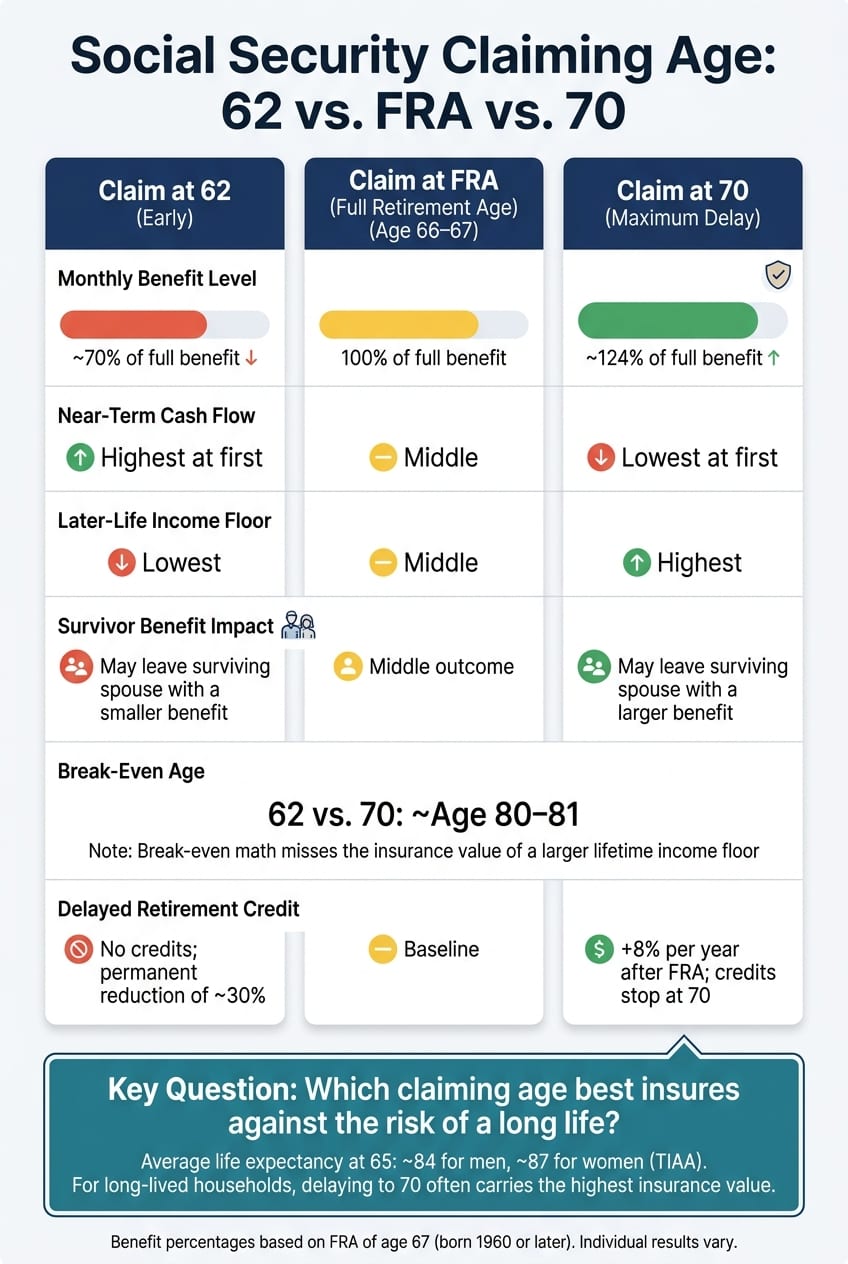
Social Security delay may make more sense as insurance against a long life than as a bet on returns. If I claim at 62, I may lock in about 70% of my full benefit. If I wait until 70, I may get about 124%. That gap may shape my monthly income for life, and for married couples, it may also shape the survivor’s income.
Here’s the short version:
- Claiming at 62 may mean more cash now, but a smaller monthly check for life
- Claiming at FRA may sit in the middle, with no early cut and no delayed credits
- Claiming at 70 may mean less income in my 60s, but a larger inflation-adjusted check later
- Break-even age may land around 80 to 81 in many 62 vs. 70 cases, but that math may miss the value of a larger lifetime income floor
- Singles may look at delay as a way to lean less on savings later
- Married couples may focus on the higher earner’s choice, since the survivor may keep the larger benefit
- Health, cash flow, taxes, and bridge assets may all shape the call
Delaying Social Security: What Longevity Data Tells Us
Quick Comparison
The core idea is simple: I may get more from this decision by asking “How much lifetime income do I want later?” instead of “How fast do I break even?”
How claiming age changes your benefit: 62, full retirement age, and 70
What changes at each claiming age
The main moving part here is claiming age. If someone claims before FRA, the reduction may be permanent. If they claim after FRA, the monthly benefit may rise through delayed retirement credits, at about 8% per year until age 70.
For workers born in 1960 or later, FRA is 67. If FRA is 67, claiming at 62 may reduce the benefit by about 30%. Waiting until 70 may lift it by about 24% above the FRA amount. At 70, delayed retirement credits stop. At that point, the benefit may equal about 124% of the FRA amount, and that larger monthly check may continue for life.
That’s the mechanical side of the longevity-insurance tradeoff. Claiming early may mean more cash now. Waiting may mean a larger guaranteed base later.
Break-even ages are useful, but only up to a point
Break-even analysis looks at the age when delaying may overtake the total dollars from claiming earlier. In a 62-versus-70 comparison, that crossover often lands around age 80 to 81, depending on assumptions like COLAs and tax treatment.
That said, break-even math only goes so far. It may not reflect the value of a larger guaranteed lifetime benefit for someone who lives well past average life expectancy. A more useful question may be whether a higher guaranteed benefit lowers the chance of outliving household assets.
Those differences may matter most when they change how much guaranteed income a household may count on.
Who benefits most from delaying Social Security
Single retirees: securing a larger floor of guaranteed income
For a single retiree, a larger check may matter more because there’s no survivor benefit to support the household later on. That risk may look different for singles, couples, and households that may have longer life spans.
The tradeoff is real: delaying may mean drawing down savings during the bridge years. But using part of a portfolio at 65 to lock in a higher government-backed benefit at 70 may be less of a sacrifice and more of a conversion - trading portfolio assets for guaranteed, inflation-adjusted income. For single retirees in reasonably good health who have enough assets to bridge the years before claiming, that trade may reduce the chance of running short in their late 80s or 90s, when waiting for a portfolio recovery may be harder.
Married couples: why the higher earner's delay often protects the survivor
In a married household, the higher earner’s claiming age may carry extra weight because survivor benefits are tied directly to it. When one spouse dies, the survivor receives the higher benefit, not both. If the higher earner claimed early and locked in a reduced benefit, that lower amount may follow the survivor for life. If the higher earner delayed to 70, the survivor may inherit that larger amount.
Research estimates that each additional year a husband delays claiming may reduce the survivor’s income drop by about 12%. That may offer a meaningful buffer after a first death, when household expenses may not fall as fast as household income.
One common split-claiming approach is for the lower earner to claim around FRA to provide current cash flow, while the higher earner delays to 70 to increase the long-term survivor benefit. For example, if the lower earner’s FRA benefit is $1,200/month and the higher earner’s FRA benefit is $2,300/month, the higher earner waiting to 70 may push that benefit to roughly $3,000/month - and that’s the amount the survivor may step up to after the first death.
Longer-life households: when the insurance value is highest
The insurance value of delay may be highest when the odds of a long life are high. Good health, a family history of long life, and enough assets to bridge the gap may together support the case for waiting.
TIAA notes that average life expectancy at 65 is roughly 84 for men and 87 for women. For households where at least one person may live past those averages, the break-even math may tilt toward delay. One planning analysis shows that for someone in good health with a life expectancy around 89, or excellent health with a life expectancy above 93, the math may favor delaying to 70 on both the 62-vs-67 and 67-vs-70 comparisons. The next question is whether delaying still fits with the household’s cash flow, taxes, and withdrawal needs.
A practical framework for the claiming decision: health, cash flow, taxes, and withdrawal pressure
Once delaying starts to look appealing from a longevity angle, the next step may be more down to plain life math: does your health support waiting, and does your cash flow let you do it? A simple way to think about it is through four inputs: health, cash flow, taxes, and portfolio withdrawal pressure.
When claiming earlier makes sense
Delaying may look appealing in many cases, but it’s not always the better fit. Some households may have good reasons to claim at 62 or soon after.
Poor health is the clearest example. If you have a serious chronic condition or a medical history that may shorten your lifespan in a meaningful way, the odds of living long enough to get the full upside from waiting may be lower. In that case, taking a smaller benefit sooner may make more sense than waiting for a larger one you may not fully use.
Limited bridge assets are another big factor. If you don’t have enough accessible savings to cover a few years of living costs while you wait, the cash needed to fill that gap may outweigh the insurance value of delay. A 63-year-old with modest savings, health issues, and fixed bills may have very little room to wait.
Other cases may also lean toward earlier claiming. That might include forced early retirement, heavy short-term money obligations, or a lower-earning spouse in poor health. The point isn’t that delaying is wrong. It’s that the choice may need to match your day-to-day cash flow.
How a higher benefit can reduce future portfolio withdrawals
A larger Social Security benefit may directly cut how much you need to withdraw each year from IRAs, 401(k)s, and taxable accounts.
Take a retiree with a $2,500 monthly benefit at FRA (age 67). Waiting until 70 raises that to about $3,100 per month - a 24% increase, inflation-adjusted for life. If annual spending is $70,000, Social Security may cover about $30,000 a year at FRA and about $37,200 a year at 70. That would shrink the portfolio gap from about $40,000 to about $32,800.
That smaller gap may matter more than it first appears. Lower withdrawals may mean slower drawdown and less strain on the portfolio early in retirement.
There’s also the timing problem. If markets fall early in retirement and you’re still pulling money out, you may end up selling shares at lower prices. That may leave less behind for a rebound. A higher Social Security benefit may let you pull less from the portfolio during down markets, which may give investments more time to recover. It’s not about beating the market. It’s about relying on it a bit less.
A simple claiming matrix for real households
These four inputs often point toward one of three broad paths. The table below lines up common situations with typical claiming patterns and the tradeoffs that may come with them.
Taxes add another layer. The bridge years may be used for larger pre-tax withdrawals or Roth conversions while income is lower. That may reduce future RMDs and may lower the share of Social Security benefits subject to tax later on. At the same time, larger bridge withdrawals may push income into higher tax brackets or trigger Medicare IRMAA surcharges. Because of that, some people map out a simple year-by-year income projection before they decide.
In practice, the test may come down to whether your accounts can cover the bridge years without forcing big withdrawals. The next step is to compare those options against your actual account balances and spending needs.
Conclusion: choose the claiming age that best protects your retirement income
Social Security may be better viewed as longevity insurance, not a market trade. The main question usually isn't whether you'll "break even" by a certain age. It's whether a larger monthly benefit may do more to protect you if you live into your late 80s or 90s, when a guaranteed income floor may matter more.
Claiming age may depend on health, life expectancy, marital status, bridge assets, taxes, and withdrawal pressure. For singles, delaying may increase the income floor and may reduce reliance on market returns later in life. For married couples, the higher earner's delay often may matter more because that benefit may be the one the surviving spouse keeps for life. For households with a strong chance of a long life, delaying often may carry more insurance value. Those factors may shape whether the larger future check feels worth the smaller income today.
At 62, you lock in roughly 70% of your full benefit; at 70, about 124%. Break-even math may be a starting point, but it may miss the insurance value of a larger guaranteed check. The better question may be: which claiming age best insures against the risk of a long life?
To turn that judgment into a real decision, it may help to test it against your actual accounts. Mezzi connects read-only to your accounts and models claiming at 62, FRA, or 70 using your actual balances and tax picture. You keep your assets where they are, with no transfers required. For retirees within five to ten years of claiming, that kind of test may change the decision.
FAQs
How do I know if delaying Social Security fits my life expectancy?
Look at your health, family history, and the usual break-even point, which may fall around ages 78 to 80. If you expect to live past that range, delaying may provide more longevity insurance through a higher, inflation-adjusted income for life.
If you have serious health concerns or expect a shorter lifespan, claiming earlier may make more sense. It also may help to weigh your current cash-flow needs against your ability to use other retirement savings until age 70.
Should the higher earner always wait until 70?
Not necessarily. Waiting until 70 may maximize the worker’s benefit and potential survivor benefits, but the right choice may depend on your situation.
Waiting may make more sense for people with longer life expectancies and enough other assets to cover income needs until 70. If you have health concerns or may need income sooner, claiming earlier may make more sense, even with lower permanent monthly payments.
Can delaying Social Security lower portfolio risk?
Yes. Delaying Social Security may lower portfolio risk by increasing your guaranteed, inflation-adjusted lifetime income.
That larger income floor may reduce your reliance on investments for core expenses. And that, in turn, may help shield savings during market downturns and lower sequence of returns risk.
Disclosures:
- This content is for informational purposes only and does not constitute investment advice or a recommendation to buy or sell any security.
- Past performance is not indicative of future results. No guarantee of future performance or outcomes is implied.
Related Blog Posts
- Top 5 Social Security Strategies for Couples
- Maximizing Social Security for Early Retirement
- When to Claim Social Security: The 8%-a-Year Question
- The Social Security Break-Even Age Is the Wrong Question
Look at your health, family history, and the usual break-even point, which may fall around ages 78 to 80. If you expect to live past that range, delaying may provide more longevity insurance through a higher, inflation-adjusted income for life.
If you have serious health concerns or expect a shorter lifespan, claiming earlier may make more sense. It also may help to weigh your current cash-flow needs against your ability to use other retirement savings until age 70.
Not necessarily. Waiting until 70 may maximize the worker’s benefit and potential survivor benefits, but the right choice may depend on your situation.
Waiting may make more sense for people with longer life expectancies and enough other assets to cover income needs until 70. If you have health concerns or may need income sooner, claiming earlier may make more sense, even with lower permanent monthly payments.
Yes. Delaying Social Security may lower portfolio risk by increasing your guaranteed, inflation-adjusted lifetime income.
That larger income floor may reduce your reliance on investments for core expenses. And that, in turn, may help shield savings during market downturns and lower sequence of returns risk.