
The short answer: a break-even age may be too narrow to guide a Social Security claim decision.
If I only ask, “When do I get back more by waiting?”, I may miss the parts that shape retirement more: monthly cash flow, taxes, portfolio withdrawals, and survivor income. In many cases, the choice between 62, full retirement age (67), and 70 may work less like a math puzzle and more like a plan test.
Here’s the simple takeaway:
- Claiming at 62 may give me income sooner, but it may lock in a lower monthly check for life.
- Claiming at 67 may land in the middle, with a full base benefit and less waiting.
- Claiming at 70 may mean a larger monthly check, more room for tax moves before benefits start, and a higher survivor benefit for a spouse.
The break-even point often lands around the late 70s or early 80s. But that number may leave out a lot:
- A 65-year-old woman may have about a 50% chance of living past 87
- A married couple may have about a 50% chance that one spouse lives past 92
- Claiming at 62 may cut benefits by about 30%
- Waiting until 70 may lift benefits to about 124% of the full retirement age amount
So instead of asking only about break-even, I may get a better answer by asking:
- How much of my monthly spending may come from Social Security?
- How much may need to come from savings?
- How may claiming timing affect Roth conversions, IRA withdrawals, and taxes?
- If I’m married, how may my choice shape survivor income?
Why Most Retirees Claim Social Security at the Wrong Age
Quick Comparison
*Example based on a $2,000 FRA benefit for someone born in *1964*.
A better way to frame this topic may be simple: does my claiming age support the rest of my retirement plan?
The problem: what break-even analysis leaves out
Break-even math asks a narrow question: when does waiting to claim pass claiming early? That math may be useful, but it leaves out something bigger. It doesn't ask whether the rest of a retirement plan may hold up against longevity risk, market risk, and survivor risk. The core issue isn't just the age when the numbers cross. It's the set of risks the plan may need to absorb over time.
Longevity risk matters more than winning the break-even math
The typical break-even point between claiming at 62 versus 70 falls around age 80–81. On paper, that may sound straightforward.
Life expectancy adds a different layer. A 65-year-old woman has roughly a 50% chance of living past 87, and a married couple has about a 50% chance that at least one spouse lives past 92. So for many households, the odds of outliving the break-even age may be fairly high.
Claiming at 62 permanently locks in an about 30% reduction from your full retirement age (FRA) benefit. Waiting until 70 raises that benefit to roughly 124% of FRA - an 8% increase for each year you delay past FRA. That larger monthly check is inflation-adjusted and guaranteed for life. In practice, it may work less like a pure math win and more like insurance against living longer than expected and drawing down savings for more years.
That same framing may apply when taxes and withdrawals enter the picture.
Taxes and portfolio withdrawals can change the real outcome
Your after-tax outcome may look very different from a simple break-even chart. Claiming earlier may appear to preserve a portfolio, but it may also push more of your Social Security benefits into taxable income if other income sources are already high. Delaying may create lower-income years that some households use for Roth conversions before RMDs begin.
A higher guaranteed benefit at 70 may also reduce pressure to sell investments during a market downturn later in retirement. That may matter because poor early returns are associated with weaker retirement outcomes over time. If Social Security covers more of monthly spending, withdrawals from a portfolio may be lower when markets are weak, which may leave more time for those assets to recover.
For married couples, there's another layer that a solo break-even view may miss.
Spousal and survivor income effects are not side issues
For married couples, the higher earner's claim sets the survivor's lifetime income floor, so delay may improve survivor protection even when individual break-even math does not. A single-person break-even calculation leaves that out.
When earnings histories are uneven, looking at the household as a whole may point in a different direction than looking at each spouse alone. In those cases, the household-level view may often point toward the higher earner delaying.
These trade-offs may stand out more when you compare claiming at 62, FRA, and 70.
How claiming at 62, full retirement age, and 70 changes the retirement plan
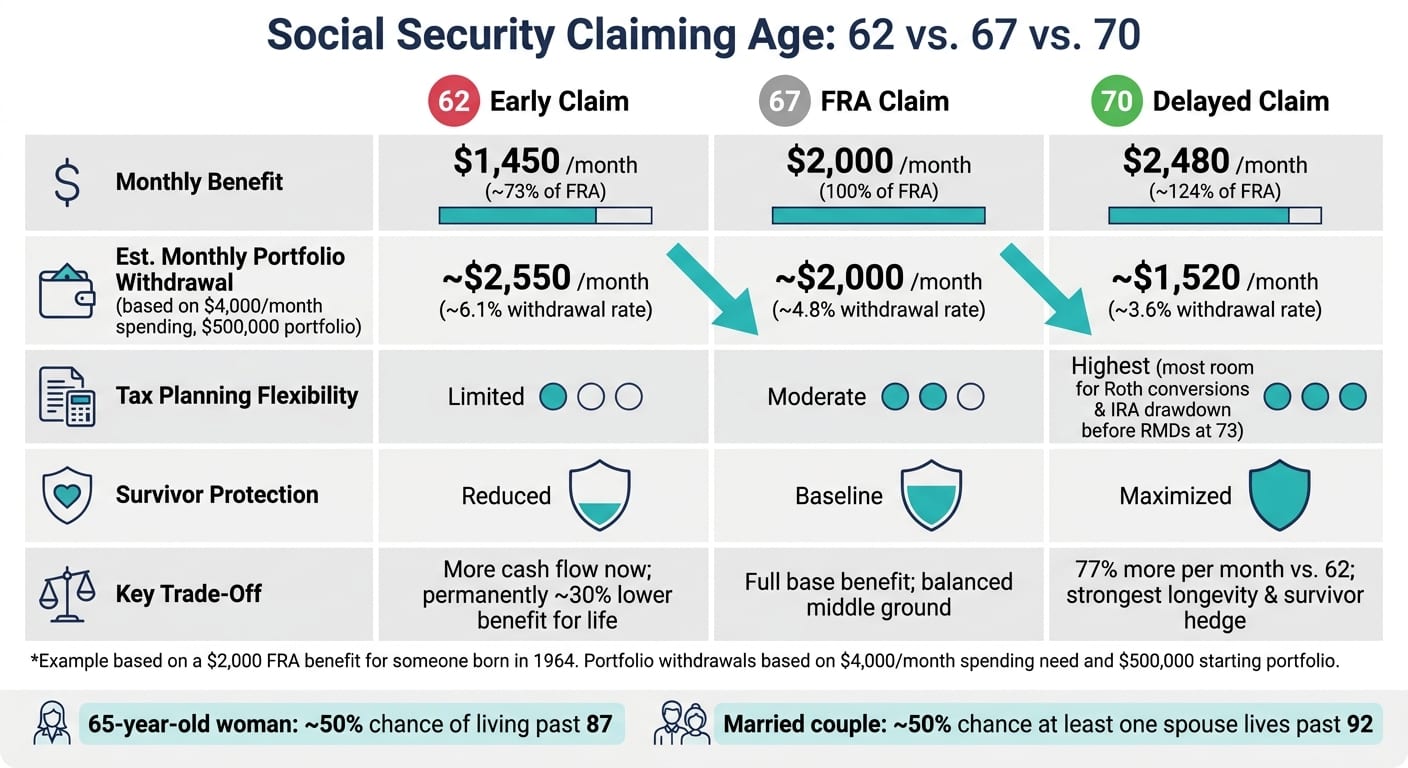
Here’s what those trade-offs may look like in dollar terms. Take a single retiree born in 1964 with a full retirement age of 67 and a projected FRA benefit of $2,000/month. That same earnings record may produce about $1,450/month at 62 and about $2,480/month at 70. Those differences may shape how much comes from savings, how taxes play out, and what a surviving spouse may receive.
Claiming at 62: more cash flow now, permanently lower guaranteed income
If spending runs at $4,000/month, claiming at 62 may bring in $1,450. That leaves $2,550/month to come from savings - about $30,600 per year, or around 6.1% of a $500,000 portfolio in year one. A higher withdrawal rate early in retirement may leave the plan more exposed if markets drop.
Claiming at 62 locks in a permanent ~30% reduction from FRA. That lower base may also reduce each future COLA and the survivor benefit. For the higher earner in a married couple, that may mean a smaller survivor benefit, which may leave a spouse with less income for many years after the higher earner dies.
Early claiming may still make sense in some cases: a serious health condition, a job loss with limited chances of finding similar work, or a need to avoid forced withdrawals from a small IRA at a high marginal rate. Outside those cases, claiming at 62 may increase cash flow now by giving up income later.
Claiming at full retirement age: the middle-ground baseline
Claiming at 67 provides the full $2,000/month. With a $4,000/month spending target, portfolio withdrawals may fall to $2,000/month, or 4.8% of a $500,000 portfolio.
FRA may fit households that want the full base benefit without covering a bridge to 70. It may also fit couples with average health and life expectancy who want a steady income base without going to either end of the range. The survivor benefit at FRA is the full $2,000 - more than the reduced amount locked in at 62, though still less than what a delay to 70 may provide.
Claiming at 70: higher monthly income and a stronger hedge against a long retirement
Waiting until 70 lifts the monthly benefit to $2,480 - 77% more per month than claiming at 62, paid for life and adjusted for inflation. With the same $4,000/month spending target, portfolio withdrawals may fall to about $1,520/month, or roughly $18,240/year. That’s near 3.6% of the $500,000 portfolio. A lower draw may preserve more principal and may give the portfolio more room to recover after market drops.
The gap before 70 may create room for lower-tax IRA withdrawals or Roth conversions before RMDs start at 73. For married couples, delaying the higher earner’s benefit to 70 means the surviving spouse may inherit that larger, inflation-adjusted check - a form of protection that a break-even calculation does not capture.
Seen side by side, the trade-offs may be easier to compare.
*Based on $4,000/month spending need and $500,000 starting portfolio.
The solution: evaluate claiming age as part of a full retirement plan
Use the 62, FRA, and 70 options to test the whole retirement plan - not just the break-even date. The better fit may depend on how Social Security lines up with the rest of retirement, not only on which age may pay more over time. A good place to start is simple: check whether guaranteed income may cover essential spending.
Start with income floor, spending needs, and portfolio stress
The first step is pretty direct. Figure out how much of your core spending may already be covered by guaranteed income. If a pension or a spouse's benefit may cover housing, food, and utilities, delaying Social Security may feel easier because you may not depend on it to fill an immediate gap. If your portfolio may need to cover most of the load in early retirement, the timing of withdrawals may matter more.
Then pressure-test the first five years. That's the stretch when a market drop may do the most harm. Sequence-of-returns risk may be most damaging early on, when the portfolio may be at its largest and the withdrawal period may be longest. A higher Social Security benefit starting at 70 may reduce how much needs to come out of investments during that window. Research by Wade Pfau found that in historical simulations, claiming at 70 rather than 62 produced better final wealth outcomes in 64–89% of scenarios, depending on stock allocation. That frames the issue as a plan test, not a break-even test.
If that cash-flow test looks workable, the next step may be taxes and withdrawals.
Coordinate Social Security timing with a tax-aware withdrawal strategy
Claiming timing doesn't just change monthly income - it may reshape your tax picture for years. Some retirees use the years before benefits start for Roth conversions and IRA drawdown before RMDs begin. With less taxable income coming in, there may be room to do Roth conversions at lower marginal rates or draw down a traditional IRA before RMDs start at 73.
Once Social Security starts, it may cause more of the benefit to become taxable - up to 85% for some married couples. Delaying benefits may shorten the number of years when that taxation applies, while also leaving more time to reduce the traditional IRA balance that may later push RMDs higher. The practical goal may be to look for the lowest-tax path across the full span of retirement, not just the highest monthly check.
Then it makes sense to check whether your actual account mix may support that withdrawal path.
Use connected account data to pressure-test the decision
This choice may depend on your account mix, spending, and survivor exposure. Connected account data may make it easier to test the decision against your actual balances instead of a rough estimate.
Mezzi connects all your accounts in one place through read-only access, so the analysis may reflect your actual balance sheet rather than hypothetical inputs. As an SEC-registered fiduciary, Mezzi may show how Social Security timing is associated with withdrawal sequencing, Roth conversion openings, and survivor benefit exposure. When all accounts are visible together, it may be easier to see whether delaying benefits may strengthen cash flow or whether it may require a different withdrawal path.
Conclusion: the right question is whether your claiming strategy strengthens the whole plan
After comparing 62, FRA, and 70, the better question may be simpler than break-even math: does your claiming age support your retirement plan, or put pressure on it?
That may mean looking at the decision at the household level, not just the individual level. The higher earner's claiming age may set the base for spousal and survivor benefits, and a delayed benefit may compound through inflation adjustments, survivor income, and portfolio pressure during the years when sequence-of-returns risk may be most damaging.
That same household view may shape taxes and withdrawals too. Those pieces may belong in the same decision, not in separate buckets.
In that sense, claiming age may be judged by how well it supports income stability, tax efficiency, and survivor protection.
FAQs
How do I know if delaying to 70 fits my plan?
Delaying Social Security until 70 may fit your plan if you’re able to balance current income needs against the value of larger future payments. For some people, that may make sense if they’re in good health, expect to live longer, or want to increase survivor benefits for a spouse.
It may also depend on whether you have enough savings to cover the gap years, and on how withdrawals, taxes, and account types may work together before benefits begin.
When does claiming at 62 make sense?
Claiming Social Security at 62 may make sense if you have immediate, unavoidable financial needs or serious health concerns and expect a shorter life expectancy.
The trade-off is simple: it permanently reduces your monthly benefit, typically by 25% to 30% compared with claiming at full retirement age. That lower payment may affect more than just your monthly cash flow.
A lot of people focus on the break-even age. That may be part of the picture, but it may not be the whole story. Early income may also shape your retirement goals, tax planning, and overall income stability.
How should married couples choose claiming ages?
Married couples may want to treat Social Security claiming ages as a shared decision, not two separate ones. The goal for some households may be to balance cash flow now with total lifetime income and survivor income later on.
One approach some couples use is a split timeline: one spouse claims earlier, while the higher earner waits until age 70. That setup may provide income sooner, while also leaving room for a larger benefit tied to the higher earner.
Other factors may shape the choice too. Couples may weigh:
- their current and future tax brackets
- portfolio withdrawal needs
- life expectancy
- age differences
- health status
- possible Medicare IRMAA surcharges
In plain English, the “best” claiming plan may depend less on one rule of thumb and more on how these moving parts fit together inside the household.
Disclosures:
- This content is for informational purposes only and does not constitute investment advice or a recommendation to buy or sell any security.
- Past performance is not indicative of future results. No guarantee of future performance or outcomes is implied.
- Registration does not imply a certain level of skill or that the SEC has approved the company or its services.
Related Blog Posts
- Top 5 Social Security Strategies for Couples
- Maximizing Social Security for Early Retirement
- When to Claim Social Security: The 8%-a-Year Question
- The Retirement Tax Torpedo: How Provisional Income Taxes Your Social Security
Delaying Social Security until 70 may fit your plan if you’re able to balance current income needs against the value of larger future payments. For some people, that may make sense if they’re in good health, expect to live longer, or want to increase survivor benefits for a spouse.
It may also depend on whether you have enough savings to cover the gap years, and on how withdrawals, taxes, and account types may work together before benefits begin.
Claiming Social Security at 62 may make sense if you have immediate, unavoidable financial needs or serious health concerns and expect a shorter life expectancy.
The trade-off is simple: it permanently reduces your monthly benefit, typically by 25% to 30% compared with claiming at full retirement age. That lower payment may affect more than just your monthly cash flow.
A lot of people focus on the break-even age. That may be part of the picture, but it may not be the whole story. Early income may also shape your retirement goals, tax planning, and overall income stability.
Married couples may want to treat Social Security claiming ages as a shared decision, not two separate ones. The goal for some households may be to balance cash flow now with total lifetime income and survivor income later on.
One approach some couples use is a split timeline: one spouse claims earlier, while the higher earner waits until age 70. That setup may provide income sooner, while also leaving room for a larger benefit tied to the higher earner.
Other factors may shape the choice too. Couples may weigh:
- their current and future tax brackets
- portfolio withdrawal needs
- life expectancy
- age differences
- health status
- possible Medicare IRMAA surcharges
In plain English, the “best” claiming plan may depend less on one rule of thumb and more on how these moving parts fit together inside the household.