
Most retirees may not need a flat 10% cash rule. A more useful starting point may be this: cash = the spending your portfolio may need to cover for the next 1 to 3 years*.*
Here’s the short version:
- If guaranteed income like Social Security, a pension, or an annuity covers most monthly bills, a retiree may need less cash than a rule-of-thumb suggests.
- If the portfolio may need to fund a big share of spending, a retiree may need more cash, especially near the start of retirement.
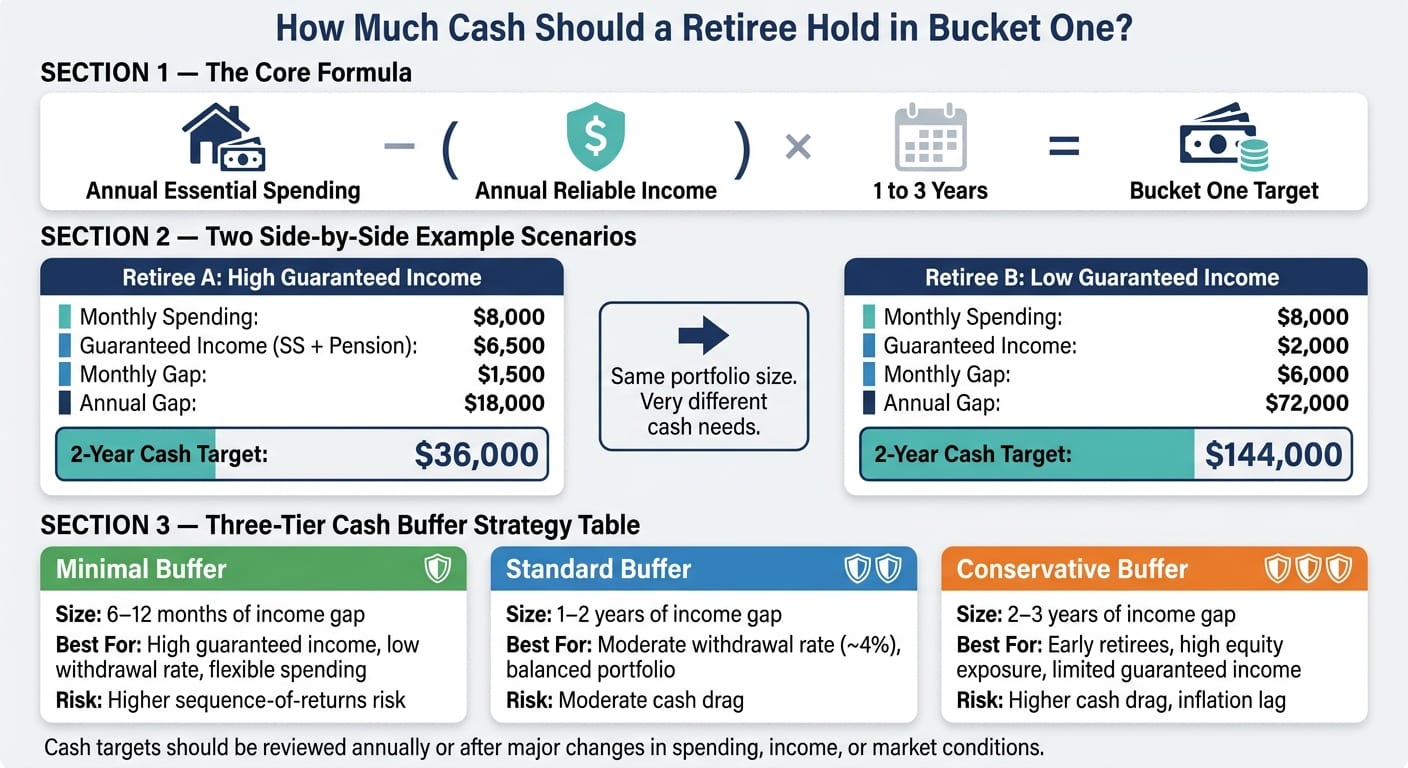
- A simple formula may work better than a flat percentage: annual spending gap × 1 to 3 years
- The spending gap may be: yearly must-pay costs + any lifestyle spending you want to shield − steady non-portfolio income
- Taxes may change the math. A retiree taking money from IRAs or 401(k)s may need a higher gross withdrawal than the net spending gap.
- Cash that sits too high for too long may trail inflation, which has averaged about 2% to 3% over long periods.
A fast example:
- Spending: $8,000/month
- Guaranteed income: $6,500/month
- Portfolio gap: $1,500/month or $18,000/year
- Two-year cash target: $36,000
That may look very different from someone with the same portfolio but only $2,000/month in guaranteed income. In that case, the gap may be $72,000/year, and a two-year cash target may be $144,000.
That’s the point: the cash target may be tied more to income gap than to portfolio size alone.
If I were boiling the article down to one line, it would be this: Bucket One may work best when it is built from spending, income, taxes, and time horizon - not a blanket cash percentage.
How Do You Maintain a Bucket System for Your Retirement Portfolio?
Step 1: Calculate the Income Gap Bucket One Must Fund
Bucket One begins with your annual income gap: protected spending minus reliable income.
Use this formula:
annual essential spending + any discretionary spending you want to protect - income that does not come from your portfolio = annual income gap
This gives you the amount Bucket One may need to cover.
Separate essential spending from optional spending
Start by listing the costs you may need to pay each month. Then split them into two groups: spending that likely needs funding no matter what, and spending that may be reduced during a market downturn.
Essential costs generally may not flex much in a down market. Discretionary spending may. Keeping those categories separate may give you a more accurate cash target and a clearer view of where you may have room to adjust.
Subtract Social Security, pensions, annuities, and other reliable income
Once you have your annual spending number, subtract each income stream that may continue during a market downturn.
That may include:
- Social Security
- Defined-benefit pensions
- Lifetime annuities
Rental income may count too, but only if it is net and stable after property taxes, insurance, and maintenance are factored in.
Turn the gap into a one-year cash target
If you want Bucket One to cover one year of withdrawals, the cash target may simply be that annual income gap.
If withdrawals come from a traditional IRA or 401(k), gross withdrawals may need to be higher than the net spending gap to account for taxes. That annual gap then becomes the baseline for deciding whether Bucket One may hold one, two, or three years of withdrawals.
Step 2: Decide How Many Years of Withdrawals to Hold in Cash
Once you know your annual income gap, the next step is choosing a cash runway. For some retirees, 1 year may feel lean but workable. For others, 2 to 3 years may offer more breathing room.
When 1 year of cash may be enough
Start by looking at how much of your spending gap needs to be covered. A one-year buffer may make sense when guaranteed income already covers most of the basics.
Say a married couple, both 68, receives $3,500/month in combined Social Security and $1,000/month from a pension. That gives them $4,500/month in total guaranteed income. If their essential expenses run $4,800/month, the shortfall is just $300/month, or $3,600/year. In that case, one year of cash may mean holding about $3,600 in cash-equivalent accounts. That number stays small because their guaranteed income does most of the heavy lifting.
This setup may also fit retirees with lower withdrawal rates, bond-heavy portfolios, or spending that may be trimmed in a downturn, like travel, home projects, or hobbies.
The trade-off? You may need to refill Bucket One through annual rebalancing from investment accounts. That approach may work, but it tends to require discipline.
When 2 to 3 years of cash makes more sense
A larger buffer may make more sense when the portfolio carries more market risk or the income gap is much larger.
That may apply if you're retiring in your early 60s before Social Security starts, or if guaranteed income covers only part of your essential expenses. In those cases, you may face more sequence-of-returns risk. In plain English, that means you may have to sell stocks after a drop early in retirement just to fund withdrawals.
Here’s a simple example. A single retiree at 66 gets $2,200/month from Social Security and has $3,800/month in essential expenses. That leaves a gap of $19,200/year. A two-year buffer would mean holding about $38,400 in cash. That amount may cover two full years of withdrawals without pulling from the investment portfolio.
The downside is pretty straightforward: more cash may mean lower long-term return and less protection against inflation.
Comparison table: minimal, standard, and conservative cash buffers
Next, convert that dollar target into a portfolio percentage and place it in the right accounts.
Step 3: Convert Bucket One Into a Portfolio Percentage and Place It in the Right Accounts
Once you have the dollar amount for Bucket One, turn it into a portfolio percentage. That gives you a cleaner way to judge whether your cash level may be too low, too high, or roughly on target.
The key detail: taxes may change the gross amount you need to withdraw. So this percentage should be based on spending power, not just the cash balance sitting in an account.
How your withdrawal rate changes the cash percentage
The math is pretty simple. Start with your annual income gap. If withdrawals may trigger taxes, gross that number up. Then multiply by the number of years you want Bucket One to cover, and divide by your total portfolio value.
Say your income gap is $40,000 per year and you want a two-year buffer. That puts Bucket One at $80,000. Against a $1,200,000 portfolio, that comes to about 6.7% of your portfolio in cash. In other words, the target comes from your spending needs, not a generic rule of thumb.
Taxes may shift that number. If withdrawals come from a traditional IRA or 401(k), the amount you withdraw may need to be higher to cover estimated taxes. Here’s how that may look for a retiree with a $48,000 annual net spending goal and a $1,200,000 portfolio:
Once you’ve set the cash target, the next step is placing that cash where it may be spent without adding extra tax friction.
Where to hold the cash
Not all cash accounts work the same way. Placement matters for liquidity and tax treatment. The best home for Bucket One may depend less on what feels easiest and more on where the money may actually be spent from.
For many retirees, taxable accounts may be the simplest place to hold Bucket One. Roth accounts may also offer tax-free flexibility.
How Mezzi helps size and monitor your cash target
Mezzi connects your 401(k), IRA, Roth IRA, and brokerage accounts through read-only access via Plaid and Finicity. That gives you a full view of current portfolio value, contributions, withdrawals, fees, and asset allocation across accounts.
It also shows whether your cash balance may be above or below target as your portfolio, spending, and withdrawals change. That target may shift over time with spending, taxes, and market conditions.
Review the target after major spending, income, or market changes.
Conclusion: A Better Bucket One Target Is Spending-Based, Risk-Aware, and Revisited Regularly
Once you've sized the gap and picked the runway, the next step may be keeping Bucket One lined up with actual spending. A simple way to frame it:
(Annual Essential Spending − Annual Reliable Income) × 1–3 years = Bucket One target
Both extremes may come with tradeoffs. Too little cash may force portfolio sales during a downturn. Too much cash may weigh on returns and may lose purchasing power over time.
Bucket One may deserve a review when spending, income, taxes, or market conditions change. The same may apply when your allocation drifts by more than 5%, Social Security starts, RMDs begin at 73, or Medicare IRMAA thresholds change.
This target may be something to check, not assume. Some people review it at least once a year, and monthly during active withdrawals. It may also help to track it in both dollars and as a share of the portfolio.
Taxes may change gross withdrawal needs, so withdrawal sequencing to minimize taxes may be worth reviewing with a qualified tax professional.
FAQs
How do I choose between 1, 2, or 3 years of cash?
Choose based on how much liquidity you want and how much market volatility you may be comfortable with. One year may cover near-term essential spending. Two or three years may give investments more time to recover during a downturn, which may reduce the chance of selling at a loss.
It also may make sense to look at your risk tolerance and how steady other income sources may be, such as Social Security or pensions. More stable income may mean you need less cash.
Should Bucket One cover only essential expenses or some discretionary spending too?
Bucket One acts as a liquidity buffer for near-term expenses, and it often covers one to three years of spending. Even if guaranteed income like Social Security or a pension may cover basic costs, Bucket One may still serve a purpose: it may reduce the need to sell long-term investments during market downturns.
Because of that, some retirees include not just essential spending, but also part of their discretionary spending in Bucket One. The idea is pretty simple. You may keep reliable access to cash while leaving growth-focused assets alone during periods of market volatility.
How often should I recalculate my Bucket One cash target?
Review and adjust your Bucket One cash target on a regular basis so it may stay in line with your income needs, risk tolerance, and market conditions.
A formal rebalance may be done once a year. But it may make sense to revisit it sooner if your allocations drift in a meaningful way, or during periods of market stress or volatility, to check whether your liquidity may still be sufficient.
Disclosures:
- This content is for informational purposes only and does not constitute investment advice or a recommendation to buy or sell any security.
- Past performance is not indicative of future results. No guarantee of future performance or outcomes is implied.
Related Blog Posts
- What portfolio value and withdrawal strategy would generate a specific monthly after-tax income?
- Retirement Planning at 50: How to Assess If You Have Enough
- Sequence-of-Returns Risk: Why the First Five Years Decide Everything
- Bucket Strategy vs. Total-Return: Which Decumulation Model Actually Wins
Choose based on how much liquidity you want and how much market volatility you may be comfortable with. One year may cover near-term essential spending. Two or three years may give investments more time to recover during a downturn, which may reduce the chance of selling at a loss.
It also may make sense to look at your risk tolerance and how steady other income sources may be, such as Social Security or pensions. More stable income may mean you need less cash.
Bucket One acts as a liquidity buffer for near-term expenses, and it often covers one to three years of spending. Even if guaranteed income like Social Security or a pension may cover basic costs, Bucket One may still serve a purpose: it may reduce the need to sell long-term investments during market downturns.
Because of that, some retirees include not just essential spending, but also part of their discretionary spending in Bucket One. The idea is pretty simple. You may keep reliable access to cash while leaving growth-focused assets alone during periods of market volatility.
Review and adjust your Bucket One cash target on a regular basis so it may stay in line with your income needs, risk tolerance, and market conditions.
A formal rebalance may be done once a year. But it may make sense to revisit it sooner if your allocations drift in a meaningful way, or during periods of market stress or volatility, to check whether your liquidity may still be sufficient.