Waiting until year 10 may turn an inherited IRA into a large tax bill. For many high-income heirs, the issue may not be the 10-year deadline itself. The issue may be when the money comes out.
Here’s the short version:
- Most non-spouse heirs may need to empty the IRA by December 31 of the 10th year after the year of death.
- If the account is a pre-tax IRA, withdrawals may be taxed as ordinary income.
- If the original owner died on or after their required beginning date, annual RMDs in years 1-9 may still apply.
- Waiting may let the balance grow, but it may also pile a large withdrawal on top of salary, bonuses, RSUs, or business income.
- That may push part of the distribution into higher tax brackets, and it may also affect IRMAA, state taxes, and other income-based limits.
- Some heirs look at three main patterns: even yearly withdrawals, bracket-filling withdrawals, or larger withdrawals in lower-income years.
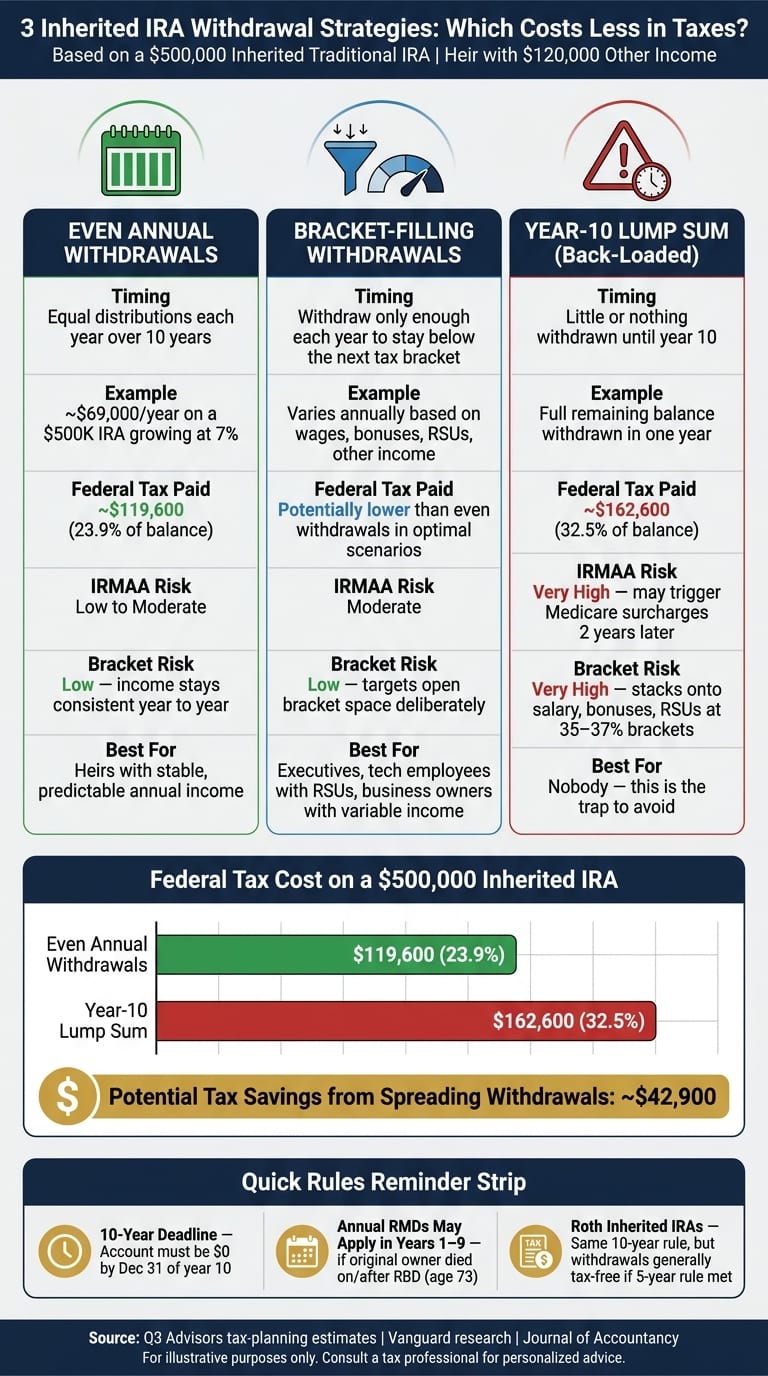
- One example in the article shows a gap of about $42,900 in federal tax between a year-10 lump sum and level withdrawals on a $500,000 inherited IRA.
A Roth inherited IRA may be different. The same 10-year payout rule may apply, but qualified withdrawals are often not taxed the same way.
So the core idea is simple: the 10-year rule may be a tax-timing problem, not just a deadline problem. I’d read this article as a year-by-year planning piece, not a one-time withdrawal rule.
What the 10-year rule requires and who it applies to
Most non-spouse designated beneficiaries who inherit an IRA from someone who died after December 31, 2019, may need to empty the account by December 31 of the 10th year after the year of death. A death on June 15, 2024, for example, may mean the account needs to be at $0 by December 31, 2034. During that 10-year window, withdrawals may be spaced out in different ways, but the balance may still need to be fully distributed by the deadline.
Who falls under that rule matters almost as much as the date itself.
The rule applies to designated beneficiaries, which may include individuals and some qualifying trusts listed on the IRA beneficiary form. Eligible designated beneficiaries - surviving spouses, minor children, disabled or chronically ill individuals, and beneficiaries who are less than 10 years younger than the decedent - may generally use life expectancy payouts instead. Most adult children don’t fit that group, so they may fall under the 10-year rule. For them, the stretch IRA approach may no longer be available.
From there, the tax hit may depend on whether the inherited account is traditional or Roth.
Traditional vs. Roth inherited IRAs
The 10-year depletion rule may apply to both traditional and Roth inherited IRAs for most non-spouse beneficiaries. The big difference is how withdrawals may be taxed. Distributions from an inherited traditional IRA are generally taxed as ordinary income to the beneficiary at the federal level and, in many states, at state marginal rates too, on top of other income earned that year. For someone already in a high bracket, even a mid-sized withdrawal may push more income into a higher bracket.
Inherited Roth IRA withdrawals are generally free from federal income tax, as long as the original Roth account met the 5-year aging requirement. The timing still matters for meeting the deadline, but the tax effect may be much smaller than it is with a traditional inherited IRA.
When annual RMDs apply in years 1 through 9
Annual RMDs in years 1 through 9 may depend on whether the original owner died before or after the required beginning date, or RBD. Under current law, the RBD is generally April 1 of the year after the owner reached age 73.
If the owner died on or after their RBD, a standard designated beneficiary - such as an adult child - may need to take annual RMDs in years 1 through 9 and still make sure the account is fully emptied by December 31 of year 10. Missing a required annual distribution may trigger an excise tax of up to 25% of the shortfall, with a lower 10% rate if it’s fixed promptly. That may add to the total tax cost.
And that’s where the timing issue starts to matter. The rule itself may sound simple. The tax bill may not be.
How delayed withdrawals create a larger tax bill
Once the withdrawal deadline is clear, the next issue may be timing. On paper, waiting may look safer: leave the account invested now, deal with taxes later. But that choice may bunch a lot of income into year 10. If salary, bonuses, and RSUs are still high at that point, the final withdrawal may land on top of all of it.
Why year-10 lump sums hit the highest marginal brackets
If little or nothing comes out for nine years, the balance left in year 10 may be much larger than the amount originally inherited. The full amount still in the account must be withdrawn by December 31 of that year.
For someone with high earned income, that last distribution may stack onto wages and other taxable income. That may push more of those dollars into the 35% or 37% federal brackets.
Costs beyond the federal income tax rate
The federal bracket may be only one part of the total cost. A large withdrawal may also lift MAGI enough to trigger Medicare IRMAA surcharges two years later. State income taxes may add another layer as well.
Comparison table: even withdrawals vs. back-loaded withdrawals vs. low-income-year withdrawals
These three patterns show why timing may shape the tax bill just as much as account size.
Each dollar from an inherited IRA may be taxed very differently depending on when it is withdrawn and how much other income shows up in that same year.
Withdrawal strategies that work better than waiting
For high earners, the 10-year window may be more useful when it’s used along the way, not saved for year 10. The idea here may be simple: spread withdrawals across years that may have tax room, instead of letting the whole balance stack up at the end.
Equal annual withdrawals to spread taxable income
The simplest path may be to divide the inherited IRA balance by 10 and withdraw roughly the same amount each year, then adjust for market gains or losses. If you inherit a $1,000,000 traditional IRA in 2026, that may mean planning for about $100,000 per year through 2036.
This approach may keep added taxable income steady and easier to plan around. Vanguard’s research found that roughly equal annual distributions were the most tax-efficient approach in more than 99% of cases, and the Journal of Accountancy describes a practical version of this: take one-tenth in year 1, one-ninth in year 2, and so on.
The downside is pretty clear. It may not adjust for unusually low-income years, so some bracket space may go unused.
Bracket-filling withdrawals based on unused bracket room
A more precise approach may look like this: each year, estimate total taxable income from all sources - wages, bonuses, RSU vesting, business income, interest, and dividends - then withdraw only enough to stay below the next bracket. The goal may be to use open bracket space without pushing inherited IRA income into peak-rate territory.
This method may fit heirs with uneven compensation, such as executives with annual bonuses, tech employees with RSU schedules, or business owners with shifting profits. It usually calls for an annual income projection, often with a CPA, but it may reduce the average tax rate on distributions across the full 10-year window.
Larger withdrawals in planned low-income years
Some heirs may spot lower-income windows ahead of time. A planned sabbatical, an early retirement year, or a gap in bonus income may make room for a larger withdrawal at a lower rate. That may reduce the risk of a year-10 pileup, which is often where the inherited IRA problem shows up for high earners.
For heirs who may be subject to annual RMDs in years 1–9 because the original owner died after their required beginning date, taking only the minimum may leave too much for year 10. In those cases, some people take the required amount plus extra withdrawals during lower-income years to avoid that buildup.
This tends to work best when the lower-income year is easy to spot in advance. The next step may be to line up those withdrawal years with income, deadlines, and other tax moves.
A step-by-step planning framework for high-income heirs
Once you know why timing matters, this framework may help turn the 10-year rule into a plan.
Map the rule set, deadline, and income forecast
Start by confirming your beneficiary category and whether annual RMDs may apply. Most non-spouse heirs fall under the 10-year rule. Check whether the original owner died before or after the required beginning date. Then review whether years 1–9 may require RMDs and compare those rules against each year's expected income.
Map your expected income across all 10 years. That may include wages, bonuses, RSUs, business income, and other taxable income. The point here is simple: see how much room you may have each year before the next marginal tax rate, and where an inherited IRA withdrawal may fit.
Next, line up withdrawals with deductions that may absorb part of that income.
Coordinate inherited IRA withdrawals with other tax moves
In years when a larger distribution may make sense, some people increase pre-tax contributions to a 401(k), 403(b), or 457(b) with the goal of offsetting part of that added income. If you're enrolled in a high-deductible health plan, maxing out an HSA may add another deduction. Charitable bunching may also reduce taxable income in a high-withdrawal year.
After that, compare the math before moving any money.
Model withdrawal scenarios before taking distributions
Model the numbers before you withdraw. Run three scenarios side by side:
- Equal annual withdrawals
- Bracket-filling withdrawals
- A pattern weighted toward your lowest-income years
A concrete example from tax-planning research shows that a $500,000 inherited IRA growing at 7% annually may require roughly $69,000 per year under an equal-depletion approach to empty the account by the deadline.
Use inherited IRA calculators and tax-planning tools that may model account balance, expected growth, and year-by-year income. Then compare how each approach may affect your marginal tax brackets over the 10-year window.
Conclusion: Start planning withdrawals in year 1, not year 10
For high earners, the 10-year rule may be less about the deadline and more about timing. Hitting the deadline and paying the lowest tax bill may not be the same thing. That gap may show up pretty fast when you model taxes year by year.
The tax difference may be meaningful. Q3 Advisors estimate that on a $500,000 inherited traditional IRA, a single heir with $120,000 in other income who waits and takes a single year-10 lump sum may pay about $162,600 in federal tax (32.5% of the balance). The same heir using level withdrawals across the 10-year window may pay about $119,600 (23.9% of the balance). That’s a gap of roughly $42,900, based on timing alone.
Two common mix-ups may lead people the wrong way. First, annual RMDs may still apply in years 1 through 9 when the original owner died after their required beginning date. Second, waiting until year 10 may turn tax deferral into bracket compression. For some heirs, that may mean early withdrawal planning offers one of the few ways to keep the tax bill from getting boxed into a tighter range.
The practical move may be pretty simple: treat the 10-year rule like an annual tax plan, not a one-time deadline. Model each year’s income before choosing a withdrawal pattern. When inherited IRA withdrawals are layered onto annual income, it may become easier to spot where bracket headroom exists and where a distribution may cost more.
Treat the inherited IRA as a 10-year tax project starting the day you inherit it. For many people, starting in year 1 may leave more room to plan, while year 10 may leave less room to change the outcome.
FAQs
How do I know if annual RMDs apply to my inherited IRA?
For an inherited IRA, annual RMDs may not apply during the 10-year distribution period. Instead, a non-spouse beneficiary may need to fully withdraw the account by December 31 of the tenth year after the original owner's death.
That means you may have some flexibility in how the money comes out over that window. Some people take periodic withdrawals. Others wait and take a lump sum. Some use a mix of both, depending on their tax picture and timing.
Should I take inherited IRA withdrawals every year or wait for lower-income years?
The 10-year rule doesn’t require annual withdrawals, so heirs may choose when to take distributions within that window.
For higher-earning heirs, timing may matter. Large withdrawals during peak income years may push taxable income into a higher marginal tax bracket. Because of that, some heirs may wait for years when income is lower.
Spreading withdrawals across the 10-year period may also help manage taxable income and may reduce the chance of an unexpected tax bill.
How can inherited IRA withdrawals affect IRMAA and your tax bracket?
Inherited IRA withdrawals generally count as ordinary income. That means they may increase your adjusted gross income and, for higher-earning heirs, may push taxable income into a higher federal tax bracket.
They may also increase your Modified Adjusted Gross Income (MAGI), which may trigger IRMAA and increase Medicare Part B and Part D premiums. And because Medicare uses a two-year lookback, a large withdrawal today may lead to higher premiums later.
Disclosures:
- This content is for informational purposes only and does not constitute investment advice or a recommendation to buy or sell any security.
- Past performance is not indicative of future results. No guarantee of future performance or outcomes is implied.
Related Blog Posts
- Ultimate Guide to Roth IRA Inheritance Tax Rules
- Are there tax implications from realizing gains inside a Traditional IRA?
- Tax-efficient withdrawal sequencing: which accounts to pull from first
- The RMD Tax Bomb: Why Your 70s Could Be Your Highest-Tax Decade
For an inherited IRA, annual RMDs may not apply during the 10-year distribution period. Instead, a non-spouse beneficiary may need to fully withdraw the account by December 31 of the tenth year after the original owner's death.
That means you may have some flexibility in how the money comes out over that window. Some people take periodic withdrawals. Others wait and take a lump sum. Some use a mix of both, depending on their tax picture and timing.
The 10-year rule doesn’t require annual withdrawals, so heirs may choose when to take distributions within that window.
For higher-earning heirs, timing may matter. Large withdrawals during peak income years may push taxable income into a higher marginal tax bracket. Because of that, some heirs may wait for years when income is lower.
Spreading withdrawals across the 10-year period may also help manage taxable income and may reduce the chance of an unexpected tax bill.
Inherited IRA withdrawals generally count as ordinary income. That means they may increase your adjusted gross income and, for higher-earning heirs, may push taxable income into a higher federal tax bracket.
They may also increase your Modified Adjusted Gross Income (MAGI), which may trigger IRMAA and increase Medicare Part B and Part D premiums. And because Medicare uses a two-year lookback, a large withdrawal today may lead to higher premiums later.