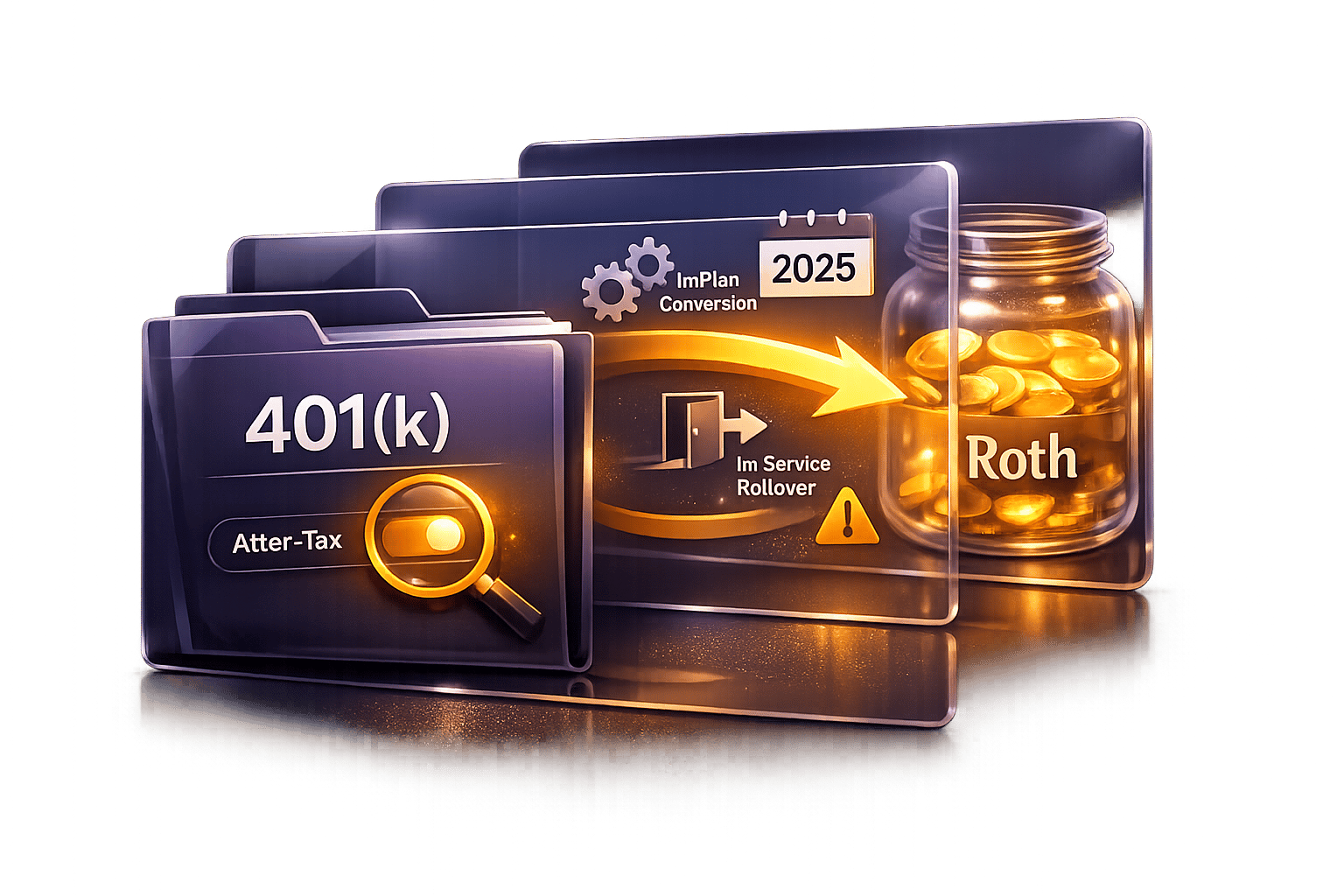
The Mega Backdoor Roth is a strategy that lets high-income earners contribute beyond standard 401(k) limits to grow tax-free retirement savings. Here's the key: your 401(k) plan must allow after-tax contributions and provide options for Roth conversions. In 2026, the total 401(k) contribution limit rises to $72,000 (or $83,250 for ages 60–63), making this strategy even more appealing.
Quick Key Points:
- How It Works: Contribute after-tax dollars to your 401(k), then convert them to a Roth IRA or Roth 401(k).
- Plan Requirements: Your 401(k) must allow after-tax contributions and Roth conversion options.
- 2026 Limits: $24,500 for employee deferrals; total contributions up to $72,000.
- Steps to Check:
Review your 401(k) Summary Plan Description (SPD) for after-tax and Roth conversion options.
- Contact HR or your plan administrator with specific questions.
- Use tools like Mezzi for detailed analysis.
This strategy works best for those already maxing out standard contributions and looking to grow tax-free retirement savings. Be mindful of IRS rules, plan testing, and potential tax implications during conversions.
Mega Backdoor Roth: What It Is and Who Should Use It (Complete Guide!)
2026 401(k) Contribution Limits and Rules
The Mega Backdoor Roth leverages the gap between what you, as an employee, can contribute to your 401(k) and the much larger total limit set by the IRS. This approach works by using after-tax contributions to fill the space between your employee deferral limit and the overall contribution cap, including employer contributions.
Contribution Limits for 2026
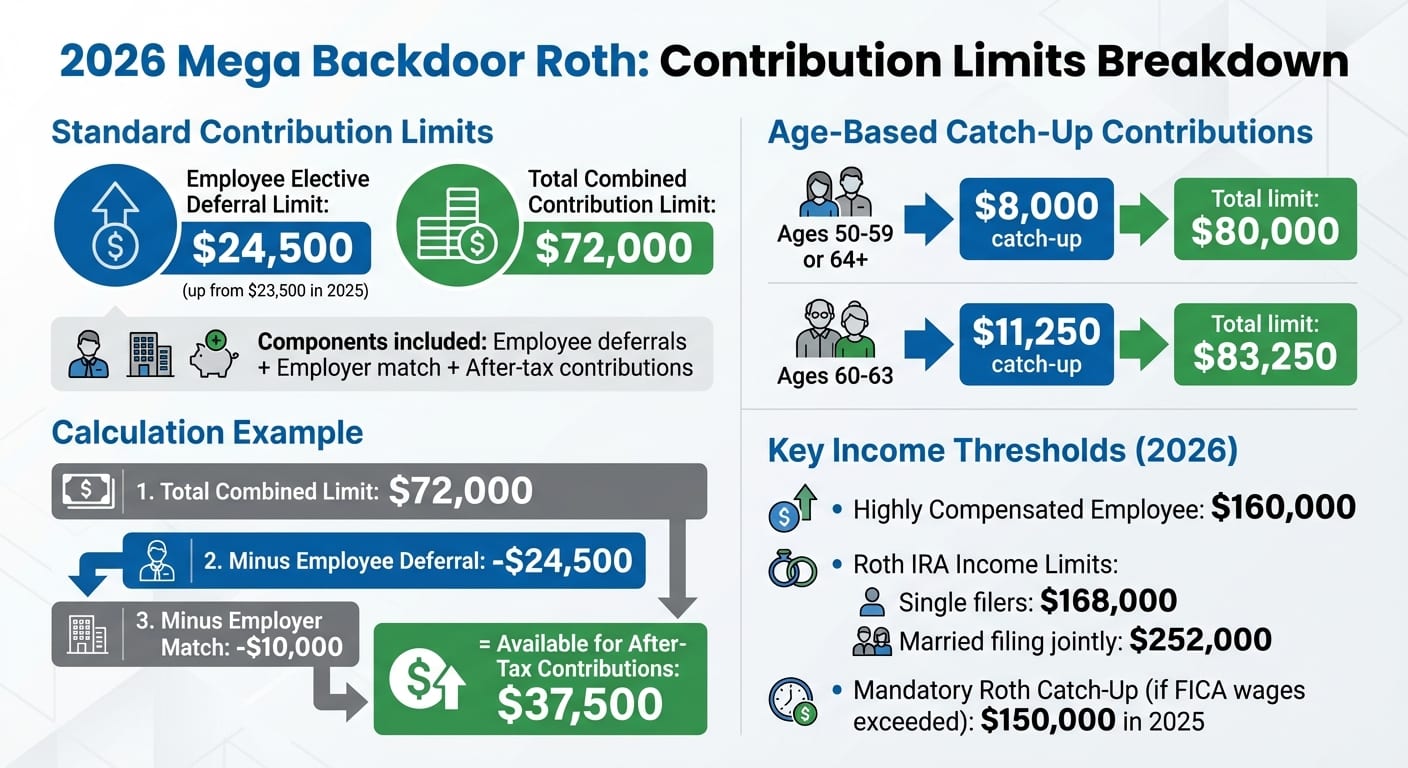
In 2026, the IRS has increased the employee elective deferral limit to $24,500, up from $23,500 in 2025. This applies to both traditional pre-tax and Roth 401(k) contributions. The combined contribution limit - which includes your deferrals, employer matches, and after-tax contributions - rises to $72,000.
"The amount individuals can contribute to their 401(k) plans in 2026 has increased to $24,500, up from $23,500 for 2025." - Internal Revenue Service
After-tax contributions play a crucial role in the Mega Backdoor Roth strategy. Unlike Roth 401(k) contributions, which count toward the $24,500 limit, after-tax contributions go beyond your standard deferrals and employer match. For example, if you contribute $24,500 and your employer provides a $10,000 match, you’d still have $37,500 available for after-tax contributions, which could later be converted to Roth.
For participants aged 60 to 63, there’s an enhanced catch-up provision of $11,250, allowing total contributions to reach $83,250. For those aged 50–59 or 64 and older, the standard catch-up amount is $8,000, making the maximum total $80,000.
Next, it’s important to understand the IRS rules that govern how these limits interact with catch-up contributions and nondiscrimination testing.
Key IRS Rules to Know
To take advantage of a Mega Backdoor Roth, your 401(k) plan must allow after-tax contributions and provide options for either in-plan Roth conversions or in-service distributions to a Roth IRA.
There’s a new requirement for 2026: if your FICA wages exceeded $150,000 in 2025, any catch-up contributions must be designated as Roth contributions. If your plan doesn’t offer a Roth option, this could mean you’re unable to make catch-up contributions.
"If your W-2 Social Security wages for the previous year are $150,000 or more from a single employer, then all catch-up contributions you make to that employer's plan must be made as Roth contributions." - Denise Appleby, CEO, Appleby Retirement Consulting Inc.
Additionally, after-tax contributions are subject to nondiscrimination testing, specifically the Actual Contribution Percentage (ACP) test. If your plan fails this test - often due to higher contributions from highly compensated employees - excess contributions may be refunded, which could disrupt your Mega Backdoor Roth strategy. For 2026, the threshold for being classified as a highly compensated employee is $160,000.
Knowing these rules and limits is essential to determine whether your 401(k) plan can support the Mega Backdoor Roth strategy effectively.
How to Check if Your 401(k) Plan Allows a Mega Backdoor Roth
To determine if your 401(k) plan supports a mega backdoor Roth, you’ll need to confirm two things: whether your plan permits voluntary after-tax contributions and whether it provides a way to convert those funds to a Roth account. This could be done through in-service distributions or in-plan Roth conversions. Here’s how to check if your plan qualifies.
Step 1: Review Your 401(k) Plan Documents
Start by examining your Summary Plan Description (SPD). This document outlines the features of your 401(k) plan, and employers are required to provide it within 90 days of your enrollment. Focus on sections labeled "After-tax contributions", "In-service non-hardship withdrawals", or "In-plan Roth rollovers".
Search for terms like "after-tax", "in-service", "non-hardship", and "conversion". You’ll want to confirm two key features:
- A contribution source labeled "Voluntary After-Tax", separate from Roth contributions.
- The ability to move these funds without triggering events like leaving your job or reaching age 59½.
Some plans simplify the process by automatically converting after-tax contributions to a Roth account, which minimizes taxable gains. For example, certain plans may allow scheduled semi-annual withdrawals from your after-tax balance, as long as you meet eligibility requirements.
Step 2: Contact Your HR or Plan Administrator
If the SPD doesn’t provide clear answers, reach out to your HR department or plan administrator. Ask specific questions, such as:
- Does the plan allow voluntary after-tax contributions separate from Roth contributions?
- Are in-service distributions or in-plan Roth conversions permitted?
- What are the restrictions or triggering events, if any?
- How frequently can conversions or distributions be made?
- Is there an automatic conversion feature?
"The mega-backdoor Roth is an informal term; neither the IRS nor your company will officially recognize it... if you come across someone who has never heard of it, just use the terms 'after-tax 401(k) contribution' and 'Roth conversion' instead." - Bogleheads
Also, inquire about nondiscrimination testing. Plans must pass the Actual Contribution Percentage (ACP) test, which ensures that highly compensated employees don’t contribute disproportionately more than others. If the plan fails this test, after-tax contributions may be refunded.
If both your plan documents and HR confirm these features, you’re well on your way to understanding your plan’s capabilities.
Step 3: Use Mezzi to Analyze Your Plan
For a detailed review, consider using Mezzi’s AI-powered platform. By connecting your retirement accounts, Mezzi analyzes your plan’s features and highlights opportunities for tax optimization, including after-tax contribution options and conversion strategies.
Mezzi provides real-time insights tailored to your situation, helping you determine whether your plan supports voluntary after-tax contributions and how to make the most of them. With memberships that include expert coaching, Mezzi can guide you through implementing this strategy as part of your long-term retirement planning. This tool simplifies the process and helps you decide if moving extra funds into a Roth account aligns with your financial goals.
Is the Mega Backdoor Roth Right for Your Financial Goals?
Using the steps outlined earlier, determine if this strategy fits into your overall financial plan. The mega backdoor Roth is ideal for individuals with extra cash flow - those who have already maxed out their 401(k) contributions and still have funds left after covering essential expenses. This foundation is crucial for weighing both the potential benefits and challenges.
Benefits of the Mega Backdoor Roth
The standout advantage here is tax-free growth. Once you convert after-tax contributions to a Roth account, any future investment earnings grow tax-free and can also be withdrawn tax-free when you retire. For high-income earners who exceed Roth IRA income limits - set at $168,000 for single filers and $252,000 for married couples filing jointly in 2026 - this strategy offers a unique way to build Roth assets that would otherwise be out of reach.
Take, for example, a 35-year-old software engineer earning $180,000 in December 2023. She maximized her $23,500 pre-tax deferral and received a $9,000 employer match. By contributing an additional $37,500 through the mega backdoor Roth, she projected tax-free growth of $3.5 million over 30 years at a 7% return. In comparison, the same amount in a taxable account would grow to just $2.1 million.
This approach offers more than just tax advantages. It eliminates required minimum distributions (RMDs) during the owner's lifetime, provides access to converted after-tax principal without taxes or penalties at any time, and enhances flexibility for both retirement and legacy planning. Additionally, having a mix of pre-tax and Roth assets can help you better manage future tax brackets.
Drawbacks and Considerations
That said, the strategy comes with its share of challenges. First, it requires significant cash flow management. To make it work, you’ll need to contribute the maximum standard deferral, add after-tax contributions, and still maintain an emergency fund covering three to six months of expenses.
Tax implications are another important factor. Any investment earnings that accumulate between your after-tax contribution and the conversion will be taxed as ordinary income in the year you convert. To minimize this, it's wise to convert funds quickly or use auto-conversion features to limit taxable gains.
For highly compensated employees, there’s also the risk of compliance issues. Your plan must pass the Actual Contribution Percentage (ACP) test, which ensures balance between contributions made by highly compensated and non-highly compensated employees. If the plan fails this test, your after-tax contributions could be refunded.
"The Mega Backdoor Roth can and does work. But you need to have ideal demographics and likely a very generous employer contribution to the plan" - Parker Elmore, President and CEO of Odyssey Advisors
Carefully weighing these factors against your long-term tax outlook is key. This strategy is most effective if you expect your retirement tax rate to be the same or higher than your current rate, or if you want to protect yourself from potential future tax increases. Keep in mind, converted funds are subject to the five-year rule for tax-free withdrawal of earnings, making this approach better suited for retirement savings rather than short-term goals like buying a home.
Conclusion
The Mega Backdoor Roth offers a way to boost your tax-free retirement savings beyond standard contribution limits. For 2026, while the standard deferral limit is $24,500, the total contribution potential can be much higher - if your plan includes the necessary features.
To use this strategy, it’s crucial to confirm your plan’s capabilities. Start by reviewing your Summary Plan Description or reaching out to your HR department. For added clarity, Mezzi can analyze your 401(k) documents and provide actionable insights, helping you determine whether you have the contribution room needed to make this strategy work effectively.
This approach is particularly suited for individuals with strong cash flow, a long-term financial outlook, and strategic tax planning. If you’re a high-income earner who’s already maxed out standard contributions and faces Roth IRA income limits ($168,000 for single filers and $252,000 for married couples filing jointly), the Mega Backdoor Roth can still be a valuable tool to grow your retirement savings in a tax-efficient way.
To get started, verify your plan’s eligibility, calculate your available contribution space, and consult a tax professional to ensure this strategy fits into your overall financial goals. With the right plan features and a solid financial foundation, the Mega Backdoor Roth can be a powerful way to build significant tax-free retirement wealth.
FAQs
What’s the fastest way to confirm my 401(k) supports a mega backdoor Roth?
To find out if your 401(k) supports a mega backdoor Roth, start by checking if it allows after-tax contributions and in-plan Roth conversions. You can do this by reviewing your plan documents or reaching out to your HR department or plan administrator. Be sure to ask specifically about voluntary, non-Roth after-tax contributions and whether in-plan Roth conversion options are available. These two features are key for making this strategy work.
How do I calculate my 2026 after-tax contribution room?
To figure out your 2026 after-tax contribution room, start by taking the projected limit of $72,000 and subtracting your total contributions so far, including both employee deferrals and employer contributions. Make sure your plan allows after-tax contributions, and check if it offers options like in-service withdrawals or conversions.
For instance, if you've already contributed $20,000, you might have $52,000 left in contribution room - assuming your plan permits it. It's always a good idea to confirm the details with your HR department or plan administrator to ensure accuracy.
What taxes or penalties can apply when converting after-tax 401(k) money to Roth?
When transferring after-tax 401(k) funds to a Roth account, you might face taxes on any earnings generated before the conversion, as these are considered taxable income. However, the original after-tax contributions themselves won’t be taxed again. As long as the conversion is handled properly and follows IRS guidelines, penalties typically don’t apply.
Disclosures:
- This content is for informational purposes only and does not constitute investment advice or a recommendation to buy or sell any security.
- Past performance is not indicative of future results. No guarantee of future performance or outcomes is implied.
- Savings and performance examples are hypothetical and for illustrative purposes only. Actual results will vary based on individual circumstances, portfolio composition, market conditions, and fees.
Related Blog Posts
- Roth IRA Contribution Timing for High Earners
- What is a mega backdoor roth?
- I Make Too Much for a Roth IRA. What Are My Options?
- Can I Do a Mega Backdoor Roth Contribution?
To find out if your 401(k) supports a mega backdoor Roth, start by checking if it allows after-tax contributions and in-plan Roth conversions. You can do this by reviewing your plan documents or reaching out to your HR department or plan administrator. Be sure to ask specifically about voluntary, non-Roth after-tax contributions and whether in-plan Roth conversion options are available. These two features are key for making this strategy work.
To figure out your 2026 after-tax contribution room, start by taking the projected limit of $72,000 and subtracting your total contributions so far, including both employee deferrals and employer contributions. Make sure your plan allows after-tax contributions, and check if it offers options like in-service withdrawals or conversions.
For instance, if you've already contributed $20,000, you might have $52,000 left in contribution room - assuming your plan permits it. It's always a good idea to confirm the details with your HR department or plan administrator to ensure accuracy.
When transferring after-tax 401(k) funds to a Roth account, you might face taxes on any earnings generated before the conversion, as these are considered taxable income. However, the original after-tax contributions themselves won’t be taxed again. As long as the conversion is handled properly and follows IRS guidelines, penalties typically don’t apply.