
Yes, your non-working spouse can contribute to an IRA. Thanks to the IRS's Spousal IRA provision, a working spouse's income can be used to fund an IRA for the non-working spouse. Here’s what you need to know:
- Eligibility: You must file taxes as "Married Filing Jointly." The working spouse's income must cover the total contributions for both IRAs.
- Contribution Limits for 2026: Up to $7,500 per person ($8,600 if 50 or older), with a combined limit based on the working spouse’s earned income.
- Account Ownership: The non-working spouse fully owns and controls their IRA account.
- Income Limits: Traditional IRA deductions and Roth IRA contributions are subject to income thresholds. High earners may also consider Roth IRA conversions to bypass these limits. For example, Roth IRA contributions phase out between $242,000 and $252,000 MAGI for joint filers in 2026.
- Deadline: Contributions for 2026 must be made by April 15, 2027.
This setup allows couples to maximize tax-advantaged retirement savings, even if one spouse isn’t earning income. Let’s dive into the details.
Retirement for Two: The 2026 Spousal IRA Rules
Who Qualifies for Spousal IRA Contributions
Not all couples can take advantage of a spousal IRA. The IRS has specific rules that must be followed, so knowing these guidelines ahead of time can help you avoid costly mistakes or penalties.
Joint Tax Filing Requirement
To contribute to a spousal IRA, you must file your federal taxes under the "Married Filing Jointly" status. Filing as ["Married Filing Separately"] (https://www.mezzi.com/blog/tax-reporting-for-married-filing-separately-joint-accounts) disqualifies you from making these contributions, even if one spouse has significant earned income.
The reason for this rule is that the IRS views joint filers as sharing their household income. When you file jointly, the working spouse’s income is considered available for the non-working spouse’s IRA contributions. This shared income rule is what makes spousal IRAs possible.
"Spousal IRAs grant an exception to this earned income provision, so as long as either one of the spouses has adequate income, contributions can be made for the nonworking spouse to their IRA." – Tyler Miller, CPA/PFS, CFP®, CIMA®, Wealth Manager, Rhame & Gorrell Wealth Management
Before contributing to a spousal IRA, ensure you plan to file a joint tax return for that year. Filing separately could lead to disqualification and penalties for over-contribution.
Working Spouse Income Requirements
The working spouse must earn enough to cover the total contributions to both IRAs. For instance, if you want to contribute $7,500 to each IRA in 2026 (a total of $15,000), the working spouse needs to earn at least $15,000 for that year.
Qualifying income includes wages, salaries, tips, bonuses, commissions, professional fees, and net self-employment income. However, passive income - like interest, dividends, rental income, pensions, Social Security benefits, or unemployment compensation - doesn’t count.
The Motley Fool provides an example: If the working spouse earns $10,000 in 2026, the couple’s total IRA contributions would be capped at $10,000, even if they intended to contribute $7,500 to each account.
"As long as one spouse earns enough to cover both spouses' contributions, that person can contribute to their own account as well as to an account in the nonworking spouse's name." – Robin Hartill, CFP, The Motley Fool
Double-check that the working spouse’s income - whether from W-2 wages or self-employment - covers the total planned contributions before proceeding.
2026 IRA Contribution Limits
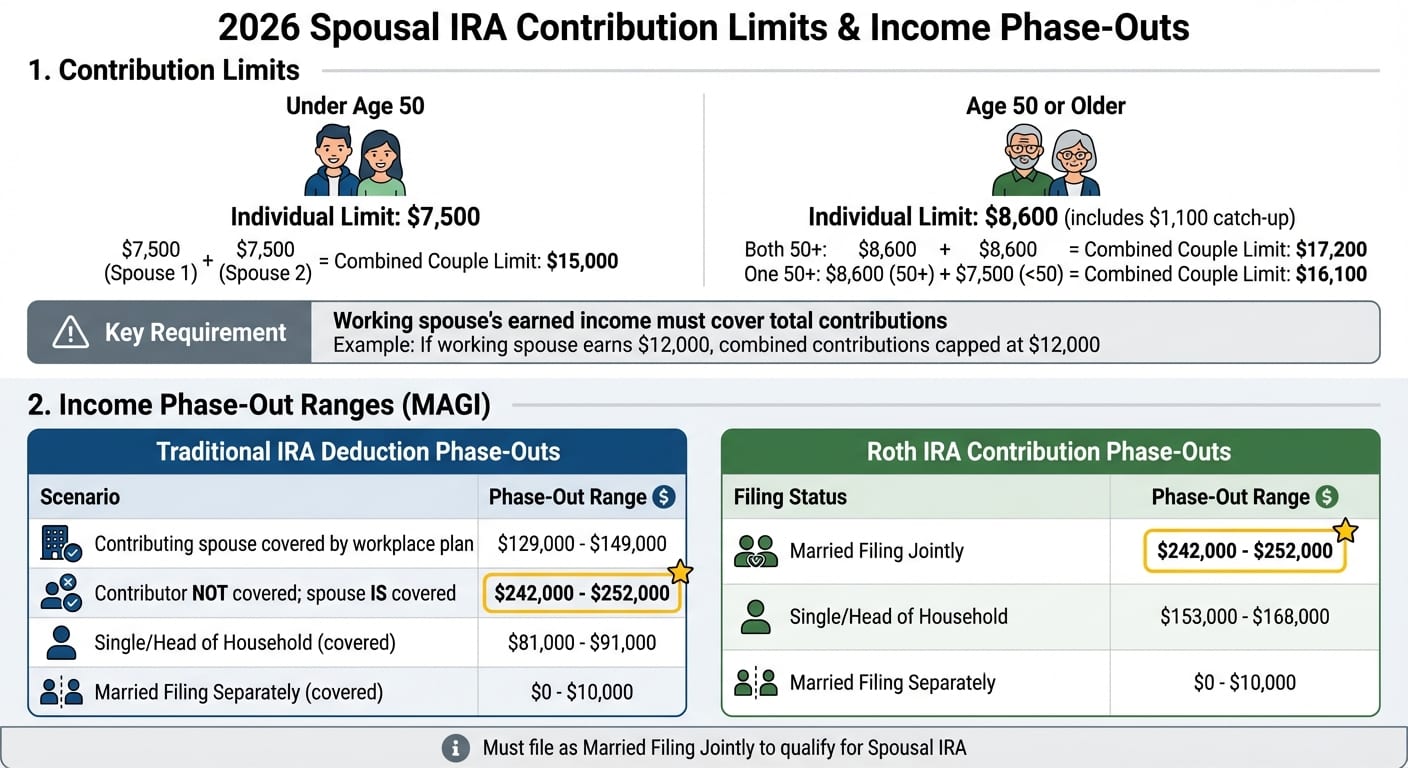
For 2026, the IRS has raised the individual contribution limit for both Traditional and Roth IRAs to $7,500 for those under 50. This is a $500 increase compared to the 2025 limit. The same limit applies to spousal IRAs, allowing a non-working spouse to contribute the full $7,500 to their own account, even if they have no personal income.
Standard and Catch-Up Limits
If you're 50 or older, you can take advantage of an additional catch-up contribution of $1,100, bringing your total annual limit to $8,600. This increase also applies to spousal IRAs, meaning a non-working spouse aged 50 or older can contribute up to $8,600 as long as the working spouse has enough earned income.
"For 2026, you can contribute up to $7,500 to an IRA. That's $500 more than last year. If you're 50 or older, you qualify for an additional $1,100 catch-up contribution, bringing your total to $8,600." – Kevin Kroskey, Wealth Advisor, True Wealth Design
The catch-up contribution amount has risen slightly, from $1,000 in 2025 to $1,100 in 2026. For couples where both spouses are 50 or older, the combined maximum contribution reaches $17,200. If only one spouse qualifies for the catch-up, the combined limit is $16,100 ($7,500 + $8,600).
Now, let’s see how these limits interact with your household income.
Combined Contribution Caps
While each spouse can contribute up to their individual limit, the total contributions cannot exceed the working spouse's taxable compensation. For example, if the working spouse earns $80,000, both accounts can be fully funded. However, if the working spouse earns only $12,000, the combined contributions for both IRAs are capped at $12,000, regardless of the per-person limits.
Take Sarah and Tom as an example. In 2026, Sarah earns $80,000 while Tom has no income. Because Sarah's earned income exceeds the combined IRA limit, she can contribute $7,500 to her own Roth IRA and another $7,500 to Tom's spousal Roth IRA. That’s a total of $15,000 contributed between the two accounts.
This brings us to the specific IRS rule that makes such contributions possible.
Kay Bailey Hutchison Spousal IRA Provision
The Kay Bailey Hutchison Spousal IRA provision is the IRS rule that allows non-working spouses to contribute to their own IRAs using the working spouse's income. This rule is especially beneficial for households where one spouse does not earn taxable income.
"Thanks to the Kay Bailey Hutchison Spousal IRA provision, a non-working spouse can contribute to their own IRA based on their partner's income." – Kevin Kroskey, Wealth Advisor, True Wealth Design
There’s one important caveat: this rule only applies to couples who file joint tax returns. If you file as "Married Filing Separately", the spousal IRA provision cannot be used, even if one spouse has significant earned income.
Income Limits and Tax Deduction Rules
Contribution limits determine how much you can put into an IRA, while income limits dictate tax deductions and Roth IRA eligibility. A key factor in this process is your Modified Adjusted Gross Income (MAGI), which adjusts your AGI by adding back specific deductions. MAGI plays a crucial role in determining if you can deduct contributions or qualify for a Roth IRA.
If neither you nor your spouse is covered by a workplace retirement plan, contributions to a Traditional IRA are fully deductible. However, when one of you has access to an employer-sponsored plan, income thresholds come into play.
Traditional IRA Deduction Phase-Outs
For 2026, deduction eligibility depends on whether you or your spouse is covered by a workplace plan:
- If the contributing spouse is covered by a workplace plan, the deduction phases out with a MAGI between $129,000 and $149,000.
- If the contributing spouse is not covered, but their spouse is, the phase-out range is higher, between $242,000 and $252,000. Within this $10,000 range, the deduction gradually decreases until it is fully phased out above the upper limit. Even if you exceed these thresholds, you can still make non-deductible contributions and later convert them to a Roth IRA.
These deduction rules are a stepping stone to understanding Roth vs. Traditional IRA tax implications and income limits.
Roth IRA Income Limits
Roth IRAs differ from Traditional IRAs in that they don’t offer an upfront tax deduction, but qualified withdrawals in retirement are tax-free. For 2026, married couples filing jointly can make full Roth IRA contributions if their MAGI is below $242,000. Contributions phase out between $242,000 and $252,000, and above $252,000, direct Roth IRA contributions are not allowed.
Interestingly, the Roth IRA phase-out range for married couples filing jointly mirrors the phase-out range for Traditional IRA deductions when the contributing spouse is not covered by a workplace plan, but their spouse is. Couples with a MAGI above $252,000 might explore options like a backdoor Roth conversion or maximizing contributions to workplace retirement plans.
Keep in mind that excess contributions to an IRA result in a 6% annual penalty until corrected. Staying within the income limits is key to avoiding penalties and making the most of the tax benefits tied to spousal IRA contributions.
How to Set Up and Fund a Spousal IRA
Setting up a Spousal IRA is a straightforward process once you understand the basic requirements and steps. It involves confirming your eligibility, selecting the right type of IRA, opening the account in your spouse's name, and ensuring contributions are made before the tax deadline.
Step 1: Confirm Eligibility
The first step is to ensure your household meets the IRS criteria. Spousal IRAs are only available to couples who file jointly for the tax year. Additionally, your household's earned income - such as wages, tips, or self-employment income - must be enough to cover contributions to both IRAs.
For the 2026 tax year:
- If both spouses are under 50, your combined earned income should be at least $15,000 to fund both accounts at $7,500 each.
- If both are 50 or older, you'll need a minimum of $17,200 to account for the additional catch-up contributions allowed for older individuals.
Once you've confirmed eligibility, decide how to choose the right account for your long-term financial goals.
Step 2: Choose Traditional or Roth IRA
Next, determine whether a Traditional IRA or Roth IRA aligns better with your needs. The choice often depends on your current tax situation and how you envision your retirement.
- Traditional IRA: This option may allow for an upfront tax deduction, which can be helpful if you expect to be in a lower tax bracket during retirement. However, keep in mind that income limits may apply. For example, if the working spouse is covered by a workplace retirement plan, the deduction phases out for incomes between $129,000 and $149,000 in 2026.
- Roth IRA: Contributions to a Roth IRA are made with after-tax dollars, but withdrawals during retirement are tax-free. This can be a better option if you're currently in a lower tax bracket. Note that you can't contribute directly to a Roth IRA if your Modified Adjusted Gross Income (MAGI) is $252,000 or higher in 2026.
Weigh the tax implications of each option carefully before making your decision.
Step 3: Open the Account in the Non-Working Spouse's Name
A Spousal IRA is not a joint account. It must be opened exclusively in the non-working spouse's name. This ensures that the non-working spouse has full control over the investments and can designate their own beneficiaries. While the working spouse provides the funding, the IRS bases the contribution eligibility on the couple's combined earned income.
Step 4: Make Contributions Before the Tax Deadline
To ensure your contributions count for the intended tax year, fund the account by the federal tax deadline, which is typically April 15. For instance, contributions for a 2026 Spousal IRA can be made anytime between January 1, 2026, and April 15, 2027. You can use paycheck deposits or transfers from a joint account to fund the IRA.
How Mezzi Helps Manage Spousal IRA Contributions
Managing a Spousal IRA can feel like juggling multiple moving parts - contribution limits, income thresholds, tax filing details, and deadlines. Mezzi's AI platform takes the guesswork out of the process by connecting your household accounts and automatically keeping tabs on compliance requirements.
Account Aggregation for Full Financial Clarity
Mezzi links all your retirement accounts - whether it's 401(k)s, Traditional IRAs, Roth IRAs, or brokerage accounts - using secure, read-only access through services like Plaid and Finicity. This gives you a unified view of your household's retirement savings. Unlike traditional advisors who can only see what they manage, Mezzi sees the whole picture, allowing it to offer comprehensive guidance for your retirement strategy.
This complete visibility ensures you stay within the combined contribution limits - $15,000 for couples under 50, or $17,200 for those 50 and older in 2026. Plus, this integration sets the stage for automated tax and compliance checks to keep you on track.
Tax Optimization and Compliance Tracking
Mezzi's AI keeps a close eye on your tax filing status to confirm you're filing as Married Filing Jointly, a key requirement for Spousal IRA eligibility. The platform also monitors your combined earned income and total IRA contributions across both spouses’ accounts.
For Roth IRAs, Mezzi tracks your Modified Adjusted Gross Income (MAGI) against the 2026 phase-out range of $242,000 to $252,000, sending alerts as you approach the limits. For Traditional IRAs, it checks whether the working spouse is covered by a workplace retirement plan and keeps an eye on the deduction phase-out range of $129,000 to $149,000. This ensures you stay compliant while maximizing your contributions.
Long-Term Retirement Projections
Beyond monitoring, Mezzi helps you see the bigger picture by projecting how your contributions will impact your retirement. Using real account data, it calculates the potential growth of your Spousal IRA contributions. For instance, a $7,500 annual contribution over five years, with an 8% return, could grow to nearly $937,000 in 30 years - compared to $598,000 if those five years were skipped.
This highlights the power of starting early and helps couples decide whether to focus on a Traditional or Roth IRA, depending on their expected retirement tax bracket. You can even ask Mezzi tailored questions like, “Should we do a Roth conversion this year?” and get personalized advice based on your complete financial picture.
Key Takeaways and Next Steps
A spousal IRA is a great way for a non-working spouse to save for retirement using the working spouse's income. Here’s how it works: the couple must file taxes jointly, have sufficient earned income, and each spouse must have their own IRA account. For 2026, contributions are capped at $7,500 per person - or $8,600 if you’re 50 or older - with a deadline of April 15, 2027.
The next step is to evaluate the tax advantages of different IRA types. The benefits depend on your Modified Adjusted Gross Income (MAGI). For example, Roth IRA contributions phase out if your MAGI is between $242,000 and $252,000 for joint filers. On the other hand, Traditional IRA deductions phase out between $129,000 and $149,000 if the working spouse is part of a workplace retirement plan. Knowing your MAGI will help you choose the account that offers the best tax benefits while staying compliant.
Starting early can make a huge difference in long-term savings. For instance, contributing $7,500 annually for just five years at an 8% return could grow to over $339,000 in 30 years, thanks to the power of compounding interest. Even if one spouse isn’t earning, this approach ensures both partners can take full advantage of retirement savings opportunities.
To move forward, align these steps with your broader retirement goals. Use tools like those from Mezzi (mentioned earlier) to simplify account management and track growth. Open an IRA for the non-working spouse, decide on the best account type for your situation, and make contributions before the April deadline to stay on track.
FAQs
×
Can we still do a spousal IRA if we file Married Filing Separately?
No, you cannot make spousal IRA contributions if you file as Married Filing Separately, except in very limited circumstances. Generally, the IRS requires couples to file jointly to be eligible for spousal IRA contributions.
×
What if our earned income is less than the amount we want to contribute?
If your earned income falls short of the amount you'd like to contribute to a spousal IRA, your contributions are capped at your earned income level. However, if your income meets the requirements, you can contribute up to the maximum limit set for IRAs. According to IRS rules, contributions must always be made from earned income.
×
How do we contribute if our income is too high for a Roth IRA?
If your income is too high to contribute directly to a Roth IRA, you still have options. One approach is to contribute to a traditional IRA. Depending on your specific situation, this contribution might even qualify as tax-deductible.
Another possibility is a spousal IRA. If your spouse has earned income, you can use this account to boost your retirement savings further. Both strategies offer ways to keep building your retirement nest egg, even if Roth IRA limits apply.
Disclosures:
- This content is for informational purposes only and does not constitute investment advice or a recommendation to buy or sell any security.
- Past performance is not indicative of future results. No guarantee of future performance or outcomes is implied.
- Savings and performance examples are hypothetical and for illustrative purposes only. Actual results will vary based on individual circumstances, portfolio composition, market conditions, and fees.