
Physicians often face unique financial challenges: starting their careers later, managing high student debt, and balancing multiple income streams. These factors, combined with demanding schedules, can make it harder to build and manage an effective investment portfolio. Here's a quick summary of how physicians might address these issues:
- Consolidate Accounts: Many physicians juggle multiple accounts (401(k)s, IRAs, HSAs, taxable accounts). Combining them into a unified view may reduce inefficiencies and make oversight easier.
- Set Clear Goals: Define specific, measurable financial objectives (e.g., saving $2M for retirement by 2040) to guide investment decisions.
- Optimize for Taxes: Place tax-inefficient assets (e.g., bonds, REITs) in tax-deferred accounts and high-growth assets in Roth accounts to potentially improve after-tax returns.
- Automate Contributions: Regular, automated savings can help maintain consistency, even with a busy schedule.
- Monitor and Rebalance: Periodically review asset allocation to ensure it aligns with your goals and risk tolerance. Tools like Mezzi may help simplify this process by tracking accounts, identifying risks, and offering rebalancing suggestions.
This structured approach may help physicians manage their portfolios more efficiently while addressing their unique challenges.
The Financial Challenges Physicians Face
High Earnings That Start Late, Often From Multiple Sources
While many professionals begin building wealth in their early 20s, physicians often face a delayed start. After completing four years of medical school, followed by three to seven years of residency, and sometimes additional fellowship training, most doctors don’t reach their peak earning years until their early to mid-30s. This late start means they have less time to grow their wealth compared to peers in other fields.
When physicians do start earning, their income often comes from multiple sources. A doctor might receive a W-2 salary from a hospital, 1099 income from locum tenens or telemedicine work, and possibly a share of private practice profits. Each income stream comes with unique tax implications and retirement account options, requiring careful financial planning. Median compensation for physicians ranges from $243,000 for those in primary care to $346,000 for specialists. Managing these varied income streams can be complex.
"Physicians are different than the average U.S. investor because of their income tax liability and net worth, the time they have available, and the highest and best use of that time." - David B. Mandell, JD, MBA
Debt, Time Constraints, and Behavioral Pitfalls
Physicians often face significant financial pressures beyond their income challenges. Many enter their attending years burdened with large student loan balances while simultaneously trying to save for retirement, build an emergency fund, and catch up on delayed investments. Balancing these competing priorities can feel overwhelming.
Time is another major obstacle. With fewer than 15% of physicians working less than 40 hours per week, finding time for active portfolio management is a struggle. This lack of time, combined with financial stress, can lead to behavioral pitfalls like lifestyle creep - spending more as income rises - or emotional, reactionary investment decisions. These factors often push physicians toward simplified, automated investment strategies.
"The irony is striking: people trusted to make life‑altering decisions under pressure often hesitate when navigating financial markets." - Dr. David Edward Marcinko, MBA, CMP
What These Challenges Mean for a Physician's Portfolio
The combination of income variability, heavy debt, and time constraints underscores the need for a low-maintenance, tax-efficient portfolio strategy. High-earning physicians may face combined marginal tax rates - including federal, state, and net investment income tax - ranging from 44% to 50% in certain states. This tax burden can significantly reduce investment returns over time.
"The biggest drag on a high‑earning physician's portfolio is not fees. It is taxes." - Residency Advisor
To offset their delayed wealth-building start, financial advisors often suggest that physicians invest 20% to 30% of their gross income - amounting to $5,000 to $12,000 or more per month. Achieving this consistently, especially with a demanding schedule, requires a systematic approach. Automated contributions, consolidated account management, and a portfolio designed to minimize hands-on oversight are key strategies. These are precisely the types of solutions that tools like Mezzi aim to provide.
The 12 Core Financial Principles for Physicians
How to Set Clear Investment Goals and Constraints
Before opening an investment account, take the time to define your objectives. Without clear goals, you may find yourself saving inconsistently, taking on inappropriate levels of risk, or holding assets that don’t align with your needs.
Types of Goals Physicians Should Plan For
Physicians often juggle multiple financial priorities. These might include paying off student loans, saving for a home, funding children's education, and building retirement savings. To manage these effectively, make your goals specific and tied to a timeline. For example, instead of a general goal like "save for retirement", aim for something measurable, like "accumulate $2 million in retirement assets by January 1, 2040." This clarity helps you calculate how much to save each month and track your progress.
Another key goal for physicians is to create a "burnout cushion" - a reserve of liquid assets that can support career changes or temporary breaks if needed.
Once you’ve outlined your goals, assess how much risk you’re willing and able to take and identify the account types that best align with each objective.
Risk Tolerance vs. Risk Capacity
Understanding your risk profile involves distinguishing between risk tolerance - your emotional comfort with market fluctuations - and risk capacity, which is your financial ability to absorb potential losses. For example, a physician in their 30s with decades of earning potential may have a high risk capacity, even if they’re uneasy about market swings.
"A physician in their 30s with decades of earning potential can afford a more aggressive allocation than a physician nearing retirement. The key is aligning investments with the ability to stay calm during market downturns." - Dr. David Edward Marcinko
The table below provides guidance on how to align your stock and bond allocations with your career stage:
Career StageAge RangeRecommended Stock AllocationRecommended Bond/Safe AllocationEarly Career30–4080–90%10–20%Mid-Career40–5565–75%25–35%Pre-Retirement55–6550–60%40–50%
After determining your risk profile, you can align your investments with the appropriate account types to maximize their efficiency.
Drafting an investment statement that outlines your goals, asset allocation, and strategy rationale can also help you stay disciplined during periods of market volatility.
Aligning Account Types With Time Horizons and Liquidity Needs
Each financial goal should be paired with the right account type, based on its time horizon and liquidity needs. Short-term goals require easily accessible, tax-efficient accounts, while long-term objectives benefit from tax-advantaged accounts like 401(k)s, 403(b)s, or IRAs, which allow money to grow tax-deferred or tax-free.
Account TypeTax TreatmentBest Assets to HoldTime HorizonTaxable BrokerageCapital gains/dividends taxed at lower ratesIndex funds, ETFs, municipal bondsShort to mid-termTax-Deferred (401k/IRA)No taxes until withdrawal; taxed as ordinary incomeCorporate bonds, REITs, actively managed fundsLong-termTax-Exempt (Roth IRA**/401k)**No taxes on qualified withdrawalsHigh-growth stocks, small-cap funds, emerging marketsLong-term
To optimize returns, consider an asset location strategy. For instance, place high-growth investments in Roth accounts and income-generating assets in tax-deferred accounts. Strategies like this may add 1% to 2% to your annual returns. Over the course of a 20- to 30-year career, this incremental advantage can compound into a meaningful boost.
How to Centralize and Track All Your Investment Accounts
Physicians often build their investment portfolios gradually, collecting accounts as they move through different stages of their careers - residency, fellowship, attending positions, and side ventures. Over time, this leads to a scattered collection of accounts, making it tough to get a clear picture of overall financial health. Consolidating these accounts is the first step toward understanding your financial standing. Let’s explore the types of accounts physicians typically manage and the challenges fragmented accounts can create.
Account Types Physicians Typically Manage
By mid-career, physicians often juggle several account types, including:
- A 401(k) or 403(b) tied to their current employer
- One or more rollover IRAs from previous jobs
- A Roth IRA
- An HSA (Health Savings Account)
- A taxable brokerage account
- Private investments, such as real estate syndications or equity in a medical practice
Each of these accounts comes with its own tax rules, contribution limits, and liquidity considerations. When managed separately, they can make it difficult to see the full picture of your financial situation.
Why Fragmented Accounts Can Be Problematic
Managing accounts in isolation often leads to inefficiencies and blind spots. For instance, you might unknowingly hold the same large-cap U.S. equity fund in your 401(k), rollover IRA, and brokerage account. This duplication could mean paying fees multiple times for essentially the same investment, all while mistakenly believing your portfolio is diversified.
Other issues include:
- Idle cash: Some accounts might hold uninvested cash while others are under-allocated to key asset classes like bonds.
- Hidden fees: Without a consolidated view, high-fee funds can go unnoticed, as expense ratios aren’t easily compared across accounts.
- Inefficient rebalancing: Rebalancing each account separately instead of at the household level can result in less tax-efficient adjustments.
- Time and oversight challenges: Logging into multiple platforms to reconcile statements is time-consuming, and gaps in oversight increase the risk of missing important details.
By centralizing your accounts, you can save time, simplify management, and reduce the likelihood of errors.
How Mezzi Simplifies Account Management

Mezzi offers a solution by connecting to your accounts through read-only access using Plaid and Finicity (Mastercard). This integration provides a unified view of your balances, holdings, and transactions without requiring you to transfer assets or give up trading control. Your money stays exactly where it is.
With Mezzi, you can:
- Identify overlapping holdings across accounts
- Spot tax-inefficient assets that may be sitting in the wrong account type
- View your true asset allocation at the household level
Instead of piecing together your financial picture across multiple platforms, Mezzi allows you to review everything in minutes. This consolidated view lays the groundwork for more informed financial decisions moving forward.
How to Use Mezzi's Tools to Improve Your Portfolio
Once you've connected your accounts and can see everything in one place, the next step is diving into the details: assessing how your holdings align with your financial goals and identifying areas where adjustments may help.
Tracking Asset Allocation and Rebalancing Suggestions
Mezzi lets you compare your household-level asset allocation with a target you set. This target takes into account factors like your age, career phase, risk tolerance, and goals - whether it's retirement or buying into a practice. For instance, a 40-year-old anesthesiologist might aim for an 80% stock and 20% bond mix, while someone nearing retirement at 58 might shift to 50–60% stocks. Once your target is established, Mezzi monitors your portfolio daily and flags any deviations of more than 5% from your intended allocation.
When rebalancing is needed, Mezzi prioritizes efficiency. It starts by redirecting new contributions - for example, adjusting 401(k) elections to underweighted bond funds. Next, it suggests trades in tax-advantaged accounts, minimizing tax impacts, before recommending moves in taxable accounts with an estimated tax cost.
Identifying Risks and Overlap with the X-Ray Tool
Mezzi's X-Ray tool digs into your portfolio to uncover the exact holdings within your funds. For example, you might own a U.S. index fund, a large-cap growth ETF, and individual tech stocks across multiple accounts. Mezzi could reveal that 26% of your portfolio is concentrated in a handful of mega-cap stocks, even if it initially seemed diverse.
The tool goes further, breaking down your sector exposure across all accounts and flagging sectors that exceed reasonable thresholds. This is particularly important for physicians, who already face career-related risks tied to the healthcare sector. Holding a heavy healthcare allocation on top of that could amplify risk in ways that aren't immediately obvious. Additionally, the X-Ray tool calculates your portfolio's weighted average expense ratio. For example, moving $500,000 from active funds with a 0.90% expense ratio to index funds charging 0.07% might save around $4,150 annually - adding up to over $40,000 in a decade.
"Asset location - which holdings sit in which accounts - can be worth more than stock picking over time." - Mezzi
By highlighting hidden risks and overlaps, the X-Ray tool can help you refine and simplify your portfolio.
Simplifying a Complex Portfolio
Physicians often end up with a mix of holdings - leftover funds from a previous employer, bonus-stock picks, or sector ETFs recommended at some point. Over time, this can lead to a portfolio that's cluttered and difficult to manage.
Mezzi can guide you toward a core-satellite structure. This approach involves building a core of broad, low-cost index funds to cover your main exposure, while reserving a small satellite portion - typically 5–10% of your investable assets - for speculative or niche positions. The key is keeping the satellite portion in check so it doesn't unintentionally dominate your portfolio. Mezzi's tools make it easy to spot when that balance has shifted and what adjustments are needed to simplify your portfolio back to its intended structure.
With Mezzi, you can maintain a streamlined, efficient portfolio that aligns with the financial challenges and opportunities unique to a physician's career.
Building Tax-Efficient, Low-Maintenance Portfolio Habits
How to Structure Accounts for Tax Efficiency
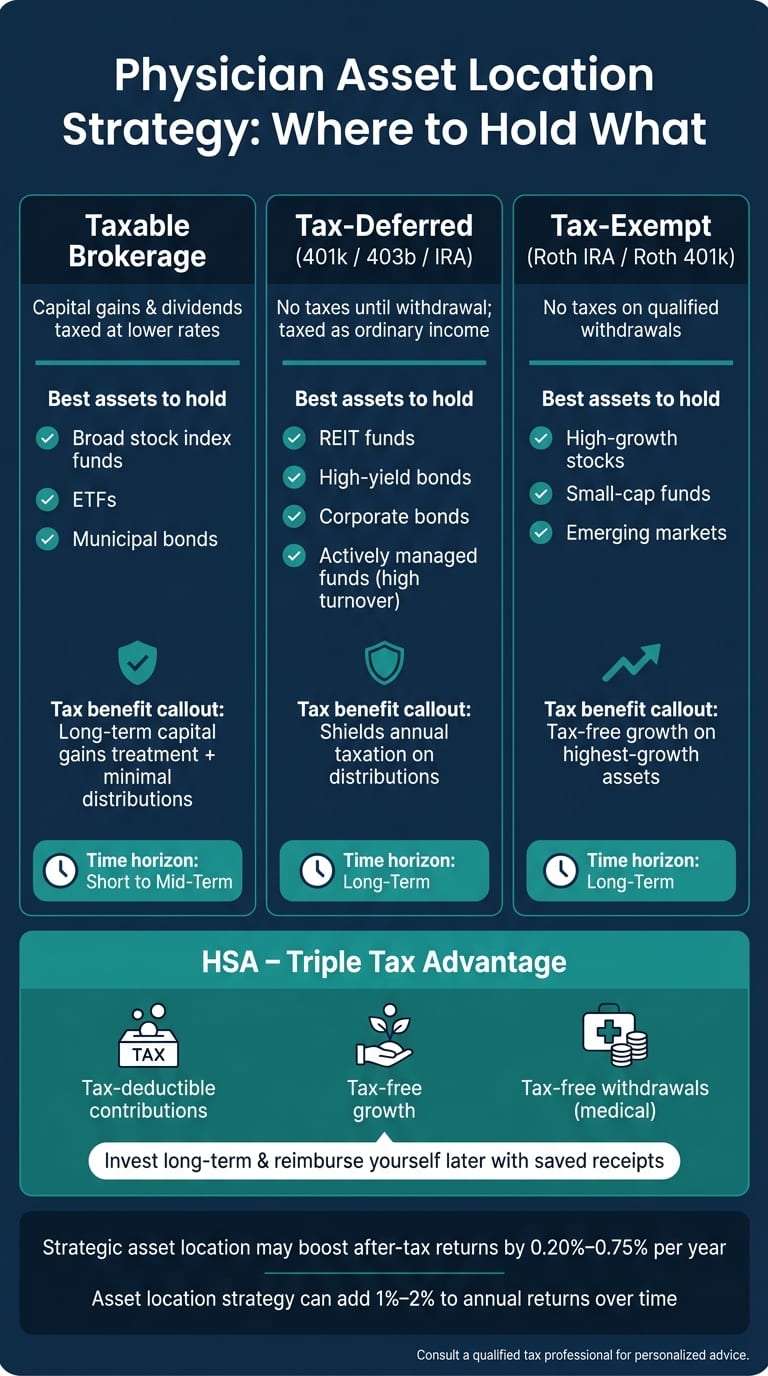
Where you hold your investments can matter just as much as what you invest in. Structuring accounts strategically may boost after-tax returns by approximately 0.20%–0.75% per year, all without increasing risk.
Here’s how it works: Place tax-inefficient assets - such as REIT funds, high-yield bonds, and actively managed funds with high turnover - inside tax-deferred accounts like a 401(k), 403(b), or 457(b). These accounts shield you from annual taxation on distributions. On the other hand, broad stock index funds and ETFs are better suited for taxable brokerage accounts because they benefit from long-term capital gains treatment and produce minimal taxable distributions. For Roth accounts, prioritize your highest-growth investments since qualified withdrawals from these accounts are tax-free.
Don’t overlook your HSA (Health Savings Account). If you can cover short-term medical expenses out of pocket, consider investing your HSA funds for the long term. This allows the account to grow tax-free, and you can reimburse yourself later using saved receipts. It’s a rare account offering triple tax advantages.
Mezzi can help identify inefficiencies in your asset placement. For instance, it might flag a high-turnover bond fund sitting in a taxable account that would be better placed in your 403(b). It also provides actionable recommendations to realign your assets during rebalancing, while keeping contribution limits and plan rules in mind.
Tax-Loss Harvesting and Wash Sale Risks
Once your accounts are structured efficiently, managing losses wisely can further improve after-tax returns. Tax-loss harvesting (TLH) involves selling an investment in a taxable account that’s worth less than its original cost. This creates a capital loss that can offset capital gains or up to $3,000 of ordinary income annually. Any leftover losses can be carried forward indefinitely. For those in higher tax brackets - such as physicians with a 20% long-term capital gains rate and the 3.8% Net Investment Income Tax (NIIT) for married couples earning over $250,000 MAGI - these losses may offer meaningful tax relief.
However, the IRS’s wash sale rule complicates things. If you repurchase the same or a “substantially identical” security within 30 days before or after selling it, the loss is disallowed. This rule applies across all accounts, including IRAs, HSAs, and even your spouse’s accounts. Common pitfalls include automatic 401(k) contributions or dividend reinvestments accidentally repurchasing a fund within the restricted window.
Mezzi simplifies this process by monitoring all your linked accounts - not just your taxable brokerage account. It identifies TLH opportunities, flags potential wash sale risks before you act, and tracks the required 61-day period to let you know when it’s safe to repurchase. Additionally, it can estimate the tax impact of trades, helping you decide whether a TLH opportunity is worth pursuing.
Automating Contributions and Tracking Progress
Automating your contributions is another way to keep your portfolio on track with minimal effort. Features like auto-enrollment and auto-escalation often lead to higher savings rates because they eliminate the need to make active decisions each year.
Set up automatic contributions to your 401(k) or 403(b) to hit the annual maximum, fund your HSA, and execute backdoor Roth IRA contributions if your income exceeds direct Roth limits. Mezzi can help you organize your accounts, track contributions, and recommend a savings priority - such as maximizing employer plan matches first, followed by HSAs, then backdoor Roths, and finally taxable accounts.
Instead of frequently checking your portfolio, aim to review it twice a year, such as in January and July. During these reviews, compare your allocation to your target, act on any rebalancing suggestions Mezzi provides, look for TLH opportunities, and adjust your savings rate if your financial situation has changed. With Mezzi’s continuous monitoring, you’ll only be alerted when something requires immediate attention, like a rebalancing threshold breach or a significant tax-saving opportunity. This approach keeps things manageable while still being effective for busy professionals.
Disclaimer: The tax strategies outlined here are for informational purposes only and should not be taken as tax advice. Consult a qualified tax professional for guidance specific to your situation.
Conclusion: Steps to Take Control of Your Financial Future
Physicians often face financial challenges that differ from those in other professions: starting later in their careers, managing significant debt, juggling multiple income sources, and navigating limited free time. While these hurdles may seem daunting, the key to addressing them lies in consistency and a structured approach.
Here’s a practical checklist to help simplify and organize your financial strategy:
- Consolidate your accounts into one unified view to reduce complexity.
- Determine a target asset allocation that aligns with your risk tolerance and financial timeline.
- Review asset placement to ensure tax efficiency.
- Automate contributions to maximize annual limits without extra effort.
- Set up rebalancing alerts to address any drifts in your portfolio allocation.
This straightforward routine helps tackle the time constraints and fragmented accounts that many physicians encounter, turning financial management into a manageable process.
With Mezzi, this system becomes even more efficient. As an SEC-registered fiduciary, Mezzi provides continuous monitoring of your portfolio, identifies tax-saving opportunities, and flags risks such as asset overlap or concentration. At a cost of $39/month or $399/year, Mezzi offers portfolio insights that might otherwise cost $10,000/year with a traditional advisor charging 1% AUM on a $1,000,000 portfolio.
While Mezzi organizes your financial data and highlights important considerations, it’s essential to set your own goals and consult a financial professional for personalized advice. By linking your accounts and setting a clear target allocation, you can shift from a fragmented approach to a more streamlined and proactive financial strategy.
FAQs
How much should I invest each month as a physician?
Begin by outlining specific financial goals, whether it's preparing for retirement, saving for a child’s college education, or another milestone. Assign each goal a clear dollar amount and a target deadline. This level of detail can provide direction and make your objectives feel more achievable.
From there, shape your investment strategy around your unique financial situation. Consider factors like your income, current expenses, comfort with risk, and the timeline for each goal. Tools like Mezzi allow you to link your accounts, offering tailored projections based on your existing balances and how much you’re able to contribute. This can give you a clearer picture of how much you may need to save each month to stay on track.
Which investments belong in taxable vs. 401(k) vs. Roth vs. HSA?
To fine-tune your portfolio, Mezzi’s AI can help align your assets with the right account types, taking tax characteristics into account.
- Taxable accounts: These are well-suited for assets that are tax-efficient, such as municipal bonds, index funds, ETFs, and growth stocks with minimal dividend payouts.
- Tax-deferred accounts (e.g., 401(k), Traditional IRA): Designed to hold tax-inefficient assets, including taxable bonds, high-yield funds, and REITs, where taxes on income can be deferred.
- Tax-exempt accounts (e.g., Roth IRA, HSA): A great option for high-growth investments, like small-cap stocks or emerging market equities, as withdrawals in retirement are generally tax-free.
How can I avoid wash sales with multiple accounts?
To steer clear of wash sales across multiple accounts, it's essential to track all holdings, including those in IRAs and spousal accounts. Many brokerage firms only keep tabs on activity within their own platforms, which means they may overlook violations triggered by trades in other accounts.
Mezzi simplifies this process by combining all your accounts into a single, unified view. It automatically keeps an eye out for potential wash-sale risks and flags "substantially identical" securities, helping you stay on top of compliance when engaging in tax-loss harvesting.
Mezzi is free to get started. Choose Advisory for unlimited advice and advanced features at $39/month or $399/year. Concierge includes the same, plus hands-on support, at $99/month or $999/year.
Disclosures:
- This content is for informational purposes only and does not constitute investment advice or a recommendation to buy or sell any security.
- Past performance is not indicative of future results. No guarantee of future performance or outcomes is implied.
- Always consult with a qualified financial advisor before making investment or financial planning decisions.