
Retirement planning can feel overwhelming, especially for married couples managing shared financial goals. Here’s a quick breakdown of what you need to know:
- Key Savings Goal: Aim to save about 10 times your household income by age 67.
- Benchmarks by Age: For a $75,000 household income, you may want $225,000 saved by 40, $450,000 by 50, and $750,000 by 67.
- Current Reality: Many couples fall short. For example, the median savings for those aged 55–64 is $185,000, far below the recommended $480,000–$640,000.
- Strategies to Improve: Max out 401(k) contributions, take advantage of catch-up contributions after age 50, and use tools like Mezzi to track and optimize your savings.
The earlier you start saving, the easier it is to reach these targets thanks to compounding growth. If you’re behind, small changes - like increasing contributions by 1% annually or redirecting bonuses - can help close the gap. Let’s dive deeper into the numbers and strategies.
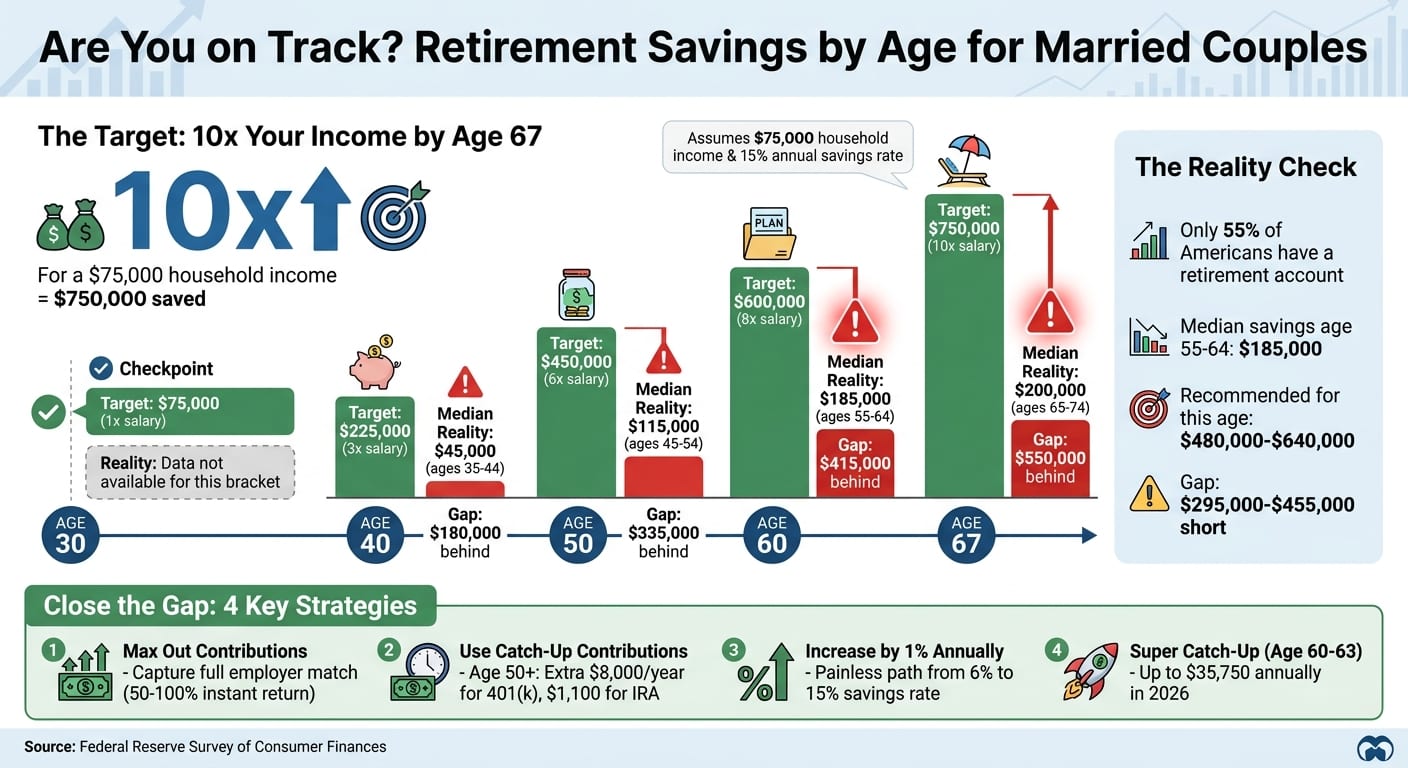
Are You On Track? Average Retirement Savings by 55/60/65
Average Retirement Savings by Age for Married Couples
Understanding how your retirement savings compare to others in your age group can provide a helpful perspective. It’s not about competition but rather about gauging your progress toward financial security. The data below highlights both average and median retirement savings across various stages of life. While average figures may be skewed by wealthier households, the median offers a clearer picture of what’s typical for most couples.
Interestingly, only 55% of Americans have a dedicated retirement savings account, such as a 401(k) or IRA. This means nearly half of the population may not be actively preparing for retirement.
Here’s a breakdown of what married couples typically save at different ages, along with suggested targets for households earning $75,000 annually. Dual-income households often have higher benchmarks due to access to two employer-sponsored plans and matching contributions.
Let’s take a closer look at each age group and the steps couples might consider to stay on track.
Under 35: Building the Foundation
For couples under 35, the average retirement savings stands at $49,130, while the median is a more modest $18,880. This gap reflects how a small number of high earners can inflate the average. Many young couples are juggling student loans, home purchases, and emergency funds, which can make building retirement savings challenging.
At this stage, the focus is on forming consistent saving habits. Experts suggest saving 10% to 15% of your household income annually. For a combined income of $75,000, that translates to $7,500 to $11,250 each year. If your employer offers a 401(k) match, aim to contribute enough to take full advantage of it.
"If you don't, it's like leaving free money on the table",
says Paul Deer, Vice President of Wealth Private Client at Empower.
Starting small but staying consistent can set you up for long-term success.
35-44: Boosting Contributions
By your mid-30s to early 40s, average savings rise to $141,520, with a median of $45,000. This period often brings career growth and higher earnings, but it also comes with added financial responsibilities like raising children, paying off a mortgage, or managing debt.
As your income increases, consider raising your contribution rate. Redirecting raises or bonuses into your 401(k) or IRA can make a significant difference over time. If you’re in a dual-income household, ensure both partners are contributing to their employer-sponsored plans to maximize matching opportunities. Paying down high-interest debt can also free up funds to allocate toward retirement savings.
45-54: Catching Up
During your 40s and early 50s, average savings climb to $313,220, with a median of $115,000. This decade often represents peak earning years, and retirement may start to feel closer on the horizon.
If you’re behind on your savings goals, this is the time to catch up. Once you turn 50, you’re eligible for catch-up contributions - up to $1,100 extra for an IRA and $8,000 for a 401(k) or 403(b) in 2026. For a couple where both partners are over 50, that’s an additional $18,200 per year in tax-advantaged savings. Focus on maximizing these contributions while keeping expenses in check and avoiding unnecessary lifestyle upgrades.
55-64: Refining Your Plan
As retirement approaches, average savings reach $537,560, while the median is $185,000. At this stage, it’s crucial to fine-tune your strategy. For households earning $75,000, dual-income couples may aim for $412,500, while single-income households might target $337,500.
This period is about solidifying your plan. Review your portfolio to ensure it aligns with your risk tolerance as you near retirement. Consider whether delaying retirement by a year or two could strengthen your financial position. On average, Americans now retire at 61, up from 57 in 1991, with current workers expecting to retire closer to 66. Tools like Mezzi can help you model different scenarios - such as working longer or adjusting withdrawal rates - to better understand the potential impact on your retirement income.
65 and Older: Managing Savings Wisely
At 65 and beyond, the average retirement savings reach $609,230, with dual-income couples targeting $675,000 and single-income households aiming for $562,500. The focus shifts from saving to managing income efficiently.
This stage involves coordinating Social Security benefits, managing withdrawals, and covering healthcare expenses. Currently, retired couples receive an average of $2,910 per month from Social Security. Developing a thoughtful withdrawal strategy can help stretch your savings throughout retirement. Tools like Mezzi can assist with tracking spending, monitoring balances, and offering insights on how to optimize withdrawals for long-term financial stability.
How Much You Should Have Saved by Retirement Age
Financial experts often suggest saving a multiple of your annual income at key life stages to prepare for retirement. One widely referenced guideline is to aim for 10 times your annual salary by age 67. This assumes you’ve been consistently saving 15% of your gross income (including any employer contributions) starting at age 25, with plans to retire at 67.
These benchmarks are designed to help replace about 45% of your pre-retirement income through savings, while Social Security is expected to cover an additional portion. If you anticipate reduced Social Security benefits, you might need to aim for 15–17 times your salary instead. Conversely, if you have a pension or own your home outright, a lower target, such as six times your salary, might suffice.
Retirement savings benchmarks provide a useful reality check - are you on track, ahead of the curve, or falling behind? While everyone's situation differs, having age-based targets gives you a concrete goal to measure against.
Tahir Özcan, Founder & Lead Author, WealthCalc
This approach offers a clear framework for setting long-term savings goals. Below, we’ll break down specific savings targets by age and explore factors that may influence these benchmarks.
Savings Targets by Age and Income Level
Using these guidelines, here’s a breakdown for a household earning $75,000 annually:
These figures assume a 15% annual savings rate. If you’re currently saving less, consider increasing your savings rate by 1% each year until you reach that target.
However, many Americans fall short of these benchmarks. For example, the median retirement savings for those aged 55 to 64 is $185,000 - far below the recommended $480,000–$640,000 range. Similarly, for individuals 65 and older, the median savings is $200,000, compared to a benchmark of $800,000 or more.
What Affects Your Retirement Savings Goals
Several factors can influence your retirement savings needs beyond these general targets.
- Lifestyle choices: Planning for a more luxurious retirement or retiring early could mean aiming for 12 times your income - or even more.
- Longevity and healthcare costs: Medical expenses tend to rise faster than general inflation, especially in your 60s and 70s.
- Social Security benefits: Your benefits depend on your earnings history and the age at which you start claiming. Waiting beyond your Full Retirement Age can increase your benefit by 8% annually until age 70.
- Investment growth and inflation: Your portfolio’s performance over 20–30 years needs to outpace inflation to maintain purchasing power.
- Household income structure: Dual-income households may require higher savings multiples due to differing Social Security benefits and tax considerations.
- Housing situation: Downsizing or relocating to a lower-cost area can unlock home equity to bolster your retirement funds. However, if you plan to stay in your current home, its equity typically won’t count toward your savings unless you use tools like a reverse mortgage.
These variables highlight the importance of tailoring your savings strategy to your unique circumstances, ensuring you’re prepared for the retirement lifestyle you envision.
How Mezzi Helps You Track Your Retirement Progress
Getting a clear picture of your retirement finances can make all the difference in making informed decisions. Mezzi connects your financial accounts - like 401(k)s, IRAs, and brokerage accounts - using secure, read-only access through platforms such as Plaid and Finicity. This allows you to see your total retirement savings in one place without moving any funds.
Unlike traditional advisors who only see the accounts they manage, Mezzi provides a full view of your financial landscape. This comprehensive approach is especially helpful for married couples, giving you the tools to answer the big question: "Are we on track?" By setting clear benchmarks, Mezzi helps you monitor progress and make adjustments as needed.
See All Your Accounts in One Place
Mezzi consolidates all your accounts into a single, easy-to-use dashboard. No more juggling multiple websites or manually tracking your finances in spreadsheets. This unified view simplifies tracking gaps, monitoring performance, and even preparing for tax season.
For couples, this feature is particularly useful. For instance, you might have a 401(k) with your current employer, a rollover IRA from a previous job, your spouse’s Roth IRA, and a taxable brokerage account you share. Mezzi pulls all of these together, offering a clear picture of your household’s net worth and retirement trajectory. With this consolidated view, you can base your decisions on accurate, personalized projections.
Get Retirement Projections Based on Your Real Data
Mezzi takes your connected account data and uses it to create tailored retirement projections. It considers factors like your current portfolio value, contribution rates, fees, asset allocation, and withdrawal plans to estimate when you might be able to retire.
You can even ask Mezzi’s AI specific questions, such as, "Can we retire at 62 if we downsize our home?" or "What happens if we increase our 401(k) contributions by 2%?" The answers are based on your actual financial data rather than generic scenarios, helping you move from guesswork to informed planning.
Receive AI-Driven Advice on What to Do Next
Mezzi’s platform goes a step further by identifying opportunities and risks within your portfolio. It can highlight automated tax-loss harvesting opportunities, warn you about wash sale risks across accounts, and offer guidance on whether to contribute to Roth or Traditional accounts based on your tax situation.
For example, Mezzi’s Portfolio X-Ray feature might reveal overlapping stock exposure - like unknowingly holding the same tech stocks in multiple ETFs. For a $1 million portfolio, insights like these could potentially help identify opportunities to reduce costs or improve diversification. The platform also provides advice on asset location strategies, helping you decide which account types (taxable or tax-advantaged) are best for your investments to reduce your long-term tax burden.
You’ll get high-quality planning without paying high management fees. As an SEC-registered fiduciary, Mezzi is committed to acting in your best interest.
Note: While Mezzi offers insights and advice through its read-only access, it does not handle trades or move funds. For tax-related strategies, consult a qualified tax professional.
How to Increase Your Retirement Savings and Close Gaps
Falling behind on retirement savings doesn’t have to be permanent. Small, consistent adjustments can compound over time, making a big difference. By starting now and using tools like tax-advantaged accounts, smarter spending habits, and tax strategies, you may be able to close the gap between your current savings and the benchmarks mentioned earlier. Here are some practical steps to help you catch up.
Max Out Your 401(k) and IRA Contributions
Take full advantage of your employer match - it’s essentially free money. An employer match can provide an immediate 50–100% return on your contributions. If both you and your spouse have workplace plans, prioritize contributing enough to capture the full match before exploring other accounts.
"Going from 6% to 15% over 9 years is painless - you barely notice each bump",
says Tahir Özcan, Founder of WealthCalc.
To make this easier, use a 1% annual increase strategy. Automate your contributions to rise by 1% each year or whenever you get a raise. Over time, this approach helps you reach the recommended 15% savings rate without significantly affecting your take-home pay.
For couples where one spouse isn’t working, a Spousal IRA can double your IRA savings potential. The working partner can contribute on behalf of the non-working spouse, ensuring both continue building retirement assets.
Reduce Taxes on Your Investments
After maximizing contributions, focus on strategies that may lower your tax burden. Tax optimization can potentially save thousands over time. Tools like Mezzi can help by identifying opportunities for tax-loss harvesting, monitoring wash sale risks, and suggesting asset location strategies.
For instance, placing high-growth or tax-inefficient investments into tax-advantaged accounts like Roth IRAs - and keeping tax-efficient investments in taxable brokerage accounts - can reduce long-term tax costs. Mezzi’s Portfolio X-Ray feature can analyze your entire household portfolio to uncover these opportunities and guide you on whether to contribute to Roth or traditional accounts based on your current and anticipated future tax brackets.
Cut Expenses and Redirect the Savings
Lowering your expenses can free up more money for retirement contributions. Start by tackling high-interest debt. Credit card rates often exceed 20%, far outpacing average market returns of about 7%. Once high-interest debt is eliminated, redirect those payments into your retirement accounts.
Small spending adjustments can add up over time. For example, redirecting $300 a month from discretionary spending or former debt payments could add up to $54,000 over 15 years - before factoring in investment growth. If you’re significantly behind, downsizing your home might also be worth considering. This can free up home equity for investments while reducing your monthly expenses.
Another effective strategy is to use windfalls - like raises, bonuses, or tax refunds - for retirement savings. Since you’re already managing on your current income, allocating these extra funds to your retirement accounts won’t disrupt your budget.
Conclusion: Are You on Track to Retire Comfortably?
Retirement planning for married couples often comes down to hitting clear savings milestones. For instance, aiming to save 10x to 11x your household income by age 67 and consistently setting aside 15% of your gross income can serve as a reliable guide for progress. These benchmarks, combined with practical strategies, create a solid foundation for a more secure financial future.
Currently, the median American aged 55–64 has about $185,000 saved - well below the suggested $480,000 to $640,000 target for this age group. However, deliberate steps can help bridge this gap.
Some of the strategies mentioned earlier - like maximizing 401(k) and IRA contributions, reducing taxes, trimming unnecessary expenses, and utilizing catch-up contributions - can accelerate savings. For example, couples aged 60–63 can take advantage of the 2026 "super catch-up", allowing them to boost 401(k) contributions to $35,750 annually. Additionally, delaying Social Security benefits until age 70 can increase payouts by 8% annually, offering a higher baseline of guaranteed income.
Tools like Mezzi simplify the process by consolidating financial accounts and providing AI-driven projections tailored to your situation. These projections help you measure your progress against key benchmarks and identify actionable next steps. You can also explore AI tools for retirement planning by age to see how strategies shift as you get closer to your target date. With 40% of people reportedly fearing retirement more than death, having a concrete plan can help replace uncertainty with a sense of control.
Whether you’re building your savings in your 30s or catching up in your 50s, consistent contributions and strategic adjustments can make a big difference over time. By aligning with these benchmarks and leveraging Mezzi’s insights, married couples may feel more prepared to achieve a comfortable retirement. With tools that provide guidance similar to a traditional advisor, you can make informed decisions and take charge of your financial future.
FAQs
Do I count home equity in my retirement savings goal?
When planning for retirement, home equity is generally not factored into savings goals. Retirement savings typically focus on liquid assets like 401(k)s, IRAs, and other investments that are readily accessible. While the equity in your home can serve as a financial resource, it’s not usually classified as money specifically set aside for retirement purposes.
What if one spouse doesn’t work - how can we still save more?
If one spouse isn’t employed, the working spouse has several options to help build retirement savings for the household. For instance, they can maximize contributions to their own retirement accounts, such as a 401(k) or IRA. Additionally, they might open a spousal IRA, which allows them to save on behalf of their non-working partner.
For those aged 50 or older, catch-up contributions can be a way to set aside extra funds for retirement. Other approaches might include trimming household expenses or using taxable brokerage accounts to increase overall savings. These steps may support steady progress toward a more secure retirement.
How do we know if we can retire earlier than 67?
To figure out if early retirement might work for you, start by comparing your current savings and expected growth to common benchmarks. For instance, by age 67, many aim to have savings equal to about 10 times their annual income. Consider whether your savings, investment growth, and income sources - such as Social Security or pensions - could potentially cover your future expenses. Tools like Mezzi are designed to help refine your strategy and run simulations, giving you a clearer picture of your readiness.
Disclosures:
- This content is for informational purposes only and does not constitute investment advice or a recommendation to buy or sell any security.
- Past performance is not indicative of future results. No guarantee of future performance or outcomes is implied.
- Registration does not imply a certain level of skill or that the SEC has approved the company or its services.
- Savings and performance examples are hypothetical and for illustrative purposes only. Actual results will vary based on individual circumstances, portfolio composition, market conditions, and fees.
- Users should not rely solely on AI-driven tools for financial decision-making.
Related Blog Posts
- How Income Affects IRA Deductions for Couples
- Top 5 Social Security Strategies for Couples
- Retirement Planning at 50: How to Assess If You Have Enough
- Average net worth by age - and what it actually means for your goals
When planning for retirement, home equity is generally not factored into savings goals. Retirement savings typically focus on liquid assets like 401(k)s, IRAs, and other investments that are readily accessible. While the equity in your home can serve as a financial resource, it’s not usually classified as money specifically set aside for retirement purposes.
If one spouse isn’t employed, the working spouse has several options to help build retirement savings for the household. For instance, they can maximize contributions to their own retirement accounts, such as a 401(k) or IRA. Additionally, they might open a spousal IRA, which allows them to save on behalf of their non-working partner.
For those aged 50 or older, catch-up contributions can be a way to set aside extra funds for retirement. Other approaches might include trimming household expenses or using taxable brokerage accounts to increase overall savings. These steps may support steady progress toward a more secure retirement.
To figure out if early retirement might work for you, start by comparing your current savings and expected growth to common benchmarks. For instance, by age 67, many aim to have savings equal to about 10 times their annual income. Consider whether your savings, investment growth, and income sources - such as Social Security or pensions - could potentially cover your future expenses. Tools like Mezzi are designed to help refine your strategy and run simulations, giving you a clearer picture of your readiness.