
Stealth wealth is about keeping your financial life private. High-net-worth individuals often face risks like fraud, social pressures, and financial exposure due to public records or visible spending. To address these, they adopt strategies to protect their wealth and privacy, focusing on discretion in lifestyle, asset management, and digital security.
Key takeaways:
- Privacy Risks: Public records, social expectations, and visible assets can lead to fraud, identity theft, or financial exploitation.
- Stealth Wealth Habits: Avoid public displays of wealth, limit social media sharing, and use tools like off-market real estate deals to stay discreet.
- Tools for Privacy: Platforms like Mezzi provide a secure, consolidated view of finances without transferring assets or exposing sensitive data.
- Asset Structuring: Trusts, LLCs, and family partnerships help protect and separate assets from personal identity.
- Investment Approach: Focus on low-cost index funds, avoid speculative investments, and limit portfolio overlap.
- Tax Strategies: Use asset location, tax-loss harvesting, and estate planning to optimize taxes while maintaining privacy.
- Digital Security: Encrypt data, use multi-factor authentication, and choose privacy-focused financial tools.
Stealth wealth prioritizes privacy and control, helping individuals protect their financial and personal lives.
The Invisible Elite: 7 Signs of Stealth Wealth and the Structures That Protect Them
The Stealth Wealth Mindset
Stealth wealth is all about keeping your financial status private - it’s a mindset where your net worth isn’t a tool for signaling status but rather a personal matter. This way of thinking influences everything from how you live day-to-day to how you safeguard your digital presence.
Habits for Keeping a Low Financial Profile
Many wealthy individuals adopt what Thomas Stanley and William Danko famously called the "Millionaire Next Door" lifestyle. Instead of flashy spending, they prioritize modest living and focus on long-term financial growth. It’s a simple but effective approach: building wealth instead of showing it off.
As financial coach Gabrielle Wallace succinctly puts it:
You become more wealthy if you're not spending [money] trying to look wealthy.
Keeping a low profile often extends to limiting public displays of wealth, like sharing luxury vacations or expensive purchases on social media. This discretion aligns with broader habits that protect financial privacy.
Even major transactions can reflect this mindset. For instance, high-net-worth individuals often conduct off-market real estate deals to maintain anonymity. In 2025, New York saw a noticeable rise in off-market residential sales, and a major estate sale in Atherton highlighted how much value is placed on privacy.
Digital Privacy Best Practices
Just as offline habits protect your privacy, smart digital practices can help shield your financial information online. Here are a few ways to keep your financial footprint secure:
- Use privacy-focused login methods. Services like Apple Login can mask your email address, making it harder for companies to link your identity to financial activities.
- Pick platforms that respect your data. Opt for financial tools that offer read-only access, avoid selling your data to third parties, and don’t rely on ad-supported models.
- Limit trading activity. A buy-and-hold investment strategy not only helps with long-term growth but also reduces the number of public records tied to your financial transactions.
- Securely aggregate your data. Choose platforms that connect to your accounts using encrypted, third-party APIs. These tools give you a complete view of your finances without creating extra paper trails or requiring asset transfers that could appear in public records.
How to Structure Assets for Privacy and Control
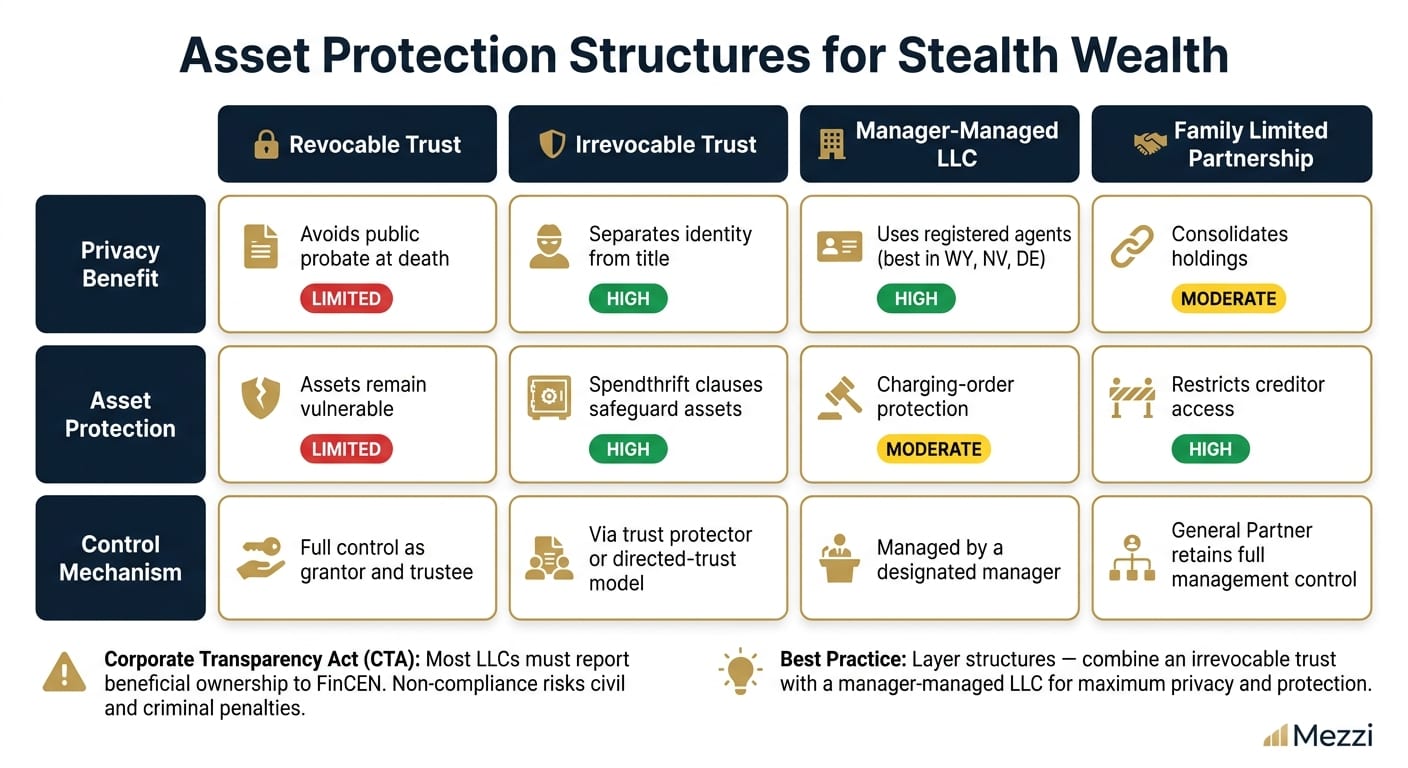
Using legal structures to separate your identity from your assets can help reduce exposure to opportunistic lawsuits.
"Visibility equals vulnerability. The more your name appears on titles, cap tables, or beneficiary designations, the larger a target you present to opportunistic creditors and plaintiffs." - UltraTrust
Trusts, LLCs, and Family Limited Partnerships
A layered approach often works best. High-net-worth families frequently use irrevocable trusts combined with manager-managed LLCs. This setup creates multiple layers of separation: the trust removes the assets from your personal balance sheet, while the LLC - particularly if formed in states like Wyoming, Nevada, or Delaware - keeps your name off public registries.
Family Limited Partnerships (FLPs) are another option. They allow you to retain management control through a general partnership interest while gradually transferring non-voting equity to heirs, which supports long-term estate planning. For real estate, land trusts can hold title so that public deed records show the trust's name instead of yours.
To maintain these protections, avoid common mistakes: choose non-descriptive entity names, use a registered agent, and never mix personal funds with entity accounts. For example, in 2018, a Colorado court pierced an LLC holding $3.2 million in real estate because the owner commingled personal and LLC funds, treating the entity as an "alter ego". Such errors can undo years of careful planning.
While these structures offer a degree of privacy, they don't shield you from government oversight. Under the Corporate Transparency Act (CTA), most LLCs and similar entities must report beneficial ownership details to FinCEN. Though this information isn't public, non-compliance can lead to civil and criminal penalties.
Strategic estate planning can further enhance privacy and ensure wealth transfers are both discreet and tax-efficient.
Estate Planning for Discreet Wealth Transfer
Without a trust, an estate typically goes through probate - a public process that reveals the size and distribution of assets. Trusts, along with beneficiary designations on accounts and insurance policies, allow assets to bypass probate entirely.
An irrevocable trust, when properly funded, avoids probate and removes assets from the taxable estate under IRC §2036. This can result in significant tax savings. For example, on a $30 million estate, such planning could preserve approximately $12 million that might otherwise be subject to a 40% federal estate tax rate. However, to secure these benefits, the grantor must not act as trustee or retain investment control.
Timing is critical. Structures must be established well before any legal claims arise. Under the Uniform Voidable Transactions Act (UVTA), transfers made to defraud known creditors can be reversed. Acting early makes a significant difference. In 2020, a Florida physician successfully protected his $6.8 million investment portfolio from a malpractice judgment by transferring assets into an irrevocable trust seven years before the claim arose. This timeline proved essential.
Proactive estate planning is a key step in managing risk and optimizing your overall wealth strategy.
Building a Quiet Portfolio and Managing Risk
Core Investment Principles for Stealth Wealth
A quiet portfolio thrives on simplicity and intention. Instead of seeking high returns through risky bets or flashy private investments, those who embrace stealth wealth focus on low-cost index funds and high-quality bonds. These assets offer steady growth while avoiding unnecessary attention or public scrutiny.
There’s solid evidence backing this strategy. The S&P Dow Jones SPIVA U.S. Scorecard reveals that over the 20 years ending in 2023, about 94% of U.S. large-cap active equity funds underperformed the S&P 500 after fees. Active strategies often fail to justify their higher costs and can draw unwanted attention, especially when fund managers or advisors publicize their involvement.
A rules-based approach can help streamline portfolio management. For example, an allocation like 60% equities, 35% bonds, and 5% cash eliminates emotional decision-making. By setting rebalancing thresholds - such as adjusting when an asset class deviates more than 5% from its target - and reviewing on a regular schedule, you can maintain focus without reacting to market noise.
To maintain discretion, consider limiting speculative investments to no more than 5% of your liquid net worth, with individual positions capped at 1%. If an opportunity requires your name to appear in promotional materials or press releases, it’s likely best to decline. Once these foundational strategies are in place, it’s time to address the challenges of managing multiple portfolios.
Managing Fragmented Portfolios Privately
Wealthy households often juggle several portfolios - a 401(k) from a previous job, a taxable brokerage account, a Roth IRA, or accounts held through trusts or LLCs. Surveys show that many high-net-worth investors manage four to six financial relationships, and this fragmentation can create blind spots.
One common issue is hidden concentration. For instance, you might hold VOO, VTI, and a tech-heavy 401(k) fund, thinking you’re diversified. However, these funds can overlap significantly, exposing you to the same underlying stocks. As Nishant Jayant, a Meta engineer, noted after analyzing his portfolio: "I discovered individual stock exposure I didn't even know I had. Turns out my 'diversified' ETF portfolio had significant overlap, with some companies appearing across multiple funds."
Mezzi’s X-Ray tool helps tackle this problem. By securely connecting all your accounts - brokerage, retirement, and trust-held - through platforms like Plaid and Finicity, Mezzi consolidates your holdings into a single view. It highlights overlapping positions, flags sector or stock-specific concentrations, and evaluates whether your portfolio aligns with your risk goals.
"The hidden concentration is such a good feature. Particularly for those in tech who already hold significant amount of company stock. They often forget those same holdings make up a large % of the indexes they hold." - Andre Nader, Author of FAANG FIRE
This tool fits seamlessly into Mezzi’s broader approach to discreet wealth management, offering insights that can guide your next steps in addressing portfolio drift and tax considerations.
Tax-Aware Rebalancing and Risk Management
Portfolio drift can quietly increase risk over time. For example, a 60/40 portfolio may shift to 75/25 after a prolonged bull market, creating an imbalance that needs correction.
Mezzi keeps an eye on drift and provides tax-aware rebalancing guidance. Unlike discretionary managers who execute trades on your behalf, Mezzi identifies adjustments and leaves the execution to you. This hands-on control is especially important for high-net-worth investors, as it ensures decisions consider your full tax situation.
To rebalance effectively, direct new contributions toward underweight assets, adjust tax-advantaged accounts first, and use tax-loss harvesting in taxable accounts to improve after-tax returns. Mezzi tracks the 30-day wash sale rule, letting you know when it’s safe to repurchase a sold position. For those in higher tax brackets, consistent tax-loss harvesting and disciplined rebalancing may add 1% or more in annual after-tax returns, compounding into meaningful gains over time.
Tax Strategies for High-Net-Worth Privacy
Building a stealth wealth strategy isn't just about keeping your finances under the radar - it can also help you manage taxes more effectively.
Asset Location and Tax Efficiency
Once you've structured your portfolio with privacy in mind, the next step is using tax strategies to optimize it further. Where you hold your investments can be just as important as the types of investments you choose. Research from Vanguard and Morningstar suggests that smart asset placement - known as asset location - may improve after-tax returns by 0.20% to 0.60% annually. This approach doesn't require changing your allocation or creating unnecessary public records.
Here's how it works: Tax-inefficient investments, like high-yield bond funds, REITs, or actively traded strategies, often generate ordinary income taxed at your highest marginal rate. These are best placed in tax-deferred accounts, such as traditional IRAs or 401(k)s. On the other hand, investments like broad equity index ETFs, which have low turnover and generate mostly qualified dividends, may be better suited for taxable brokerage accounts. Long-term gains in these accounts are subject to lower federal tax rates - 0%, 15%, or 20%. For those subject to the 3.8% Net Investment Income Tax (NIIT), this distinction can make a noticeable difference.
"Asset location - which holdings sit in which accounts - can be worth more than stock picking over time." - Mezzi
Mezzi evaluates your asset placement across all accounts, identifying mismatches between your holdings and tax profile. This analysis provides actionable insights tailored to your specific positions and balances.
Year-Round Tax-Loss Harvesting
Many investors focus on tax-loss harvesting at the end of the year, but waiting until November or December could mean missing out on better opportunities earlier in the year. By monitoring your portfolio continuously, you can capture losses during temporary market dips and spread them across multiple years. This approach not only smooths out the process but also avoids drawing unnecessary attention.
The process is straightforward: When an investment in your taxable account drops below the price you paid, you sell it to realize the loss, then reinvest in a similar-but-not-identical fund. This allows you to maintain your market exposure while locking in a deductible loss. According to the Tax Policy Center, nearly 60% of all capital gains in the U.S. are reported by the top 1% of earners. For high-net-worth individuals, disciplined tax-loss harvesting can be a highly effective tool.
One key risk to watch for is the wash sale rule. Under IRS guidelines (IRC §1091), if you buy a "substantially identical" security within 30 days before or after selling, the loss is disallowed. Mezzi helps by tracking this 30-day window across all connected accounts - including taxable brokerage accounts, IRAs, and trusts. It flags potential conflicts, such as recurring purchases, before they can invalidate a harvested loss. Combining automated tools with expert guidance strengthens your tax strategy and reduces errors.
When to Bring in a Tax Professional
While Mezzi provides ongoing monitoring and analysis, some situations call for the expertise of a licensed tax professional.
A CPA or enrolled agent can help with complex scenarios like selling a business, exercising stock options, managing multi-state income, or handling real estate transactions with large embedded gains. For more intricate matters - such as creating or revising trust structures, drafting family limited partnership agreements, or reviewing aggressive strategies - a tax attorney may be necessary. With the IRS ramping up enforcement on high-income taxpayers and partnerships, having clean documentation and professional oversight is more important than ever.
By using Mezzi throughout the year to uncover tax-saving opportunities, you can streamline discussions with your CPA during tax season. This not only reduces billable hours but also ensures your financial details stay private. As Mezzi puts it: "Tax Optimization finds opportunities throughout the year so there's less tax to report in April."
Liquidity Management and Long-Term Planning
Managing Cash and Liquidity Without Signaling Wealth
Discreet liquidity management is a key part of maintaining a low profile. High-net-worth households often keep modest balances in their visible bank accounts - typically between $10,000 and $50,000 - while the majority of their liquid assets are held in less obvious vehicles. These might include money market funds, short-term Treasury ETFs, or laddered certificates of deposit (CDs) managed by private custodians. A tiered approach to liquidity can be helpful, dividing funds into categories like immediate expenses, short-term reserves that earn interest, and a liquid "opportunity fund" that covers one to three years of living costs. Additionally, secured borrowing options, such as securities-backed lines of credit or home equity lines of credit, can provide flexibility for large, unexpected expenses - like tax payments or real estate transactions - without having to sell long-term investments.
Mezzi simplifies this process by linking checking, savings, brokerage, and credit accounts through secure, read-only integrations with services like Plaid and Finicity. This allows you to view your overall liquidity across all tiers without physically moving funds. It can also send alerts when your visible bank balance drops below a certain threshold, prompting a quiet internal transfer. This low-key approach to managing liquidity helps set the stage for a private and sustainable retirement plan.
Retirement Planning Without Public Milestones
For those prioritizing privacy, retirement planning avoids traditional public benchmarks like reaching a specific retirement age. Instead, the goal might be a "work-optional" lifestyle funded by a portfolio designed to generate, for instance, $250,000 annually after taxes by a certain age, such as 52. Planning relies on real financial data - like 401(k)s, Roth IRAs, taxable accounts, RSUs, and Social Security projections - rather than generic planning assumptions.
Mezzi aggregates this data to estimate after-tax income under various withdrawal strategies, factoring in U.S. tax rules for different account types (tax-deferred, tax-free, and taxable). This creates a clear, personalized view of your retirement readiness based on your actual financial situation.
Lifestyle changes are often subtle. For example, bonuses might be redirected into investments instead of noticeable upgrades, and transitions to flexible or part-time work are handled quietly, avoiding any outward signal of retirement. Mezzi tracks progress toward private financial goals and can notify you when your portfolio reaches a "work-optional" threshold - even if you decide to continue working. Alongside this private approach, clear family financial policies can further support long-term wealth management.
Family Financial Governance
Structured financial policies can make wealth management across generations more seamless. Many families create written guidelines for recurring decisions, such as how to handle capital requests, when spending thresholds should trigger family discussions, how to coordinate charitable giving, and how to approach financial education at different life stages.
While these guidelines don't need to be formal legal documents, they help replace spontaneous, emotionally charged money conversations with clear, agreed-upon rules. This consistency helps reduce unnecessary spending and ensures alignment across generations.
Financial literacy is another cornerstone of discreet wealth management. When family members understand basic investing and tax principles - and the importance of discretion - they're less likely to unintentionally reveal wealth or disrupt broader financial strategies. Mezzi can assist in these efforts by presenting real portfolio data in a controlled and private way, making financial education more relatable and impactful within the family.
Security and Discretion in Day-to-Day Wealth Management
Managing wealth discreetly requires a combination of cutting-edge digital security and clear, trustworthy practices.
How Mezzi Protects Your Data
High-net-worth individuals often face increased risks from cybercriminals. In fact, the FBI's Internet Crime Complaint Center reported over $3.4 billion in investment scams in 2023 alone.
Mezzi connects to your financial institutions, like banks and brokerages, through secure aggregators such as Plaid and Finicity. This connection is strictly read-only, meaning Mezzi can access balances, holdings, and transactions for analysis but cannot move funds, execute trades, or alter your accounts. Importantly, your login credentials are never stored. Instead, token-based authentication ensures your username and password remain between you and your financial institution. Additionally, account and routing numbers are masked and not retained.
To safeguard your information, Mezzi uses TLS 1.3 encryption for data transmission and AES-256 encryption for data storage. Encryption keys are managed through a secure system with tight access controls. Personal identifiers are kept separate from financial data, linked only through internal tokens. This approach means no single dataset reveals your full financial profile.
For added discretion in your daily financial activities, consider these tips:
- Use a dedicated email address for financial accounts.
- Enable app-based multi-factor authentication instead of SMS.
- Disable account balance previews on your phone’s lock screen.
- Store exported Mezzi reports in encrypted folders rather than shared drives.
As Mezzi emphasizes:
Free apps make money by selling your data to advertisers, meaning you're the product. With Mezzi, you're the customer.
Mezzi’s subscription-based model reflects its commitment to privacy. There are no advertising partnerships, no data sales, and no public metrics that could inadvertently expose your financial standing.
In addition to strong digital safeguards, Mezzi's operational structure and transparent fees further protect your financial privacy.
Fiduciary Responsibility and Transparent Fees
As an SEC-registered investment adviser (RIA), Mezzi operates under a fiduciary duty to prioritize your best interests. This responsibility is enforced through regular SEC examinations, compliance programs, and mandatory disclosures of any conflicts of interest.
Mezzi’s flat-fee structure supports this client-first approach. Instead of charging a percentage of assets under management, Mezzi offers three subscription tiers:
- Core: $299/year
- Plus: $499/year
- White Glove: $1,499/year
This flat pricing eliminates incentives to encourage unnecessary trades or promote proprietary products, ensuring unbiased guidance.
According to research from the CFA Institute, clear and transparent fees rank among the top factors that build trust in advisory relationships. For those aiming to maintain financial privacy, this transparency also ensures that your wealth management costs don’t inadvertently hint at the size of your portfolio.
Conclusion: Your Stealth Wealth Plan
Creating a stealth wealth plan involves building habits and structures that align with a long-term mindset. It starts with a shift in perspective: separating your financial success from public recognition, keeping a low profile, and prioritizing financial privacy as a fundamental practice. Once the mindset is established, the focus moves to setting up structures like trusts, LLCs, and family limited partnerships. These tools help manage assets discreetly, keeping your name off public records. From there, the emphasis turns to a diversified portfolio aimed at achieving long-term goals while avoiding unnecessary short-term distractions.
After setting the foundation, the next step is incorporating strategies for tax efficiency and security. Techniques such as systematic asset location and year-round tax-loss harvesting may increase after-tax returns by 0.5–1.0 percentage points annually. Additionally, over 70% of family offices already use consolidated reporting technology to streamline management across multiple custodians. Strong digital practices, including encrypted storage, app-based authentication, and limiting data sharing, help address vulnerabilities that legal structures alone may not fully cover.
A key element to tying everything together is having a single, private view of your finances. This is where Mezzi comes in. Mezzi acts as a central dashboard, consolidating accounts from banks, brokerages, retirement funds, and entity-held assets through secure, read-only access. This allows you to view your entire financial picture without exposing sensitive information to unnecessary third parties. Its AI tools can highlight tax-saving opportunities, identify risks related to portfolio concentration, and suggest rebalancing needs, offering guidance for your own decision-making.
To implement this framework, consider the following steps: Start your stealth wealth plan with Mezzi by connecting your accounts, aligning legal and tax strategies with your overall framework, maintaining a liquidity buffer of 6–24 months of expenses, and scheduling quarterly reviews to make intentional, thoughtful adjustments.
As an SEC-registered fiduciary, Mezzi is committed to acting in your best interest. Its flat-fee pricing, starting at $299 per year, ensures that its advice is not influenced by commissions or asset-based incentives. Combining fiduciary responsibility, a privacy-focused platform, and AI-driven insights, Mezzi provides a practical system for managing wealth with clarity and confidence.
FAQs
What’s the first step to start practicing stealth wealth?
The journey to practicing stealth wealth starts with simplifying your financial portfolio. Tools like Mezzi make this process easier by allowing you to securely link all your financial accounts into a single, private dashboard. This unified view gives you a clear picture of your finances without requiring you to transfer assets.
With everything in one place, you may be able to spot potential risks, explore tax-saving opportunities, and manage your wealth more discreetly. It's a practical way to maintain financial control while keeping a low profile.
Do trusts or LLCs really keep my name off public records?
Trusts and LLCs may help keep your name off public records, but they have limitations. When assets are placed in an irrevocable trust, the trust itself becomes the legal owner, meaning your name typically won’t appear on deeds or related filings. Similarly, forming an LLC in states like Wyoming or Delaware - known for their privacy-friendly laws - can offer anonymity by using registered agents to shield your identity.
However, it’s important to note that these strategies don’t offer complete privacy. Court orders, tax reporting requirements, or regulatory subpoenas can still expose your connection to these entities when legally required.
How can I see my full portfolio without giving an app control of my money?
You can securely monitor your entire portfolio without granting an app control over your assets by opting for platforms that offer read-only connections. Mezzi partners with trusted aggregators like Plaid and Finicity to link your accounts. This setup lets you review your holdings, track performance, and even identify potential tax-saving opportunities - all while ensuring your assets remain untouched and cannot be moved or traded.
Disclosures:
- This content is for informational purposes only and does not constitute investment advice or a recommendation to buy or sell any security.
- Past performance is not indicative of future results. No guarantee of future performance or outcomes is implied.
- Always consult with a qualified financial advisor before making investment or financial planning decisions.
Related Blog Posts
- High-Net-Worth investing strategies
- High-Net-Worth Financial Planning Guide
- Embracing Stealth Wealth: How to Achieve Quiet Luxury and Stay Invisible
- What is ultra high net worth - and what changes
The journey to practicing stealth wealth starts with simplifying your financial portfolio. Tools like Mezzi make this process easier by allowing you to securely link all your financial accounts into a single, private dashboard. This unified view gives you a clear picture of your finances without requiring you to transfer assets.
With everything in one place, you may be able to spot potential risks, explore tax-saving opportunities, and manage your wealth more discreetly. It's a practical way to maintain financial control while keeping a low profile.
Trusts and LLCs may help keep your name off public records, but they have limitations. When assets are placed in an irrevocable trust, the trust itself becomes the legal owner, meaning your name typically won’t appear on deeds or related filings. Similarly, forming an LLC in states like Wyoming or Delaware - known for their privacy-friendly laws - can offer anonymity by using registered agents to shield your identity.
However, it’s important to note that these strategies don’t offer complete privacy. Court orders, tax reporting requirements, or regulatory subpoenas can still expose your connection to these entities when legally required.
You can securely monitor your entire portfolio without granting an app control over your assets by opting for platforms that offer read-only connections. Mezzi partners with trusted aggregators like Plaid and Finicity to link your accounts. This setup lets you review your holdings, track performance, and even identify potential tax-saving opportunities - all while ensuring your assets remain untouched and cannot be moved or traded.