
Ultra-high net worth (UHNW) refers to individuals with a net worth of $30 million or more. This includes assets like real estate, investments, and collectibles. By 2023, there were over 626,000 UHNW individuals globally, with the U.S. home to 208,560 of them. Crossing this threshold often shifts financial priorities from growing wealth to preserving it, managing risks, and planning for generational transfer.
Key insights:
- UHNW wealth management focuses on tax planning, estate strategies, and asset structuring (e.g., trusts, LLCs).
- Portfolios differ: UHNW individuals allocate more to private equity, real estate, and alternative investments compared to traditional investors.
- Tax challenges: High tax exposure and estate planning complexities require careful timing and asset placement.
- Wealth tools: Platforms like Mezzi provide UHNW investors with insights into tax strategies, portfolio risks, and long-term planning.
UHNW individuals face unique challenges and opportunities, requiring tailored high-net-worth investing strategies to manage their wealth effectively.
The Financial Landscape of UHNW Individuals
What UHNW Portfolios Look Like
Ultra-high-net-worth (UHNW) portfolios stand apart from the holdings of most investors. For example, while someone with a high net worth might allocate 47% of their assets to public equities, that figure often drops to 38% or less for those with a net worth exceeding $25 million. At the uppermost levels - families with $250 million or more - private equity alone makes up 28% of allocations. The core of most UHNW portfolios revolves around the "Big Three": private equity, public equity, and real estate, which together account for over 56% of total holdings. Beyond these, allocations extend into private credit, hedge funds, venture capital, and less traditional assets like infrastructure, fine art, and even sports franchises. Each of these plays a distinct role, whether it’s for income generation, inflation protection, or hedging against risks.
Managing these diverse assets across numerous accounts and entities adds layers of complexity. A UHNW family might hold investments through taxable brokerage accounts, retirement accounts, irrevocable trusts, LLCs, and family limited partnerships, each with unique tax implications and reporting requirements. This intricate structure makes high-net-worth financial planning and precise tax management essential for UHNW wealth.
Tax Challenges at UHNW Status
Highly diversified portfolios often come with intricate tax exposures. Federal income taxes, the 3.8% Net Investment Income Tax (NIIT), the Alternative Minimum Tax (AMT), and Medicare surcharges (IRMAA) can all stack up, resulting in effective marginal rates that far exceed standard levels.
The way different types of income are taxed adds another layer of complexity. For instance, long-term capital gains are taxed at a federal rate of 23.8% (20% top bracket + 3.8% NIIT), while ordinary income reaches 40.8% (37% top rate + 3.8% NIIT). This 17-percentage-point gap means the type of income generated can significantly influence tax outcomes. For UHNW families in high-tax states like California, where the top capital gains tax rate is 13.3%, the total tax on capital gains can reach as high as 37.1%.
"A single poorly timed asset sale can push a VHNWI into the highest marginal brackets across federal and state systems, costing hundreds of thousands in avoidable taxes." - SmartAsset
The federal estate tax exemption is another pressing concern. As of 2024, the exemption stands at $13.61 million per individual, but it is set to drop to roughly half that amount in 2026. For UHNW families, this creates a limited window for planning, emphasizing the need to act sooner rather than later.
Access to Private Markets and Niche Strategies
Navigating these tax complexities is crucial, especially as UHNW investors take advantage of exclusive private market opportunities. One of the defining features of UHNW wealth management is access to private equity, venture capital, private credit, and direct investments in private companies - opportunities that are largely unavailable to the average investor.
The appeal lies in the "illiquidity premium" these private markets offer - higher expected returns in exchange for locking up capital for extended periods, often ranging from 7 to 10 years. For UHNW individuals, these lockup periods are less of a concern because their liquid assets are typically sufficient to cover decades of living expenses without requiring asset sales. As BNY Wealth explains:
Wealthy families see private equity as a way to secure higher returns and benefit from the 'illiquidity premium,' while gaining access to opportunities beyond public markets.
In addition to private equity, UHNW investors often turn to private credit for floating-rate income that surpasses public bond yields, and to real assets like infrastructure or data centers for stable, inflation-linked cash flows. Direct investments in private companies are also on the rise, allowing families to bypass traditional fund structures, reduce fees, and gain greater control. In fact, by 2024, nearly half of family offices expected to make at least six direct investments within the year.
These strategies come with trade-offs, including illiquidity, limited transparency, and high minimum investment requirements. However, for UHNW investors, the potential benefits often outweigh the challenges. With the right tools and insights, such as those provided by Mezzi, UHNW individuals can navigate the complexities of asset allocation, tax planning, and private market opportunities with greater precision.
How Ultra-High-Net-Worth Families Really Invest (It's Not What You Think)
How Investment Strategies Change at UHNW Levels
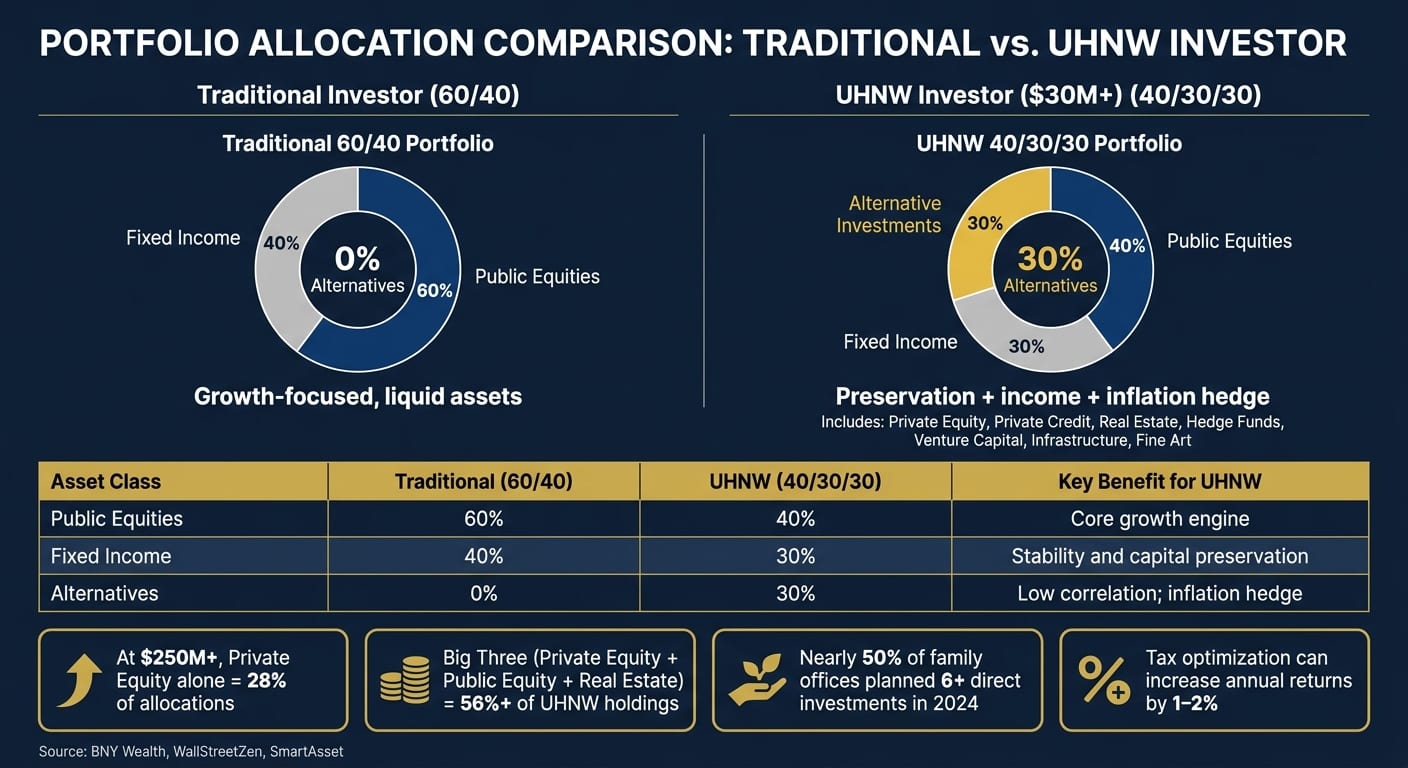
When wealth surpasses $30 million, the investment strategy often shifts dramatically. The focus moves from pure growth to a combination of preservation, income generation, and managing both taxes and market risks. Achieving these goals requires a completely restructured portfolio.
Diversification and Concentration Risk
Reaching ultra-high-net-worth (UHNW) status often stems from concentrated wealth in a single area - whether it's a business sale, a dominant stock position, or inherited real estate. While this concentration may have been key to building wealth, it also poses a significant risk. Diversification at this level means expanding investments across asset classes, regions, and strategies that are minimally correlated. However, as portfolios expand across multiple accounts and entities, tracking this diversification becomes increasingly complex.
Mezzi’s Portfolio X-Ray tool directly tackles this issue by scanning all linked accounts to highlight overlapping holdings that might otherwise go unnoticed. As Shuping, the Founder of Summer AI, shared:
Mezzi's X-Ray feature allowed me to uncover exposure to stocks I didn't realize I had.
This level of insight enables UHNW investors to rebalance effectively, ensuring a more even distribution between public and private assets.
Balancing Public and Private Market Allocations
The traditional 60/40 portfolio model - 60% stocks and 40% bonds - has fallen out of favor among UHNW investors. Instead, many now adopt a 40/30/30 allocation: 40% public equities, 30% fixed income, and 30% alternative investments.
The alternative investments in this model often include private equity, private credit, and real estate - assets that tend to have minimal correlation with public markets. As Jacob Wade of WallStreetZen explains:
Alternative assets don't march to the same beat as traditional investments - and the returns often have very little correlation with public markets.
Since private investments can tie up capital for extended periods, maintaining liquidity in public markets becomes critical. Mezzi enhances this process by offering a unified view of risk and returns across both public and private investments, helping investors better understand their liquidity positions.
Tax-Aware Investment Decisions
Tax strategies play a critical role in refining UHNW portfolios. Even with identical holdings, two portfolios can yield vastly different after-tax results based on asset placement and timing of trades. Tax optimization has the potential to increase annual returns by 1%–2%, which can make a significant difference when managing portfolios worth tens of millions.
Mezzi actively monitors accounts year-round to identify opportunities for tax-loss harvesting, rather than waiting until the end of the year. It also tracks wash sale risks across all connected accounts, a crucial feature when managing trades in multiple portfolios. Beyond harvesting, Mezzi provides guidance on asset location, helping investors decide which assets should go into tax-advantaged accounts like Roth IRAs versus taxable accounts. This ensures every account operates as efficiently as possible. As Mezzi explains:
Mezzi analyzes your full picture: Roth, traditional, taxable, 401(k). It shows you what's misplaced and what to move - so every account is working as tax-efficiently as possible.
Advanced Tax Strategies for UHNW Individuals
At ultra-high net worth (UHNW) levels, taxes can significantly influence long-term financial outcomes. To address this, advanced strategies that coordinate efforts across various account types and entities become a priority. Here's how UHNW investors can approach tax planning more effectively.
Tax Planning Across Multiple Accounts
Tax planning for UHNW individuals often involves managing a mix of accounts and entities. One key approach is asset location, which involves strategically placing investments based on their tax efficiency. For example:
- Tax-inefficient assets like high-yield bonds, real estate investment trusts (REITs), and actively managed funds are often better suited for tax-deferred or Roth accounts.
- Tax-efficient investments, such as index ETFs and municipal bonds, are typically held in taxable accounts.
This approach may reduce annual tax drag while maintaining the desired overall allocation.
Roth conversions provide another layer of flexibility. By converting assets from traditional IRAs or 401(k)s into Roth accounts during periods of lower taxable income - like after selling a business, before a major liquidity event, or during a market downturn - investors may limit future tax exposure. For those anticipating large required minimum distributions (RMDs) in retirement, staggered Roth conversions can help spread out the tax burden, especially if higher tax rates are expected in the future.
However, managing multiple accounts can lead to unintended consequences. For instance, purchasing an asset in a spouse's IRA could inadvertently trigger a wash sale if a loss was recently harvested in a taxable account. Tools like Mezzi monitor all connected accounts to flag these risks and provide guidance on asset placement, ensuring that Roth, traditional, and taxable accounts work together efficiently.
Estate and Gift Tax Planning
For UHNW families, federal estate and gift taxes can pose a significant challenge to wealth transfer. Proactive strategies are critical to mitigating these risks. For example, the 2025 annual gift tax exclusion allows individuals to transfer up to $19,000 per recipient without tapping into their lifetime exemption. By combining this with trust structures, families can create a systematic approach to transferring wealth across generations.
Charitable giving tools like donor-advised funds (DAFs) and charitable remainder trusts (CRTs) also play a role in reducing taxable estates while aligning with philanthropic goals. For instance, donating appreciated stock directly to a DAF can help avoid capital gains taxes, offer a charitable deduction, and allow proceeds to be diversified tax-efficiently. These strategies, when coordinated effectively, can help preserve wealth while supporting broader family and charitable objectives.
How Mezzi Supports Tax Efficiency
Managing these advanced strategies across multiple accounts and entities can be daunting. Mezzi simplifies this process by providing a unified view of your financial landscape and delivering actionable insights. Instead of relying solely on an annual tax review, Mezzi continuously monitors connected accounts to:
- Flag potential wash sale risks.
- Identify opportunities for tax-loss harvesting throughout the year.
- Advise on optimal asset placement across account types.
This kind of ongoing coordination, traditionally requiring a team of advisors, is now more accessible and cost-efficient with Mezzi. By streamlining these processes, Mezzi helps UHNW investors execute complex tax strategies more effectively.
Legacy and Multi-Generational Wealth Planning
Building wealth is no small feat, but preserving it across generations presents an even greater challenge. In the U.S., an estimated $124 trillion is expected to transfer between generations by 2048. Yet, a staggering 90% of wealthy families lose their wealth by the third generation. Surprisingly, this isn’t usually due to poor investment decisions.
"90% of wealthy families lose their wealth by the third generation, often due to governance failures rather than investment mistakes." - Coldstream
Estate Planning for UHNW Families
For ultra-high-net-worth (UHNW) families, estate planning goes far beyond drafting a simple will. It evolves as the estate grows, requiring increasingly sophisticated strategies.
For estates valued between $10M and $25M, the focus is on foundational elements. This includes creating a revocable living trust to bypass probate, ensuring beneficiary designations on retirement accounts and insurance policies align with the overall plan, and establishing powers of attorney. It’s worth noting that beneficiary designations take precedence over a will, so any misalignment can lead to unintended outcomes.
When estates exceed $25M, planning strategies shift. The goal often centers on transferring appreciating assets out of the taxable estate before their value increases further. Tools like Grantor Retained Annuity Trusts (GRATs) are frequently employed. With a GRAT, you transfer an asset into the trust, receive annuity payments for a set term, and any appreciation above the IRS hurdle rate can pass to heirs tax-free. Irrevocable Life Insurance Trusts (ILITs) serve a different purpose, offering tax-free liquidity to cover estate taxes, which can prevent heirs from needing to sell illiquid assets such as real estate or a family business.
For estates exceeding $50M to $100M, advanced structures like Dynasty trusts, SLATs (Spousal Lifetime Access Trusts), and IDGTs (Intentionally Defective Grantor Trusts) come into play. These tools are designed to preserve and grow wealth across multiple generations. Transferring assets - such as stakes in private companies or real estate portfolios - before a significant appreciation event can help shift more wealth outside the taxable estate.
These strategies are only part of the equation. They must be paired with well-thought-out family governance and education to ensure the estate plan becomes a true legacy.
Family Governance and Financial Education
The high rate of third-generation wealth loss underlines a critical issue: heirs who are unprepared to manage wealth effectively. Strong family governance offers a practical solution to this challenge.
Family governance involves creating a framework that documents shared values, an investment philosophy, and decision-making processes. Many families formalize this in a written family constitution or charter. Some even establish a family council, a structured forum where members from different generations come together to discuss financial matters, review performance, and build a sense of shared responsibility. This approach helps reduce conflicts and ensures younger members understand that managing wealth requires active effort, not passive inheritance.
Financial education is equally important and should be treated as an ongoing process. Teaching heirs to read financial statements, grasp fiduciary responsibilities, and assess investment risks can be as impactful as any trust or legal structure. Families that successfully preserve wealth often treat financial literacy as a core value, integrating it into their culture rather than leaving it as an afterthought. Together, governance and education transform an estate plan into a lasting legacy.
Philanthropy as a Legacy Tool
Strategic philanthropy is another key element in establishing a lasting legacy, complementing estate planning and governance efforts.
At the UHNW level, philanthropy serves dual purposes: reflecting personal values while also reducing the taxable estate. Donor-Advised Funds (DAFs) are a flexible starting point. These allow families to contribute appreciated assets, take an immediate tax deduction, and recommend grants to charities over time. The assets grow tax-free within the DAF while decisions are made about where to direct them.
For families with larger philanthropic ambitions, private foundations provide more control and the opportunity to involve heirs in grantmaking. This involvement can also serve as a practical tool for financial education. Meanwhile, Charitable Remainder Trusts (CRTs) offer a way to provide income to the donor or heirs for a set period, with the remaining assets eventually going to charity. These trusts can deliver both income and estate tax benefits.
Mezzi simplifies the complexities of managing these various elements - trusts, LLCs, holding companies, investment accounts, and philanthropic vehicles - by consolidating them into one comprehensive view. With its read-only access to accounts across ownership structures, Mezzi offers a clear picture of how each piece contributes to the broader plan.
"Estate planning strategy becomes more than taxes and trusts: it becomes a blueprint for multigenerational opportunity, stewardship, and impact." - Coldstream
Conclusion: Managing UHNW Wealth with Mezzi
For those with ultra-high net worth (over $30 million), the emphasis often shifts from rapid growth to managing wealth in a coordinated and strategic way. Key challenges include addressing concentration risk across various holdings and entities, navigating complex tax considerations like the 3.8% Net Investment Income Tax and estate tax exposure, accessing private markets thoughtfully, and creating governance structures to ensure wealth preservation for generations to come.
At this level, financial decisions carry significant implications for taxes, estate planning, and liquidity. This complexity calls for an integrated approach. Mezzi provides tools to help manage these intricate needs by offering insights into concentration risk, tax planning, and long-term wealth strategies. As an SEC-registered fiduciary, Mezzi consolidates all your financial entities - brokerage accounts, IRAs, trusts, LLCs, and holding companies - into a single, comprehensive view. Its AI-powered platform highlights actionable insights, such as identifying tax-loss harvesting opportunities, modeling the after-tax effects of gifting strategies, and assessing how private market commitments may impact liquidity.
Plans start at $299 per year for the Core option or $499 per year for the Plus plan, which includes advanced AI research and concierge support. Mezzi offers institutional-level fiduciary guidance without the traditional 1% AUM fee.
With Mezzi, UHNW investors gain the tools to manage their wealth with clarity and tax-efficient control at every step of their financial journey.
FAQs
Does $30M net worth include my primary home and private business equity?
Whether your $30 million net worth factors in your primary home and private business equity depends on how net worth is defined. Investable assets generally exclude your primary residence, focusing instead on liquid or marketable assets. On the other hand, total net worth takes a broader view, including all assets - such as your home and private business equity. No matter the definition, overseeing a mix of asset types is an important part of financial planning for individuals with ultra-high net worth.
What changes first in investing once I’m UHNW - risk, liquidity, or taxes?
Reaching ultra-high-net-worth (UHNW) status brings unique financial challenges that require balancing risk management, liquidity, and tax planning all at once. With complex assets, such as alternatives or concentrated equity holdings, the focus often shifts to achieving tax efficiency while maintaining structured liquidity. Estate planning also takes center stage, particularly when addressing potential liabilities like the 40% federal estate tax. Mezzi works to align these priorities, helping ensure your wealth strategy adapts to preserve and grow your assets effectively.
What should I do before the estate tax exemption drops in 2026?
The federal estate and gift tax exemption has been permanently set at $15 million per person (or $30 million for married couples) under the One Big Beautiful Bill Act (OBBBA). If your estate plan was created before 2026, it may be worth reviewing to ensure it aligns with the current law. Consider whether gifting still fits your financial strategy or if holding onto appreciated assets for a potential step-up in basis at death better suits your objectives.
Disclosures:
- This content is for informational purposes only and does not constitute investment advice or a recommendation to buy or sell any security.
- Past performance is not indicative of future results. No guarantee of future performance or outcomes is implied.
- Always consult with a qualified financial advisor before making investment or financial planning decisions.
Related Blog Posts
- High-Net-Worth investing strategies
- High-Net-Worth Financial Planning Guide
- AI in Wealth Transfer: Legal and Tax Insights
- Income vs net worth: why high earners are often still asset-poor
Whether your $30 million net worth factors in your primary home and private business equity depends on how net worth is defined. Investable assets generally exclude your primary residence, focusing instead on liquid or marketable assets. On the other hand, total net worth takes a broader view, including all assets - such as your home and private business equity. No matter the definition, overseeing a mix of asset types is an important part of financial planning for individuals with ultra-high net worth.
Reaching ultra-high-net-worth (UHNW) status brings unique financial challenges that require balancing risk management, liquidity, and tax planning all at once. With complex assets, such as alternatives or concentrated equity holdings, the focus often shifts to achieving tax efficiency while maintaining structured liquidity. Estate planning also takes center stage, particularly when addressing potential liabilities like the 40% federal estate tax. Mezzi works to align these priorities, helping ensure your wealth strategy adapts to preserve and grow your assets effectively.
The federal estate and gift tax exemption has been permanently set at $15 million per person (or $30 million for married couples) under the One Big Beautiful Bill Act (OBBBA). If your estate plan was created before 2026, it may be worth reviewing to ensure it aligns with the current law. Consider whether gifting still fits your financial strategy or if holding onto appreciated assets for a potential step-up in basis at death better suits your objectives.