
Earning a high income doesn’t guarantee financial security. Many high earners struggle to build wealth due to rising costs, debt, and poor financial planning. Here's why income and net worth aren’t the same - and why focusing on net worth matters more.
- Income is what you earn (like salary or bonuses), while net worth is what you own minus what you owe (assets minus liabilities).
- High earners often face challenges like lifestyle inflation, heavy debt, and tax burdens, leaving little room to save or invest.
- Nearly half of six-figure earners live paycheck to paycheck, and many delay building wealth until later in life, missing out on the benefits of early compounding.
- Achieving financial independence requires consistent savings, smart investments, and a focus on growing net worth - not just earning more.
Key takeaway: Turning income into lasting wealth means managing spending, reducing debt, and investing wisely over time.
Why High Income Often Does Not Build Wealth
Lifestyle Inflation and Rising Fixed Costs
Earning more money doesn't always translate to saving more. As income increases, so do expenses - a phenomenon called lifestyle inflation. It's not just about splurging on vacations or designer goods. Over time, fixed costs creep up: a bigger house, a luxury car, private school tuition. These recurring expenses gradually raise your "spending floor", the minimum amount you need to maintain your lifestyle.
The trouble with fixed costs is their inflexibility. They don't adjust when income drops. So, if bonuses shrink or the market dips, those hefty mortgage payments and other obligations remain, leaving high earners financially stretched despite their impressive salaries. As clinical psychologist Sabrina Romanoff explains:
Earning doesn't actually make you feel rich; spending it does.
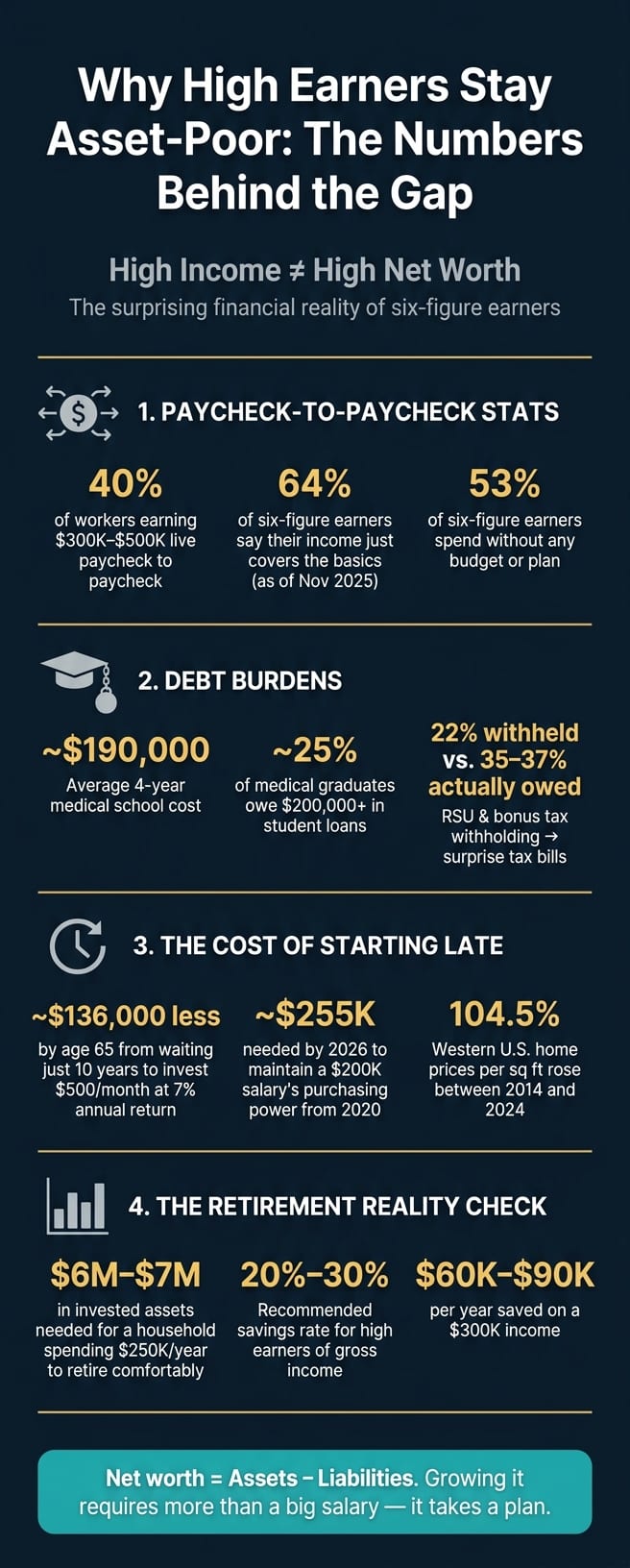
The statistics paint a clear picture. Approximately 40% of workers earning between $300,000 and $500,000 report living paycheck to paycheck. Even more striking, by November 2025, 64% of six-figure earners said their income merely covers the basics.
And that's just one piece of the puzzle. Debt and stock concentration add another layer of complexity to wealth-building.
Debt Loads and Concentrated Stock Risk
For many high earners, debt and concentrated investments create significant hurdles to building lasting wealth.
Take student loans, for example. Careers in medicine, law, and other high-paying fields often start with massive debt. The average four-year medical school costs nearly $190,000, and about 25% of graduates owe more than $200,000 in student loans. This can leave new professionals with a negative net worth before their first paycheck even clears.
On top of that, many high earners are compensated heavily through restricted stock units (RSUs). This creates a triple risk: their salary, benefits, and net worth all depend on the performance of a single company. If that company struggles, the financial impact can be severe. Additionally, RSUs and bonuses are taxed at a flat 22%, but high earners often owe 35–37% at tax time. This mismatch can lead to an unwelcome surprise when taxes come due.
Here's a breakdown of how these factors affect wealth growth:
These financial pressures make it harder to save and invest consistently, which are critical for long-term wealth.
Wealth Gaps and Late Financial Starts
Building wealth isn’t just about earning more - it’s about starting early. Unfortunately, many high earners begin their investing journey later than ideal. Professions like medicine and law often delay peak earnings until the mid-to-late 30s, which can significantly impact long-term savings. For instance, waiting 10 years to start investing $500 per month at a 7% annual return could shrink your portfolio by nearly $136,000 by age 65.
Inflation compounds the challenge. A six-figure salary doesn’t stretch as far as it used to. Maintaining the purchasing power of a $200,000 salary in 2020 would require about $255,000 by 2026. Meanwhile, housing costs have skyrocketed. In the Western U.S., home prices per square foot jumped 104.5% between 2014 and 2024. For high earners in cities like San Francisco or New York, a significant portion of income goes toward housing, leaving little room to save or invest.
"A household earning $200,000 a year may appear financially comfortable, but if most of that income goes toward a large mortgage, child care, debt payments and other fixed costs, there may be little flexibility if something goes wrong." - Kearney Consumer Institute
These combined factors - rising costs, debt, delayed investing, and inflation - highlight why even high earners may struggle to build lasting wealth.
Common Mistakes That Keep High Earners Asset-Poor
Earning Well Without a Savings Plan
Earning a high salary doesn't automatically lead to building wealth. In fact, 53% of six-figure earners admit they spend without any kind of budget or plan. Without a structured approach, there’s often little - or nothing - left to invest.
The solution isn’t about relying on willpower; it’s about setting up systems. For example, automating 15%–20% of your gross income into retirement accounts can help you save consistently. The IRS has set the 2026 401(k) contribution limit at $24,500, while Health Savings Account (HSA) limits are $4,400 for individuals and $8,750 for families. These accounts not only reduce taxable income but also allow your money to grow over time - provided you take advantage of them.
"A budget should be a representation of your values. You can't value everything. You have to pick maybe one or two things where you're going to focus your discretionary spending, and then take that extra and reroute it to savings." - Kamila Elliott, CEO, Collective Wealth Partners
Another misstep is holding onto too much cash, which may feel secure but can work against your financial goals.
Sitting on Too Much Cash
While keeping cash on hand might seem like a safe strategy, it often results in losing value due to inflation and missing out on the power of compounding growth. This is one reason high earners can remain asset-poor, even with substantial incomes. Some choose to hold excess cash for flexibility, but that decision can come at a steep cost. Early compounding growth is a critical opportunity that, once missed, is difficult to recover.
For context, a household spending $250,000 annually would need around $6 million to $7 million in invested assets to maintain that lifestyle during retirement. Sitting on cash rather than investing makes reaching that target far more challenging.
Diversification issues can also be a hidden obstacle for high earners.
Overlapping Holdings and Concentrated Positions
Even consistent investors can unknowingly end up with portfolios that aren’t as diversified as they appear. For instance, owning multiple S&P 500 ETFs - like VOO, IVV, and SPY - might seem like a smart move, but these funds often hold nearly identical stocks. This creates hidden concentration and adds unnecessary fees.
The problem intensifies when restricted stock units (RSUs) or employer stock are involved. For example, a tech professional might have their salary, bonus, and a large portion of their investments tied to the same company. If that stock drops by 30%, the financial impact is felt across multiple areas simultaneously.
Mezzi’s X-Ray tool helps identify these issues by flagging redundant fund holdings, overlapping positions, and concentrated risks across all connected accounts. Instead of manually combing through statements, this tool provides a clear breakdown of your portfolio’s exposure, helping you make better decisions before market volatility reveals the weaknesses.
How to Turn Income Into Net Worth
Track Net Worth, Not Just Income
Earning a solid paycheck is one thing, but understanding how much of that income turns into lasting wealth is another. Your net worth provides that insight. It’s calculated by subtracting your total liabilities (like mortgages, student loans, auto loans, and credit card balances) from your total assets, which may include things like 401(k) accounts, brokerage investments, Roth IRAs, HSAs, home equity, and RSUs.
For high earners, reviewing net worth quarterly strikes a good balance. It’s frequent enough to catch potential issues early, without being so often that short-term market fluctuations cloud your judgment. The key is to focus on long-term trends to see if your income is translating into growing assets over time.
Tools like Mezzi make this process easier by securely connecting to your financial accounts through services like Plaid and Finicity. Instead of manually gathering statements, Mezzi provides a consolidated dashboard with a clear trendline and alerts for significant changes, such as concentrated stock positions that might skew your overall financial picture.
Once you’ve got a handle on your net worth trends, the next step is to actively grow it through smart savings strategies.
Set Savings Targets and Automate Contributions
Tracking your net worth is just the beginning. Actively building it means setting clear savings goals and automating contributions to ensure consistency. For high earners, a general rule of thumb is to allocate 20%–30% of gross income toward wealth-building efforts. For example, a household with a $300,000 annual income might aim to save between $60,000 and $90,000 each year, whether through retirement accounts, investment portfolios, or debt repayment.
Research in behavioral finance suggests that automation can be a game-changer. One study of a large U.S. employer showed that 401(k) participation rates jumped from 37% to 86% after automatic enrollment was introduced. Similarly, scheduling automatic transfers right after payday can help you hit your savings targets without relying on willpower or risking lifestyle spending eating into your surplus.
For irregular income - like bonuses, RSU vests, or commissions - having a pre-set plan can be helpful. For instance, you might decide to invest 70% of any bonus, reserve 20% for taxes, and spend the remaining 10% however you like. This approach prevents windfalls from being quietly absorbed into day-to-day spending, ensuring they contribute to your long-term goals. Mezzi can further assist by reviewing your savings settings, calculating your effective savings rate, and flagging opportunities to increase automated contributions when it detects excess funds sitting in your checking account.
Get More Out of Tax-Advantaged Accounts
Tax-advantaged accounts can play a key role in growing wealth by helping you retain more of what you earn. For high earners, an effective strategy typically begins with contributing enough to a 401(k) to secure the full employer match - essentially free money, often equating to a 50%–100% return on those contributions. If you’re enrolled in a high-deductible health plan, funding an HSA is another smart move, thanks to its triple tax benefits: pre-tax contributions, tax-free growth, and tax-free withdrawals for qualified expenses.
For those whose income exceeds direct Roth IRA contribution limits, a backdoor Roth IRA strategy can provide access to tax-free growth. After maxing out these options, consider contributing to your 401(k) up to the annual limit (currently around $23,000).
Beyond just contributing, where you hold your investments can impact your after-tax returns. Tax-inefficient assets, like corporate bonds or actively managed funds, often perform better in tax-deferred accounts, while index funds and ETFs are better suited for taxable accounts. Vanguard research suggests that strategies like tax-loss harvesting can add 0.3–0.7 percentage points to after-tax returns annually for high-income investors.
Mezzi simplifies this process by identifying opportunities across all connected accounts. It flags tax-loss harvesting candidates, advises on tax-efficient asset placement across your Roth, Traditional, and taxable accounts, and even monitors for wash sale risks. This proactive approach helps you avoid costly mistakes and optimize your portfolio for long-term growth.
How Mezzi Helps High Earners Build Wealth
A Complete View of All Your Accounts in One Place
For many high earners, managing wealth can feel like juggling too many pieces at once. A 401(k) here, a brokerage account there, RSUs managed on a separate equity platform, and maybe an untouched HSA sitting somewhere else. Without a centralized way to track everything, understanding your true net worth - or whether your investments are balanced - can be a challenge.
Mezzi simplifies this by aggregating all your accounts - 401(k), Roth IRA, taxable accounts, HSA, and more - into one secure, read-only dashboard. This consolidated view shows your total net worth, asset allocation, and risk exposure in a single place. With its X-Ray feature, Mezzi digs deeper, analyzing your ETF and mutual fund holdings to uncover hidden overlaps, like an overconcentration in large-cap tech stocks.
By bringing everything together, Mezzi provides the foundation for tailored financial insights at your fingertips.
Fiduciary Advice On Demand, Without the Advisor Fees
Once your financial picture is complete, Mezzi offers personalized advice as an SEC-registered fiduciary, which means it’s required to put your interests first. And it does this at a fraction of what traditional advisors typically charge. For perspective, a financial advisor often takes around 1% of your assets under management each year. On a $750,000 portfolio, that’s $7,500 annually - whether or not their advice actually impacts your results.
With Mezzi, you can ask complex financial questions whenever you need to. Whether it’s about the timing of a Roth conversion, choosing between paying off debt or investing, or managing RSU vesting, Mezzi provides guidance tailored to your specific accounts. Its advice spans areas like identifying tax-loss harvesting opportunities, optimizing asset locations across account types, avoiding wash sales, and rebalancing your portfolio. While you remain in control of executing decisions, Mezzi breaks down exactly what to do and why, so you can act confidently.
Advice Built for Tech, Healthcare, and Finance Professionals
Mezzi’s guidance gets even more focused when it comes to the unique financial challenges faced by professionals in industries like tech, healthcare, and finance. For example, tech employees often see RSUs make up 20%–40% of their total compensation. Without a clear plan, vesting events can lead to idle cash or an overconcentration in a single stock. Mezzi tracks vesting schedules, flags when employer stock exposure exceeds safe thresholds (like 15% of total investable assets), and suggests structured selling plans that balance tax considerations with diversification goals.
For healthcare professionals with irregular income - think bonuses, locum shifts, or moonlighting - Mezzi helps establish rules-based savings strategies to ensure extra income flows into long-term investments instead of disappearing into day-to-day expenses. And for those managing multiple accounts like a 403(b), 457(b), HSA, and taxable brokerage, Mezzi maps out the tax treatment of each account and recommends a coordinated plan to maximize efficiency.
Why High Earners Stay Broke (The Wealth Trap Nobody Talks About)
FAQs
What’s a good net worth target for my age?
There’s no universal net worth goal that works for everyone, as benchmarks often fail to account for things like your profession, living expenses, and personal financial goals. While general advice might recommend saving the equivalent of your annual income by age 30 and ten times that by retirement age, the real focus should be on consistently building your net worth over time. Tools such as Mezzi can assist in creating tailored goals, monitoring your progress, and fine-tuning your approach based on factors like your income, comfort with risk, and long-term plans for retirement.
How much of my income should I save to build real wealth?
To grow your wealth effectively, consider setting aside at least 20% of your gross income. If you're able to increase this to 30% or even 40%, you may reach financial independence more quickly. What's key here is that your savings rate often outweighs your income level in importance. A helpful strategy is to automate your savings - this way, any raises or bonuses can go straight into savings or investments before they even hit your checking account. This approach may help you stay consistent and avoid the temptation to spend extra income.
How do I reduce RSU risk without a big tax hit?
When your RSUs vest, selling the shares right away may help reduce risk by avoiding over-concentration in a single stock and securing your position at the vesting price. Since the cost basis is set at the fair market value upon vesting, selling immediately may also limit any additional capital gains exposure.
To manage potential tax implications, consider using Mezzi to calculate your tax gap. This can help you identify whether you're under-withholding taxes. If needed, you can adjust your W-4 or make estimated quarterly tax payments to address any shortfall and avoid surprises, especially since RSU income is typically subject to a 22% supplemental withholding rate.
Disclosures:
- This content is for informational purposes only and does not constitute investment advice or a recommendation to buy or sell any security.
- Past performance is not indicative of future results. No guarantee of future performance or outcomes is implied.
- Always consult with a qualified financial advisor before making investment or financial planning decisions.
Related Blog Posts
- Does high net worth include 401k?
- Average net worth by age - and what it actually means for your goals
- How to calculate your lifetime wealth ratio
- Lifestyle Creep: How High Earners Spend Their Way to Mediocrity
There’s no universal net worth goal that works for everyone, as benchmarks often fail to account for things like your profession, living expenses, and personal financial goals. While general advice might recommend saving the equivalent of your annual income by age 30 and ten times that by retirement age, the real focus should be on consistently building your net worth over time. Tools such as Mezzi can assist in creating tailored goals, monitoring your progress, and fine-tuning your approach based on factors like your income, comfort with risk, and long-term plans for retirement.
To grow your wealth effectively, consider setting aside at least 20% of your gross income. If you're able to increase this to 30% or even 40%, you may reach financial independence more quickly. What's key here is that your savings rate often outweighs your income level in importance. A helpful strategy is to automate your savings - this way, any raises or bonuses can go straight into savings or investments before they even hit your checking account. This approach may help you stay consistent and avoid the temptation to spend extra income.
When your RSUs vest, selling the shares right away may help reduce risk by avoiding over-concentration in a single stock and securing your position at the vesting price. Since the cost basis is set at the fair market value upon vesting, selling immediately may also limit any additional capital gains exposure.
To manage potential tax implications, consider using Mezzi to calculate your tax gap. This can help you identify whether you're under-withholding taxes. If needed, you can adjust your W-4 or make estimated quarterly tax payments to address any shortfall and avoid surprises, especially since RSU income is typically subject to a 22% supplemental withholding rate.