
Sudden Wealth Syndrome (SWS) happens when an unexpected financial windfall - like an inheritance, lottery win, or business sale - leads to emotional and financial stress. People may feel overwhelmed, anxious, guilty, or even paralyzed by the fear of losing their wealth. Common pitfalls include overspending, poor investment decisions, or avoiding financial planning altogether.
To manage SWS effectively:
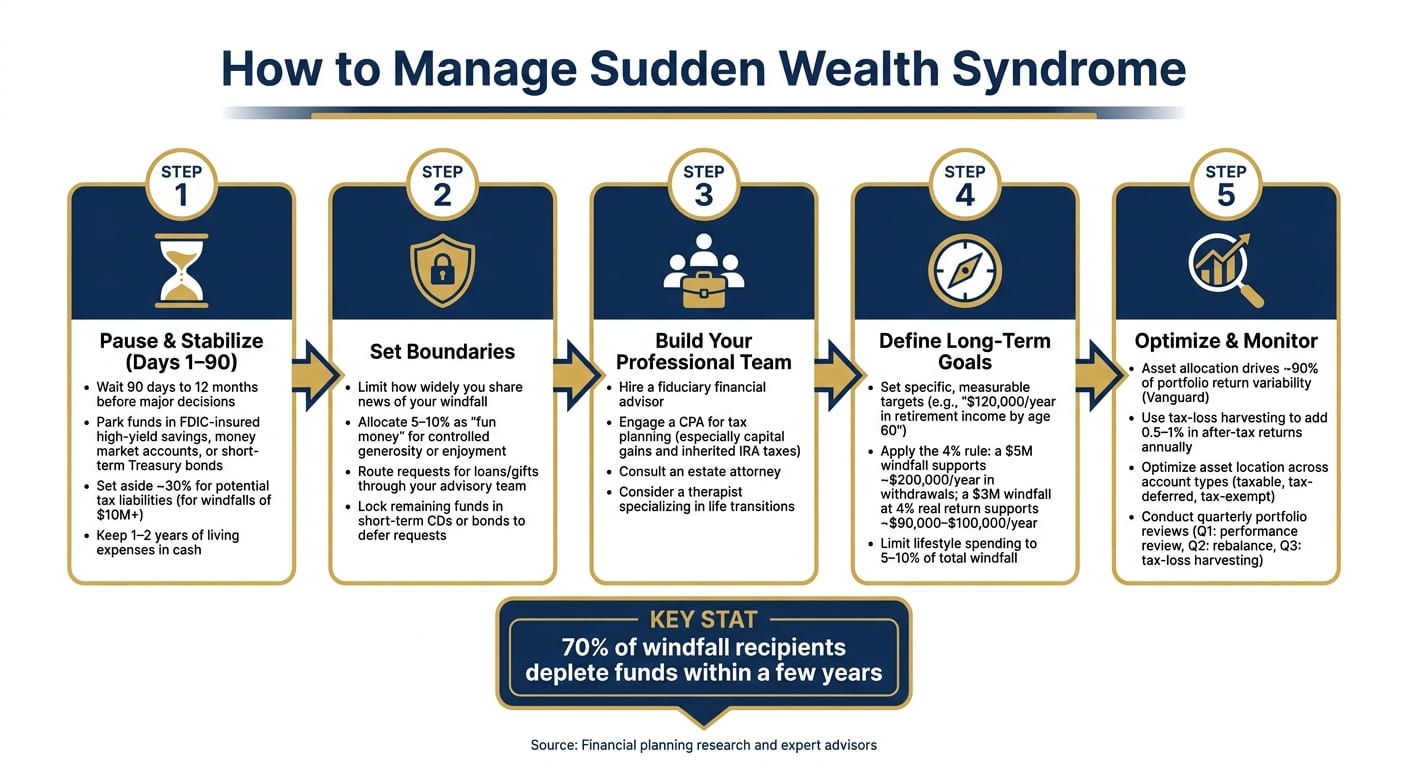
- Pause before making big decisions: Experts suggest waiting 90 days to a year before major purchases or gifts.
- Set boundaries: Limit how widely you share your news and create clear guidelines for requests.
- Work with professionals: Financial advisors, CPAs, and attorneys can provide guidance and help protect your assets.
- Focus on long-term planning: Define clear goals, align investing strategies with your risk tolerance, and prioritize tax-efficient strategies.
How to Manage a Sudden Money Windfall: IPOs, Business Sale, or Inheritance
What Is Sudden Wealth Syndrome?
Sudden Wealth Syndrome (SWS), a term introduced by Dr. Stephen Goldbart, refers to the emotional and behavioral challenges that can follow an unexpected financial windfall. While it’s not a formal diagnosis listed in the DSM, professionals in both financial and mental health fields widely acknowledge it as a genuine phenomenon that can disrupt lives.
At its essence, SWS arises when someone's net worth grows faster than their ability to emotionally and financially adapt. Lex Zaharoff of HTG Advisors explains:
The money arrives before the person's emotional and financial framework is ready to absorb it. Without robust psychological and professional support, outcomes can be devastating.
This concept provides a foundation for understanding the events that trigger SWS and the ripple effects it creates.
What Causes Sudden Wealth Syndrome?
SWS can result from any event that delivers a large financial gain in a short timeframe. Common triggers include tech IPOs, the sale of a business, inheritances, divorce settlements, legal awards, or lottery winnings. Each scenario brings its own psychological hurdles. For instance, a business owner who sells their company may struggle with a loss of identity, transitioning from being a creator to a financial caretaker. Brian Bachelier, CFP at HCW Advisor, describes this challenge:
When wealth is tied to one stock, the emotional attachment runs deeper. It's more than money - it's recognition, loyalty, belief in a mission, even identity.
Inherited wealth often arrives under the shadow of grief, further complicating decision-making during an already emotional time.
These life events set the stage for the emotional and behavioral patterns that often accompany SWS.
Emotional and Behavioral Symptoms
The psychological impact of sudden wealth can be profound. Anxiety often emerges from the overwhelming number of decisions that need to be made. Many experience guilt, sometimes referred to as "financial imposter syndrome", where they feel undeserving of their newfound fortune. Isolation is another common reaction, as individuals may distance themselves from loved ones to avoid feelings of exploitation or misunderstanding.
Behaviorally, responses to SWS tend to fall into two extremes. Some individuals spend recklessly, upgrading their lifestyle, making impulsive investments, or giving away large sums. Others become paralyzed by fear, leaving their money untouched in low-interest accounts to avoid making costly mistakes. Neither approach supports long-term financial well-being.
Consider this: 15.7% of NFL players file for bankruptcy within 12 years of retiring, and 78% face severe financial challenges just two years after leaving the league - even after earning millions during their careers. These statistics highlight the risks of sudden wealth without adequate emotional and financial preparation. Recognizing the symptoms of SWS is a critical first step toward building strategies for lasting financial stability.
Early Warning Signs of Sudden Wealth Syndrome
Recognizing the early indicators of sudden wealth syndrome (SWS) can make navigating this unique financial situation far less overwhelming. Mezzi's AI-driven tools are designed to help identify and address these challenges, which generally fall into two categories: emotional responses and financial behaviors.
Emotional Red Flags
After the initial excitement of a financial windfall subsides, lingering anxiety can emerge as a major emotional red flag. This unease may suggest that decision-making is already being affected. Another common feeling is guilt, particularly after receiving an inheritance. Often referred to as "financial imposter syndrome", this guilt stems from the belief that you don't deserve the money. It can lead to rash decisions, such as giving away funds too quickly or avoiding investments altogether. Additionally, social withdrawal - distancing yourself from friends or family due to doubts about their intentions - is another emotional signal worth noting.
"Sudden wealth offers greater choices, but it can cause a lot of problems and anxiety because of the sheer number of decisions to make." - Barry Glassman, Founder and President, Glassman Wealth Services
These emotional challenges often translate into problematic financial behaviors, making it equally important to keep an eye on your spending patterns.
Financial Red Flags
Behavioral changes often accompany emotional shifts, and they can serve as clear indicators of SWS. One of the most noticeable signs is lifestyle inflation. For example, Barry Glassman recalls a client who sold a business for $15 million and immediately spent $4 million on real estate, incurring $100,000 in new annual carrying costs. While the purchase felt manageable at the time, it created a significant long-term financial burden.
Other financial warning signs include:
- Making large gifts or loans to family members before fully understanding your own financial needs.
- Chasing speculative investments, often based on tips from acquaintances.
- Keeping large amounts of money in low-interest savings accounts out of fear of losing it.
- Neglecting tax and estate planning, which can lead to unexpected obligations, such as capital gains taxes from a business sale or ordinary income taxes from an inherited IRA.
"We have a bias to think that large sums of money will last a long time. There is so much motivation to take the big lump sum and so much that wants to part us from that money." - Sheryl Garrett, Founder, Garrett Planning Network
For perspective, the 4% rule suggests that a $5 million windfall should allow for no more than $200,000 in annual, tax-inclusive withdrawals to ensure long-term sustainability. If your spending habits exceed this level early on, it may be a strong signal to reassess your approach.
First Steps to Take After a Windfall
Pause and Assess
Before making any major financial moves, take a step back. Experts suggest waiting between 90 days and 12 months before diving into significant purchases or gifting. In the meantime, it’s wise to park your funds in secure, easily accessible accounts like FDIC-insured high-yield savings accounts, money market accounts, or short-term Treasury bonds.
"The discipline in the first 90 days is not about avoiding opportunity. It's about avoiding irreversible decisions before your financial structure has caught up with your new reality." - Michael Baker, FSM Wealth Advisors
To ease the pressure of immediate decisions, consider keeping one to two years of living expenses in cash. Additionally, if your windfall is substantial (e.g., $10 million), set aside roughly 30% right away for potential tax liabilities.
Once your funds are secure, focus on creating clear financial boundaries to protect yourself from external demands.
Set Boundaries and Expectations
A windfall often attracts attention, and with it, requests for loans, gifts, or investment opportunities. Unfortunately, statistics show that nearly 70% of windfall recipients deplete their funds within a few years, often due to external pressures.
To safeguard your wealth, limit how widely you share your news. Setting aside 5–10% of the windfall as "fun money" can help you enjoy your newfound wealth responsibly or offer controlled generosity. For the remaining funds, locking them into short-term CDs or bonds can provide a tactful way to defer requests by making the money temporarily inaccessible.
"Set clear boundaries by routing requests through your advisory team to safeguard relationships and assets." - Will Grant, Senior Wealth Manager, 360 Financial
Engaging a professional advisor, such as a CPA, attorney, or fiduciary, can also help. They can handle requests on your behalf, alleviating the discomfort of saying "no" while ensuring your relationships and assets remain intact.
How Mezzi Can Help You Stabilize
Once you've taken these initial steps, technology can play a key role in simplifying wealth management. Mezzi offers a secure platform that consolidates all your financial accounts into a single, real-time view of your net worth.
Using AI, Mezzi provides actionable insights, such as optimizing asset location and identifying capital gains thresholds. As an SEC-registered fiduciary, Mezzi is committed to acting in your best interest, working alongside your CPA and attorney to uncover year-round tax-saving opportunities.
"Asset location - which holdings sit in which accounts - can be worth more than stock picking over time." - Mezzi
This level of strategic insight supports long-term wealth management and complements the foundational steps outlined earlier. Establishing this clarity early on can set the stage for sustained financial stability.
Building a Long-Term Wealth Plan
Once your funds are secure and boundaries are in place, it's time to think long-term. This involves moving past short-term stability and focusing on where you want to be in the next 10, 20, or even 30 years. Start by setting specific goals and aligning your assets to achieve them.
Defining Goals and Priorities
Clear goals lead to actionable plans. Instead of vague aspirations like "I want to be comfortable", aim for something measurable. For instance, you might decide, "I want $120,000 per year in retirement income starting at age 60", or "I want to fully fund four years of in-state college for two children by 2035." These specific targets provide a clear direction for your financial planning.
Mezzi simplifies this process by consolidating your accounts and modeling whether your current assets align with your goals. For example, a $3,000,000 windfall invested at a conservative 4% real return might support approximately $90,000–$100,000 in annual, inflation-adjusted withdrawals. What makes Mezzi stand out is its ability to base these projections on your actual connected accounts, offering a realistic view of your financial situation.
Once your goals are in place, the next step is to align your portfolio with your risk tolerance.
Aligning Asset Allocation With Your Risk Tolerance
Studies from Vanguard reveal that asset allocation accounts for about 90% of the variability in a portfolio's returns over time. In other words, how you allocate your money across stocks, bonds, and cash has a far greater impact than choosing individual investments.
For those with sudden wealth, there's often a disconnect between their emotional comfort with risk and their financial capacity to handle it. Striking the right balance in your asset allocation is critical for preserving wealth over time. Mezzi helps you assess these factors separately. For example, it can identify concentration risks, such as a single stock making up more than 10–15% of your investable assets. In such cases, Mezzi may suggest gradual diversification, like reducing that position by 10–15% each quarter over 12–36 months to minimize both tax burdens and market risks.
The platform also monitors your portfolio for rebalancing opportunities as markets shift. It prioritizes rebalancing within tax-advantaged accounts like IRAs and 401(k)s, helping you avoid unnecessary capital gains taxes in taxable accounts.
Tax-Efficient Wealth Management
Tax efficiency plays a crucial role in growing wealth over time. For example, tax-loss harvesting - selling investments at a loss to offset gains - can potentially add 0.5%–1% per year in after-tax returns. Mezzi keeps an eye on your taxable accounts, flagging losses over $1,000 and suggesting replacement securities to maintain your target allocation without violating wash sale rules.
Another often-overlooked strategy is asset location, which involves placing specific investments in the most tax-efficient accounts. For instance, holding high-yield bonds or REITs in a tax-deferred IRA while keeping index ETFs in a taxable account can improve after-tax returns by 0.2%–0.6% annually, according to Vanguard research. Mezzi analyzes your holdings across all linked accounts and offers step-by-step guidance to optimize their placement. This approach ensures tax efficiency without triggering large, unnecessary tax bills, preserving your wealth for future needs.
Managing the Emotional Side of Sudden Wealth
Tax strategies and portfolio allocation are essential, but they can fall apart if the emotional challenges of sudden wealth aren't addressed. Feelings like anxiety, guilt, or even unworthiness can disrupt your financial stability just as much as poor investment choices.
Healthy Ways to Respond to New Wealth
Sudden wealth often stirs up intense emotions. Studies indicate that 70% of family wealth is lost during the first generational transfer, and by the third generation, 90% of it is gone. Emotional struggles are often at the heart of this decline, leading to impulsive financial decisions.
Lex Zaharoff of HTG Advisors captures this sentiment well:
Why do I deserve this?
It feels wrong to spend money my parents worked their entire lives for.
These feelings are common, but they can lead to costly choices like overspending or avoiding financial planning altogether. Working with a therapist who specializes in life transitions can help you process these emotions in a constructive way. At the same time, grounding your financial decisions in your personal values is essential. Before making significant financial moves, reflect on whether they align with the long-term goals you've set in your wealth plan.
By addressing these emotional challenges, you create a strong foundation for thoughtful and disciplined wealth management.
Staying Financially Disciplined Over Time
Once emotions are in check, maintaining a structured routine becomes critical for long-term financial stability. Mezzi offers more than just financial insights - it helps reinforce a disciplined approach, even during emotionally challenging times. One effective strategy is adopting a quarterly review framework that keeps you informed without overwhelming you. Mezzi enhances this process by providing real-time, data-driven insights tailored to your accounts.
Here’s how a quarterly review might look:
- Q1: Assess the previous year's performance, set contribution goals, and adjust target allocations.
- Q2: Check for portfolio drift and rebalance if needed.
- Q3: Evaluate your year-end tax position and explore tax-loss harvesting opportunities.
This kind of routine can help you stay focused and avoid letting emotions dictate financial decisions. If uncertainty arises, Mezzi’s AI chat can provide personalized guidance. For instance, you might ask, "I need to liquidate $50,000; what holdings should I sell to minimize taxes?" Mezzi responds with advice based on your specific accounts, avoiding generic recommendations.
Conclusion: Turning Sudden Wealth Into Lasting Stability
Sudden wealth doesn’t have to bring stress - it can be an opportunity for growth and security. As Will Grant, Senior Wealth Manager at 360 Financial, wisely says:
Wealth is a tool, not a finish line.
This perspective encourages viewing a financial windfall as a starting point rather than an endpoint. The key is to pause, reflect on your values, and take measured steps - starting with stabilizing your finances, setting clear goals, and then creating a long-term plan.
The emotional and financial sides of sudden wealth are deeply connected. Acting on impulse, falling into lifestyle inflation, or avoiding decisions altogether can jeopardize your future stability. One practical approach is to limit lifestyle spending to just 5–10% of your windfall while channeling the rest toward clearly defined objectives. Combining disciplined strategies with effective financial tools can help turn unexpected wealth into lasting security.
Mezzi supports this journey by connecting your accounts and providing real-time insights to keep your decisions aligned with your long-term goals. And as an SEC-registered fiduciary, Mezzi is legally committed to acting in your best interest at every step.
"Capital alone does not replace planning." - Siebert Financial
A thoughtful, intentional approach is essential for managing new wealth effectively.
FAQs
Do I have sudden wealth syndrome or normal stress?
Sudden wealth syndrome refers to the emotional hurdles that can follow a significant financial windfall. These challenges often go beyond typical stress and may include anxiety, guilt, isolation, mood swings, or struggles with decision-making related to your newfound wealth. You might also find yourself feeling disoriented, questioning others' motives, or even grappling with an identity crisis. If these emotions seem tied to recent financial changes, you could be facing this phenomenon.
What should I do first in the first 90 days after a windfall?
In the first 90 days, prioritize taking a step back and resisting the urge to make quick financial decisions. Consider placing the funds in a secure, easily accessible account, such as a high-yield savings account or a money market fund. Steer clear of significant purchases or lifestyle shifts during this period. Instead, focus on building a team of trusted professionals, gaining clarity on tax responsibilities, and defining your long-term objectives. Once you've done this groundwork, you can work with Mezzi to create a formal financial plan that takes tax considerations into account.
How can I avoid a big tax bill after a large payout?
To avoid an unexpected tax bill, it’s important to address taxes as soon as possible. Start by estimating your potential tax liability with a conservative approach and set aside those funds in a dedicated account. This can help you avoid dipping into money you may need for taxes later.
Consider consulting a CPA early in the process. They can help you explore options such as charitable contributions, setting up trusts, or spreading gains across multiple years to potentially reduce your tax burden. Tools like Mezzi can also help you organize your finances, making it easier to implement tax-efficient strategies with clarity.
Lastly, avoid rushing into big financial decisions. Taking the time to plan strategically can make a significant difference.
Disclosures:
- This content is for informational purposes only and does not constitute investment advice or a recommendation to buy or sell any security.
- Past performance is not indicative of future results. No guarantee of future performance or outcomes is implied.
- Always consult with a qualified financial advisor before making investment or financial planning decisions.
Related Blog Posts
- Why wealth management is important
- High-Net-Worth Financial Planning Guide
- AI in Wealth Transfer: Legal and Tax Insights
- Income vs net worth: why high earners are often still asset-poor
Sudden wealth syndrome refers to the emotional hurdles that can follow a significant financial windfall. These challenges often go beyond typical stress and may include anxiety, guilt, isolation, mood swings, or struggles with decision-making related to your newfound wealth. You might also find yourself feeling disoriented, questioning others' motives, or even grappling with an identity crisis. If these emotions seem tied to recent financial changes, you could be facing this phenomenon.
In the first 90 days, prioritize taking a step back and resisting the urge to make quick financial decisions. Consider placing the funds in a secure, easily accessible account, such as a high-yield savings account or a money market fund. Steer clear of significant purchases or lifestyle shifts during this period. Instead, focus on building a team of trusted professionals, gaining clarity on tax responsibilities, and defining your long-term objectives. Once you've done this groundwork, you can work with Mezzi to create a formal financial plan that takes tax considerations into account.
To avoid an unexpected tax bill, it’s important to address taxes as soon as possible. Start by estimating your potential tax liability with a conservative approach and set aside those funds in a dedicated account. This can help you avoid dipping into money you may need for taxes later.
Consider consulting a CPA early in the process. They can help you explore options such as charitable contributions, setting up trusts, or spreading gains across multiple years to potentially reduce your tax burden. Tools like Mezzi can also help you organize your finances, making it easier to implement tax-efficient strategies with clarity.
Lastly, avoid rushing into big financial decisions. Taking the time to plan strategically can make a significant difference.