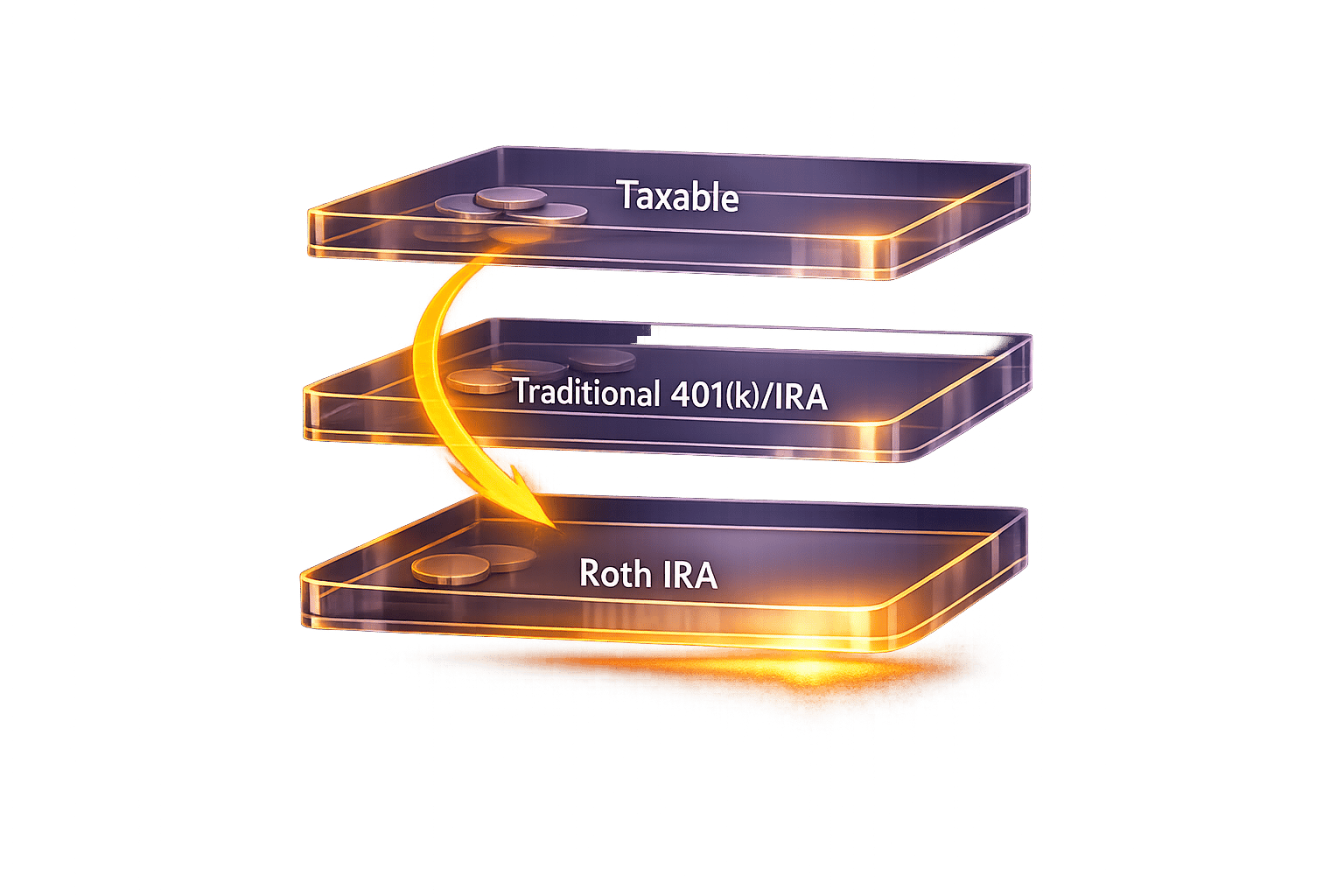
Retirement withdrawals can significantly impact your taxes and long-term savings. The sequence in which you withdraw from taxable, tax-deferred, and tax-exempt accounts matters. Here's a quick breakdown:
- Start with taxable accounts: These accounts are taxed only on gains, allowing tax-deferred and Roth accounts to grow longer.
- Move to tax-deferred accounts: Withdrawals are taxed as ordinary income, and Required Minimum Distributions (RMDs) start at age 73 or 75 (depending on birth year).
- Save Roth accounts for last: Withdrawals are tax-free, and they don’t require RMDs, making them great for long-term growth or inheritance.
This standard approach works for many but may not suit everyone. Strategies like Roth conversions, proportional withdrawals, or filling lower tax brackets early can help reduce lifetime taxes and extend portfolio longevity. Planning ahead is key to minimizing taxes and maximizing retirement savings.
Step-by-Step Guide to Tax-Efficient Retirement Withdrawals: Social Security, Roth IRAs & 401(k)s
3 Types of Retirement Accounts and How They're Taxed
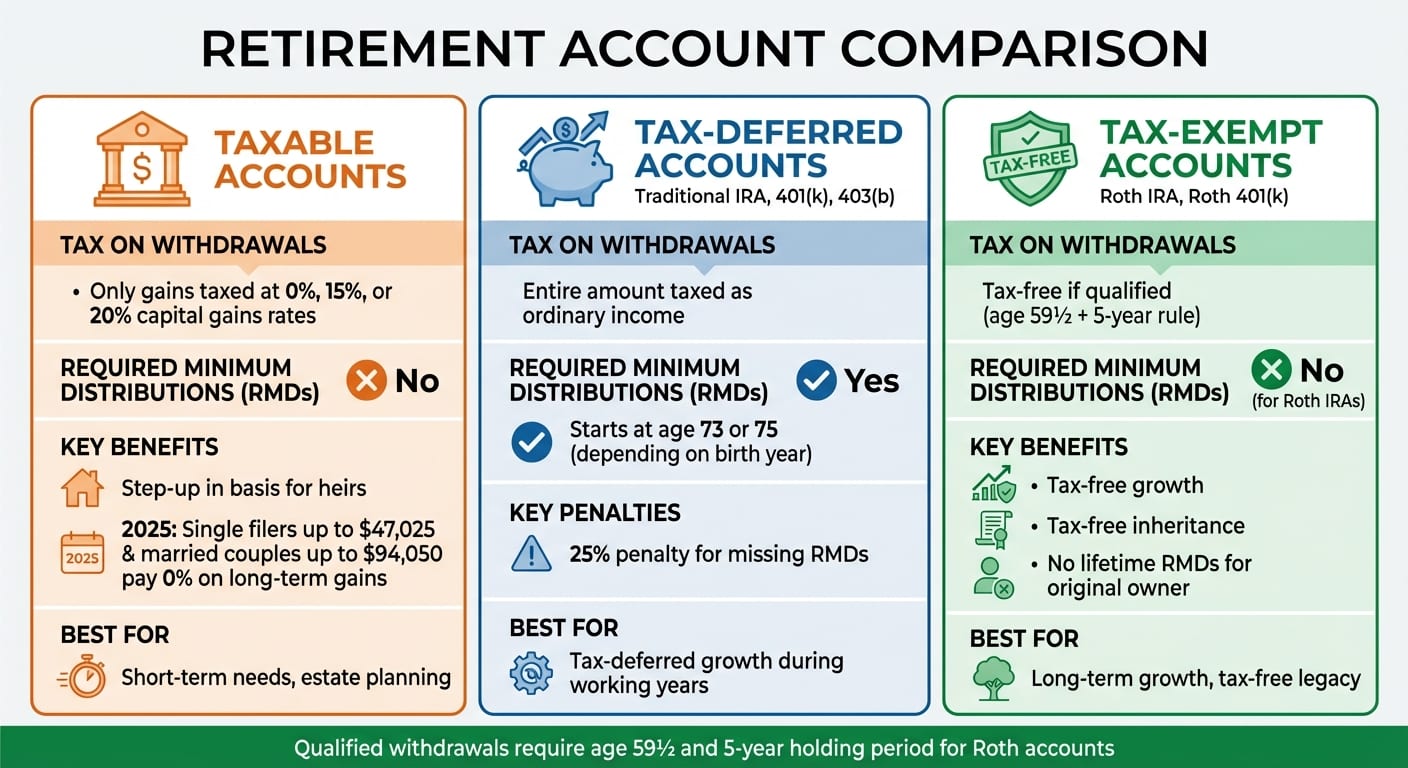
When it comes to retirement savings, your money typically falls into three distinct categories, each with its own tax rules. Understanding these rules is essential for crafting a smart withdrawal strategy during retirement.
Taxable Accounts
Taxable accounts, such as brokerage and savings accounts, are funded with money you've already paid taxes on. The good news? You only owe taxes on the growth of your investments, not the full withdrawal amount. When you sell investments, you'll pay capital gains tax on the appreciation. Assets held for more than a year qualify for long-term capital gains rates of 0%, 15%, or 20%, which are often lower than ordinary income tax rates.
For example, in 2025, single filers with taxable income up to $47,025 and married couples filing jointly with income up to $94,050 can sell appreciated assets and owe no federal tax on those gains. Qualified dividends also benefit from these favorable tax rates, unlike non-qualified dividends.
"Taxable brokerage accounts are your least tax-efficient accounts, subject to capital gains and dividend taxes." - Marc Knauss, CFP, Financial Planner, Decker Retirement Planning
Another perk: if you pass away, your heirs receive a "step-up in basis." This means the cost basis adjusts to the market value at the time of your death, effectively erasing any capital gains tax on the appreciation during your lifetime.
Tax-Deferred Accounts
Tax-deferred accounts - like traditional IRAs, 401(k)s, and 403(b)s - offer another avenue for retirement savings. Contributions are made with pre-tax dollars, but withdrawals are fully taxed as ordinary income, including both your original contributions and any investment growth.
These accounts come with a catch: Required Minimum Distributions (RMDs). Starting at age 73 (or 75 for those born in 1960 or later), you're required to withdraw a minimum amount each year. Failing to take your RMD triggers a hefty 25% penalty on the amount you should have withdrawn.
Tax-Exempt Accounts
Tax-exempt accounts, such as Roth IRAs and Roth 401(k)s, work differently. Since contributions are made with after-tax dollars, qualified withdrawals are entirely tax-free, including any growth your investments have earned over time. To qualify, you need to be at least 59½ years old and have held the account for at least five years.
A major advantage of Roth IRAs is that they have no RMDs for the original account holder. This allows your money to grow tax-free for the rest of your life, making Roth accounts an excellent choice for leaving a tax-free inheritance. Additionally, Roth 401(k) balances can be rolled into a Roth IRA to avoid RMDs altogether.
By grasping these tax nuances, you can determine the best withdrawal strategy to minimize taxes and make your retirement savings go further.
The Standard Withdrawal Order: Taxable, Tax-Deferred, Then Tax-Exempt
The general rule of thumb for retirement withdrawals is straightforward: start with taxable accounts, move to tax-deferred accounts, and save tax-exempt accounts for last. This method aims to reduce your tax burden early on while allowing your tax-advantaged accounts to grow over time.
"The traditional approach is to withdraw first from taxable accounts, then tax-deferred accounts, and finally Roth accounts where withdrawals are tax free. The goal is to allow tax-deferred and Roth assets the opportunity to grow over more time." - Andrew Bachman, Director of Financial Solutions, Fidelity Investments
This strategy takes advantage of the tax-efficient nature of taxable withdrawals. Taxable accounts, like brokerage accounts, are subject to annual taxes on interest, dividends, and capital gains, which can hinder their growth compared to tax-advantaged accounts. By prioritizing withdrawals from these accounts, you give your tax-deferred and Roth accounts more time to grow without the drag of annual taxes. Additionally, spending down taxable accounts first avoids triggering higher ordinary income tax rates, preserving the tax benefits of your retirement accounts.
However, this approach has a potential downside: the "RMD tax tsunami". By delaying withdrawals from tax-deferred accounts, you risk letting these accounts grow so large that when Required Minimum Distributions (RMDs) start at age 73, they could push you into higher tax brackets. This can significantly reduce your retirement income due to increased tax liabilities.
"In my experience, retirees hate taxes, and oftentimes, avoiding some taxes today means paying substantially more taxes later." - David Rae, President, DRM Wealth Management
While the standard withdrawal order works well for many retirees, it’s not a universal solution. A personalized withdrawal strategy can make a big difference, potentially extending the life of your savings by several years. Evaluating your unique financial situation can help determine whether this traditional method or a customized plan is better for you. Up next: strategies to optimize your Required Minimum Distributions and minimize tax impacts.
How to Manage Required Minimum Distributions (RMDs)
RMD Rules Explained
Once you turn 73, you're required to withdraw a minimum amount each year from your tax-deferred accounts. This rule applies to accounts like traditional IRAs, SEP IRAs, SIMPLE IRAs, 401(k)s, 403(b)s, and 457(b) plans. However, Roth IRAs are exempt during your lifetime, and starting in 2024, designated Roth accounts (like Roth 401(k)s) will also be exempt for the original account owner.
The calculation for your RMD is straightforward. Take your account balance as of December 31 from the previous year and divide it by a life expectancy factor from the IRS Uniform Lifetime Table. For example, at age 73, the distribution period is 26.5 years, meaning you'd withdraw approximately 3.77% of your account balance. By age 90, this percentage increases to about 8.20%. You must take your RMD by December 31 each year, although you can delay your first RMD until April 1 of the following year. Keep in mind, delaying means you'll need to take two distributions in the same tax year, which could have tax implications.
Failing to meet the RMD deadline can be costly. The penalty for not withdrawing the full amount is 25% of the shortfall. However, this penalty may drop to 10% if corrected within two years. Although your account custodian might provide an RMD estimate by January 31, the responsibility to ensure the correct amount is withdrawn falls entirely on you.
"If you automate, you could avoid the potentially costly consequences of forgetting to take your RMD."
– Andrew Bachman, Director Financial Solutions, Fidelity
There are a few additional nuances to consider. For individuals born in 1960 or later, the RMD starting age will increase to 75 beginning in 2033. If you're still working at age 73 and own 5% or less of your company, you might be able to delay RMDs from your current employer's 401(k) until you retire.
Understanding these rules is key to managing your RMDs efficiently and minimizing their tax impact.
Ways to Reduce the Tax Impact of RMDs
RMDs are taxed as ordinary income, which can push you into a higher tax bracket, increase your Medicare premiums, and even make more of your Social Security benefits taxable. Here are some strategies to help ease the tax burden:
Qualified Charitable Distributions (QCDs)
If you're 70½ or older, you can transfer up to $111,000 (for 2026) directly from your IRA to a qualified charity. This satisfies your RMD requirement without adding to your adjusted gross income. For couples filing jointly, this benefit essentially doubles, allowing for up to $222,000 in QCDs.
Alternative Withdrawal Options
If you don't need the RMD for living expenses, consider reinvesting it in a taxable brokerage account. You could also use the funds to purchase permanent life insurance, which transforms the taxable distribution into a tax-free death benefit for your heirs. Another option is to take the distribution in-kind by transferring shares from your IRA to a taxable account. While taxes are due on the value of the shares at the time of transfer, this approach can provide flexibility in managing your investments.
Proactive Account Management
Taking steps before RMDs begin can significantly reduce your tax-deferred account balance - and your future tax burden. Between the ages of 59½ and 73, you can make voluntary withdrawals to fill lower tax brackets, such as the 12% or 22% brackets. Another effective strategy is converting portions of your tax-deferred accounts to Roth IRAs during this time. Since Roth IRAs don't require RMDs during the original owner's lifetime, this move can eliminate future mandatory withdrawals altogether.
"If you ignore RMDs until you are required to take them, you will be overpaying taxes in retirement."
– David Rae, President, DRM Wealth Management
These strategies can work alongside other withdrawal approaches to help you manage your tax liability more effectively. By planning ahead, you can minimize the impact of RMDs and keep more of your retirement savings.
Other Withdrawal Strategies to Lower Your Taxes
When it comes to retirement withdrawals, sticking to the standard sequence isn’t your only option. Your personal tax situation and long-term goals play a big role in shaping the best strategy for you. Beyond the usual methods, there are alternative approaches that can help fine-tune your withdrawals, potentially lowering your tax bill while preserving your savings.
Bracket-Topping Strategy
This strategy focuses on withdrawing from tax-deferred accounts up to the limit of a lower tax bracket, then supplementing your income with taxable or Roth accounts. The goal? To fill lower tax brackets - like the 10%, 12%, or 22% brackets - early in retirement. This helps keep future Required Minimum Distributions (RMDs) more manageable.
The period between retirement and age 73, often called the "tax trough", is a prime opportunity for this approach. For example, a T. Rowe Price study found that a married couple, both age 65, with a $2 million portfolio and $120,000 annual spending, saved $35,000 in lifetime taxes by strategically filling the 10%–12% tax brackets before claiming Social Security at age 70. This strategy also left their heirs $106,000 richer after taxes.
However, tax laws, RMD rules, and portfolio balances can shift over time. It’s crucial to reassess your strategy annually to avoid crossing income thresholds that could increase Social Security taxes or Medicare premiums. If a step-by-step withdrawal plan feels too rigid, you might explore a more integrated, smoother approach.
Proportional Withdrawal Strategy
Rather than focusing on one account type at a time, the proportional strategy spreads withdrawals across all your accounts - taxable, tax-deferred, and tax-exempt - based on their share of your total portfolio. For instance, if your portfolio is 60% tax-deferred, 30% taxable, and 10% Roth, and you need $50,000 for the year, you’d withdraw approximately $30,000 from tax-deferred accounts, $15,000 from taxable accounts, and $5,000 from Roth accounts.
This method helps smooth out taxable income over time, avoiding sharp tax increases when RMDs kick in. A hypothetical retiree with a $500,000 portfolio reduced lifetime taxes by over 40% - from $56,000 to about $31,500 - using this approach, while also extending their portfolio’s longevity by one year.
"A proportional withdrawal strategy can be especially effective for retirees with sizable pre-tax accounts like 401(k)s, 403(b)s, or IRAs. The core benefit is that this approach can allow retirees to optimize tax efficiency by utilizing lower income tax years and reducing the risk of larger, bracket-accelerating distributions in future years."
– Kayla R. Fernandez, Financial Advisor, California Financial Advisors
This approach also stabilizes taxable income, minimizing the taxation of Social Security benefits and reducing the chance of Medicare premium hikes. Once RMDs begin, these distributions take priority, with proportional withdrawals from other accounts covering any additional income needs. It’s a well-rounded method for balancing taxable income and avoiding sudden tax spikes.
Roth Conversion Strategy
Roth conversions let you move funds from tax-deferred accounts into a Roth IRA by paying taxes on the converted amount now. This can be especially effective during years when you’re in a lower tax bracket - typically after retirement but before Social Security or RMDs begin. Converting smaller amounts during this window can shrink future taxable distributions and reduce the portion of your Social Security benefits that gets taxed.
For example, a T. Rowe Price analysis looked at a single retiree born in December 1959 with $600,000 in total assets ($450,000 in tax-deferred accounts, $100,000 in taxable accounts, and $50,000 in Roth accounts). By converting $123,000 over three years starting at age 66 - before claiming Social Security at age 70 - she reduced the taxable portion of her Social Security benefits from 52% to 24% on average. This strategy cut her lifetime taxes by $36,000 and boosted her after-tax legacy by $22,000.
"Roth conversions aren't only for people in high tax brackets who will leave large estates. In some cases, they can also help people at lower income levels reduce taxes on their Social Security benefits."
– Roger Young, CFP, T. Rowe Price
Keep in mind that Roth conversions increase your Adjusted Gross Income in the year of conversion, which could lead to higher Medicare premiums. Additionally, you must wait five years after a conversion before withdrawing the converted principal tax-free, so plan carefully to align with your liquidity needs. Converting just enough to stay within your current tax bracket is often the best move.
Mezzi’s AI-driven tools can help you identify withdrawal strategies that align with your tax profile, account balances, and retirement timeline. These tools are designed to support your planning process and may improve the efficiency of your retirement plan.
Early Withdrawals: Rules, Penalties, and Exceptions
Life doesn’t always go as planned, and sometimes you may need to dip into your retirement savings earlier than expected. Whether you’re retiring in your 50s or dealing with an unexpected financial challenge, understanding the rules for early withdrawals can help you avoid unnecessary penalties and make informed decisions about accessing your funds.
How Early Withdrawal Penalties Work
Accessing money from tax-deferred retirement accounts before age 59½ typically triggers a 10% penalty on the taxable portion of the withdrawal. For example, if you take $20,000 from a Traditional IRA at age 55, you’ll owe ordinary income tax on that amount, plus an additional $2,000 penalty.
"The 10% additional tax is charged on the early distribution amount you must include in your income and is in addition to any regular income tax from including this amount in income." – Internal Revenue Service
Some accounts have even stricter rules. For instance, SIMPLE IRAs impose a 25% penalty if you withdraw funds within the first two years of participation. On the other hand, governmental 457(b) plans don’t generally penalize early withdrawals after you leave your job, making them a potential lifeline for early retirees.
Roth IRAs operate differently. You can withdraw your original contributions tax-free at any time. However, withdrawing earnings before age 59½ - and before meeting the five-year holding period - results in income tax and a 10% penalty unless you qualify for an exception.
When You Can Avoid the Early Withdrawal Penalty
The IRS offers several exceptions to the 10% penalty, though regular income taxes may still apply. For instance, if your unreimbursed medical expenses exceed 7.5% of your adjusted gross income, you can withdraw funds penalty-free. Other exceptions include withdrawals due to disability or after the account holder’s death.
One popular exception is the "Rule of 55." If you leave your job during or after the year you turn 55, you can access your 401(k) or 403(b) without penalty. However, this rule doesn’t extend to IRAs. Christine Benz, Director of Personal Finance and Retirement Planning at Morningstar, explains:
If you're between 55 and 59 1/2 and you left your employer after you turned 55, you can tap your 401(k) without penalty.
For certain public safety employees, like firefighters and police officers, the age threshold for penalty-free withdrawals drops to 50.
IRAs have their own set of exceptions. You can withdraw funds penalty-free for specific purposes, such as:
- Higher education expenses
- First-time home purchases (up to $10,000 lifetime limit)
- Paying health insurance premiums while unemployed
Employer-sponsored plans like 401(k)s also have unique exceptions. For instance, distributions made under a Qualified Domestic Relations Order (QDRO) during a divorce are penalty-free, but this doesn’t apply to IRAs.
Other penalty-free withdrawal options include:
- Up to $5,000 per child for qualified birth or adoption expenses
- Up to $1,000 annually for emergency personal expenses
- Up to the lesser of $10,000 or 50% of your account balance for domestic abuse victims
If you need regular income before 59½, you might explore Substantially Equal Periodic Payments (SEPP) under IRS Section 72(t). This method requires fixed withdrawals for either five years or until you turn 59½, whichever is longer.
Finally, ensure your 1099-R form reflects the correct exception code, or file Form 5329 to claim your exemption.
Conclusion
Creating a withdrawal strategy that fits your financial needs and tax situation is essential. While the traditional approach - drawing from taxable accounts first, then tax-deferred, and finally tax-exempt accounts - works for some, it may miss opportunities to optimize taxes early in retirement.
"There isn't a one-size-fits-all solution to withdrawal sequencing because an investor's strategy will be determined by age and tax rate when taking the withdrawal." - Christine Benz, Director of Personal Finance and Retirement Planning at Morningstar
The best strategy for you depends on several factors, including your current tax bracket, the size of your tax-deferred accounts, the timing of Social Security benefits, and your long-term goals. Options like Roth conversions, strategic IRA withdrawals, or adjusting withdrawal timing can help reduce your tax burden significantly.
These decisions highlight how even small adjustments can make a big difference in managing taxes. Tools like Mezzi simplify this process by modeling different withdrawal scenarios, tracking cost basis, and identifying tax-saving opportunities. With AI-driven insights, you may be able to make more informed decisions and reduce taxes, potentially extending the life of your retirement savings.
Now is the time to take action. Review your account balances, evaluate your current and future tax brackets, and explore strategies like bracket-topping or proportional withdrawals. A solid withdrawal plan not only protects your savings but also aligns with your broader retirement goals, ensuring a tax-efficient and secure future.
FAQs
When should I deviate from the “taxable, then tax-deferred, then Roth” order?
You might need to change the order of withdrawals if shifts in your tax situation or retirement goals make it more advantageous. For example, you may want to avoid moving into a higher tax bracket, manage Required Minimum Distributions (RMDs), or apply strategies such as Roth conversions or capital loss harvesting to improve tax outcomes. Tweaking the sequence of withdrawals can better align your approach with your financial goals.
How can I reduce future RMDs before they start?
To potentially reduce future Required Minimum Distributions (RMDs), you might want to withdraw from tax-deferred accounts, such as traditional IRAs or 401(k)s, before reaching age 73. Lowering these account balances early can decrease the amount subject to RMDs later. Another option is converting funds into Roth accounts since Roth IRAs are not affected by RMD rules. Strategically timing withdrawals during years when your income is lower can also help lessen the tax burden and shrink future RMD amounts.
Will my withdrawals increase taxes on Social Security or Medicare premiums?
Withdrawals can bump up your taxable income, which might influence Medicare premiums and how much of your Social Security benefits are taxed. Although withdrawals themselves don’t directly increase Social Security or Medicare taxes, they can push your income into higher brackets. This shift could lead to higher premiums or additional taxes. Thoughtful planning can help you navigate and potentially minimize these effects.
Disclosures:
- This content is for informational purposes only and does not constitute investment advice or a recommendation to buy or sell any security.
- Past performance is not indicative of future results. No guarantee of future performance or outcomes is implied. Users should not rely solely on AI-driven tools for financial decision-making.
- Registration does not imply a certain level of skill or that the SEC has approved the company or its services.
- Savings and performance examples are hypothetical and for illustrative purposes only. Actual results will vary based on individual circumstances, portfolio composition, market conditions, and fees.
Related Blog Posts
- 7 Steps to Minimize Taxes on Retirement Withdrawals
- When can you start pulling from a 401k?
- How can I minimize taxes when withdrawing from tax-advantaged accounts?
- Tax-efficient withdrawal sequencing: which accounts to pull from first
You might need to change the order of withdrawals if shifts in your tax situation or retirement goals make it more advantageous. For example, you may want to avoid moving into a higher tax bracket, manage Required Minimum Distributions (RMDs), or apply strategies such as Roth conversions or capital loss harvesting to improve tax outcomes. Tweaking the sequence of withdrawals can better align your approach with your financial goals.
To potentially reduce future Required Minimum Distributions (RMDs), you might want to withdraw from tax-deferred accounts, such as traditional IRAs or 401(k)s, before reaching age 73. Lowering these account balances early can decrease the amount subject to RMDs later. Another option is converting funds into Roth accounts since Roth IRAs are not affected by RMD rules. Strategically timing withdrawals during years when your income is lower can also help lessen the tax burden and shrink future RMD amounts.
Withdrawals can bump up your taxable income, which might influence Medicare premiums and how much of your Social Security benefits are taxed. Although withdrawals themselves don’t directly increase Social Security or Medicare taxes, they can push your income into higher brackets. This shift could lead to higher premiums or additional taxes. Thoughtful planning can help you navigate and potentially minimize these effects.