
A low-income year may open the door to a 0% federal tax rate on long-term capital gains. That may let me sell appreciated investments in a taxable account, buy them back, and reset my cost basis at a higher price.
Here’s the short version:
- This may apply only to long-term gains in a taxable brokerage account
- The key number may be taxable income, not gross income
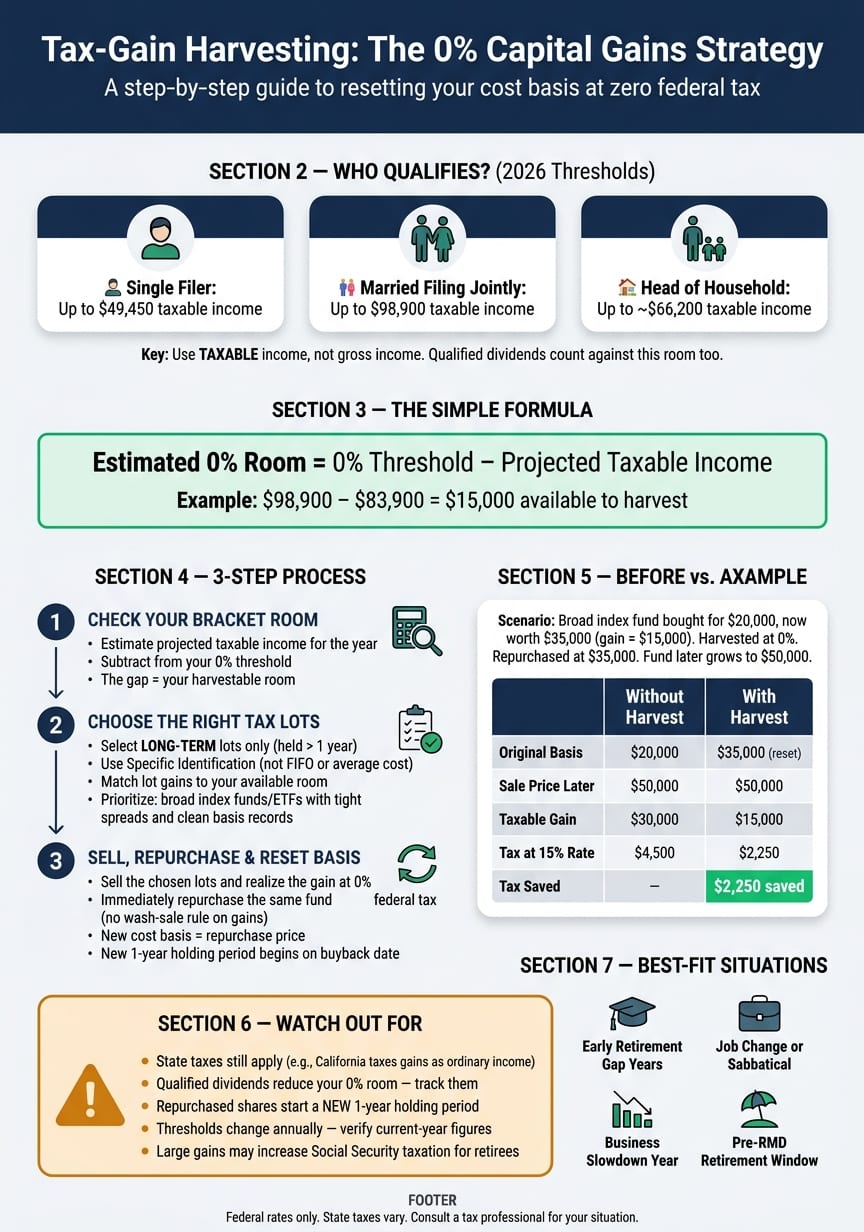
- For 2026, the 0% federal long-term capital-gains bracket may go up to $49,450 for single filers, $98,900 for married filing jointly, and about $66,200 for head of household
- Qualified dividends may use the same 0% room
- State tax may still apply
- Wash-sale rules may not apply to gains, so an immediate buyback may be possible
- The main goal may be to reset basis now so a later taxable gain may be smaller
What tends to trip people up? They may look at gross income instead of taxable income, forget to count qualified dividends, or sell the wrong tax lots.
A simple way to think about it:
Estimated 0% room = 0% threshold − projected taxable income
If that gap remains open, some investors may use it to realize gains at a 0% federal rate. The trade-off: the new shares start a new one-year holding period.
How to Sell Investments While Targeting the 0% Capital Gains Bracket
Quick comparison
So if my income for 2026 may land on the low side, this may be less about “avoiding gains” and more about using a tax bracket that many people overlook.
Step 1: Check whether you have room in the 0% federal capital-gains bracket
Before selling anything, estimate how much of the 0% bracket you may have left. That gap may be your room to harvest gains.
Use taxable income, not gross income
In a low-income year, unused 0% bracket room may become a planning opportunity. Once you’ve identified that room, the idea may be to fill it on purpose. Compare your projected year-end taxable income with your 0% threshold. Wages, RMDs, and other ordinary income may fill lower brackets first. Qualified dividends and short-term gains may also use bracket room.
How to estimate your remaining 0% bracket room
Estimated room = 0% threshold − projected taxable income
If your projected taxable income may fall below the threshold, the difference may be your available room. If it may land above the threshold, you may no longer have room for 0% long-term gains. That room may be the amount you’re able to realize now while keeping federal long-term gains at 0%.
State tax may still apply.
Once you know your room, the next step may be choosing which lots to use to fill it.
Step 2: Choose which taxable holdings to harvest
Once you've estimated your remaining 0% room, the next step is picking the lots that may fit inside it. This is where a lot of people get tripped up. If your account defaults to FIFO, you may end up selling the wrong shares. Specific lot identification gives you more control because you pick the exact shares and the exact gain you want to realize.
Review cost basis, holding period, and unrealized gain by lot
Open the Positions or Tax lots view in your taxable brokerage account and look at each tax lot on its own. Most major U.S. brokers show the purchase date, cost basis per share, share count, and unrealized gain for each lot.
Start with holding period. For this approach, use only lots held for more than one year. Short-term gains are taxed at ordinary income rates and may not fit this setup.
After that, compare the long-term lots by unrealized dollar gain. If your room may be about $2,500, look for lots that add up to roughly $2,500 of long-term gain. The idea is simple: use today's unused 0% room while increasing basis for later sales.
Lots that are close to the one-year mark need a closer look. Check the exact trade date in your transaction history. If a lot becomes long-term in a few weeks, waiting until after the one-year anniversary may make more sense.
Good candidates versus poor candidates for harvesting
Not every appreciated holding may be worth harvesting. A simple way to sort them is by gain size, liquidity, and how clean the records look.
When it's time to enter the sale, choose specific identification in the trade ticket. Not FIFO. Not average cost. Not LIFO. Pick the lots by purchase date and share count, then keep the trade confirmation.
After settlement, check your broker's realized gains report to confirm the sale shows up as long-term.
Step 3: Sell, repurchase if needed, and reset your basis
After you pick the lots, the next part may be pretty mechanical.
You sell the chosen long-term shares. Then, if you want to keep the position, you may buy them back right away. If the gain fits within your remaining 0% federal capital-gains bracket room, you may realize that gain at 0% federal tax and reset your cost basis to the new purchase price. From there, any later growth may be measured from that higher basis, which may mean a smaller taxable gain when you sell down the road.
The big question for many people: do you have to wait before buying back?
For tax-loss harvesting, the wash-sale rule may disallow a loss deduction if you repurchase a substantially identical security within 30 days before or after the sale. But tax-gain harvesting creates a realized gain, not a loss. So on that point, the wash-sale rule does not apply. In many cases, someone may repurchase the same fund the same day without creating a wash-sale issue.
One detail is easy to miss: the repurchased shares start a new one-year holding period on the date of the buyback. So if you may want to sell again soon, that timing may matter.
A before-and-after basis example
Here’s how this may look in practice.
Say you bought a broad U.S. index fund for $20,000 a few years ago. It’s now worth $35,000, so you have an unrealized long-term gain of $15,000. This year, you may have enough room in the 0% bracket to absorb that gain.
You sell for $35,000, realize the $15,000 gain, and owe $0 in federal tax on that gain. Then you immediately repurchase the same fund for $35,000. Your new cost basis becomes $35,000 instead of $20,000.
A few years later, say the fund grows to $50,000 and you sell.
- Without the harvest, your taxable gain would be $30,000 ($50,000 - $20,000).
- With the harvest, your taxable gain would be $15,000 ($50,000 - $35,000).
If you’re in the 15% federal capital-gains bracket at that later point, cutting the gain in half may reduce federal tax by $2,250. That tax result may come from using a low-income year to reset the basis higher.
State tax may still apply.
When this strategy works, where it breaks down, and what to track going forward
Best-fit situations: retirees, early retirees, job changes, and other low-income years
Tax-gain harvesting may make sense in low-income years. It's a tax move, not a market-timing move.
That may include the gap between retirement and the start of Social Security or RMDs. It may also come up during a sabbatical, a job change, a business slowdown, or a year with job loss. The window may close fast once other income starts filling the bracket.
For retirees, one more detail may matter: a large gain may make more of Social Security taxable.
Key limits: state taxes, threshold changes, and incomplete account data
Most of the attention goes to the federal 0% rate. But state capital-gains taxes may still apply in most states. California, for example, taxes capital gains as ordinary income and does not offer a lower capital-gains rate. Depending on where you live, state taxes may shrink the upside. And because thresholds change each year, last year's figures may miss the mark.
The biggest place this may break down is incomplete data. Qualified dividends and long-term gains share the same 0% room, so a dividend-heavy taxable portfolio may quietly reduce your harvesting capacity before you spot it. Add a spouse's income on a joint return, a mid-year freelance payment, or a prior sale you forgot about, and gains may spill into the 15% bracket.
Because dividends and gains share that same room, it may help to track them together. A full view of taxable accounts may make it easier to see lot-level gains, qualified dividends, and year-to-date realized gains in one place.
A few items may be worth watching through year-end:
- Realized gains
- Qualified dividends
- Basis changes
- Income through year-end
That kind of tracking may lower the odds of overshooting the 0% bracket.
FAQs
Who qualifies for tax-gain harvesting?
Investors with taxable income low enough to fall into the 0% federal long-term capital gains tax bracket may find tax-gain harvesting worth looking at.
This often comes up for retirees, people going through lower-income years, and early-career earners. Whether it applies may depend on your total taxable income and filing status.
How do I know how much 0% gain room I have?
Compare your total taxable income with the current federal threshold for the 0% long-term capital gains bracket. For 2025, that rate may apply to taxable income up to $44,625 for single filers.
To estimate your room, subtract your projected annual taxable income from that $44,625 limit. A look at your prior-year Form 1040 may help you spot income patterns and times when tax-free gains may be possible.
Can tax-gain harvesting affect Social Security or state taxes?
Yes, potentially. Tax-gain harvesting may be a federal income tax strategy, but state tax laws may affect the overall benefit.
Realizing capital gains, even at the 0% federal rate, may increase your adjusted gross income. That may affect how Social Security gets taxed and may also change state-level tax results based on where you live.
Disclosures:
- This content is for informational purposes only and does not constitute investment advice or a recommendation to buy or sell any security.
- Past performance is not indicative of future results. No guarantee of future performance or outcomes is implied.
- Tax laws are subject to change and individual circumstances may vary. Consult a qualified tax professional for personalized advice.
- State and local tax laws may differ from federal tax laws and may affect the outcome of tax strategies discussed.
Related Blog Posts
- Tax-Loss Harvesting: Best Seasons for Maximum Savings
- Tax-Loss Harvesting Across Multiple Accounts: A Complete Guide
- Tax-Loss Harvesting Tools: How to Find Losses Hiding in Your Portfolio
- Capital Gains Tax Calculator for Your Investment Portfolio
Investors with taxable income low enough to fall into the 0% federal long-term capital gains tax bracket may find tax-gain harvesting worth looking at.
This often comes up for retirees, people going through lower-income years, and early-career earners. Whether it applies may depend on your total taxable income and filing status.
Compare your total taxable income with the current federal threshold for the 0% long-term capital gains bracket. For 2025, that rate may apply to taxable income up to $44,625 for single filers.
To estimate your room, subtract your projected annual taxable income from that $44,625 limit. A look at your prior-year Form 1040 may help you spot income patterns and times when tax-free gains may be possible.
Yes, potentially. Tax-gain harvesting may be a federal income tax strategy, but state tax laws may affect the overall benefit.
Realizing capital gains, even at the 0% federal rate, may increase your adjusted gross income. That may affect how Social Security gets taxed and may also change state-level tax results based on where you live.