
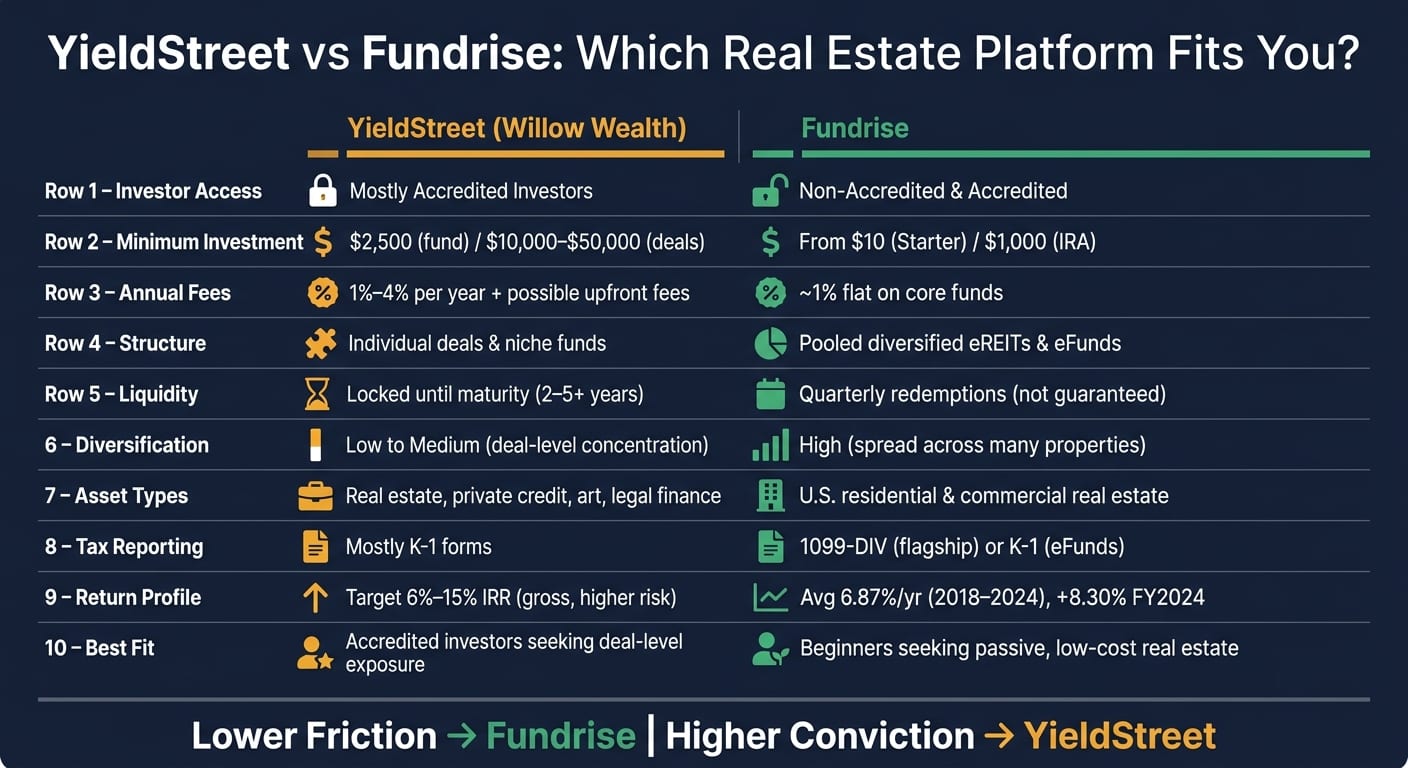
If I had to sum it up in one line: Fundrise may fit people who want a low-cost, low-minimum, hands-off way to get private real estate exposure, while YieldStreet may fit accredited investors who want to pick higher-minimum deals and accept more lockup and deal risk.
Here’s the short version:
- Fundrise starts at $10 and is open to non-accredited and accredited U.S. investors.
- YieldStreet (now Willow Wealth) usually starts at $2,500 for a fund and $10,000+ for many individual deals.
- Fundrise uses pooled real estate funds, which may spread risk across more properties.
- YieldStreet often offers deal-by-deal access, which may give more choice but may also leave investors more exposed to one deal going wrong.
- Fundrise core fees are about 1.00% per year.
- YieldStreet fees may vary by offering and may run 1% to 4% annually, sometimes with upfront fees too.
- Liquidity may be limited on both, but YieldStreet deals are often locked until maturity, while Fundrise may allow quarterly redemption requests that are not guaranteed.
My take: if someone wants simple access and broad spread with a small starting amount, Fundrise may look easier. If someone is accredited, comfortable tying up more money, and wants more say in each investment, YieldStreet may look like the closer match.
💰 Fundrise vs Willow Wealth (Yieldstreet) 2026: 🚨 Don’t Get Caught In This Investor Trap!
Quick Comparison
So if you’re comparing minimums, fees, liquidity, diversification, taxes, and risk, this comes down to one plain question: Do you want a fund to do the picking for you, or do you want to pick the deals yourself?
YieldStreet: Higher Minimums, Deal-Level Exposure, and More Underwriting Risk
Asset Types, Investor Eligibility, and Typical Minimums
Unlike Fundrise's pooled real estate funds, YieldStreet offers individual alternative-investment deals across areas like real estate, private credit, and legal finance.
Most individual offerings are limited to accredited investors. That generally means people with more than $1 million in net worth, excluding a primary residence, or $200,000 in annual income, or $300,000 jointly. Non-accredited investors are generally limited to one multi-asset fund. For individual deals, minimums often fall between $10,000 and $50,000 per offering.
That setup may make diversification harder. At $10,000 per deal, holding five positions may require $50,000 before fees.
Fees, Lockups, and Return Tradeoffs
Minimums are only part of the picture. YieldStreet's fee structure may add another tradeoff. Fees vary by offering, but many deals charge 1% to 4% per year plus 1% to 3% upfront. Many offerings also use partnership structures, so investors may receive K-1s and may face more complex tax filing.
Illiquidity may be the other big constraint. Individual deal investments are usually locked up until maturity, with terms often running two to five years and little secondary-market liquidity. Even the lower-minimum Alternative Income Fund suspended share repurchases in April 2026.
The risk picture has also drawn scrutiny. A CNBC review of 30 YieldStreet real estate deals found that 4 were written down to zero and 23 were on watchlists, involving more than $370 million in capital, with $78 million already classified as defaults.
YieldStreet may advertise target IRRs of 6% to 15%, but those figures are gross - before fees and before any losses tied to a concentrated single-asset position. For some investors, that tradeoff may fit if they are comfortable with illiquidity and deal-level underwriting risk.
Fundrise: Low Minimums, Diversified Funds, and Limited Liquidity
Fund Structure, Account Access, and Starting Amounts
If YieldStreet leans toward picking individual deals, Fundrise leans toward pooled diversification. The platform pools investor capital into private real estate funds that hold a mix of U.S. residential, commercial, and industrial assets. In plain English, you give up deal-by-deal choice in exchange for a broader spread and a simpler setup.
Fundrise is open to U.S. investors age 18 and older, including non-accredited investors. The Starter account begins at $10, while IRA accounts require a $1,000 minimum. As of 2026, Fundrise reports more than $7 billion in total portfolio value across over 385,000 active investors.
Investors pick from one of three plans - Supplemental Income, Balanced Investing, or Long-Term Growth - and Fundrise handles the allocation automatically.
Fees, Redemptions, and Expected Risk Level
Fundrise charges a 0.15% annual advisory fee plus a 0.85% annual asset management fee, for 1% total, on its core real estate funds. It does not charge a performance fee on those core funds. The Innovation Fund has a higher 1.85% flat fee, and Fundrise Pro costs $10 per month or $99 per year for added customization.
On liquidity, Fundrise offers quarterly redemptions for the Flagship, Income, and Innovation Funds, though redemptions may not be guaranteed and may be suspended. eREIT and eFund shares held for less than five years may face an early redemption penalty of about 1%, while the Flagship and Income funds do not apply that penalty.
That setup may look less risky than a single-deal model, but returns may still move around. For example, the Fundrise Income Real Estate Fund posted +8.30% in FY2024 after the platform’s first losing year in 13 years in 2023, when it returned -7.45%.
Those differences tee up the side-by-side look at minimums, fees, liquidity, and risk.
YieldStreet vs Fundrise Side by Side: Minimums, Fees, Liquidity, and Risk
Investor Requirements, Asset Mix, and Diversification
Fundrise is open to all U.S. investors and starts at $10. YieldStreet is geared more toward accredited investors, with most deals starting at $10,000 to $50,000. Its Alternative Income Fund starts at $2,500.
The tradeoff is pretty straightforward. Fundrise is built for lower-friction diversification across both accredited and non-accredited investors. YieldStreet gives accredited investors more direct exposure to individual deals.
That difference matters. Fundrise pools money across multiple residential and commercial properties. YieldStreet often places money into a single deal or a narrower vehicle, which may mean more concentration risk.
Fees, Liquidity, and Time Horizon
Fundrise charges about 1% on its core funds. YieldStreet fees vary by deal and usually fall between 1% and 4%. The Alternative Income Fund is around 1.5%.
Liquidity may be limited on both platforms, but YieldStreet often comes with a longer lockup. Fundrise offers quarterly redemption windows, though those redemptions are not guaranteed and a penalty may apply if shares are redeemed before five years. YieldStreet individual deals are usually locked until maturity, and repurchases for the Alternative Income Fund are currently suspended.
Risk, Return Profile, and Platform Experience
YieldStreet often presents higher target returns, but that may come with more concentration risk and a higher chance that a single deal has problems. Fundrise uses a pooled setup, which may reduce the effect of one troubled asset on the full portfolio.
Fundrise reports that the Income Real Estate Fund returned +8.30% in FY2024, and the platform lists an average annual return of 6.87% from 2018 through 2024.
So the fit may come down to what matters more to a given investor: a lower minimum, broader diversification, easier tax reporting, or access to higher-risk private deals with less liquidity.
Which Platform Fits Your Goals and How Mezzi Can Help You Evaluate the Tradeoff
Best Fit: Non-Accredited Beginner vs Accredited Alternative Investor
After comparing minimums, fees, liquidity, and risk, the decision mostly comes down to fit. Budget, eligibility, and comfort with illiquidity may shape the choice more than anything else.
Fundrise may fit beginners who want low minimums and pooled real estate exposure. The platform is open to non-accredited investors, charges a simple 1% annual fee, and handles the underlying selection automatically.
YieldStreet may fit investors who are willing to accept higher minimums and deal-level risk. In exchange for accredited access, investors may get exposure to niche alternatives, but with less liquidity, more complex fees, and higher concentration risk.
Using Mezzi to Check Allocation, Overlap, and Tax Placement
The bigger question may be how either platform changes your total real estate exposure. If you already hold a public REIT ETF in a brokerage account, adding Fundrise on top may increase your real estate concentration more than you intended. That may make account-level tracking more useful than headline returns alone.
Mezzi shows combined exposure across brokerage, IRA, 401(k), Fundrise, and YieldStreet accounts. Its X-Ray tool may surface hidden overlap across ETFs, funds, and individual positions. Its tax insights are designed to help you think through account placement, such as whether high-yield real estate distributions may fit better in a taxable account or a tax-advantaged IRA.
Mezzi also helps you compare real estate exposure across taxable and tax-advantaged accounts. With that fuller view, the platform choice may become easier.
Conclusion: Fundrise Is the Lower-Friction Choice; YieldStreet Is the Higher-Conviction Choice
Fundrise may suit investors who want low minimums, non-accredited access, and broad real estate diversification with structured, though limited, liquidity. YieldStreet may fit investors who are comfortable with higher minimums, longer lockups, and deal-level underwriting risk in exchange for access to institutional-quality alternatives. Put simply, Fundrise may be the lower-friction choice, while YieldStreet may be the higher-conviction choice.
FAQs
Which platform is easier to diversify with a small budget?
Fundrise may be more accessible if you're looking to diversify with a small budget. Its $10 minimum gives new and non-accredited investors a way to get into diversified real estate portfolios through eREITs and eFunds.
By contrast, YieldStreet usually asks for at least $2,500 for its Prism Fund, and individual offerings often require more. That setup may make it a better fit for investors with more capital to put to work. Fundrise’s automated approach may also make portfolio allocation feel simpler and more hands-off.
How hard is it to get my money out early?
Generally, getting your money out may be tough on both platforms because both are built with long-term investing in mind.
Fundrise allows quarterly redemption requests. But liquidity isn’t guaranteed, and early withdrawals may come with a 1% to 3% penalty.
Yieldstreet investments are usually locked up for the full term, often 2 to 5 years. Many individual deals also have no secondary market, which may make early exits harder.
What tax forms should I expect from each platform?
Tax forms may depend on how your investments are set up.
YieldStreet usually issues 1099 forms for most deals. But for partnership investments, you may receive a K-1 instead.
Fundrise generally issues 1099-DIV forms for its Flagship and Income funds. Its eFunds typically provide a K-1, which is often available between March and April. For timing and status, investors may want to check the investor dashboard for updates.Disclosures:
- This content is for informational purposes only and does not constitute investment advice or a recommendation to buy or sell any security.
- Past performance is not indicative of future results. No guarantee of future performance or outcomes is implied.
- Savings and performance examples are hypothetical and for illustrative purposes only. Actual results will vary based on individual circumstances, portfolio composition, market conditions, and fees.
Related Blog Posts
- Rithotz Wealth Management vs Mezzi
- Mezzi vs TradeLog
- Mezzi vs. Retirable
- Music Royalties and Catalog Investing: Royalty Exchange and ANote
Fundrise may be more accessible if you're looking to diversify with a small budget. Its $10 minimum gives new and non-accredited investors a way to get into diversified real estate portfolios through eREITs and eFunds.
By contrast, YieldStreet usually asks for at least $2,500 for its Prism Fund, and individual offerings often require more. That setup may make it a better fit for investors with more capital to put to work. Fundrise’s automated approach may also make portfolio allocation feel simpler and more hands-off.
Generally, getting your money out may be tough on both platforms because both are built with long-term investing in mind.
Fundrise allows quarterly redemption requests. But liquidity isn’t guaranteed, and early withdrawals may come with a 1% to 3% penalty.
Yieldstreet investments are usually locked up for the full term, often 2 to 5 years. Many individual deals also have no secondary market, which may make early exits harder.
Tax forms may depend on how your investments are set up.
YieldStreet usually issues 1099 forms for most deals. But for partnership investments, you may receive a K-1 instead.
Fundrise generally issues 1099-DIV forms for its Flagship and Income funds. Its eFunds typically provide a K-1, which is often available between March and April. For timing and status, investors may want to check the investor dashboard for updates.Disclosures:
- This content is for informational purposes only and does not constitute investment advice or a recommendation to buy or sell any security.
- Past performance is not indicative of future results. No guarantee of future performance or outcomes is implied.
- Savings and performance examples are hypothetical and for illustrative purposes only. Actual results will vary based on individual circumstances, portfolio composition, market conditions, and fees.