
One missed tax detail before December 31, 2026 may change the result of every other move in a $1M+ household portfolio.
I’d boil this article down to six year-end checks: gather account-level tax data, harvest losses, avoid wash sales, review charitable share gifts, check Roth conversions and RMDs, and rebalance with asset location in mind. The big idea is simple: taxes may apply at the household level, while many errors happen account by account.
Here’s the full article in one plain-English snapshot:
- Pull records from every account: taxable, IRA, Roth IRA, 401(k), HSA, and stock plans
- Review realized and unrealized gains/losses by tax lot before 12/31/2026
- Set a gains budget instead of reacting trade by trade
- Harvest losses where they may fit your tax picture and portfolio mix
- Check the 61-day wash sale window across your accounts, IRA, and spouse’s accounts
- Turn off DRIP on positions tied to planned loss sales
- Use replacement funds carefully so market exposure may stay in place without buying something too similar
- Gift appreciated shares or use a QCD if that may fit your giving plan
- Check RMD status before any Roth conversion
- Review Roth conversion room based on your 2026 tax bracket
- Rebalance in tax-advantaged accounts first
- Review asset location so tax-inefficient holdings may sit in accounts that fit them better
A few tax rules shape much of the checklist:
- The IRS may allow up to $3,000 in net capital losses to offset ordinary income each year, with extra losses carried forward
- Wash sales may apply across a 61-day window
- Long-term gains may also be tied to the 3.8% Net Investment Income Tax for some households
- Roth conversions, RMDs, QCDs, and charitable share transfers generally need to be done by December 31, 2026
Quick comparison
If I were summarizing the article in one sentence, it would be this: year-end tax moves may work better when every account is viewed together, not one at a time.
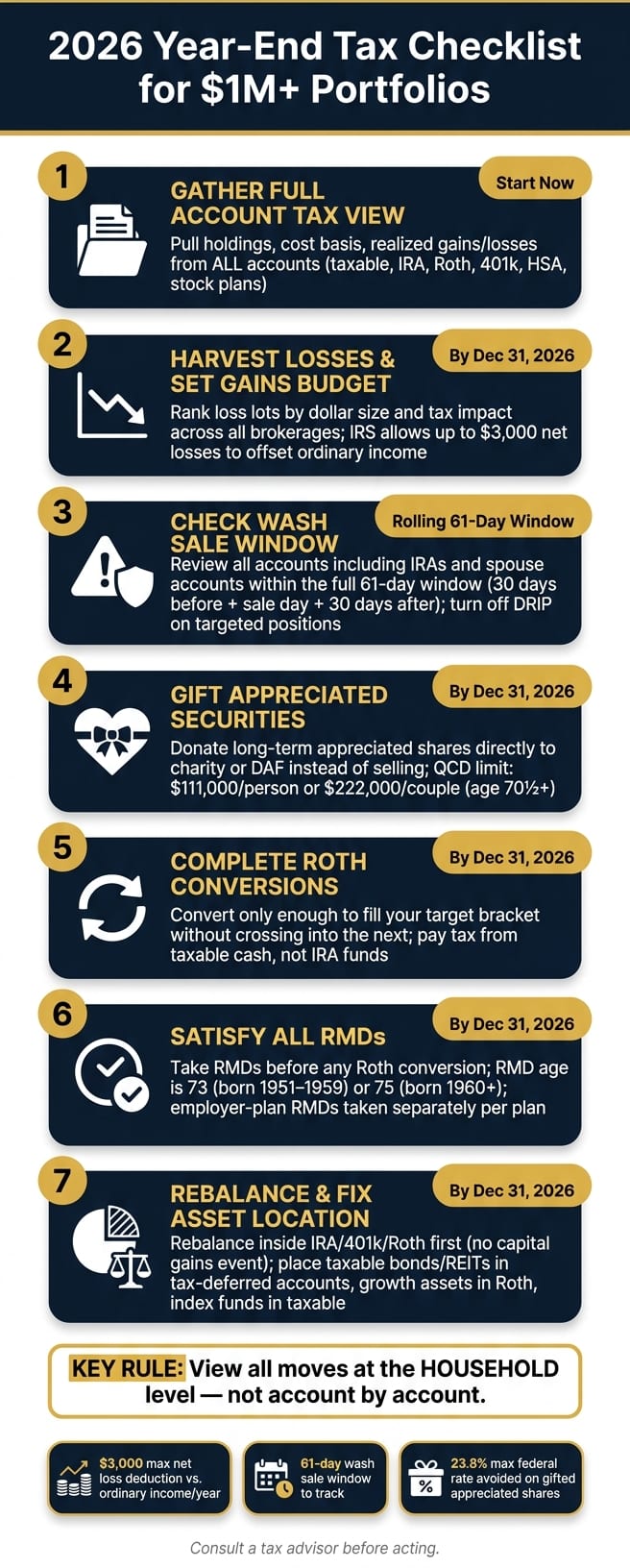
6 Must-Do Tax Moves Before Year-End
1. Harvest losses and set a capital gains budget across all brokerages
When all taxable accounts sit in one view, it may be easier to rank losses against realized gains before placing another trade.
Find the loss lots that actually matter
Start with the lots that may have the biggest tax impact. In many cases, that may mean losses of about $2,000 or more, or positions worth more than 1% of total portfolio value, as long as selling still fits your allocation or risk plan. For example, a $19,000 loss in one account may offset $19,000 of gains realized in another account, which may reduce net long-term gains to $9,000.
To spot those opportunities, pull a lot-level unrealized gain/loss report from every taxable brokerage account. That includes individual accounts, joint accounts, and any other taxable accounts. The report should include:
- Account name
- Owner
- Ticker
- Number of shares
- Current market value
- Cost basis per share
- Total unrealized gain or loss
- Acquisition date
- Whether each lot is short-term or long-term
You’ll also want a 2026 realized gains and losses report for each account. From there, some households put everything into a simple spreadsheet with one row per lot and columns for account, owner, tax status, ticker, shares, current market value, cost basis per share, unrealized gain/loss, acquisition date, and short-term vs. long-term status. That kind of setup may help you rank loss lots by dollar size and tax impact, not just by which account they happen to sit in.
Once the likely sale candidates are clear, the next step is to set a gains target before trading.
Set a year-end gains target instead of reacting trade by trade
A capital gains budget is a target for net gains or losses across all taxable accounts. That may keep each trade tied to the full household picture.
Begin by totaling your 2026 realized gains and losses across all brokerages, split between short-term and long-term. Then estimate full-year taxable income, including salary, business income, interest, dividends, and retirement distributions. That total income may help identify the long-term capital gains rate that may apply and whether the 3.8% Net Investment Income Tax may come into play.
From there, the objective may vary. Some people may try to offset most of the gains they’ve already realized. Others may harvest extra losses to build a carryforward for future years. In a lower-income year, some may choose to realize gains up to the top of the 0% or 15% long-term capital gains bracket. Each path may point to a different trade list.
One tax rule often serves as the main guardrail: after capital gains are fully offset, the IRS allows up to $3,000 of net losses to offset ordinary income each year, or $1,500 if married filing separately. Any amount above that carries forward with no expiration and may offset future gains dollar-for-dollar. For a household that rebalances often or expects to diversify a concentrated position in later years, building a carryforward of $20,000 to $50,000 may be an intentional move rather than an accident.
Use Mezzi to find cross-account tax-loss opportunities
Mezzi shows loss candidates across accounts in one view. It flags positions with large unrealized losses, separates short-term from long-term positions, and shows how harvesting those losses may interact with gains already realized in 2026 across other accounts.
That side-by-side view may make it easier to focus on the trades with the biggest tax effect first. After identifying the loss lots, sales would still need to be placed in each brokerage account, along with replacement securities that keep market exposure in place without triggering a wash sale. The next step is to review replacement securities and trade timing to avoid wash sales.
2. Avoid wash sales, donate appreciated shares, and coordinate trade timing
After you pick the loss lots, the next step may be protecting the tax result before you place the trade.
Check the full 61-day wash sale window across every account
The wash sale window lasts 61 days total: the 30 days before the sale, the day of the sale, and the 30 days after. If the same or a substantially identical security is bought in any household account during that window, the loss may be disallowed and added to the replacement shares' basis. In an IRA, the result may be harsher, because a wash sale triggered by a purchase inside a retirement account may leave the disallowed loss unrecoverable through a basis adjustment in that account.
Brokerages usually track wash sales only inside their own platform, not across firms or household accounts. That means the cross-account review may fall on you.
For each position you may harvest, a simple checklist may help:
- Export position lists from every household account
- Flag any ticker that shows up in more than one account
- Turn off dividend reinvestment (DRIP) and automatic purchase plans for those tickers before selling
- Record the sale date for each harvested position
- Mark day 31 as the earliest safer rebuy date
Mezzi may help flag when the 30-day window has passed at the position level, so you may know when a rebuy looks safer without tracking every date by hand across accounts.
Choose replacement securities that keep your exposure without triggering a wash sale
Selling at a loss doesn't have to mean leaving the market. A common approach is to buy a similar, but not substantially identical, security right after the sale, so your allocation may stay in place while the 30-day window runs.
The IRS does not define "substantially identical", so many people use a replacement with a different index or fund construction.
Mezzi's X-Ray and overlap tool may show when two funds that look different on the surface hold almost the same stocks underneath. If overlap is very high, harvesting a loss in one and buying the other may bring wash sale risk. That may make it easier to find a replacement with a more meaningfully different approach instead of guessing.
Gift appreciated securities before year-end when cash giving is less tax-efficient
If you're planning a charitable gift and you hold long-term appreciated securities, donating the shares directly may be more tax-efficient than selling first and giving cash. For itemizers, appreciated shares are generally deductible at fair market value, subject to AGI limits, and may avoid capital gains tax on the embedded appreciation.
This may matter most for concentrated positions, low-basis stock, and years when large gains have already been realized. Say an investor holds $200,000 of a single stock with a $40,000 cost basis. Donating $50,000 of those shares to a DAF may allow a $50,000 deduction and may avoid capital gains tax on the appreciation embedded in those shares. For high earners, the federal capital gains tax avoided on that embedded appreciation may be as high as 23.8%.
For IRA owners age 70½ or older, qualified charitable distributions (QCDs) may offer a related year-end move. If a person qualifies, QCDs would need to be completed by December 31, 2026, because they exclude the amount from income and may count toward the RMD. Many custodians also have processing cutoffs in mid-December, so starting early may matter.
Keep the transfer notice, charity acknowledgment, and valuation records. Those documents may matter for tax reporting and for any later audit.
After charitable transfers, move to Roth conversions and RMDs before December 31.
3. Review Roth conversions, RMDs, and asset location before December 31
Once taxable-account moves are done, it may make sense to look at the retirement side of the household. Three choices often shape the longer-term tax picture: how much to convert to Roth, whether each RMD has been fully taken, and whether assets may be sitting in the account type that fits them best.
Run a Roth conversion check based on your 2026 tax bracket
Use the 2026 IRS bracket table and convert only enough pre-tax IRA or 401(k) money to reach your target marginal bracket without moving into the next one.
Start by gathering wages, bonuses, RSU vests, interest, dividends, realized gains, and planned deductions. Then compare that total with the 2026 bracket thresholds for your filing status. Before acting, use the final 2026 IRS bracket table.
A few details may sharpen the call. Paying the tax from taxable cash, rather than IRA funds, may leave more money inside the Roth for tax-free growth. State income tax may matter too. Converting while living in a high-tax state like California or New York may increase the effective rate, which may support a smaller conversion now if a move to a lower-tax state may happen later. Roth conversions must be completed by December 31, 2026, and recharacterization is no longer allowed under current law.
If an RMD applies, take it first. Only the remaining pre-tax balance may be eligible for conversion.
Confirm every RMD is satisfied and coordinate QCDs where eligible
Take any 2026 RMD before any Roth conversion. Traditional IRA RMDs may be satisfied from one or more IRAs. Employer-plan RMDs generally must be taken from each plan separately.
If you're subject to RMDs in 2026 - age 73 if born between 1951 and 1959, or age 75 if born in 1960 or later - those RMD dollars may not be converted to Roth.
If eligible, a QCD may satisfy part or all of your IRA RMD. Planning sources cite a 2026 QCD limit of $111,000 per person, or $222,000 for a married couple if both spouses are eligible and each has their own IRA.
After income and distribution choices are sorted out, the next step may be to rebalance where tax drag may be lower.
Fix asset location and rebalance in tax-advantaged accounts first
When you rebalance before Dec. 31, start by placing assets in the account type that may fit them best from a tax standpoint. A common rule of thumb looks like this:
- Put taxable bonds, REITs, and high-turnover funds in traditional accounts
- Put higher-growth assets in Roth accounts
- Keep tax-efficient index funds in taxable accounts
If rebalancing is needed, begin inside your IRA, 401(k), or Roth accounts. Trades there don't create a current-year capital gains event. Taxable-account rebalancing may make more sense last, after you've used the room inside tax-advantaged accounts.
Use Mezzi to spot assets that may be sitting in the wrong account type before you rebalance.
Conclusion: The 2026 year-end checklist for $1M+ portfolios
At this level, year-end tax savings may come less from one move and more from how the moves fit together. Tax-loss harvesting, Roth conversions, QCDs, and rebalancing may all affect each other. The difference may come from coordination and timing, not any single step.
The checklist below turns that coordination into a final pre-December 31 pass.
These items cover the full household checklist. The most expensive mistakes may happen when each item gets treated as a separate decision.
A common mistake may be acting account by account instead of looking across the household. Say you sell a losing position in one brokerage account while a spouse's IRA quietly reinvests dividends into the same fund. That kind of cross-account blind spot may disallow the loss without much warning.
A single household view may keep these moves aligned. Mezzi brings all your accounts into one read-only view and flags cross-account conflicts before you act. The moves are yours to execute. Mezzi is designed to make sure you're not executing them in the dark.
FAQs
How do I build a household-wide gains budget?
First, bring all taxable brokerage accounts into one view. Pull lot-level details for each position: ticker, unrealized gain or loss, and holding period.
Then rank possible losses by tax value. Put short-term losses first, and compare them with projected gains from stock sales, RSUs, or capital gain distributions. Include the full 61-day wash sale window across all household accounts, including IRAs and jointly filed portfolios.
What counts as a wash sale across multiple accounts?
A wash sale may happen if you buy the same security, or one the IRS may view as substantially identical, within 30 days before or after selling it at a loss.
And this rule may apply across all of your accounts, not just the one where the sale happened. That may include:
- Taxable brokerage accounts
- IRAs
- Roth IRAs
- 401(k) or 403(b) brokerage windows
- HSAs
- Your spouse’s accounts
It’s also not just about trades you place by hand. Automatic activity, like dividend reinvestment, recurring investments, or rebalancing, may trigger a wash sale too. If that happens, the tax loss may be disallowed.
Which year-end move should I prioritize first?
First, get a complete, lot-level view of every taxable position across all your brokerage accounts.
Without that view, you may miss losses or trigger accidental wash sales. When everything sits in one place, you may sort harvesting opportunities by estimated tax value and spot trade conflicts across other accounts before they happen.
Disclosures:
- This content is for informational purposes only and does not constitute investment advice or a recommendation to buy or sell any security.
- Past performance is not indicative of future results. No guarantee of future performance or outcomes is implied.
- Savings and performance examples are hypothetical and for illustrative purposes only. Actual results will vary based on individual circumstances, portfolio composition, market conditions, and fees.
Related Blog Posts
- 2025 Tax Planning Checklist for Independent Investors
- Year-Round Tax Planning for Your Portfolio: A Monthly Checklist
- Year-end tax planning checklist for investors with $500K+
- "How do I lower my taxable income?" - 12 Levers, Ranked by Effort
First, bring all taxable brokerage accounts into one view. Pull lot-level details for each position: ticker, unrealized gain or loss, and holding period.
Then rank possible losses by tax value. Put short-term losses first, and compare them with projected gains from stock sales, RSUs, or capital gain distributions. Include the full 61-day wash sale window across all household accounts, including IRAs and jointly filed portfolios.
A wash sale may happen if you buy the same security, or one the IRS may view as substantially identical, within 30 days before or after selling it at a loss.
And this rule may apply across all of your accounts, not just the one where the sale happened. That may include:
- Taxable brokerage accounts
- IRAs
- Roth IRAs
- 401(k) or 403(b) brokerage windows
- HSAs
- Your spouse’s accounts
It’s also not just about trades you place by hand. Automatic activity, like dividend reinvestment, recurring investments, or rebalancing, may trigger a wash sale too. If that happens, the tax loss may be disallowed.
First, get a complete, lot-level view of every taxable position across all your brokerage accounts.
Without that view, you may miss losses or trigger accidental wash sales. When everything sits in one place, you may sort harvesting opportunities by estimated tax value and spot trade conflicts across other accounts before they happen.