
Yes - taxable income may be lowered in a few plain ways: put more money into pre-tax accounts, use deductions you qualify for, and shift income or deductions into a year that may have a lower tax rate.
Here’s the short version:
- Low-effort moves: 401(k)/403(b), IRA deduction, HSA, FSA, W-4 check
- Mid-effort moves: tax-loss harvesting, asset location, charitable bunching
- Higher-effort moves: self-employed retirement plans, business deductions, timing income, QBI and Roth conversion planning
A few numbers shape the picture for 2026:
- 401(k) employee limit: $24,500
- HSA limits: $4,400 self-only / $8,750 family
- IRA limit: $7,500
- Capital loss offset against ordinary income: up to $3,000 per year
- Standard deduction: $15,000 single / $30,000 married filing jointly
And one point trips people up: taxable income is not the same as take-home pay. Gross income turns into AGI, then AGI turns into taxable income after the standard deduction or itemized deductions.
Quick list of the 12 levers
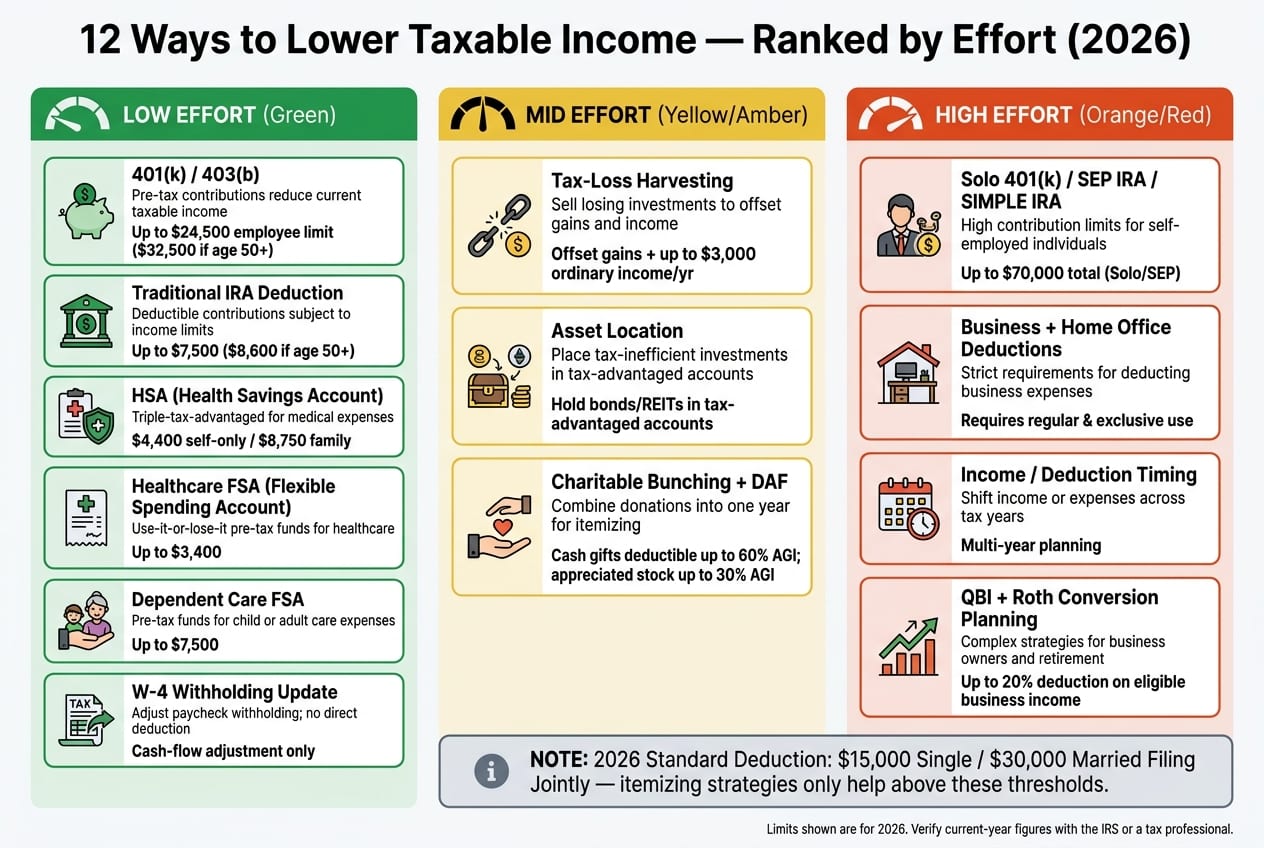
- Increase pre-tax 401(k) or 403(b) contributions
- Claim a deductible IRA contribution, if eligible
- Max out an HSA
- Use a healthcare FSA or dependent care FSA
- Adjust payroll withholding
- Harvest capital losses in taxable accounts
- Improve asset location and hold investments long enough for long-term rates
- Bunch charitable giving and use a donor-advised fund
- Max out a Solo 401(k), SEP IRA, or SIMPLE IRA
- Deduct business expenses and home office costs, if allowed
- Time income and deductions across tax years
- Plan around QBI rules and Roth conversion timing
Quick Comparison
Bottom line: most people may start with the easy payroll and account moves first, then look at the planning-heavy ones only if the tax effect may justify the extra work.
How to Read This List
This ranking measures effort, not tax savings. So #1 is the easiest move, not always the biggest one.
It may help to sort these ideas into two buckets: quick moves and planning moves. Quick moves may include payroll choices, contribution rate changes, and HSA/FSA elections. Planning moves may include income timing, self-employment deductions, and multi-year coordination. That’s the lens for the 12 levers below.
If you’re a W-2 employee, you may get the most use from the first half of the list. If you’re self-employed, some of the later levers may fit better, including solo 401(k)s, SEP IRAs, SIMPLE IRAs, home office deductions, and QBI planning. A simple way to use this list: start with the levers that match your tax profile and skip the ones that don’t.
Contribution limits and deduction thresholds change often. For 2026, the 401(k) employee deferral limit is $24,500, and HSA limits are $4,400 for self-only coverage and $8,750 for family coverage. Before acting, some readers may want to check current-year limits with the IRS or their plan administrator.
Use the ranking as a way to begin with the easiest lever first, then move to the planning-heavy ones only if the potential savings may justify the work.
Where Mezzi Fits In
The 12 levers are easy to name and hard to keep track of. Mezzi is built to show which of those 12 levers may still have room across your accounts. That may matter because some of the larger tax gains may come from account choices that are still changeable.
Mezzi is an SEC-registered fiduciary. It connects to your 401(k), IRA, HSA, and taxable brokerage accounts in read-only mode. It does not trade, move money, or change elections. It shows you the data, and you decide what to do.
That account view may surface tax-loss harvesting, wash-sale risk, contribution gaps, asset-location issues, and Roth-versus-traditional tradeoffs. Mezzi is designed to help you spot the levers that may still have room before you spend time on the more planning-heavy ones.
It surfaces the gaps; you handle the action. Next: the lowest-effort levers, starting with paycheck-based moves.
1. Increase Pre-Tax 401(k) or 403(b) Contributions
Effort level: Low - one payroll election change.
If your employer offers a traditional 401(k) or 403(b), this may be one of the simplest ways to lower taxable income. Pre-tax contributions reduce taxable wages dollar for dollar before federal income tax is withheld. They may lower federal taxable income, but they do not reduce Social Security or Medicare taxes.
At a 22% federal rate, every $100 contributed may lower take-home pay by about $78.
Then check the annual limit. For 2026, the employee limit is $24,500. People age 50 and older may add $8,000, and those ages 60–63 may qualify for a larger catch-up, depending on plan design.
The tradeoff may be lower take-home pay and limited access before retirement. Money in the plan may be hard to reach before retirement age, and many early withdrawals may trigger penalties. If maxing out the plan doesn't fit right now, some people start by contributing enough to get the full employer match, then increase the deferral rate over time. Among payroll-based options, this may be one of the fastest ways to reduce taxable income. If there is still room after the match, some people increase deferrals bit by bit and then look at the next tax-saving lever.
2. Claim a Traditional IRA Deduction if You Qualify
Effort level: Low to moderate - one contribution, but eligibility may require a quick income check.
If you still have room after your workplace plan, the next low-effort move may be a deductible Traditional IRA.
A deductible Traditional IRA contribution may reduce your AGI dollar for dollar.
For 2026, the annual contribution limit across all Traditional and Roth IRAs combined is $7,500, or $8,600 if you're age 50 or older, as long as you have enough earned income.
The catch? Not everyone may qualify for the deduction.
Eligibility may depend on whether you or your spouse are covered by a workplace retirement plan and on your modified adjusted gross income (MAGI). If neither spouse is covered by a workplace plan, you may generally deduct the full contribution up to your annual limit. If you are covered by a workplace plan, the deduction may phase out based on your filing status. It may make sense to check the current-year IRS thresholds before contributing. Use the current-year MAGI phaseout ranges below.
A spousal IRA may let a nonworking spouse contribute using the working spouse's earned income, which may double the household deduction when the rules allow.
The tradeoff is access. Funds may be harder to reach until retirement. Withdrawals before age 59½ typically trigger income tax plus a 10% early withdrawal penalty, with limited exceptions.
3. Max Out a Health Savings Account (HSA)
Effort level: Low - mostly an enrollment decision and a contribution choice.
An HSA may lower AGI, and it may still work even if you take the standard deduction. The big limit here is eligibility.
To contribute, you generally need:
- An HDHP
- No disqualifying coverage
- No Medicare enrollment
- No one else claiming you as a dependent
For 2026, an HDHP needs a minimum deductible of $1,700 for self-only coverage or $3,400 for family coverage. Out-of-pocket maximums are capped at $8,500 and $17,000 for those plans, respectively.
If you qualify, the 2026 contribution limits are $4,400 for self-only coverage and $8,750 for family coverage. If you're 55 or older, you may add another $1,000.
An HSA stands out because it may offer three tax perks at once: contributions may be deductible, growth may be tax-free, and qualified medical withdrawals may be tax-free.
The tradeoff is pretty simple: you may face higher out-of-pocket medical costs before insurance starts paying. If that higher deductible fits your budget, some people use an HSA as a long-term medical reserve too. They may invest the balance and keep receipts for later reimbursement.
Next: FSAs, which may also lower taxable income but come with stricter use-it-or-lose-it rules.
4. Use a Healthcare FSA or Dependent Care FSA
Effort level: Low - this may come down to one open enrollment choice, with one main risk to watch.
If your HSA is already maxed out or not available, an FSA may be the next payroll-based option for lowering taxable income. FSAs reduce taxable wages through payroll elections. You choose an amount during open enrollment, and that money comes out of your paycheck before federal income tax and payroll taxes. This setup may be most useful for W-2 workers who have fairly steady medical or childcare costs.
There are two separate accounts here.
A healthcare FSA covers out-of-pocket medical costs, such as copays, prescriptions, and many over-the-counter items. For 2026, the healthcare FSA limit is $3,400.
A dependent care FSA covers work-related childcare and dependent care, including daycare and after-school care. For plan years beginning on or after January 1, 2026, the dependent care FSA household limit increases to $7,500, or $3,750 if married filing separately, up from the prior $5,000 cap.
The catch is pretty simple: unused funds are often forfeited. Some healthcare FSAs may offer a $660 carryover or a 2.5-month grace period, but not both. Because of that, some people base their election on what they actually spent last year.
One rule matters here. A general-purpose healthcare FSA blocks HSA contributions, so people who want both may use a limited-purpose FSA for dental and vision instead. And dependent care FSA contributions reduce the expenses that qualify for the Child and Dependent Care Tax Credit on a dollar-for-dollar basis.
Next: payroll elections and withholding, another simple paycheck-based lever.
5. Adjust Payroll Elections and Tax Withholding
Effort level: Low - this usually takes one form submission. But this lever may affect cash flow, not your actual tax bill.
Updating your W-4 changes withholding, not your total tax owed. In plain English, it only changes how much tax you prepay from each paycheck. So if you change your 401(k), HSA, or FSA elections, it may make sense to update withholding too, so your paycheck stays in line with those changes.
Here’s the trade-off:
- Over-withholding may lower take-home pay and lead to a refund
- Under-withholding may increase take-home pay now, but it may also lead to a balance due or even a penalty
A refund is basically an interest-free loan to the IRS. To avoid penalties, you generally need to pay at least 90% of current-year tax or 100% of prior-year tax through withholding and estimated payments combined.
It may be smart to review withholding at least once a year, and again after a big life event like marriage, divorce, a new child, or new freelance or investment income. Multiple jobs may also lead to under-withholding. In that case, W-4 Step 2 is meant for multiple jobs or a working spouse.
And after any pre-tax benefit change, rerun withholding so your paycheck reflects your new taxable wages. The IRS Tax Withholding Estimator may help after any pay or benefit change.
Once payroll is set, the next taxable-income lever sits in your brokerage account: capital-loss harvesting.
6. Harvest Capital Losses in Taxable Accounts
Effort level: Moderate - this may require reviewing your holdings, timing sales with care, and tracking the wash-sale window.
If you hold investments in a taxable brokerage account that sit below your cost basis, you may sell those positions and realize a capital loss. In taxable accounts, those losses may still create a deduction even if you didn't sell at a gain. Capital losses first offset capital gains. After that, net losses may offset up to $3,000 of ordinary income per year, or $1,500 if married filing separately, and any amount left over may carry forward indefinitely.
Example: $20,000 of gains and $25,000 of losses leaves $5,000 of net loss. Use $3,000 this year and carry $2,000 forward.
This move may matter more for people in the 22%–37% federal tax bracket or for those with large realized gains from rebalancing or selling a position.
The big rule here is the wash-sale rule. If you sell a security at a loss and buy the same security, or a substantially identical one, within 30 days before or after the sale, the IRS may disallow the loss. The loss doesn't disappear. Instead, it gets added to the cost basis of the replacement security, which may defer the tax effect. The rule may apply across your accounts and, if you file jointly, your spouse's accounts too.
A common workaround some investors use is to sell the losing position and buy a similar fund that isn't identical. For example, they may swap one broad U.S. equity ETF for another that tracks a different index. That way, they may stay invested while still claiming the loss.
There's a tradeoff, though: you're taking a tax break now in exchange for what may be a larger taxable gain later.
This deduction applies only to taxable accounts. Mezzi may flag harvestable losses and wash-sale risk across accounts before you trade.
If you want a lower-effort way to reduce future taxes, the next lever is asset location and long-term holding.
7. Improve Asset Location and Hold Investments Long-Term
Effort level: Low-to-moderate - the setup may take a bit of planning, but once assets are placed well, this approach may need only occasional check-ins.
After tax-loss harvesting, the next move may be to reduce tax drag before gains are realized. Asset location means putting each investment in the account that may fit it best from a tax point of view. The investments themselves stay the same. What changes is where they sit.
Bonds, REITs, and high-turnover active funds may produce taxable income more often. Because of that, they’re often held in tax-advantaged accounts like a 401(k) or traditional IRA, where that income may be sheltered from annual taxes. By contrast, broad stock index funds and individual stocks held for the long term may fit better in a taxable brokerage account. They may produce fewer taxable distributions and may qualify for lower long-term capital gains rates when sold.
That’s the where. The next part is how long.
Holding an investment for more than one year may allow gains to qualify for long-term capital gains rates, which are generally lower than ordinary income rates. Same asset, different tax treatment. That time threshold may make a meaningful difference for some investors.
This approach may fit best when bonds, REITs, or active funds are spread across both taxable and tax-advantaged accounts. The tradeoff, though, is less flexibility. If all bonds sit inside a 401(k), that money may be less accessible for near-term spending. And holding winning positions longer may reduce taxes, but it may also leave a portfolio more concentrated if one holding grows too large relative to the rest.
Mezzi may flag asset-location mismatches across accounts.
8. Bunch Charitable Giving and Use a Donor-Advised Fund
Effort level: Moderate - this takes some planning up front and a deliberate change in when you give, but the mechanics may feel pretty simple once you see the math.
If you give on a regular basis, the main issue may be whether those gifts push you past the standard deduction. If your itemized deductions do not exceed the standard deduction, giving every year may add little or no extra federal tax benefit.
Bunching changes the timing. Instead of giving $10,000 per year for three years, you give $30,000 in year one and nothing, or very little, in years two and three. In the bunching year, your itemized deductions may move above the standard deduction threshold, which may let you claim more of the tax value of those gifts. In the off years, you take the standard deduction. Same dollars, different deduction timing.
There’s one obvious snag: your charities may still need money in the off years. A donor-advised fund (DAF) may deal with that problem. You contribute the full amount in year one, claim the deduction right away, and then recommend grants to charities over the next few years. One caveat matters here: contributions to a DAF are irrevocable. Once the money goes in, you keep only advisory privileges over how grants are made.
Before planning a large bunching year, two limits are worth knowing:
- Cash gifts to public charities, including DAF sponsors, are generally deductible up to 60% of AGI.
- Appreciated securities are typically capped at 30% of AGI when you deduct the stock’s full market value.
Donating appreciated stock may be especially tax-efficient. In some cases, you may avoid capital gains tax on the embedded gain and still claim a deduction for the full market value. If contributions go over the limit that applies, the excess may usually be carried forward for up to five years.
The setup may look different depending on the donor:
- Annual direct giving may fit if you already clear the itemization threshold.
- Bunching without a DAF may fit donors who are comfortable prepaying several years of gifts at once.
- Bunching with a DAF may fit those who want the upfront deduction while giving gradually over time.
- Donating appreciated stock to a DAF may add capital gains tax savings on top.
If charitable deductions still leave your taxable income unchanged, the next levers may include self-employed retirement accounts and business deductions.
9. Max Out a Solo 401(k), SEP IRA, or SIMPLE IRA
Effort level: Moderate-to-high - these plans may shelter a large amount of income, but they also require setup, cash-flow planning, and attention to deadlines.
For self-employed readers, the next tier of tax reduction may come from retirement plans tied to business income.
If you have self-employment income, these plans may shelter more taxable income than an IRA. The tradeoff: they require setup and some planning around cash flow.
A solo 401(k) may fit business owners with no employees other than a spouse. It allows both employee and employer contributions, which may create a large pre-tax shelter. Total contributions may reach up to $70,000 for 2026, or more with catch-up contributions for those 50 and older.
A SEP IRA does not require annual IRS filing and allows employer-only contributions of up to 25% of compensation, capped at $70,000 for 2026. For sole proprietors, the effective rate may work out to roughly 20% of net earnings after adjusting for self-employment tax. If you have employees, you must contribute the same percentage for eligible workers, which may increase costs as the business grows.
A SIMPLE IRA may fit small employers with 100 or fewer employees. It has a lower contribution ceiling than the other two plans and requires an employer contribution - either a match of up to 3% of compensation or a 2% nonelective contribution.
The main tradeoff may be cash flow. These contributions require actual dollars to leave your business account. SEP IRAs offer the most flexibility on timing - contributions may be made as late as your tax return due date, including extensions, which may make them useful for last-minute tax planning.
One common mistake comes up with sole proprietors: the deduction usually runs through Schedule 1, and the contribution formula must be adjusted for half of self-employment tax.
If you also have deductible business expenses, the next lever is #10.
10. Deduct Legitimate Business Expenses and Home Office Costs
Effort level: Moderate-to-high - these deductions may be meaningful, but they usually call for steady recordkeeping.
After retirement-plan contributions, documented business expenses may reduce business income. Common examples include supplies, software, mileage, and travel.
The home office deduction may matter too, but the paperwork needs to be tight. Home office deductions require regular and exclusive use. Keep a receipt or invoice for each expense. Unsupported deductions are often disallowed.
It usually makes more sense to track expenses as they happen, not once tax season shows up. If you have some control over when income is recognized or when expenses are paid, the next lever looks at that timing.
11. Time Income and Deductions Across Tax Years
Effort level: Moderate-to-high - this lever may call for multi-year planning and some control over when income or deductions show up on your return.
This lever changes when income or deductions appear on your return, not whether they exist. If income moves into a lower-tax year and deductions move into a higher-tax year, that timing shift may be useful. Even if tax rates stay flat, deferring income may still offer a one-year cash-flow benefit.
This approach tends to matter most when you have real control over recognition dates. Fixed wages usually don't leave much room. But some people may have more flexibility:
- Self-employed workers may delay invoices
- Real estate investors may time closings
- Retirees may choose when to take extra IRA withdrawals or realize gains
- Some executives may negotiate bonus timing or use nonqualified deferred compensation plans
On the deduction side, common acceleration moves may include prepaying deductible expenses you already control, scheduling medical or dental care in the same year so you may clear the 7.5% AGI floor, and buying and placing needed equipment in service before year-end to claim Section 179 or bonus depreciation. One limit stands out: the $10,000 SALT cap. If you're already at that ceiling, prepaying state and local taxes often may not help.
The main trap is thinking deferral removes tax for good. It doesn't. It only shifts tax into another year. If next year's income ends up higher, that move may place income into a less favorable bracket. That's why tax professionals often suggest modeling 2–3 years of projected income before making timing decisions, especially if phaseouts may affect credits you might otherwise keep.
Next comes QBI and Roth conversion timing, where income thresholds and phaseouts may make timing even more sensitive.
12. Plan Around QBI Rules and Roth Conversion Timing
Effort level: High - this move usually calls for tax modeling and careful coordination across more than one tax decision.
For pass-through owners, year-end planning may get touchy because of the qualified business income (QBI) deduction. If you own a sole proprietorship, partnership, or S corporation, you may qualify for it. If so, it may let you deduct up to 20% of eligible business income from taxable income. At a 37% marginal rate, that may bring the effective federal rate on that income down to about 29.6%.
Below the annual threshold, you may generally get the full 20% deduction, assuming the business qualifies. Once income goes above that level, things may get messy fast. For non-SSTB businesses, W-2 wage and qualified property limits may start capping the deduction. For specified service trades or businesses, or SSTBs, like health, law, accounting, consulting, and financial services, the deduction may phase out as income moves through the phase-in range and may disappear entirely after that.
This is where Roth conversion timing may matter. If an SSTB owner is already close to the QBI threshold, a large conversion may push income into the phase-out range and may reduce the deduction or wipe it out. In some cases, people convert in years when taxable income is well below the threshold. Others spread conversions across a few smaller years instead. The main point: QBI rules react to income levels and timing, so current-year numbers may be worth checking before a Roth conversion.
QBI also overlaps with retirement contributions, business deductions, income timing, and Roth conversions. Because of that, many business owners bring a few items to a tax pro and ask for side-by-side, multi-year scenarios:
- The latest tax return
- K-1s
- Year-to-date P&L
- Retirement account balances
A little modeling here may change the picture quite a bit.
Key Limits, Traps, and Common Mistakes
The 12 levers may work only if you stay within the rules. That's where a lot of people get tripped up.
Contribution caps are fixed. If you put too much into a 401(k), IRA, or HSA, that may trigger penalties and may also lead to corrective distributions. And if you have both W-2 wages and self-employment income, the employee deferral limit may apply across all plans.
Itemizing may help only when your deductions are higher than the standard deduction. For 2026, the standard deduction is $15,000 for single filers and $30,000 for married filing jointly. Charitable gifts, mortgage interest, and SALT may reduce your tax bill only if your total itemized deductions go past that line.
The wash-sale rule is broader than many people expect. The 30-day window looks backward and forward. A purchase in another brokerage account or in an IRA may trigger the rule, not just the account where the sale happened. Even dividend reinvestment may cause a wash sale if shares are bought again during that window.
There’s another limit that often gets missed. After gains are offset, net capital losses may reduce ordinary income by only $3,000 per year - or $1,500 if married filing separately. Any unused losses may carry forward with no time limit.
Two more traps are worth calling out. The home office deduction requires regular and exclusive use of a specific space for business, so a guest room that also serves as an office doesn’t qualify. And employees who work from home generally may not claim that deduction at all under current federal rules.
One last point: changing your W-4 affects withholding, not the amount of tax owed. It may shift when money comes out of your paycheck, but it isn't a tax-cut lever on its own.
Next: how to choose the first lever based on your tax profile and time available.
How to Decide Which Lever to Pull First
A simple way to think about this is to move from the easiest steps to the ones that may take more effort: employer benefits and tax-advantaged accounts, taxable-account tactics, charitable and self-employed planning, and then timing-based moves.
The table below maps those layers to a possible first move based on a few common tax profiles.
After that, the last two layers may be the ones that call for more modeling.
Bunching and donor-advised funds fall into the third layer, after retirement-account and taxable-account basics.
Timing income, QBI planning, and Roth conversions sit in the final layer. These moves may involve the most effort, and they may also have the most upside in some cases. This layer may come into play when income swings, QBI thresholds, or Roth-conversion timing may change your tax rate.
Mezzi shows which levers may still be open across your accounts and payroll data in read-only mode. If you have multiple accounts or income sources, the next section shows where these plans may start to break down.
Conclusion
Lowering taxable income usually comes down to stacking a few legal moves, not hunting for one huge deduction. That may make the next step pretty simple: start with the lowest-effort lever you may actually be able to claim.
For many people, the easiest places to start may be payroll changes and account contributions. Other moves - like self-employed retirement plans, charitable bunching, income timing, and QBI planning - may take more coordination and, in some cases, support from a tax professional.
A practical way to think about it: begin with the easy lever, then move to heavier planning only if the tax savings may justify the extra work.
Which levers may fit depends on a few basics:
- Your income type
- Your filing status
- Your access to workplace benefits
- Whether you itemize
Itemizing-based strategies may matter more for taxpayers whose deductions exceed the standard deduction. And some tax cuts today may create taxable income later, so each move may be worth judging across its full life cycle, not just this year's return.
For some households, the best path may be to pick two or three levers that fit their situation, check the deadlines, and act before year-end. Put simply: easy wins first, planning moves second.
FAQs
Which lever should I use first?
Start with traditional 401(k) contributions, at least enough to get the full employer match. For some people, that may be one of the few chances to pick up extra compensation through a workplace plan, and pre-tax contributions may reduce taxable income.
After that, if you're eligible, the next move some people consider is maximizing HSA contributions for a larger near-term tax reduction.
Can I combine multiple tax-saving levers?
Yes. Combining tax-saving levers may increase your overall impact.
For example, some people may increase 401(k) contributions, use an HSA, and harvest investment losses at the same time. Coordinating these moves during the year may reduce taxable income more than relying on just one lever.
When should I talk to a tax professional?
Talk to a tax professional before making moves that may affect eligibility or trigger complex tax rules, especially investment sales, tax-loss harvesting, capital gains deferral, wash-sale issues, or year-end timing.
If you may sell appreciated assets or coordinate transactions across multiple accounts, getting guidance first may help you avoid mishandling losses and gains or running into “substantially identical” rules.
Disclosures:
- This content is for informational purposes only and does not constitute investment, tax, or legal advice. Readers should consult a qualified tax professional before making decisions that may affect their tax situation.
- Past performance is not indicative of future results. No guarantee of future performance or outcomes is implied.
- Contribution limits, deduction thresholds, and tax laws are subject to change. Check current IRS guidance or consult your plan administrator for the most up-to-date information.
- Mezzi is an SEC-registered investment adviser. Registration does not imply a certain level of skill or that the SEC has approved the company or its services.
Related Blog Posts
- 7 Tax-Saving Strategies for High-Income Earners in 2025
- Tax-Optimized Rebalancing: Strategies for 2025
- I Maxed My 401(k). What Should I Save In Next?
- Year-end tax planning checklist for investors with $500K+
Start with traditional 401(k) contributions, at least enough to get the full employer match. For some people, that may be one of the few chances to pick up extra compensation through a workplace plan, and pre-tax contributions may reduce taxable income.
After that, if you're eligible, the next move some people consider is maximizing HSA contributions for a larger near-term tax reduction.
Yes. Combining tax-saving levers may increase your overall impact.
For example, some people may increase 401(k) contributions, use an HSA, and harvest investment losses at the same time. Coordinating these moves during the year may reduce taxable income more than relying on just one lever.
Talk to a tax professional before making moves that may affect eligibility or trigger complex tax rules, especially investment sales, tax-loss harvesting, capital gains deferral, wash-sale issues, or year-end timing.
If you may sell appreciated assets or coordinate transactions across multiple accounts, getting guidance first may help you avoid mishandling losses and gains or running into “substantially identical” rules.