
An ACAT transfer may look done before every item arrives. In many cases, the main move may finish in about 5–7 business days, while leftover cash, dividend credits, cost basis data, or non-transferable holdings may show up later.
Here’s the short version:
- Whole shares may move first.
- Fractional shares may be sold at the old broker, with cash sent later.
- Dividends and interest may arrive in later residual sweeps.
- Some positions - like certain mutual funds, options near expiration, or firm-specific products - may stay behind.
- Cost basis may lag even after the holdings appear.
- A transfer marked “complete” may only mean the main sweep posted.
If I were checking an incomplete transfer, I’d usually sort it into 3 buckets:
- Normal delay
Residual cash, dividend credits, and basis files may still be in transit. 2. Tax item
Fractional-share sales may create a small taxable event and may later show on the old broker’s Form 1099-B. 3. True problem
A rejected holding, a missing position with no pending sweep, or basis data that still hasn’t arrived after a reasonable wait may need follow-up with both firms.
A simple way to review the situation may be:
- Compare the old statement to the new account
- Check share counts, cash balances, and registrations
- Look for fractional liquidation entries
- Ask both brokers for any rejection reason code
- Keep the old account open until each leftover item is accounted for
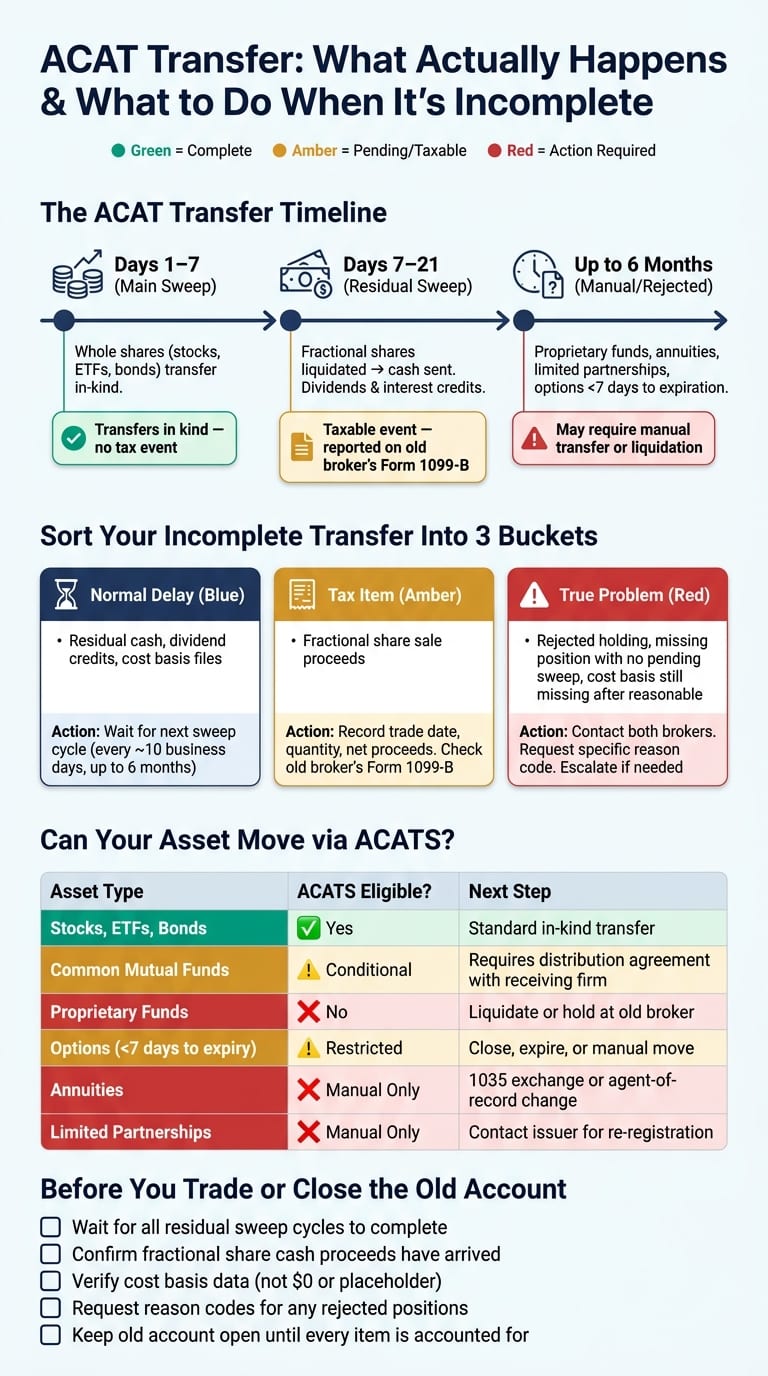
Quick comparison
That’s the core issue: “complete” may not mean fully finished, and the gap usually comes down to residuals, fractional proceeds, or holdings that did not move through ACATS.
Step 1: Verify what moved, what is pending, and what failed
The status screen is a clue, not proof. Settled means the main sweep finished. It does not confirm that every residual cash item, basis file, or rejected holding made it over.
To verify the transfer, start with positions, then cash, then tax lots.
Check positions, cash balances, and tax lots against the old statement
Match the new account against the old statement and activity history. Download the last full statement and the recent transaction history from your old broker as close to the ACAT start date as possible.
For each security, check:
- Ticker or CUSIP
- Share count
- Registration
If a whole-share position shows on the old statement but not in the new account, flag it for follow-up. Fractional shares are often sold at the old broker and sent over as cash proceeds instead of moving as a position.
Then compare cash, sweep balances, and money market balances across both accounts. If the gap is still there after two residual cycles, and neither firm shows it as pending, contact both firms.
Cost basis matters too, especially before any tax-sensitive trades. If the new account shows a $0 basis or a placeholder price, wait for the full lot data before making tax-sensitive decisions. Once the account match looks right, use the status label to sort normal lag from a real rejection.
Comparison table: Whole-share transfer vs. fractional liquidation
Read the transfer status to find out what needs manual action
Most brokers use a small set of transfer stages. Each one may point to a different next step. The table below shows when it may make sense to wait, escalate, or start over.
A Rejected status usually needs follow-up. Common reasons may include a registration or name mismatch, an SSN or TIN discrepancy, an asset type the receiving firm does not support, or a pending corporate action on the security. Ask both firms for the specific reason code.
If one security is still missing, check for a pending corporate action before treating it as a failed transfer. A merger, tender offer, spin-off, or stock split may keep the position at the old broker for a period of time and may lead to cash proceeds instead of an in-kind transfer. In cases like that, the stuck position may be tied to the event itself, not to a transfer error.
Step 2: Resolve residual shares and fractional cash proceeds
Residual shares, dividends, and interest usually arrive on a later sweep
Once you've confirmed the main sweep, it may make sense to clear the usual leftovers before treating the transfer as broken. After the main sweep posts, check the items that often show up later: residual credits, fractional proceeds, and any positions that were actually rejected. That may include dividends, bond interest, and tiny share balances.
Residual credits usually post on later sweep cycles, often every 10 business days for up to six months.
If a dividend or interest payment seems to be missing, contact both firms and ask whether the item is still scheduled for a residual sweep and, if so, when it may be expected to post. Also ask the receiving firm whether it sees a pending residual transfer tied to your account number. If the sweep window has closed and neither firm shows the item as pending, escalate it. Ask both firms to open a manual follow-up and confirm the residual is not still scheduled.
Fractional shares are usually sold and sent as cash
Whole shares transfer in kind. Fractional shares are usually sold and sent as cash. Match the cash timing to the liquidation date. Review the old broker's transaction history for a fractional share sale or liquidation entry. Note the trade date, settlement date, quantity, and net proceeds for each security, then match those amounts to incoming cash at the new broker labeled as an ACAT residual transfer.
The fractional sale is a taxable event. Because the delivering broker sold the position, any gain or loss is realized and reportable, even if the amount is small. It will appear on the delivering broker's Form 1099-B, not the receiving firm's. Keep the old broker's tax documents, and enter each fractional sale separately in your tax software.
Comparison table: Whole-share transfer vs. fractional liquidation
If the cash never posts or the position never arrives, move to the holdings that were rejected or left behind.
Step 3: Fix stuck positions and non-transferable holdings
Why some positions stay at the old broker
If the cash has arrived but one or more positions still haven’t, the issue may be transferability. In that case, the problem may be about eligibility, not timing. The next step is to sort positions into two groups: those that may transfer through ACATS and those that may need manual handling.
Common examples include proprietary mutual funds, common mutual funds that the receiving firm doesn’t carry, limited partnerships, annuities, and options with fewer than seven days to expiration. Sometimes the asset itself isn’t the only issue. Account-level restrictions may also block a transfer. An active margin debit balance, an IRS lien, or a court order may prevent the old firm from releasing assets. Brokerages are also allowed to hold securities worth up to 140% of a margin debit balance until that debt is resolved.
What to ask each firm when a position is rejected or unsupported
When a position doesn’t arrive, the first call may be to the delivering (old) broker. Ask for the specific reason code tied to the rejected position. Also ask whether any legal holds, IRS liens, or unsettled trades may be blocking release.
Then call the receiving (new) broker. Ask whether the position is eligible for transfer, whether a manual transfer may be available, and whether any hold may be blocking release. It also may make sense to ask whether they have a distribution agreement with the fund family to accept mutual fund shares in kind, and whether the position may move through a DTC Free of Payment transfer.
A DTC transfer may sometimes move specific equity positions that fail ACAT, though it often may not move cost basis data automatically. Manual transfers usually take 2 to 4 weeks or longer, compared with 3 to 6 business days for a standard ACAT.
Classification table: Transferable, conditional, and manual-only assets
Use the asset type as a rough way to decide whether it may make sense to wait, request a manual transfer, or leave the position at the old broker for now.
Conclusion: A post-transfer checklist and how Mezzi helps surface leftovers
Use the checklist below to separate normal lag from items that may still need follow-up, including residual credits, fractional cash, and stuck positions.
Use Mezzi to spot incomplete transfers across all connected accounts
A unified view may make that reconciliation faster. Mezzi connects to both your delivering and receiving brokerage accounts through read-only access, so you may see positions and cash balances side by side without logging into each platform one by one. Mezzi is read-only; it mirrors your brokerage data. That may make gaps easier to spot and may give you a clearer signal on when follow-up makes sense before trading or closing the old account.
Key steps before you place new trades or close the old account
Start with the items that may lag first, then move to positions that still look unresolved.
- Wait for residual sweep cycles. Residual sweeps and mutual fund cleanup may take additional time to finish before you escalate. A missing dividend or interest credit may still be moving through the system automatically.
- Account for fractional share proceeds. Most firms automatically liquidate fractional shares and send the cash proceeds. Record the amount once it arrives so you may reconcile the account.
- Do not close the old account yet. Keep the old account open until you have confirmed that any remaining credits and unresolved positions have been handled.
- Follow up on rejected or unsupported positions. If a transfer is rejected, the delivering firm is required to provide an explanation, and that usually means manual follow-up may be needed. Ask both firms for the specific reason code.
Do not trade or close the old account until every residual credit and rejected holding is accounted for.
FAQs
How long should I wait before treating an ACAT transfer as a problem?
A standard ACAT transfer usually completes in 5 to 7 business days. More complex portfolios may take up to 10 business days. Residual cash sweeps may also arrive separately, so it’s not unusual if everything doesn’t land at the same time.
If the transfer goes beyond those timeframes, or you see rejected mutual funds or positions that appear stuck, that may point to an issue that needs manual follow-up. Mezzi may help surface lingering positions and show which assets are still in transit.
Why does my transfer show complete if cash or positions are still missing?
A transfer may show as complete even if some cash still hasn't arrived. One common reason is residual cash. That's money from things like dividends, interest, or fractional-share sales that often moves in a separate sweep after the main transfer. That follow-up sweep may take up to 10 business days.
Delays may also happen when trades are still unsettled or when account features like dividend reinvestment are still pending. A simple way to check for missing amounts is to compare your final statement from the delivering firm with the first statement from your new brokerage.
What should I do if cost basis still hasn’t appeared in the new account?
First, verify that the cost basis may have been transferred correctly from your prior records or brokerage. Missing details often may be tied to transfer errors or incomplete documentation.
You may also contact your new brokerage for help and consult a tax advisor if there are discrepancies. If needed, historical statements or trade records may be used to reconstruct or estimate the cost basis for tax reporting.
Disclosures:
- This content is for informational purposes only and does not constitute investment advice or a recommendation to buy or sell any security.
- Past performance is not indicative of future results. No guarantee of future performance or outcomes is implied.
Related Blog Posts
- What are the tax and fee implications of transferring brokerage accounts between custodians?
- What Happens to Your Investments When You Switch Brokerages
- Dividing a Taxable Portfolio in Divorce: Who Gets the Low-Basis Shares?
- Inheriting a Taxable Brokerage Account: Step-Up Basis and What to Sell First
A standard ACAT transfer usually completes in 5 to 7 business days. More complex portfolios may take up to 10 business days. Residual cash sweeps may also arrive separately, so it’s not unusual if everything doesn’t land at the same time.
If the transfer goes beyond those timeframes, or you see rejected mutual funds or positions that appear stuck, that may point to an issue that needs manual follow-up. Mezzi may help surface lingering positions and show which assets are still in transit.
A transfer may show as complete even if some cash still hasn't arrived. One common reason is residual cash. That's money from things like dividends, interest, or fractional-share sales that often moves in a separate sweep after the main transfer. That follow-up sweep may take up to 10 business days.
Delays may also happen when trades are still unsettled or when account features like dividend reinvestment are still pending. A simple way to check for missing amounts is to compare your final statement from the delivering firm with the first statement from your new brokerage.
First, verify that the cost basis may have been transferred correctly from your prior records or brokerage. Missing details often may be tied to transfer errors or incomplete documentation.
You may also contact your new brokerage for help and consult a tax advisor if there are discrepancies. If needed, historical statements or trade records may be used to reconstruct or estimate the cost basis for tax reporting.