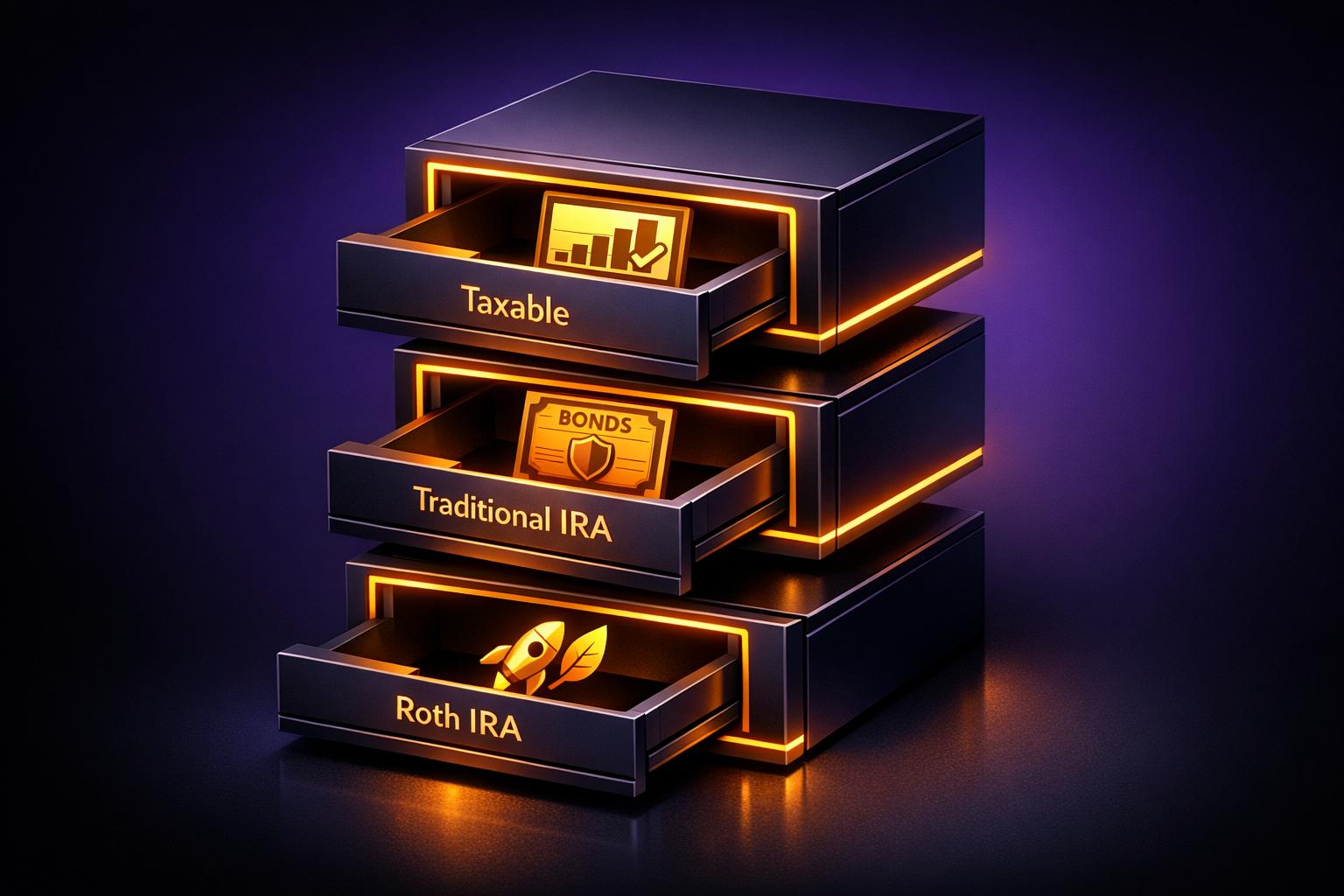
Asset location is a tax strategy that helps you boost tax-efficient returns by placing the right investments in the right accounts. Here's the gist:
- Taxable Accounts: Ideal for tax-efficient investments like index funds, municipal bonds, and international stock funds that benefit from lower capital gains rates or tax exemptions.
- Traditional IRAs: Best for tax-heavy assets like bonds, REITs, and actively managed funds, as they defer taxes until withdrawal.
- Roth IRAs: Perfect for high-growth investments like small-cap stocks and aggressive equity funds, thanks to tax-free growth and withdrawals.
How to Implement Your Asset Location: A Practical Example
This example highlights the importance of choosing between Roth vs. Traditional IRA accounts based on your current and future tax brackets.
How Different Account Types Are Taxed
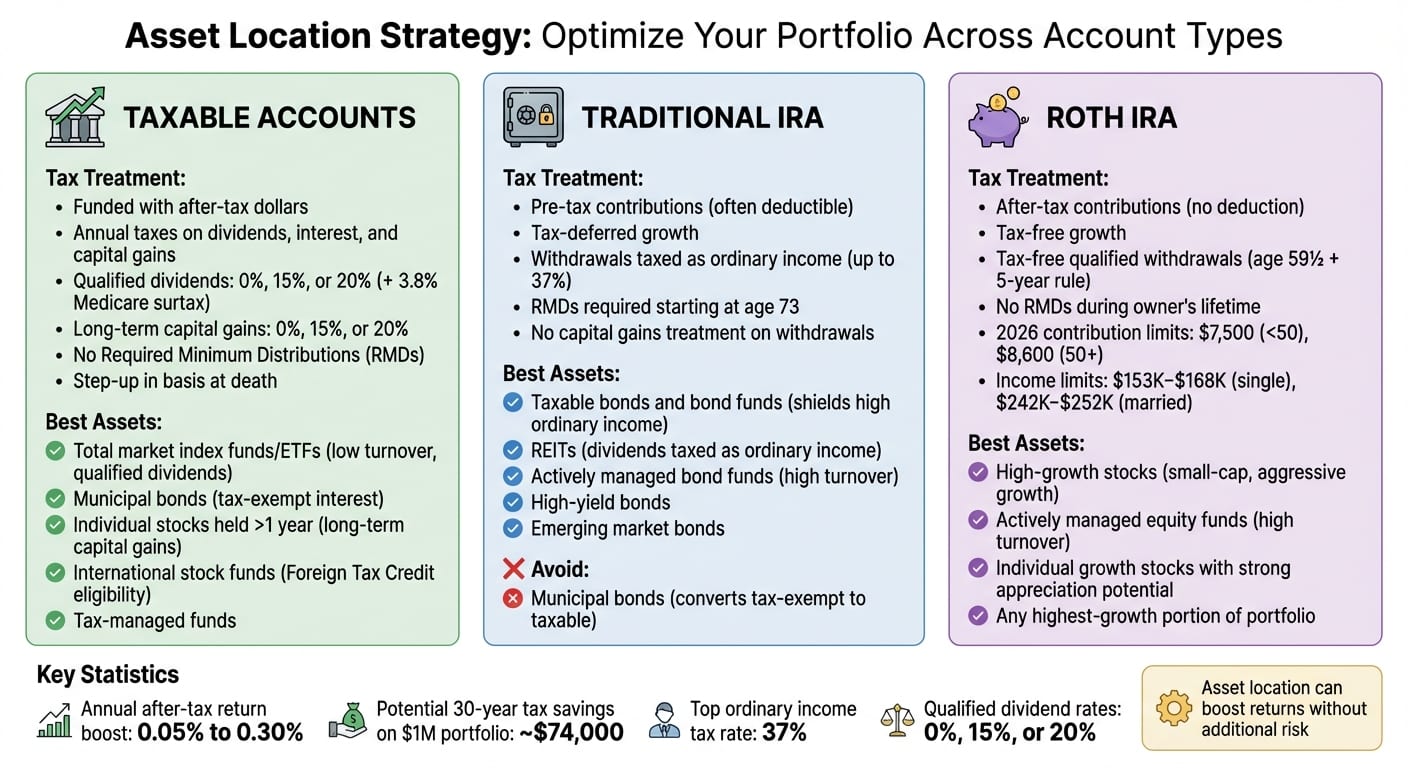
To make the most of your investments, it’s important to understand how different accounts are taxed. Taxable brokerage accounts, Traditional IRAs, and Roth IRAs each follow specific tax rules, and knowing these rules can help you decide where to place your assets.
Taxable Accounts
Taxable brokerage accounts are funded with after-tax dollars, meaning there’s no upfront tax deduction. However, you’ll pay taxes each year on any income your investments generate. For instance:
- Interest income from bonds or savings is taxed at ordinary income rates, which can go up to 37%.
- Qualified dividends are taxed at 0%, 15%, or 20%, with an additional 3.8% Medicare surtax for high earners.
- Capital gains are taxed when you sell investments. Gains from assets held over a year are taxed at lower long-term rates, while gains from shorter holding periods are taxed at ordinary income rates.
One benefit of taxable accounts is the "step-up in basis" at death. This means your heirs inherit assets at a readjusted cost basis, potentially avoiding capital gains taxes on the appreciation during your lifetime. Plus, these accounts don’t have required minimum distributions (RMDs), giving you flexibility over when and how to sell.
Traditional IRAs
Traditional IRAs allow you to contribute pre-tax dollars, often reducing your taxable income for the year. This account is especially suited for investments that generate high ordinary income, as taxes are deferred until you withdraw funds.
- Withdrawals are taxed as ordinary income, even for investments that would have qualified for lower long-term capital gains rates in a taxable account.
- Starting at age 73, you’re required to take RMDs, which could push you into a higher tax bracket if your account balance is large.
While the tax-deferred growth is appealing, the ordinary income tax treatment on withdrawals is something to plan for carefully.
Roth IRAs
Roth IRAs work differently. Contributions are made with after-tax dollars, so there’s no immediate tax break. In exchange, your investments grow tax-free, and all qualified withdrawals are completely tax-free. To qualify, you need to be at least 59½ years old and have held the account for at least five years.
Roth IRAs don’t require RMDs during your lifetime, allowing your investments to grow untouched. However, there are income limits for contributions. For 2026, eligibility phases out at:
- $153,000–$168,000 for single filers
- $242,000–$252,000 for married couples filing jointly
Contribution limits for 2026 are $7,500 if you’re under 50 and $8,600 if you’re 50 or older.
Which Assets Go in Which Accounts
To make the most of your investments, it's crucial to match specific assets with the right accounts. This approach helps reduce lifetime taxes and encourages better growth. Essentially, you want to shield tax-heavy investments from annual taxes while allowing tax-efficient ones to benefit from favorable rates. This strategy builds on earlier tax concepts.
"Getting the right investments into the right accounts is one of the clearest ways to improve after-tax wealth without taking on additional risk or changing your overall strategy." - Wedbush Securities
The impact of this strategy is far from minor. By carefully choosing where to place your assets, you could see an annual after-tax return boost of 0.05% to 0.30%. Over 30 years, that could mean saving around $74,000 in taxes on a $1 million portfolio. Here's how to align your assets with the right accounts.
Best Assets for Taxable Accounts
Taxable accounts are ideal for investments that generate little taxable income and benefit from lower capital gains rates. These accounts take advantage of preferential tax rates on capital gains and dividends.
- Total market index funds and ETFs: These are great options due to their low turnover, which results in mostly qualified dividends. These dividends are taxed at favorable rates (0%, 15%, or 20%) instead of ordinary income rates, which can go as high as 37%. ETFs, in particular, stand out because their "in-kind" redemption process minimizes capital gains distributions.
- Municipal bonds: These belong in taxable accounts since their interest is federally tax-exempt and often state and local tax-exempt if issued in your state. Putting them in an IRA wastes their tax-free advantage.
- Individual stocks: Holding these for more than a year allows you to qualify for long-term capital gains treatment, which is generally taxed at a lower rate.
- International stock funds: These should stay in taxable accounts to let you claim the Foreign Tax Credit for taxes paid to foreign governments. You lose this benefit if you hold them in an IRA.
- Tax-managed funds: Designed to minimize taxable distributions, these funds limit turnover and harvest losses, making them a smart choice for taxable accounts.
Best Assets for Traditional IRAs
Traditional IRAs are perfect for assets that generate high levels of ordinary income. Since withdrawals from these accounts are taxed as ordinary income, it's a good idea to park tax-heavy investments here.
- Taxable bonds and bond funds: These include high-yield bonds, emerging market bonds, and total bond market funds. Traditional IRAs protect these assets from annual taxes on their high ordinary income.
- Real Estate Investment Trusts (REITs): REIT dividends are taxed as ordinary income rather than at the lower qualified dividend rates. Holding them in a Traditional IRA shields you from those annual tax bills.
- Actively managed funds: With high turnover, these funds often distribute short-term capital gains taxed as ordinary income. A Traditional IRA defers these taxes, allowing the fund to trade freely without triggering annual tax events.
Important note: Avoid placing municipal bonds in a Traditional IRA. Doing so converts their tax-exempt interest into taxable ordinary income upon withdrawal, negating their tax benefits.
Best Assets for Roth IRAs
Roth IRAs are best suited for high-growth investments due to their tax-free growth and withdrawals. To maximize the benefits, focus on placing your highest-growth assets in this account.
- High-growth equities: Investments like small-cap stocks, aggressive growth funds, or individual stocks with strong growth potential fit perfectly in a Roth IRA. Since qualified withdrawals are tax-free, this account is ideal for the portion of your portfolio with the highest appreciation potential.
- Actively managed equity funds: These funds often have high turnover, generating frequent capital gains distributions. Holding them in a Roth IRA ensures all that trading activity compounds tax-free.
"Because of their potential for tax-free growth and withdrawals, the types of investments you hold inside them can have an outsized impact on long-term after-tax results." - Fidelity
Asset-Account Pairing at a Glance
How to Use Mezzi's Asset Location Calculator
Take a closer look at your portfolio to uncover ways to save on taxes. Mezzi’s AI-powered calculator reviews all your connected accounts and offers tailored suggestions based on your tax situation. It’s designed to help integrate your asset location strategy with practical steps you can act on.
How the Calculator Works
Mezzi’s calculator refines your asset-account pairing by analyzing your portfolio as a whole. It securely connects accounts like your 401(k), brokerage, Roth IRA, and taxable accounts using trusted aggregators. The tool doesn’t access your login credentials; it simply reviews your accounts to provide insights.
This comprehensive view allows Mezzi to spot overlapping holdings, identify tax-inefficient investments, and monitor wash sale risks across multiple brokerages - tasks that are tough to manage when accounts are viewed in isolation.
After connecting your accounts, Mezzi’s AI evaluates your holdings against your tax bracket and financial objectives. It pinpoints opportunities, such as recommending tax-deferred accounts for bonds, Roth IRAs for growth stocks, or highlighting ways to avoid duplicate fees.
Step-by-Step Guide
Here’s how to get started:
- Connect your accounts. Link your brokerage, retirement, and taxable accounts securely. Mezzi relies on trusted aggregators to handle this process, ensuring it never accesses your login credentials.
- Review personalized recommendations. Mezzi highlights specific tax-saving opportunities. For instance, it might suggest moving a high-yield bond fund from a taxable account to a Traditional IRA to reduce ordinary income taxes.
- Act on the advice manually. While Mezzi provides recommendations, it doesn’t execute trades or move funds. If it identifies a tax-loss harvesting opportunity, it will also notify you when the 30-day wash sale window has passed, so you can repurchase the asset without risk.
What Sets Mezzi Apart
Mezzi stands out by evaluating all your accounts together, uncovering opportunities many investors miss. Its real-time wash sale tracking alerts you if selling a losing position in one account could lead to a wash sale in another account within 30 days.
The X-Ray feature is another standout tool. It reveals hidden portfolio overlap, showing you if the same stocks are held across different funds. This insight can help you avoid redundant fees and ensure true diversification.
With Mezzi, you get fiduciary-level insights without paying a 1% AUM fee or transferring your accounts. You maintain full control of your assets while accessing insights typically reserved for high-cost financial services.
Real Examples: Tax Impact by Asset Location
Looking at real-world examples can help clarify how asset location impacts long-term wealth and tax efficiency.
Example 1: Bonds in Taxable vs. IRA
Bond interest is taxed as ordinary income, with rates reaching up to 37% for top earners. This creates a hefty tax burden if bonds are held in taxable accounts.
A Vanguard simulation over 30 years examined a $1 million portfolio split equally between stocks and bonds, allocated across taxable ($400K), tax-deferred ($400K), and tax-free ($200K) accounts. The findings? Placing bonds in a tax-deferred account saved a median of $74,000 in taxes compared to an even allocation. The model assumed a 22% tax rate on interest and 15% on qualified dividends.
This highlights why tax-deferred accounts are ideal for bonds, where income-heavy investments can grow without the drag of annual taxes. Now, let’s see how this plays out for high-growth stocks.
Example 2: Growth Stocks in Roth vs. Taxable
High-growth stocks, such as those in funds like VUG or QQQ, can increase dramatically in value over decades. In a Roth IRA, this growth is completely tax-free - no taxes on dividends or capital gains, even when you sell after 20 or 30 years.
In contrast, holding these stocks in a taxable account creates annual tax liabilities. Even low-yield growth stocks generate "tax drag" as dividends are taxed in the year they’re paid.
For example, a $50,000 investment in a growth stock fund earning 10% annually grows to about $336,000 after 20 years in a Roth IRA. In a taxable account, a 15%–20% capital gains tax on the $286,000 gain would cost between $42,900 and $57,200. The Roth IRA allows your investment to grow without these taxes eating into your returns.
Dividend stocks, however, present a different set of tax considerations depending on where they’re held.
Example 3: Dividend Stocks in Taxable vs. IRA
For 2025, single filers pay 0% on qualified dividends if their income is below $48,350, and married couples filing jointly pay 0% if their income is below $96,700.
Traditional IRAs defer taxes entirely, but withdrawals in retirement are taxed as ordinary income, which could be as high as 37%. This eliminates the benefit of the lower rates usually applied to qualified dividends.
If your income is above $38,700 you'd be in the 22% tax bracket. Considering that the qualified dividends and long-term capital gains tax rate is 15% for that level of income, you'd be paying more taxes on dividends withdrawn from a Traditional IRA than if you'd held those stocks in an ordinary non-IRA brokerage account.
Simply Safe Dividends Editorial Team
If you're in the 15% qualified dividend bracket now but expect to be in a higher tax bracket in retirement, holding dividend stocks in a taxable account may save you money. On the other hand, if your tax bracket is currently higher and you expect it to drop later, a traditional IRA might be the better choice.
Foreign dividend stocks introduce another layer of complexity. In taxable accounts, you can claim a foreign tax credit for taxes withheld by other countries. However, this credit is unavailable in an IRA. By carefully aligning dividend stocks with taxable accounts when lower tax rates apply, you can maximize your income and reduce unnecessary tax costs over time.
Conclusion
Asset location is often referred to as the closest thing to a "free lunch" in wealth management because it boosts after-tax returns without increasing your market risk. By strategically placing tax-inefficient assets like bonds and REITs in Traditional IRAs, growth stocks in Roth accounts, and tax-efficient ETFs in taxable accounts, you can minimize the impact of taxes on your returns. This approach allows your capital to compound more effectively over time.
However, managing asset location manually across multiple accounts can be a daunting task. It requires a deep understanding of the tax characteristics of each holding, keeping up with evolving tax laws, and adjusting as account balances change. Mezzi's Asset Location Calculator takes the guesswork out of this process by treating all your accounts - taxable, Traditional IRA, and Roth - as one cohesive portfolio. It pinpoints mislocated assets, calculates the tax drag on individual holdings, and offers real-time recommendations for allocating new contributions.
Unlike traditional "rule-of-thumb" strategies that rely on static advice, Mezzi's tool provides dynamic, data-driven insights tailored to your actual portfolio. It quantifies the potential additional return - known as "Tax-Alpha" - that you can achieve simply by optimizing where your assets are held, all without altering your investment strategy. Over the years, this optimization can translate into tens of thousands of dollars in added wealth.
"Asset location can play a key role as part of a comprehensive financial plan, significantly influencing tax efficiency and long‑term after‑tax portfolio performance." - T. Rowe Price
FAQs
×
What if I don’t have enough IRA or Roth space for all my bonds?
If you’re working with limited space in your IRA or Roth IRA, focus on placing tax-inefficient assets, like bonds, in these accounts to make the most of the tax advantages. Bonds produce interest that’s taxed as ordinary income, so holding them in a tax-advantaged account helps reduce your tax burden and allows the earnings to compound more effectively.
For any bonds that don’t fit into those accounts, consider holding them in taxable accounts. In this case, choosing tax-efficient options, such as index funds or municipal bonds, can help you minimize the overall tax impact.
×
When should dividend stocks go in a taxable account vs a Traditional IRA?
Dividend stocks often fit well in taxable accounts, especially when they pay qualified dividends. These dividends enjoy lower long-term capital gains tax rates - 0%, 15%, or 20% - which can help reduce your tax burden. Plus, taxable accounts allow for strategies like tax-loss harvesting, which can further optimize your tax situation.
That said, if the dividend payments are substantial enough to cause a heavy tax load, or if you prefer to defer taxes entirely, housing these stocks in a Traditional or Roth IRA might be a smarter move. This approach can help maximize their growth over time.
×
How do I change asset location without triggering big taxes or wash sales?
To shift your asset allocation without triggering major taxes or wash sales, consider using tax-advantaged accounts such as IRAs or 401(k)s. These accounts let you rebalance investments without worrying about immediate tax implications. Another strategy is directing new contributions toward assets that are underweight in your portfolio. Additionally, Roth conversions can be a smart move for achieving tax-free growth over time. Leveraging AI tools to automate these adjustments can streamline the process and help you steer clear of wash sales, which could lead to unexpected tax liabilities.
Disclosures:
- This content is for informational purposes only and does not constitute investment advice or a recommendation to buy or sell any security.
- Past performance is not indicative of future results. No guarantee of future performance or outcomes is implied.
- The use of artificial intelligence and algorithmic tools does not guarantee investment results. These tools are subject to limitations, errors, and market conditions that may affect performance.
- Registration does not imply a certain level of skill or that the SEC has approved the company or its services.
- Savings and performance examples are hypothetical and for illustrative purposes only. Actual results will vary based on individual circumstances, portfolio composition, market conditions, and fees.
Related Blog Posts
- Which asset-allocation metrics matter most for a taxable account?
- Should a concentrated growth position live in taxable or in a Roth IRA for long-term compounding?
- How to Manage Investments Across 401k, IRA, and Brokerage Accounts
- Asset location: which investments belong in which accounts for tax efficiency