
The Bogleheads 3-Fund Portfolio for 2026 focuses on simplicity, low costs, and broad diversification. It uses three index funds: U.S. stocks, international stocks, and bonds. This strategy provides exposure to over 15,000 securities worldwide, offering a balance of growth and stability. Key updates for 2026 include:
- Increased international exposure: 20-40% of the stock portion is now allocated to international markets.
- Age-based allocations: Risk levels adjust over time, with younger investors holding more stocks and older investors increasing bonds for stability.
- Low-cost ETFs: Vanguard's VTI, VXUS, and BND remain popular choices, with expense ratios as low as 0.03%.
Age-Based Allocations for 2026:
- 20s-30s: 90% stocks (54% U.S., 36% international), 10% bonds.
- 40s: 80% stocks (48% U.S., 32% international), 20% bonds.
- 50s: 70% stocks (42% U.S., 28% international), 30% bonds.
- 60s+: 60% stocks (36% U.S., 24% international), 40% bonds.
The portfolio's historical performance demonstrates resilience, with long-term annualized returns of 8-9% over recent decades. Tools like Mezzi can simplify tax-efficient rebalancing and help manage risk. This approach remains a reliable choice for achieving long-term financial goals through disciplined investing.
Core Principles and Past Performance
Diversification Across Asset Classes
The Bogleheads 3-Fund Portfolio keeps things simple by spreading investments across U.S. stocks, international stocks, and bonds. This structure gives investors access to more than 15,000 securities worldwide, offering broad exposure.
Here’s how it works: U.S. and international stocks fuel growth and help counteract the effects of inflation, while bonds provide stability during market downturns. Take the 2000–2002 bear market as an example. A 50/50 stock-to-bond allocation had an inflation-adjusted return of –13.87%, much better than the –34.35% return of an 80/20 allocation. Laura F. Dogu, co-author of The Bogleheads' Guide to Investing, explains it well:
"With only these three funds... investors can create a low cost, broadly diversified portfolio that is very easy to manage and rebalance".
This diversification lays the groundwork for a straightforward, cost-effective strategy that supports consistent long-term growth.
Low-Cost Investing Strategy
One of the standout features of the 3-Fund Portfolio is its use of ultra-low-cost index funds. For instance, Vanguard's Total Stock Market ETF (VTI) has an expense ratio of just 0.03%. Over time, even small differences in fees - like 0.03% versus 0.11% - can add up to significant differences in returns. These low costs are a key driver behind the portfolio's impressive historical performance.
Historical Performance Data
The portfolio’s track record highlights its ability to weather market challenges and recover over time. From January 1970 to August 2024, an 80% stock/20% bond allocation achieved an annualized return of 9.61%. Over the last 30 years (1994–2024), it earned an annualized return of 8.03%. More recently, as of February 20, 2026, the portfolio delivered a 10-year annualized return of 6.58%, translating to a total return of 88.89% over that decade.
Of course, no portfolio is immune to downturns. The largest drawdown, a –43.68% drop, occurred during the 2007–2009 financial crisis. More recently, it faced a –15.94% decline in 2022. Yet, the portfolio’s resilience stands out - it typically recovers within 42 months after major declines. For example, after falling in 2022, it rebounded with a 15.77% gain in 2023 and added another 10.65% in 2024. This ability to bounce back underscores its long-term reliability.
Bogleheads 3 Fund Portfolio - The Ultimate Guide
2026 Allocations by Age Group
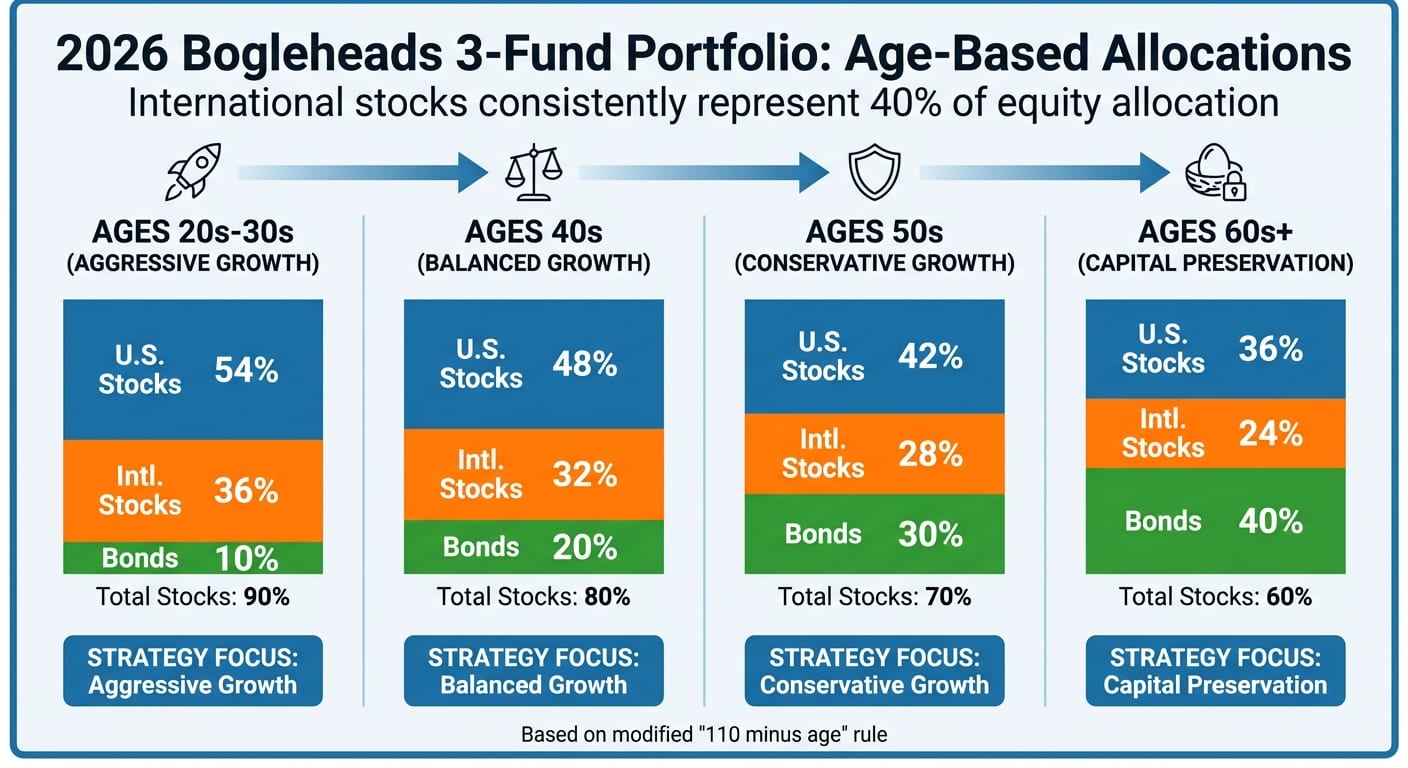
The 2026 Bogleheads allocations are designed with three main factors in mind: your capacity to take risks (based on your time horizon and income stability), your willingness to take risks (how comfortable you are with market fluctuations), and your need to take risks (the returns required to achieve your financial goals). These percentages aim to maintain global diversification while gradually increasing stability as you age.
The strategy follows a modified "110 minus age" rule to determine the equity-to-fixed-income ratio for your age, with international stocks consistently making up 40% of your equity investments. This approach minimizes reliance on any single economy while keeping the plan straightforward to implement. Below is a breakdown of allocations by age group, aligning risk levels with evolving financial priorities.
20s-30s: 54% U.S. Stocks, 36% International Stocks, 10% Bonds
At this stage, 90% of your portfolio is allocated to stocks, leveraging your long time horizon for recovery. The 10% bond allocation offers a slight safety net without compromising the growth needed to build wealth.
This is the prime time to take risks. You have decades to recover from market downturns and a steady income from employment to help you stay the course. Even in the event of a steep market drop, the impact on your long-term goals is minimal.
40s: 48% U.S. Stocks, 32% International Stocks, 20% Bonds
By your 40s, the bond allocation increases to 20%, providing more stability. With likely substantial savings at this point, protecting your wealth becomes a higher priority. The 80% stock allocation still offers robust growth potential, but the added bonds help ease the emotional toll of market volatility.
This adjustment reflects a shorter recovery window compared to your earlier years. As Vanguard founder John Bogle noted:
"As we age, we usually have more wealth to protect, less time to recoup severe losses, greater need for income, and perhaps an increased nervousness as markets jump around. All four of these factors suggest more bonds as we age".
50s: 42% U.S. Stocks, 28% International Stocks, 30% Bonds
With retirement on the horizon, a 30% bond allocation balances capital preservation with growth. A 70% stock allocation ensures your portfolio continues to grow, keeping pace with inflation during retirement.
Historical data supports this balance. During the 2000–2002 bear market, a 70% stock/30% bond portfolio weathered the downturn far better than more aggressive allocations, highlighting the importance of this shift as you approach retirement. While growth remains necessary, the focus shifts to protecting the progress you've made.
60s+: 36% U.S. Stocks, 24% International Stocks, 40% Bonds
In retirement, 40% of your portfolio is allocated to bonds, providing steady income and reducing volatility. The remaining 60% in stocks ensures your investments continue to grow, supporting potentially 30+ years of retirement expenses.
At this stage, stability takes priority. Without employment income, you need a buffer to avoid selling stocks during market downturns. Bonds play a critical role here, offering a safety net while giving your equity investments time to recover.
These allocations create a foundation for choosing ETFs that align with each asset class.
ETF Options for Each Asset Class
The Bogleheads investment strategy focuses on three main asset classes: a total U.S. stock market index fund, a total international stock market index fund, and a total U.S. bond market index fund. Vanguard ETFs are often the go-to choice because of their extremely low fees and minimal tracking error. That said, comparable options are available from iShares, Schwab, and SPDR.
For U.S. stocks, VTI (Vanguard Total Stock Market ETF) stands out, offering exposure to over 3,700 U.S. companies at a low expense ratio of 0.03%. This ETF fits seamlessly into portfolios tailored for different age groups, ensuring balance and durability. If you're looking for alternatives, consider ITOT from iShares (0.03%), SCHB from Schwab (0.03%), or SPTM from SPDR. While these funds track slightly different indexes, they all provide comparable coverage of the U.S. stock market.
For international stocks, VXUS (Vanguard Total International Stock ETF) is a strong option, covering around 8,000 companies across developed and emerging markets with a 0.07% expense ratio. Comparable choices include IXUS from iShares (0.07%) and SCHF from Schwab (0.06%). Keep in mind, SCHF focuses only on developed markets, so you'll need to pair it with SCHE to include emerging market exposure.
For bonds, BND (Vanguard Total Bond Market ETF) offers broad exposure to investment-grade bonds with an expense ratio of just 0.03%. However, some 2026 strategies suggest VGIT (Vanguard Intermediate-Term Treasury ETF) as an alternative to avoid the stock-market correlation often found in corporate bonds. Younger investors with a higher risk tolerance might also explore VGLT (Vanguard Long-Term Treasury ETF) for better protection during equity downturns. Other total bond market alternatives include AGG from iShares (0.03%), SCHZ from Schwab (0.03%), and SPAB from SPDR.
To get the most out of these ETFs, choose ones that align with your brokerage for commission-free trading. This way, you can take full advantage of their ultra-low fees while leveraging AI-driven insights to fine-tune your portfolio.
AI-Driven Portfolio Analysis with Mezzi
Once you've chosen your ETFs, Mezzi steps in to enhance your portfolio management through its advanced AI tools. These tools analyze the 2026 Bogleheads allocations in real time, uncovering potential risks and opportunities that might otherwise go unnoticed. This level of insight, once reserved for professional investors, is now available to everyone.
Market Trends Behind the 2026 Changes
AI-driven analytics highlight key factors shaping the current market landscape. Global economic growth, better fiscal conditions, and a surge in AI investments are contributing to heightened volatility. High-growth mega-cap stocks are under pressure, while metals prices remain unpredictable. To address these challenges, experts suggest increasing exposure to small-cap stocks and emerging markets, which can help reduce the risks of being overly concentrated in domestic markets. This strategy aligns with the 2026 shift toward greater international and small-cap investments, offering investors opportunities beyond U.S. borders.
Using Mezzi's X-Ray Feature to Find Hidden Risks
Mezzi's X-Ray feature is designed to uncover overlaps and correlations within your portfolio that might not be immediately obvious. For example, AI analysis reveals a high positive correlation of 0.83 between the U.S. Total Stock Market (VTI) and International Developed Markets (VEA). This means these assets often move in sync, potentially limiting diversification benefits. Additionally, the Bogleheads 3-fund portfolio shows a 0.97 correlation with VTI, indicating that U.S. stocks heavily influence its performance. On the other hand, Total Bond Market funds (BND) have a –0.15 correlation with VTI, making them a reliable buffer against market volatility.
For younger investors looking for extra protection during downturns, long-term Treasury bonds like VGLT could be a better hedge. Corporate bonds within total market funds tend to be more correlated with stocks, which can reduce their effectiveness as a safeguard. These insights underscore the importance of diversifying asset allocations to avoid over-reliance on U.S. equities.
Tax Optimization and Rebalancing with Mezzi
Rebalancing your portfolio often comes with tax implications, but Mezzi's AI tools help you navigate these challenges. The platform is designed to maximize tax-loss harvesting by avoiding costly wash sales across multiple accounts. It prioritizes rebalancing within tax-advantaged accounts to prevent triggering capital gains taxes. Mezzi also monitors your portfolio continuously, alerting you if an asset drifts more than 5% from its target allocation. By automating these complex calculations and offering clear guidance, Mezzi makes it easier to maintain your desired asset mix while reducing unnecessary tax burdens. This ensures you can adjust your portfolio without compromising your long-term financial goals.
Conclusion
The 2026 Bogleheads allocations are designed to address today's market challenges - geopolitical tensions, fluctuating interest rates, and uncertainties surrounding AI. By increasing international exposure and tailoring bond allocations to different age groups, these portfolios maintain broad diversification across more than 15,000 global securities while keeping costs impressively low (expense ratios around 0.04%).
The data backs up this strategy's effectiveness: over the past 30 years, the three-fund approach has consistently delivered strong long-term results. Meanwhile, more than 90% of actively managed funds have failed to outperform their benchmarks over 15-year periods. On top of that, fees matter - a 0.70% fee difference on a $500,000 portfolio can result in over $200,000 in lost growth over 30 years.
Sticking to this approach requires discipline. It means optimizing rebalancing frequency when any asset class strays more than 5% from its target, staying invested during market downturns, and avoiding the urge to chase trends. Fortunately, AI tools make this easier. Platforms like Mezzi simplify complex portfolio management tasks, from identifying hidden risks (like overlapping exposures) to automating tax-efficient rebalancing across multiple accounts.
The strategy moving forward remains clear. Investors in 2026 should follow age-appropriate allocations, rely on low-cost index ETFs, and use AI tools to stay consistent. Simplicity, paired with modern technology, continues to be a powerful formula for achieving long-term financial success.
FAQs
How do I pick the right stock/bond mix for my age and goals?
Choosing the right mix of stocks and bonds comes down to factors like your age, financial goals, and how much risk you're comfortable taking. A typical starting point is allocating 80% to stocks (with 60% in U.S. stocks and 20% in international stocks) and 20% to bonds.
Younger investors often lean toward a higher percentage of stocks to prioritize growth. On the other hand, those closer to retirement might shift toward a more conservative mix, such as 45% bonds, to help minimize risk. Ultimately, your allocation should reflect both your financial objectives and your personal comfort with market fluctuations.
When should I rebalance, and what’s the easiest way to do it?
Rebalancing your portfolio regularly - whether annually, quarterly, or when your asset allocation veers off by a set percentage (like 5–10%) - is key to staying on track. A straightforward way to do this is to choose a specific date, like January 1, to review your investments. From there, you can adjust by selling assets that have increased in value and buying those that have dropped. To make this process easier, consider using automated tools or setting reminders to ensure your portfolio remains aligned with your financial goals.
Which bond fund works best if I want lower stock-like risk?
Intermediate-term bond funds, such as the Vanguard Total Bond Market ETF, are a solid choice for those looking to reduce the volatility associated with stocks. These funds serve as a stabilizing force in your portfolio, helping to lower overall risk while still providing consistent returns.
Disclosures:
- This content is for informational purposes only and does not constitute investment advice or a recommendation to buy or sell any security.
- Past performance is not indicative of future results. No guarantee of future performance or outcomes is implied.
- Registration does not imply a certain level of skill or that the SEC has approved the company or its services.
- The use of artificial intelligence and algorithmic tools does not guarantee investment results. These tools are subject to limitations, errors, and market conditions that may affect performance.
- Savings and performance examples are hypothetical and for illustrative purposes only. Actual results will vary based on individual circumstances, portfolio composition, market conditions, and fees.
Related Blog Posts
- How does VXUS’ risk/return profile compare to holding VEA + VWO separately?
- VXUS vs VEA+VWO: 5-year total return and overlap analysis (country/sector/holding overlap).
- VXUS vs IXUS: Which International ETF for a Three-Fund Portfolio
- How to Build a 3-Fund Portfolio Across Multiple Accounts
Choosing the right mix of stocks and bonds comes down to factors like your age, financial goals, and how much risk you're comfortable taking. A typical starting point is allocating 80% to stocks (with 60% in U.S. stocks and 20% in international stocks) and 20% to bonds.
Younger investors often lean toward a higher percentage of stocks to prioritize growth. On the other hand, those closer to retirement might shift toward a more conservative mix, such as 45% bonds, to help minimize risk. Ultimately, your allocation should reflect both your financial objectives and your personal comfort with market fluctuations.
Rebalancing your portfolio regularly - whether annually, quarterly, or when your asset allocation veers off by a set percentage (like 5–10%) - is key to staying on track. A straightforward way to do this is to choose a specific date, like January 1, to review your investments. From there, you can adjust by selling assets that have increased in value and buying those that have dropped. To make this process easier, consider using automated tools or setting reminders to ensure your portfolio remains aligned with your financial goals.
Intermediate-term bond funds, such as the Vanguard Total Bond Market ETF, are a solid choice for those looking to reduce the volatility associated with stocks. These funds serve as a stabilizing force in your portfolio, helping to lower overall risk while still providing consistent returns.