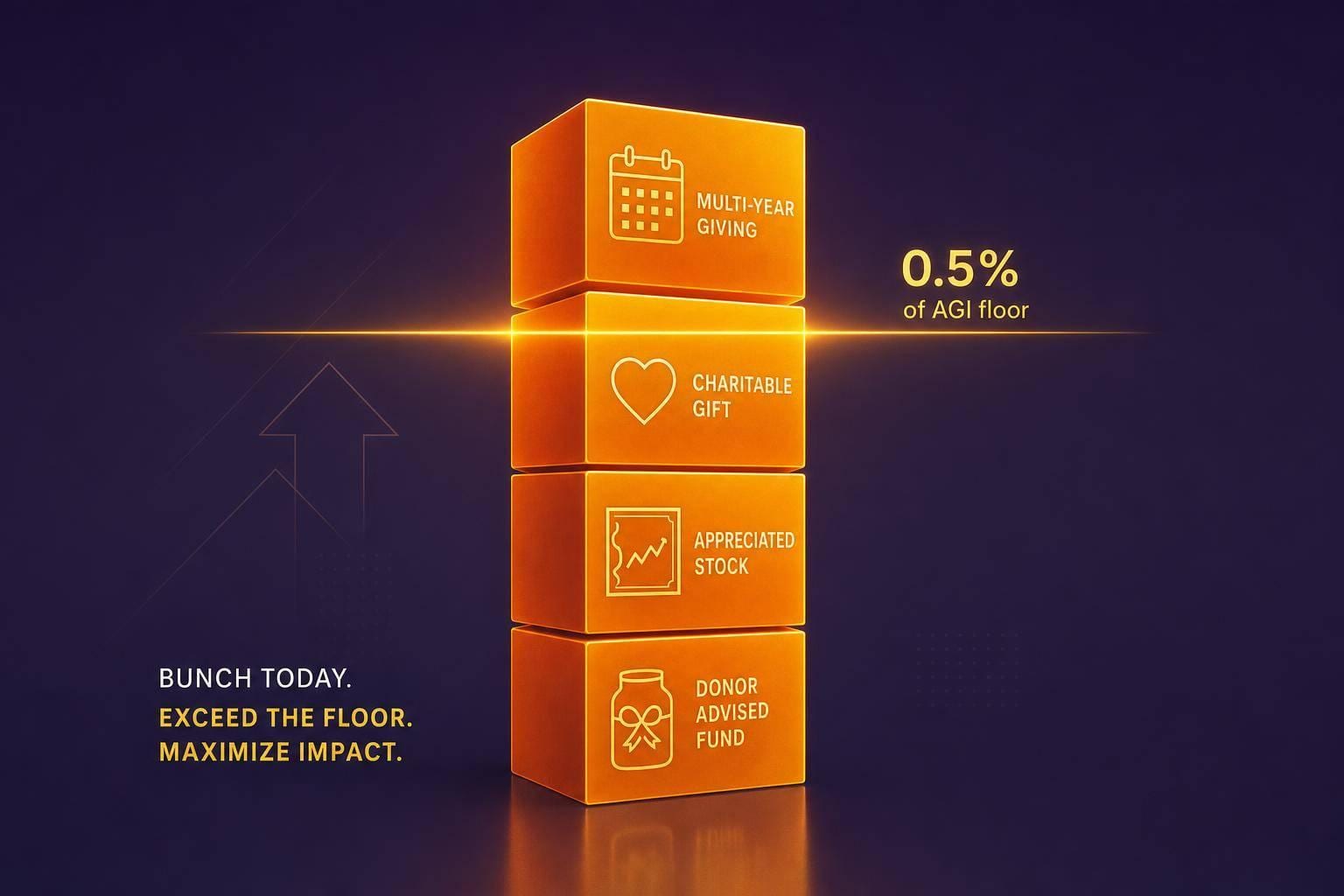
Starting in 2026, some itemizers may lose the tax deduction for the first 0.5% of AGI in charitable gifts. That means a person with $200,000 of AGI may get no deduction for the first $1,000 of annual giving.
Here’s the short version:
- If gifts are spread out each year, the 0.5% floor may apply every year
- If gifts are grouped into one year, that floor may apply once instead of several times
- The math may work better for people who:
already itemize
- are near the standard deduction
- give smaller amounts each year relative to income
- Tools some donors use include:
donor-advised funds
- donating appreciated stock
- Timing may matter, since year-end transfer deadlines may affect which tax year gets the deduction
A simple example: giving $4,000 a year for three years may produce less total deductible charity than giving $12,000 in one year, because the yearly floor may reduce the deduction more than once.
That said, bunching may not change much for everyone. If someone already itemizes far above the standard deduction each year, or if gifts stay below the floor even in a bunch year, the tax result may be limited.
I’d read this article as a planning framework, not a rulebook: run the numbers across 2 to 5 years, then see whether a bunching pattern may produce more total deductions than smooth annual giving.
Charitable Contributions (Part 2) | Bunching | DAF | QCD | Giving
How the 0.5% of AGI floor works
The OBBBA adds a 0.5% of AGI floor for itemizers. That means charitable gifts below that threshold aren't deductible. Only the portion above the threshold may be deducted, and the usual AGI percentage limits may still apply.
The basic formula with dollar examples
The math is simple: multiply your AGI by 0.005 to find the floor. That matters because gifts below the floor may produce no current-year tax benefit, which may change the math on spreading gifts across multiple years.
A taxpayer giving $1,200 a year - common for someone donating $100 a month - may get zero deduction because the full gift falls below the $1,500 floor. If annual giving rises to $4,000, then $2,500 may be deductible.
How the floor interacts with the standard deduction and AGI caps
The 0.5% floor may be only the first hurdle. Two more may come into play before charitable giving lowers a tax bill.
The next hurdle may be the standard deduction. For 2026, that's roughly $14,000–$15,000 for single filers and $29,000–$30,000 for married couples filing jointly. Take a married couple with $200,000 of AGI, $8,000 of SALT, $10,000 of mortgage interest, and $2,500 of charitable giving. After the floor, only $1,500 of that charity may be deductible, which may leave total itemized deductions below the standard deduction.
If itemized deductions still end up above the standard deduction, bunching may shift the math. In that setup, the floor may be less of a drag and more of a timing issue.
Large one-year gifts may still run into the usual AGI limits. For front-loaded gifts, the existing AGI percentage caps still apply:
- 60% of AGI for cash gifts to public charities
- 30% of AGI for appreciated property such as long-term stock
For someone with $600,000 of AGI making a $400,000 cash gift, only $360,000 may be deductible in the current year. The rest may carry forward under the normal rules.
With the floor, the standard deduction, and AGI caps all in play, the next step may be to compare when bunching works better than annual giving.
When bunching charitable gifts makes sense
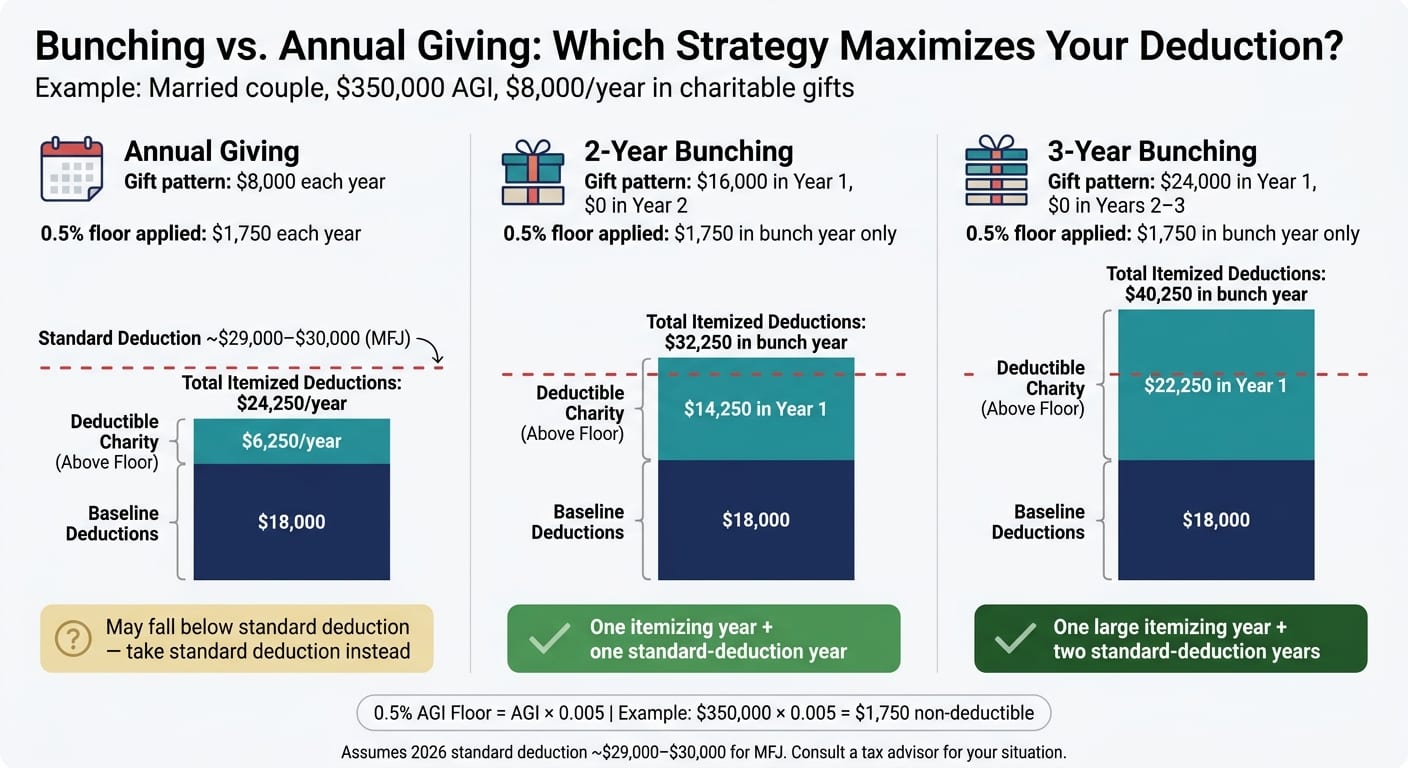
Once you know how the floor works, the next step may be deciding whether to give the same amount every year or bunch gifts into one tax year. The cleanest way to look at it: compare steady annual giving with a single bunched year.
A step-by-step deduction comparison
A common way to run the numbers may look like this: estimate the next 2 to 5 years of AGI, calculate each year's 0.5% floor, add baseline itemized deductions, and then compare annual giving with a 2- or 3-year bunch.
For a simple example, assume a married couple with $350,000 of AGI, $8,000 of planned annual giving, and $18,000 of baseline deductions. In this example, that same $8,000 annual gift is modeled in three ways: given each year, bunched into one year to cover two years of giving, or bunched into one year to cover three years of giving. Their 0.5% floor is $1,750 each year.
The main point may be easy to miss if you only look at one year: compare total deductions across multiple years. A bunching plan may look better in the gift year, but the better test may be what happens across the full 2- to 5-year window.
If AGI changes in a meaningful way, recalculate the floor for each year on its own and test the highest-income year first. Then compare the total deduction over those years under two patterns:
- Even annual giving
- A 2- or 3-year bunch
If bunching may improve the total deduction, the next step may be choosing the vehicle and timing.
Cases where bunching helps and where it does not
Bunching may help when annual gifts and baseline deductions sit close to the standard deduction. It may also help when income jumps in one year. For example, a doctor with $500,000 of AGI and larger gifts in some years, and little or none in others, may find that timing changes the deduction result.
On the other hand, bunching may add little when you already itemize well above the standard deduction every year. In that case, moving gifts around may not change much.
How Mezzi can speed up the analysis
Mezzi may model your AGI, itemized deductions, and gift timing using connected account data, so you may compare annual giving with bunching faster.
How to carry out a bunching strategy
If bunching improves the math, the next step may be execution.
Using a donor-advised fund to prepay multiple years of giving
A donor-advised fund, or DAF, may let you take the deduction now and send the money to charities later. You open the DAF, fund it with the bunched gift, and then recommend grants over time on your usual schedule.
Using the earlier example, a married couple with $200,000 of AGI front-loads three years of $6,000 annual giving into Year 1 and contributes $18,000 to a DAF. That $18,000 contribution may create a $17,000 charitable deduction after the floor. In Years 2 and 3, they recommend $6,000 in grants from the DAF each year and take the standard deduction in those off-years. The deduction stays concentrated in Year 1, while the grants still go out over time.
Any investment growth inside the DAF also may be tax-free. So if part of the balance sits there before you grant it, that amount may grow without creating a taxable event.
If you don't want to fund the DAF with extra cash, appreciated securities may be another way to do it.
Donating appreciated securities instead of cash
If you hold long-term appreciated stock or fund shares, donating them directly to a DAF or charity may avoid capital gains tax on the built-in gain while still allowing a deduction for the full fair market value of the shares. This setup may work well when appreciated stock funds a bunched gift.
Say you bought stock for $10,000 and it's now worth $25,000. Selling first may trigger $15,000 in capital gains, which may lead to capital gains tax. Donating the shares directly may sidestep that. You may deduct $25,000, subject to the 0.5%-of-AGI floor and the 30%-of-AGI limit that applies to appreciated property donated to public charities and DAFs, and the DAF may sell the shares tax-free.
For paperwork, file Form 8283 for noncash gifts over $500. And keep a contemporaneous written acknowledgment for gifts of $250 or more.
If your deduction goes past the 30%-of-AGI cap in the bunching year, the unused portion may carry forward for up to five years. So a very large gift may not be lost.
The deduction turns on the transfer date, which makes timing a big part of the process.
Year-end timing details to check before acting
Securities transfers often have sponsor cutoff dates before December 31. Stock and mutual fund transfers may take several business days. If you miss the transfer window, the deduction may slide into the next tax year and disrupt the bunching plan.
Some people start securities transfers by early to mid-December, then use cash later if needed. Late-year income events, like a year-end bonus, RSU vesting, or higher-than-expected business income, may shift your AGI enough to change both the 0.5% floor amount and the maximum allowed deduction. A recalculation in early December using updated income estimates may help you see whether the contribution amount still fits before the deadlines close.
Conclusion: A simple framework for deciding whether to bunch
If the multi-year comparison may favor bunching, this final checklist may help you decide whether to act. The new 0.5% AGI floor may make smaller annual gifts nondeductible, and bunching may make it easier to get more value from a charitable deduction.
Use this four-step check:
- Calculate your floor: Multiply estimated AGI by 0.005 to find the floor. On $300,000 of AGI, that comes to $1,500.
- Compare 2- and 3-year totals: Look at annual giving next to a 2- or 3-year bunch, while including the floor and your other itemized deductions.
- Use the tools: Some donors use a donor-advised fund or appreciated securities to front-load the deduction.
- Check AGI, security transfer timing, and DAF deadlines before December 31.
Some people may skip bunching if they already itemize well above the standard deduction or if their giving may be too small to get past the floor.
If you want to test the math quickly, Mezzi may run the scenario on your connected accounts and show whether bunching may beat annual giving.
FAQs
How do I know if bunching will actually save me taxes?
Bunching may reduce taxes for some people if combining several years of charitable gifts into one year pushes itemized deductions above the standard deduction.
It may also improve the tax result around the 0.5%-of-AGI floor, since a larger share of contributions may clear that limit in the year they’re claimed. Some taxpayers compare the tax result of bunching with the result of spreading gifts over time to see whether taxable income may end up lower.
What if my donations are still below the 0.5% AGI floor?
If your annual donations stay below the 0.5% of AGI floor, they generally may not count toward itemized charitable deductions under the new 2026 rules.
Some taxpayers may deal with that in a few different ways. For example, they may bunch multiple years of giving into one tax year, use a donor-advised fund for an immediate deduction, or, if they’re age 70½ or older, make a qualified charitable distribution from an IRA to bypass the floor.
Should I bunch gifts using cash, stock, or a donor-advised fund?
It depends on your goals and tax situation.
Appreciated stock held for more than a year may be more tax-efficient than cash in some cases. That’s because you may avoid capital gains tax and still deduct the full fair market value.
A donor-advised fund may make bunching easier. It allows an immediate deduction, while grants may go to charities over time.
If you're age 70½ or older, a qualified charitable distribution from an IRA may be another option. That said, it may not go to a donor-advised fund.
Disclosures:
- This content is for informational purposes only and does not constitute investment advice or a recommendation to buy or sell any security.
- Past performance is not indicative of future results. No guarantee of future performance or outcomes is implied.
Related Blog Posts
- 5 Ways to Donate Equity Compensation Tax-Efficiently
- Donor-advised fund: how to donate appreciated stock tax-efficiently
- "How do I lower my taxable income?" - 12 Levers, Ranked by Effort
- Donor-Advised Funds: Bunching Two Years of Giving Into One
Bunching may reduce taxes for some people if combining several years of charitable gifts into one year pushes itemized deductions above the standard deduction.
It may also improve the tax result around the 0.5%-of-AGI floor, since a larger share of contributions may clear that limit in the year they’re claimed. Some taxpayers compare the tax result of bunching with the result of spreading gifts over time to see whether taxable income may end up lower.
If your annual donations stay below the 0.5% of AGI floor, they generally may not count toward itemized charitable deductions under the new 2026 rules.
Some taxpayers may deal with that in a few different ways. For example, they may bunch multiple years of giving into one tax year, use a donor-advised fund for an immediate deduction, or, if they’re age 70½ or older, make a qualified charitable distribution from an IRA to bypass the floor.
It depends on your goals and tax situation.
Appreciated stock held for more than a year may be more tax-efficient than cash in some cases. That’s because you may avoid capital gains tax and still deduct the full fair market value.
A donor-advised fund may make bunching easier. It allows an immediate deduction, while grants may go to charities over time.
If you're age 70½ or older, a qualified charitable distribution from an IRA may be another option. That said, it may not go to a donor-advised fund.