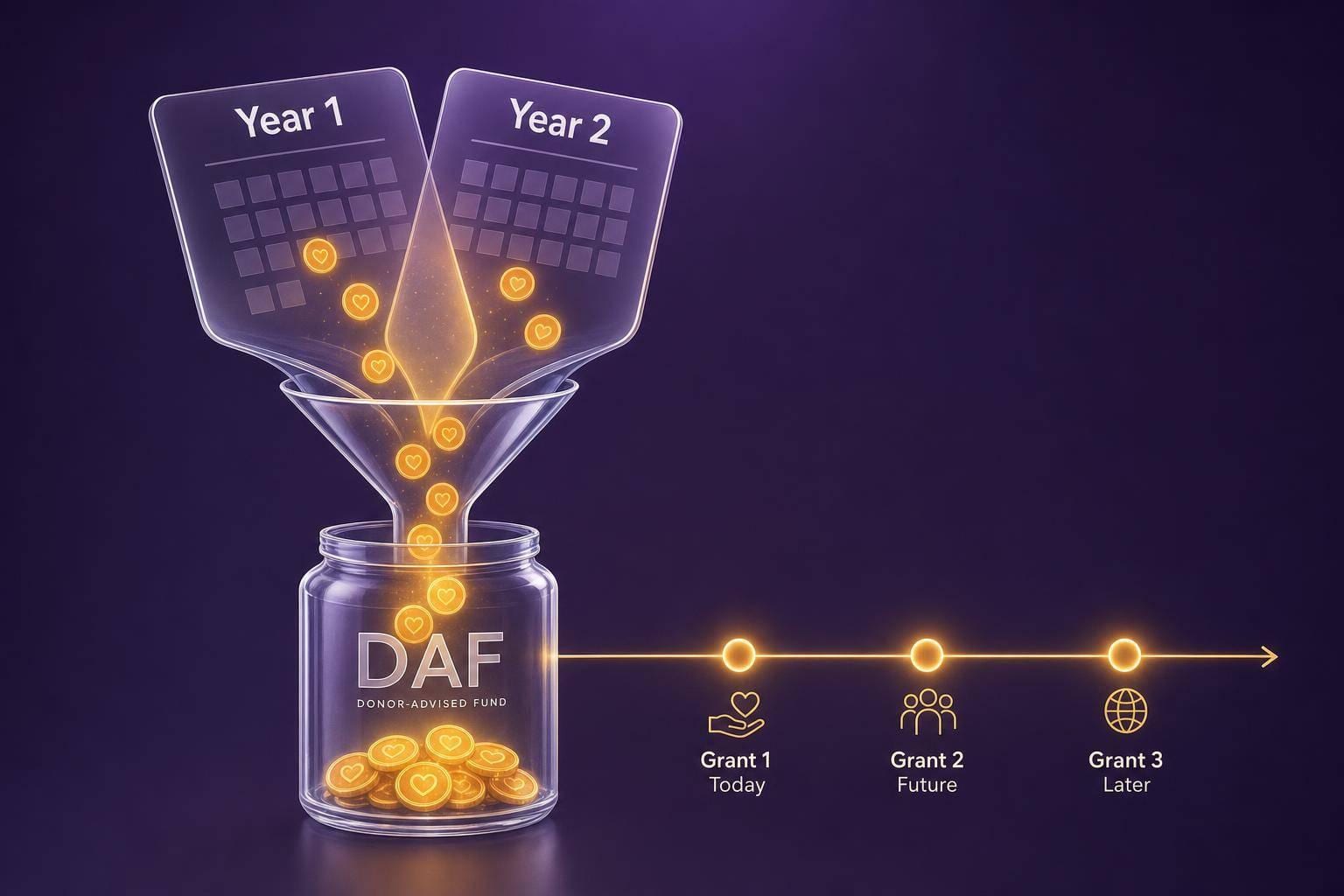
If your yearly write-offs sit near the standard deduction, bunching two years of donations into one DAF contribution may create a tax deduction in one year without changing your charities’ payout schedule.
Here’s the short version:
- I may contribute two years of planned giving at once to a donor-advised fund, such as $16,000 instead of $8,000 + $8,000
- I may itemize in the contribution year if total deductions move above the standard deduction
- I may then take the standard deduction in the next year
- My charities may still get grants on the same steady schedule
- The main tradeoffs may include AGI limits, carryforwards, fees, liquidity, irrevocable funding, and possible AMT effects
This approach does not change how much goes to charity. It only may change when the deduction shows up on the tax return.
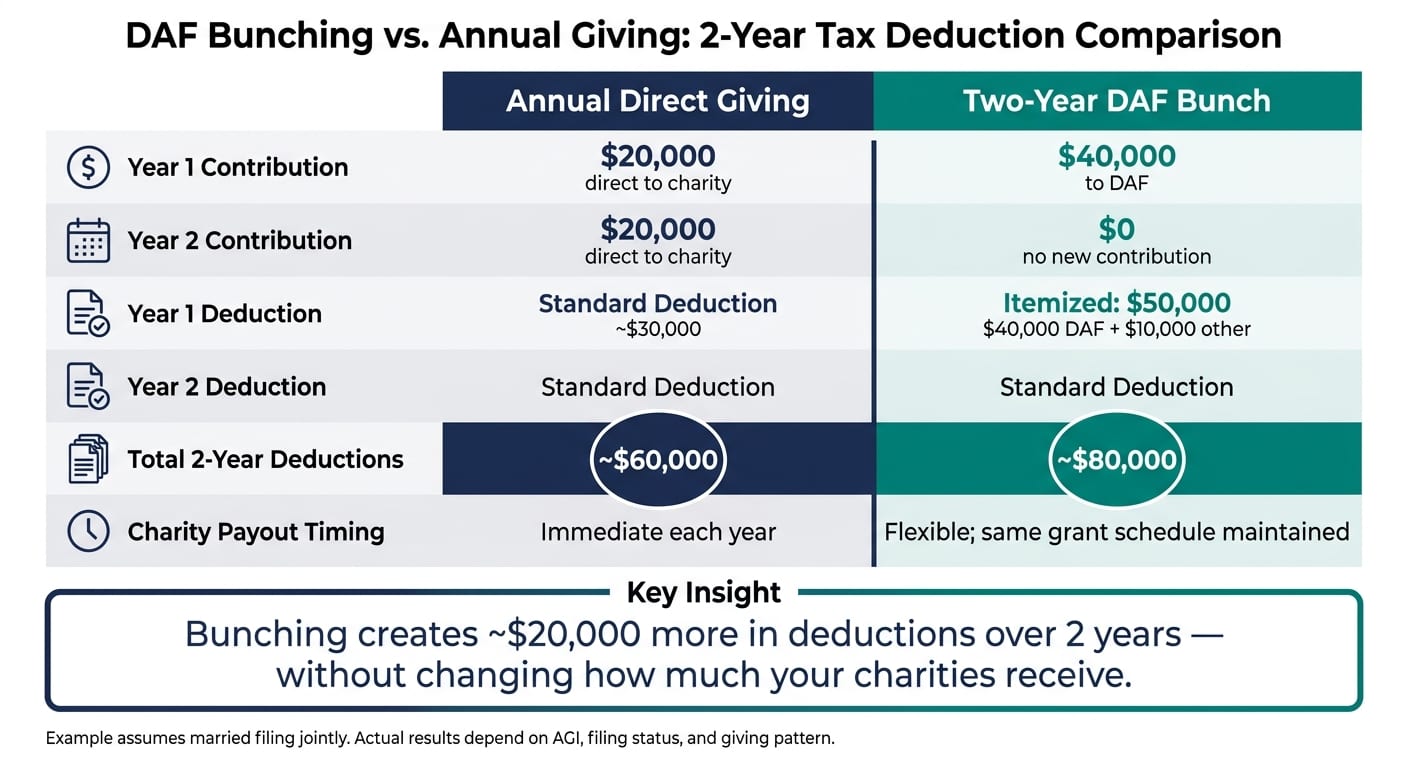
A simple example from the article shows the idea clearly: a couple giving $20,000 per year with $10,000 of other itemized deductions may end up with about $60,000 of deductions across two years if they take the standard deduction both years, versus about $80,000 across two years if they bunch $40,000 into a DAF in Year 1 and then use the standard deduction in Year 2.
Maximize tax efficiency by bunching charitable giving
Quick Comparison
The core question may be simple: does one larger deduction year create enough tax value to offset the extra steps and costs?
How to bunch two years of giving into one DAF contribution
Step 1: Estimate your baseline itemized deductions
Start with your usual deduction picture. Look at your projected itemized deductions and compare that total with the standard deduction for your filing status. If your yearly itemized deductions may fall below the standard deduction, bunching may create a year where itemizing makes more sense.
It may make sense to run this check in Q4, before the Dec. 31 deadline.
Step 2: Set the bunch amount and choose a funding method
Add up two years of planned gifts and contribute that total to the DAF in one tax year. For example, if you normally give $8,000 per year, a two-year bunch would be a $16,000 DAF contribution. That full amount may be deductible in the contribution year, subject to IRS limits.
You may fund the DAF with cash or appreciated securities. If you donate securities, the transfer may need to be completed before year-end for the gift to count in the intended tax year.
Step 3: Send grants from the DAF on your normal schedule
After the contribution, you may send DAF grants on your usual schedule. The charities may receive the same support; only the timing of the deduction changes.
The next section compares annual giving with a two-year bunch so you can see when the deduction may improve.
Annual giving vs. bunching: a two-year comparison
Year-by-year deduction math with a worked example
This example shows how bunching may change when you claim the deduction, without changing how much goes to charity.
Say a married couple filing jointly gives $20,000 to charity each year and has another $10,000 in itemized deductions, such as mortgage interest and state and local taxes. That brings total itemized deductions to $30,000 per year, which may sit close to the standard deduction for married couples filing jointly. In a normal year, itemizing may offer little added tax value.
Now look at a two-year bunching setup. Instead of giving $20,000 each year, the couple contributes $40,000 to a DAF in Year 1, then sends grants to charities on the same schedule as before.
In the bunching setup, Year 1 may produce a larger itemized deduction, while Year 2 may fall back to the standard deduction.
What actually drives the tax savings
The tax effect may come from getting over the standard-deduction threshold in one year.
Here’s the basic idea: if your itemized deductions land near the standard deduction each year, the charitable piece may not add much extra tax value on its own. The standard deduction may already cover most of that baseline.
Bunching puts two years of giving into one tax year. That may push total deductions above the standard-deduction line. The potential tax value comes from that spread - the amount by which Year 1 itemized deductions exceed the standard deduction.
The charities still receive the same total support. Only the timing of the deduction may change.
How Mezzi can model the scenario for your situation
If you want to test your own numbers, it may make sense to model the timing before year-end. Mezzi may model the tax impact using your connected accounts, while you still handle the DAF contribution and grants.
Tax rules, asset choices, and tradeoffs to review before you act
Once you know the deduction math, the next step may be to check the tax rules and the funding source before you move money.
Deduction timing, AGI limits, and carryforwards
A DAF deduction is claimed in the year you fund the account. Under IRS rules, the amount you may deduct in one year is capped at 60% of your adjusted gross income (AGI) for cash contributions and 30% of AGI for appreciated shares held for more than one year. If a bunching contribution goes over either limit, the extra amount may carry forward for up to five subsequent tax years.
The tax result may be larger when the deduction offsets income taxed at a higher marginal rate.
Why appreciated securities can be better than cash
The way you fund the gift may matter almost as much as the timing.
If you donate appreciated shares held for more than a year to a DAF, you may be able to deduct the shares' fair market value and avoid capital gains tax on the embedded gain. Cash is simpler. But appreciated shares from a taxable brokerage account may leave more after-tax value in the gift. The tradeoff: the lower 30% AGI limit applies to appreciated securities, compared with 60% for cash. So if the contribution is large relative to income, part of the deduction may need to be carried into later tax years.
Cash flow, fees, and sponsor restrictions
Pulling two years of giving into one contribution may create a real liquidity hit. It may make sense to check that the contribution won't put pressure on your cash flow.
DAF sponsors charge administrative and investment fees, which may reduce the dollars later available for grants. Once assets are contributed, they're irrevocable - you cannot reclaim them for personal use. You recommend grants, and the sponsor approves them. Before funding the account, it may help to review limits around grant minimums, eligible charities, and distribution rules.
Those tradeoffs may shape whether a two-year bunch makes sense relative to the cost.
When a two-year DAF bunch is worth doing
Once you know the rules and tradeoffs, the last piece is pretty simple: does the tax break look big enough to make bunching worth the extra effort?
A two-year DAF bunch may make sense when the deduction in the bunched year is clearly above the standard deduction, and the following year may still end up using the standard deduction.
The basic comparison looks like this:
- Tax savings from itemizing in the bunch year and then taking the standard deduction the next year
- Tax savings from taking the standard deduction in both years
There’s one more thing to factor in. Large bunches may also trigger AMT, which may reduce the value of itemized deductions.
In practice, whether this strategy pencils out may depend on your AGI, filing status, and giving pattern.
FAQs
How do I know if bunching will actually save me taxes?
Bunching may make sense only if it lets you itemize and moves your charitable deductions above the standard deduction. In practice, that may mean funding a donor-advised fund in a high-income year and checking the expected Schedule A result.
It also may make sense to confirm that the assets being donated are tax-efficient. Donating appreciated securities may avoid capital gains tax, which may improve after-tax savings. From there, some people compare projected tax savings with actual tax savings, including timing and contribution limits.
Should I fund a DAF with cash or appreciated stock?
Often, appreciated stock may be more tax-efficient than cash. Donating appreciated securities directly to a DAF may help you avoid capital gains tax while still allowing a deduction based on the full market value.
That may be especially helpful when bunching donations into a single tax year. The timing may matter, and keeping proper records may help support the deduction.
What are the main downsides of a two-year DAF bunch?
The main downsides are fairly simple:
- DAF funding is usually irrevocable. You may get the deduction now, but the assets are committed once contributed.
- The strategy may not do much if it doesn’t move you past the itemizing vs. standard-deduction breakpoint.
- After-tax results may be lower because of opportunity cost, planning mistakes, or weak assumptions about asset choice and timing.
Disclosures:
- This content is for informational purposes only and does not constitute investment, tax, or legal advice. Please consult your tax advisor regarding your specific situation.
- Past performance is not indicative of future results. No guarantee of future performance or outcomes is implied.
- Savings and performance examples are hypothetical and for illustrative purposes only. Actual results will vary based on individual circumstances, portfolio composition, market conditions, and fees.
Related Blog Posts
- 5 Ways to Donate Equity Compensation Tax-Efficiently
- Year-Round Tax Planning for Your Portfolio: A Monthly Checklist
- Donor-advised fund: how to donate appreciated stock tax-efficiently
- "How do I lower my taxable income?" - 12 Levers, Ranked by Effort
Bunching may make sense only if it lets you itemize and moves your charitable deductions above the standard deduction. In practice, that may mean funding a donor-advised fund in a high-income year and checking the expected Schedule A result.
It also may make sense to confirm that the assets being donated are tax-efficient. Donating appreciated securities may avoid capital gains tax, which may improve after-tax savings. From there, some people compare projected tax savings with actual tax savings, including timing and contribution limits.
Often, appreciated stock may be more tax-efficient than cash. Donating appreciated securities directly to a DAF may help you avoid capital gains tax while still allowing a deduction based on the full market value.
That may be especially helpful when bunching donations into a single tax year. The timing may matter, and keeping proper records may help support the deduction.
The main downsides are fairly simple:
- DAF funding is usually irrevocable. You may get the deduction now, but the assets are committed once contributed.
- The strategy may not do much if it doesn’t move you past the itemizing vs. standard-deduction breakpoint.
- After-tax results may be lower because of opportunity cost, planning mistakes, or weak assumptions about asset choice and timing.