
Managing a concentrated stock position can be tricky, especially when taxes are involved. If a single stock accounts for over 10% of your portfolio, you're exposed to significant financial risks and tax challenges. Selling these stocks often triggers hefty capital gains taxes, discouraging diversification.
Here’s what you need to know:
- Tax rates matter: Holding stocks for over 12 months reduces your tax rate from up to 40.8% (short-term) to 23.8% (long-term).
- Tax-saving strategies: Tools like tax-loss harvesting, spreading sales across years, and monitoring wash sale risks can reduce your tax burden.
- Diversification is key: Gradually selling and reallocating your assets can protect your wealth while managing taxes.
Platforms like Mezzi simplify this process by analyzing your portfolio, identifying tax-saving opportunities, and helping you plan exits from concentrated positions efficiently.
Capital Gains Planning for Concentrated Stock Positions
Concentrated Stock Positions and Tax Consequences
What Concentrated Stock Positions Are
A concentrated position occurs when a single stock represents a large portion of your investable assets - typically over 10–15%. These positions often result from employer equity compensation like RSUs or stock options, founder shares after a business exit, inherited stock, or early investments that have appreciated significantly. For corporate executives, this also means their income and portfolio rely heavily on the same company, increasing employment-related risks. As Imperio Wealth Advisors puts it:
A portfolio becomes 'concentrated' when a single stock makes up more than 10–15% of total investable assets.
Investors often hold onto these positions due to loyalty, confidence in their insider knowledge, or the desire to avoid a hefty capital gains tax bill - a situation known as the "tax lock-in effect."
Capital Gains Tax Rates for 2026
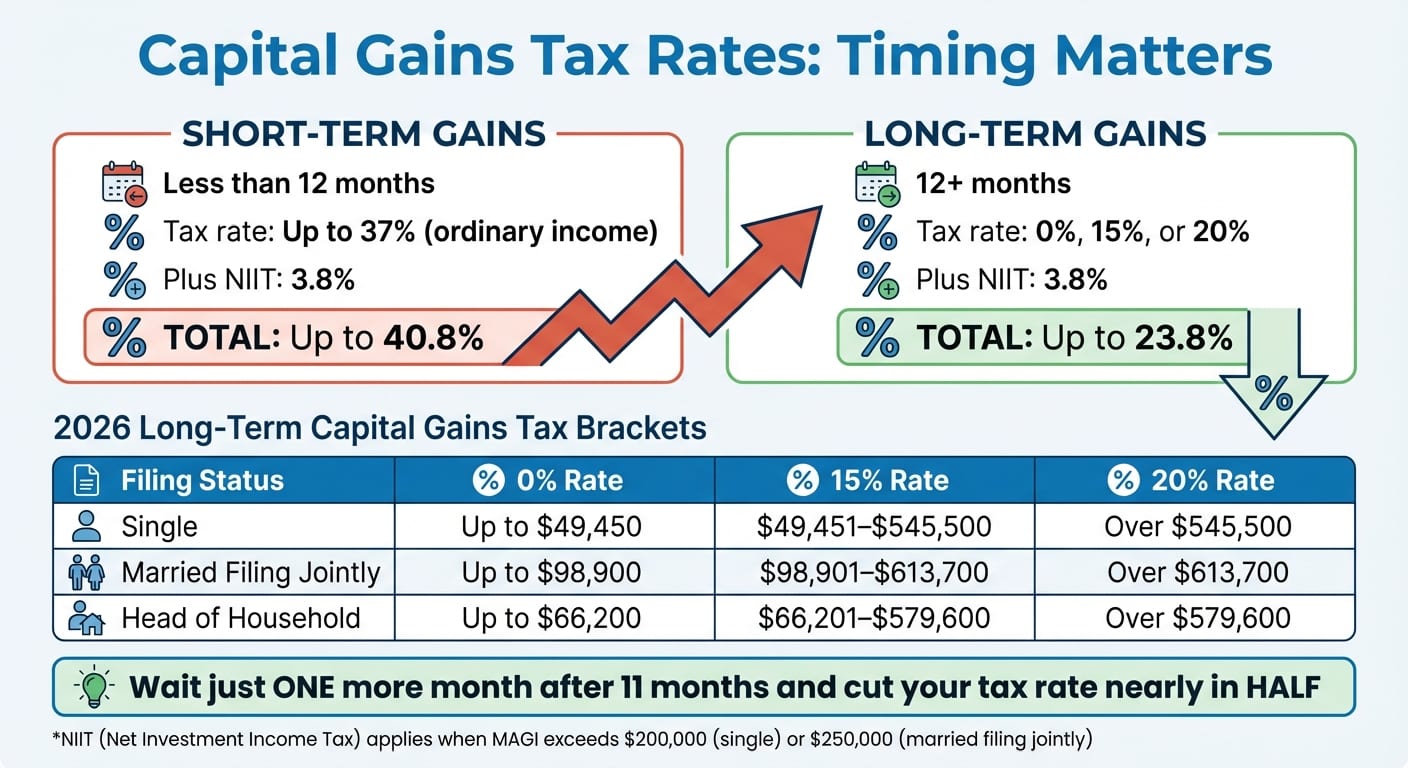
To manage concentrated positions effectively, understanding capital gains tax rates is vital. Selling a stock before holding it for 12 months means paying ordinary income tax rates, which can go as high as 37% for top earners. However, waiting until you've held the stock for at least 12 months qualifies the sale for long-term capital gains tax, capped at 20%.
"Sell a stock at 11 months and you pay your ordinary income tax rate. Wait one more month and you pay the long-term rate - often half as much." - Mezzi
For high-income earners, the tax burden doesn’t stop there. If your Modified Adjusted Gross Income exceeds $200,000 (single) or $250,000 (married filing jointly), you’ll also face a 3.8% Net Investment Income Tax. This pushes the maximum federal tax rate to 40.8% for short-term gains and 23.8% for long-term gains.
2026 Long-Term Capital Gains Rates
Filing Status0% Rate15% Rate20% RateSingleUp to $49,450$49,451–$545,500Over $545,500Married Filing JointlyUp to $98,900$98,901–$613,700Over $613,700Head of HouseholdUp to $66,200$66,201–$579,600Over $579,600
Timing your stock sales can make a big difference. By monitoring your holding periods, using the specific identification method to sell shares with the highest cost basis, and spreading sales over multiple tax years, you can ease the tax burden of reducing a concentrated position. These strategies highlight the importance of careful planning when dealing with concentrated stock positions, which we’ll dive into further in the next section.
Tax Strategies to Reduce Capital Gains on Concentrated Positions
Selling a concentrated stock position can result in a hefty tax bill. Luckily, there are ways to minimize your capital gains liability. Mezzi’s platform helps identify these opportunities across all your connected accounts, making the process more efficient.
Tax-Loss Harvesting with Mezzi

Tax-loss harvesting is a method where you sell securities at a loss to offset gains from other sales. This approach allows you to reduce your taxable income by matching losses dollar-for-dollar with gains. If your losses exceed gains, you can deduct up to $3,000 annually against ordinary income and carry forward any remaining losses to future years.
For example, one case study showed that pairing gradual sales with loss harvesting reduced the tax bill on a $10 million position by $476,000 over eight years, lowering it from $2.38 million to $1.90 million.
Mezzi simplifies this process by aggregating data from all your connected accounts, so you don’t have to manually track unrealized losses across multiple brokerages and IRAs. The platform monitors your portfolio daily, identifying opportunities for loss harvesting and advising on suitable positions. Since market conditions can change quickly, this real-time tracking is crucial.
Another key factor is managing repurchase timing to ensure you retain the tax benefits from loss harvesting.
Tracking Wash Sale Risks Across Accounts
When implementing loss harvesting, it’s important to steer clear of wash sale violations. The IRS prohibits loss deductions if you repurchase the same or a substantially identical security within 30 days before or after the sale. This rule applies across all accounts, including IRAs, 401(k)s, and taxable brokerage accounts. For example, selling a losing stock in a brokerage account and then accidentally buying it back in an IRA within 30 days would disqualify the loss deduction.
Mezzi uses AI tools for navigating wash sale rules across all your accounts. Before executing a loss harvest, the platform flags potential violations, such as overlapping positions. Once you sell, Mezzi tracks the 30-day period and notifies you when it’s safe to repurchase the security without jeopardizing your tax benefits.
Timing Stock Sales to Lower Tax Bills
In addition to loss harvesting and avoiding wash sale pitfalls, timing your stock sales can significantly impact your tax outcomes. Selling an entire concentrated position in a single year could push you into higher tax brackets, exposing portions of your gains to the top long-term capital gains rate and the 3.8% Net Investment Income Tax. Spreading sales over multiple years, however, may help you stay in lower tax brackets and reduce your overall tax burden.
Mezzi’s AI uses your aggregated account data to simulate various sale scenarios, projecting their effects on your tax bracket and after-tax proceeds. For instance, it might recommend delaying sales near a tax bracket threshold or selling portions later in the year to avoid income spikes. The platform also alerts you when a position qualifies for long-term capital gains treatment - ensuring you don’t sell prematurely and face ordinary income tax rates.
"Tax Optimization finds opportunities throughout the year so there's less tax to report in April." - Mezzi
Diversification Methods for Concentrated Stock Positions
Relying too heavily on a single stock can expose your portfolio to significant risk. Research indicates that individual stocks underperform the broader market about 80% of the time. Yet, selling off a large position to diversify often comes with hefty capital gains taxes. The challenge is finding ways to reduce this concentration while keeping your tax burden in check.
Mezzi takes a comprehensive look at your portfolio, analyzing all accounts to pinpoint tax-efficient diversification strategies. It goes beyond identifying what to sell - offering insights on where to hold specific assets and how to rebalance without triggering unnecessary tax events. Below, we’ll explore how strategic account placement and rebalancing can help you diversify while managing taxes effectively.
Choosing the Right Account Types for Your Assets
Placing assets in the right accounts - like Roth IRAs, Traditional IRAs, or taxable brokerage accounts - can significantly reduce tax drag. For example:
- High-growth assets in a Roth IRA grow tax-free, with withdrawals also free from taxes.
- Income-generating investments, such as bonds, perform well in a Traditional IRA, where growth is tax-deferred.
- Tax-efficient assets like index funds are ideal for taxable accounts, as they help minimize annual tax exposure.
Misplacing assets can be costly. For a $10 million concentrated position, poor account placement might increase your tax bill by 20–30%, while a well-structured strategy could lower tax drag by 15–25%.
Mezzi evaluates your current asset placement by aggregating data across all your accounts. For instance, if you hold a $5 million stock position with a zero cost basis, Mezzi might recommend selling 20% in your taxable account and offsetting the gains by selling losing investments to harvest losses. From there, those gains could be rolled into a Roth IRA using a conversion ladder. This approach could diversify 40% of your holdings in the first year while saving nearly $300,000 in taxes.
Account TypeIdeal Asset CharacteristicsPrimary Tax BenefitRoth IRAHigh-growth stocks; concentrated positionsTax-free withdrawals; no taxes on gainsTraditional IRAIncome-generating assets (e.g., bonds, dividend stocks)Tax-deferred growth; potential contribution deductionsTaxable BrokerageLow-turnover ETFs, index funds, tax-efficient assetsLower long-term capital gains rates
This method aligns with Mezzi's goal of leveraging AI to help you reduce taxes and safeguard your wealth.
Rebalancing Without Triggering Unnecessary Taxes
Once your assets are allocated to the right accounts, the next step is rebalancing your portfolio to reduce risk without incurring steep tax costs. Rebalancing adjusts your portfolio to meet target allocations - like moving from 70% concentrated stock to 20% single stock and 80% diversified investments. However, selling assets in taxable accounts can lead to significant tax events.
Mezzi’s AI tracks portfolio drift across all your accounts and suggests strategies to minimize taxable events. For example, with a $10 million concentrated position, spreading sales over 8–10 years could reduce your total tax liability from $2.38 million (for a lump-sum sale) to about $1.90 million.
Additionally, Mezzi recommends rebalancing within tax-advantaged accounts first - where sales don’t incur capital gains - before making adjustments in taxable accounts. This sequencing helps achieve diversification while keeping taxes low.
How Mezzi Helps You Plan for Taxes on Concentrated Positions
Handling a concentrated stock position effectively means having a clear view of all your accounts - not just the one holding the stock. Mezzi simplifies this by connecting all your financial accounts through secure, read-only access, giving you a complete picture of your holdings. This unified view is the foundation for Mezzi’s tax strategies, ensuring your entire portfolio works together for smarter tax planning.
Full Account Visibility Through Aggregation
Most traditional financial advisors can only offer advice on the accounts they directly manage. Mezzi takes a different approach by aggregating data from all your accounts - whether it’s a 401(k), Roth IRA, taxable brokerage account, or any other type of holding. This comprehensive view is key to uncovering tax-saving opportunities that might otherwise go unnoticed. It also helps identify overlapping investments, like holding the same stock in multiple accounts, which can increase your overall exposure to risk.
AI-Driven Tax Optimization
Mezzi’s platform monitors your portfolio daily, searching for opportunities like AI tax-loss harvesting. These are often time-sensitive windows that can close quickly as markets recover. When such an opportunity arises, Mezzi sends you an immediate notification so you can act fast. Additionally, the platform keeps an eye on potential wash sale risks by tracking the IRS-mandated 30-day window across all your connected accounts. This ensures you avoid unintentional violations while also optimizing holding periods to secure the best possible tax rates.
Step-by-Step Tax Planning Workflow
Mezzi’s guided workflow makes tax planning straightforward and actionable. It starts with a quick onboarding call to understand your situation. Then, you connect your accounts - a process that typically takes just two minutes. From there, the AI analyzes your portfolio, flags tax-saving opportunities, and provides ongoing guidance.
For example, if you decide to sell for tax-loss harvesting, Mezzi will notify you when the 30-day wash sale window has passed, allowing you to rebuy without worry. The platform also offers recommendations on rebalancing assets, timing sales, and selecting the right accounts for transactions - all while keeping you in full control of your decisions.
As an SEC-registered fiduciary, Mezzi is legally required to prioritize your best interests. And at just $39/month or $399/year, it delivers this service at a fraction of the cost of traditional advisors.
Compliance and Professional Advice
Mezzi, as an SEC-registered investment advisor and fiduciary, is legally obligated to act in your best interest. However, it clearly defines its role when it comes to tax and legal matters related to concentrated stock positions.
Mezzi offers guidance on tax-aware investing strategies but does not provide formal tax advice. For instance, the platform can help identify opportunities like automated tax-loss harvesting or highlight risks such as wash sales. That said, it does not handle tax return preparation, IRS filings, or the interpretation of tax laws. This approach ensures Mezzi focuses on strategy, leaving final tax decisions to your professional advisors.
As Mezzi puts it, "your CPA prepares your return and ensures compliance. Tax Optimization finds opportunities throughout the year so there's less tax to report in April. They work together". For strategies involving concentrated positions - such as timing a large sale, creating a charitable structure, or executing a tax-loss harvest - it’s essential to consult with a CPA to understand the specific tax implications based on your overall financial situation.
Keeping your financial data accurate and up to date is key to Mezzi’s ability to pinpoint tax-saving opportunities. Since the platform relies on third-party APIs and user-provided information, ensure all your accounts are fully connected and updated to maximize these opportunities.
Mezzi operates in two modes: the "Advisor" persona, which provides fiduciary-level guidance, and the "Informer" chat persona, which offers AI-generated informational content. However, the latter is not part of Mezzi's advisory services and may include inaccuracies. Always double-check any guidance and consult a qualified tax attorney or CPA for complex or unique situations.
Conclusion
By using the strategies outlined earlier, you can effectively manage your tax liabilities while diversifying your investments. Combining techniques like tax-loss harvesting, careful sale timing, wash sale monitoring, and tax-efficient rebalancing allows you to reduce your tax burden and keep more of your hard-earned money working for you.
A gradual approach, which incorporates phased sales alongside tax-loss harvesting, can significantly lower your taxes. This method not only helps free up funds for reinvestment in a diversified portfolio but also offers considerable savings compared to selling everything at once without any planning.
Mezzi simplifies the process of implementing these strategies. Its platform tracks holding periods down to the exact day, ensuring you know when a position qualifies for long-term capital gains rates. It also identifies tax-loss harvesting opportunities before market recoveries and alerts you to potential wash sale risks across all your accounts.
To get started, connect your accounts to Mezzi’s dashboard and run the AI tax optimization scan. With long-term capital gains rates currently near historical lows, timing your sales wisely can make a big difference. For example, waiting just one extra month to qualify for long-term rates can cut your tax rate by nearly 50%. A phased exit strategy can help you achieve diversification while minimizing taxes.
Protect the wealth you’ve worked so hard to build by transitioning your concentrated positions strategically.
FAQs
How do I know if my stock holding is too concentrated?
If a single stock - like employer stock - accounts for more than 10–20% of your portfolio, your holdings might be too concentrated. This level of concentration can expose you to risks such as increased volatility, potential liquidity issues, and tax complications. To manage these risks, make it a habit to review your portfolio regularly and address any imbalances.
How can I reduce capital gains taxes without selling everything at once?
To minimize capital gains taxes without selling everything at once, you can explore a few smart strategies:
- Tax-loss harvesting: This involves selling investments at a loss to offset gains, reducing your taxable income.
- Spreading sales over multiple tax years: By doing this, you may be able to stay in lower tax brackets and reduce your overall tax burden.
- Rebalancing within tax-advantaged accounts: Making adjustments in accounts like IRAs or 401(k)s can help you avoid triggering taxable events.
Tools like Mezzi’s AI can assist in optimizing the timing of your sales and pinpointing specific lots to sell. This approach not only helps with tax efficiency but also aligns with your broader investment objectives.
How do I avoid a wash sale when tax-loss harvesting across accounts?
To steer clear of a wash sale, make sure you don’t buy back the same or substantially identical security within 30 days before or after you sell it. This rule covers all accounts under your control, including both taxable and retirement accounts. Tools like Mezzi can assist by tracking your trades, identifying potential violations, and offering alternative options to help you maintain market exposure while staying within the rules.
Mezzi is free to get started. Choose Advisory for unlimited advice and advanced features at $39/month or $399/year. Concierge includes the same, plus hands-on support, at $99/month or $999/year.
Disclosures:
- This content is for informational purposes only and does not constitute investment advice or a recommendation to buy or sell any security.
- Past performance is not indicative of future results. No guarantee of future performance or outcomes is implied.
- Mezzi is an SEC-registered investment adviser. Registration does not imply a certain level of skill or that the SEC has approved the company or its services.
- Mezzi offers guidance on tax-aware investing strategies but does not provide formal tax advice. Consult a qualified tax professional for personalized tax advice.
- Savings and performance examples are hypothetical and for illustrative purposes only. Actual results will vary based on individual circumstances, portfolio composition, market conditions, and fees.