
Chubby FIRE offers a balanced approach to financial independence, sitting between Lean FIRE's frugality and Fat FIRE's luxury. It targets annual spending of $80,000–$150,000, requiring a portfolio of $2–$3.75 million based on the 4% withdrawal rule. This strategy allows for a comfortable lifestyle with room for healthcare, travel, and dining out, while avoiding the extreme sacrifices of Lean FIRE or the high savings hurdle of Fat FIRE.
Key Points:
- Annual Spending: $80,000–$150,000.
- Portfolio Target: $2–$3.75 million (based on 4% withdrawal rate).
- Lifestyle: Upper-middle-class comfort with moderate luxuries.
- Who It’s For: Professionals or dual-income households earning $150,000–$300,000 annually, saving 30%–50% over 15–20 years.
- Advantages: Financial cushion for unexpected costs, flexibility to live in most U.S. cities, and a smoother transition into retirement compared to Lean or Fat FIRE.
Chubby FIRE emphasizes saving aggressively while enjoying life’s comforts, making it a practical choice for those seeking financial independence without extreme sacrifices or unattainable goals.
Lean FIRE vs Normal FIRE vs Chubby FIRE vs Fat FIRE - Which One Is Right For You?
Chubby FIRE vs. Lean FIRE vs. Fat FIRE
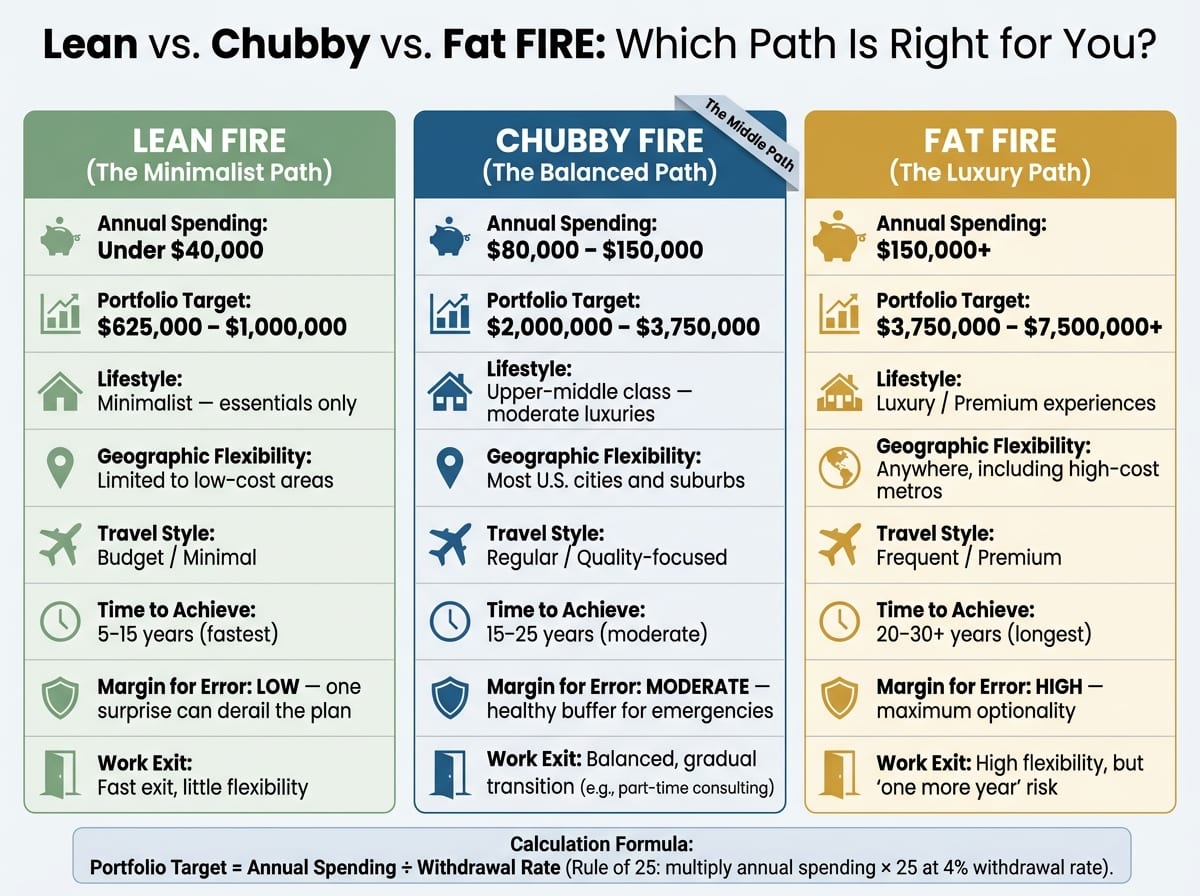
How Spending and Lifestyle Differ Across FIRE Styles
Let’s take a closer look at how Chubby FIRE compares to Lean and Fat FIRE in terms of spending habits and lifestyle choices.
At its core, each FIRE approach seeks to answer one key question: how much is enough? The answer shapes not only financial goals but also the way one lives daily, balancing spending with lifestyle preferences.
Lean FIRE focuses on frugality, with annual expenses kept below $40,000. This often means living in low-cost areas and cutting back on non-essential spending. While it requires a smaller portfolio - typically between $625,000 and $1,000,000 - it doesn’t leave much room for unexpected costs. For instance, a significant medical expense could take up nearly half of an annual budget.
Fat FIRE, on the other hand, caters to a high-end lifestyle. With annual spending starting at $150,000, it supports living in expensive cities, indulging in luxury travel, and enjoying premium experiences. However, the trade-off is steep: portfolio targets begin at $3,750,000 and can surpass $7,500,000, making it a challenging goal for most individuals.
Chubby FIRE finds a middle ground. It’s designed for those who value comfort and security without veering into extremes. This approach covers essentials like quality healthcare, while allowing for enjoyable extras like regular vacations and dining out. For example, a typical Chubby FIRE budget might allocate $15,000 annually for travel and $12,000 for dining out. Unlike Lean FIRE, it doesn’t restrict you to the cheapest locations - you can live comfortably in most U.S. cities and suburbs.
"ChubbyFIRE occupies the sweet spot between traditional FIRE and FatFIRE... You gain freedom to enjoy moderate luxuries without constant budget monitoring or feelings of restriction." - Ramit Sethi, Author and Host of "How to Get Rich"
Another advantage of Chubby FIRE is its flexibility when transitioning into retirement. While Lean FIRE often necessitates a complete exit from work due to tight margins, and Fat FIRE may tempt high earners to delay retirement with a “just one more year” mindset, Chubby FIRE allows for a smoother shift. This could mean transitioning to part-time consulting or a phased retirement plan, thanks to its built-in financial cushion.
Comparison Table: Lean, Chubby, and Fat FIRE
How to Calculate Your Chubby FIRE Number
The Core Math: Spending, Withdrawal Rate, and Portfolio Size
The formula is simple: Portfolio Target = Annual Spending ÷ Withdrawal Rate. A common approach is the "Rule of 25", which uses a 4% withdrawal rate. This means multiplying your annual expenses by 25.
For example:
- If you plan to spend $100,000 annually, your target portfolio is $2,500,000.
- For $125,000 in yearly spending, your target increases to $3,125,000.
However, if you're retiring in your 40s or early 50s, a more cautious withdrawal rate of 3.5% or even 3% is often recommended. This requires multiplying your annual spending by 28.6 or 33.3, respectively.
"The 4% rule is a floor, not a ceiling. The real constraint on early retirement isn't the withdrawal math - it's your savings rate during the accumulation decade." - We Are Calculator
The table below illustrates how different withdrawal rates affect your portfolio target based on annual spending:
Once you've identified your baseline number, you'll need to adjust it for factors like taxes, healthcare, and safety reserves.
Accounting for Taxes, Healthcare, and Safety Buffers
Taxes are the first adjustment to consider. Withdrawals from traditional retirement accounts, such as 401(k)s or IRAs, are taxed as ordinary income. If you anticipate an effective federal tax rate of 12–15% in retirement, multiply your pre-tax FIRE number by approximately 1.15 to maintain your spending power.
Healthcare costs can be a major expense for early retirees in the U.S. Before Medicare begins at age 65, a couple may spend $15,000–$25,000 annually on ACA marketplace premiums, dental, vision, and out-of-pocket medical expenses. Additionally, healthcare costs tend to rise faster than general inflation, often increasing by 5–7% each year. To manage these costs, some retirees aim to keep their taxable income below 400% of the federal poverty level, which can help qualify for ACA subsidies and reduce premiums.
"Chubby FIRE isn't hard because the math is complex. It's hard because the inputs have to be honest." - Carlos Grider, Author, A Brother Abroad
Lastly, it's wise to maintain a cushion for unexpected expenses. Set aside 1–2 years' worth of living expenses in liquid, accessible funds, and consider adding a 10–15% discretionary buffer to your portfolio for unplanned costs. This can provide a safety net during market downturns early in retirement.
Building Your Chubby FIRE Plan
How to Save More Without Cutting Everything You Enjoy
Chubby FIRE followers often aim to save between 40% and 50% of their income. While that might seem overwhelming, it doesn't mean sacrificing everything you love. The key is prioritizing spending on areas that matter most - like travel, wellness, or meaningful experiences - while trimming back on less important expenses.
Boosting your income is often more effective than simply cutting costs. By directing raises, bonuses, or side hustle earnings straight into your investments, you can increase your savings rate without compromising your lifestyle. Automating these contributions ensures they happen consistently, right after payday.
Here’s a practical tip: every $10,000 you cut from annual expenses reduces the size of the portfolio you need for FIRE by $250,000, assuming a 4% withdrawal rate. Even small adjustments in spending can make a significant difference over time.
Portfolio Construction and Asset Allocation
A strong Chubby FIRE portfolio typically relies on low-cost index funds as its foundation. These funds provide broad domestic and international exposure, keeping fees low while supporting steady, long-term growth. A common allocation might look like this: 60–80% in stocks (index funds and ETFs), 10–20% in bonds (Treasuries or municipals), and 5–10% in alternatives such as REITs.
Where you hold your investments matters as much as what you invest in. Tax-efficient strategies can help maximize after-tax returns. For example, tax-loss harvesting could add up to 1.5% annually, while effective retirement planning might contribute an additional 1.0%. Here’s a quick guide to asset placement:
Make the most of tax-advantaged accounts like 401(k)s, IRAs, HSAs, and Mega Backdoor Roths before turning to taxable accounts.
Once your portfolio is in place, the next step is creating a timeline and keeping track of your progress.
Setting a Timeline and Tracking Your Progress
Your timeline will depend on factors like your starting savings, income growth, and target portfolio size. Starting early, however, can make a huge difference thanks to the power of compounding.
A bucket strategy can help you weather market downturns: keep 1–2 years of expenses in cash, allocate 3–7 years to balanced funds, and invest the rest for long-term growth. This way, even during a tough market, you won’t need to sell investments at a loss to cover expenses.
Annual reviews are essential. Spending patterns may shift, markets fluctuate, and life circumstances change - checking in regularly helps you spot and address potential issues early. Testing your plan with a lower withdrawal rate, like 3% or 3.5%, can also provide a clearer picture of how well it might hold up if returns are lower than expected or healthcare costs increase.
How Mezzi Helps You Plan for Chubby FIRE
Keeping tabs on your Chubby FIRE progress across multiple accounts can feel overwhelming. Mezzi simplifies this process with tools designed to streamline your planning. By securely linking all your accounts through read-only access, Mezzi provides guidance typically reserved for financial advisors - without the usual 1% AUM fee. Here’s how Mezzi supports every step of your Chubby FIRE journey.
Tax Optimization with Mezzi
For Chubby FIRE investors, taxes can take a big bite out of long-term portfolio growth. Mezzi helps by analyzing your taxable accounts to identify opportunities for tax-loss harvesting. It flags positions below cost, highlights unrealized losses, estimates potential tax savings, and even suggests tax-efficient replacements to keep your portfolio fully invested. Plus, it warns you about wash sale risks across all accounts, including automatic investments that might trigger issues within the 61-day wash-sale window.
Mezzi also offers insights on asset location, helping you decide which investments to place in tax-advantaged accounts versus taxable ones. For example, it might recommend holding REITs and actively managed bond funds in a traditional 401(k) or IRA, while keeping low-turnover equity ETFs in taxable accounts. According to research from Vanguard, implementing asset location strategies like these can add around 0.75% annually in net returns for typical U.S. investors.
Mezzi's Portfolio X-Ray and Overlap Tool
Managing portfolio concentration is essential for a well-balanced Chubby FIRE plan. DIY investors often overlook the risk of unintended concentration. Mezzi’s Portfolio X-Ray uncovers the underlying holdings across your accounts, measures your exposure to specific sectors or stocks, and suggests tax-aware adjustments to rebalance your allocation. This clarity helps you maintain a balanced portfolio - such as a 70/30 equity-to-bond split - reducing the risk of unexpected volatility.
Retirement Tracking and Progress Monitoring with Mezzi
Mezzi pulls real-time data from your accounts - balances, contributions, and investment allocations - to build accurate retirement projections. For instance, if your Chubby FIRE goal is $2 million (based on $80,000 in annual spending at a 4% withdrawal rate), Mezzi shows whether you’re on track to hit that target by your planned retirement date. A 2023 Employee Benefit Research Institute survey found that only 31% of American workers feel very confident about their retirement readiness. Mezzi replaces guesswork with real data and lets you explore "what-if" scenarios - like saving more or retiring later - so you can see how adjustments might improve your chances of success.
Tradeoffs and Challenges of Chubby FIRE
Chubby FIRE isn’t without its hurdles. Achieving this level of financial independence requires a strong commitment to saving and careful planning during the accumulation phase. Let’s take a closer look at how balancing current spending with future goals plays a critical role in this journey.
Finding the Right Balance Between Spending Now and Saving for Later
Building a portfolio in the range of $2 million to $3.75 million often requires saving 30% to 50% of your gross income over a period of 15 to 25 years. That’s no small feat, especially if your income allows for luxuries that can be tempting to indulge in.
One of the biggest challenges is avoiding lifestyle creep - those small but frequent spending upgrades that gradually inflate your expenses and push retirement further out of reach. To counter this, it’s helpful to focus on 2–3 spending categories that are most meaningful to you, such as travel or health, while keeping other expenses in check. Automating your savings can also make a significant difference. By setting up automatic transfers right after payday, you remove the daily temptation to spend, turning discipline into a system rather than a constant test of willpower.
"The biggest risk is also simple: lifestyle creep dressed up as 'I deserve it.'" - Carlos Grider, Author
Another tradeoff is the potential need to extend your working years. While a disciplined savings approach helps you build a robust portfolio, it may also mean working an additional 5–10 years compared to more minimalist FIRE paths. This extra time is the price for having a financial cushion and the ability to enjoy moderate luxuries in retirement. For many, the added comfort is worth it, but it’s important to consider whether those extra working years align with your personal goals. Additionally, early retirees should plan for $12,000–$24,000 annually to cover health insurance costs before Medicare eligibility at age 65.
Comparison Table: Tradeoffs Across FIRE Styles
This table highlights how Chubby FIRE strikes a middle ground between the minimalist approach of Lean FIRE and the lavish lifestyle of Fat FIRE. While it offers a more comfortable retirement than Lean FIRE, it also requires more time and savings, making it a path that demands patience and careful planning.
Conclusion: Your Path to Chubby FIRE
Chubby FIRE strikes a balance between financial independence and a comfortable lifestyle. With a portfolio of $2 million to $3.75 million, you might generate $80,000 to $150,000 annually - enough to cover quality healthcare, regular travel, and day-to-day comfort without resorting to extreme frugality or years of extended saving. This approach reflects the harmony between maintaining a high savings rate and enjoying a fulfilling lifestyle.
Achieving this goal often involves a 30%–50% savings rate, thoughtful spending on priorities, and careful planning for taxes and healthcare along the way. The reward? A financially secure retirement that aligns with an upper-middle-class standard of living - a tradeoff many find worthwhile.
Mezzi can play an important role in this journey. As outlined earlier, Mezzi simplifies tax planning and consolidates your financial accounts, including 401(k)s, Roth IRAs, and taxable accounts. It identifies opportunities for tax-loss harvesting, flags wash sale risks, and provides asset location recommendations - tailored specifically to your financial situation. Unlike generic calculators, Mezzi's retirement tracking uses real account data, giving you insights that are relevant to your unique circumstances.
To take the next step, connect your accounts to Mezzi, run a portfolio X-Ray to assess your current financial standing, and identify hidden cost inefficiencies. With disciplined saving and smart tax strategies, your path to Chubby FIRE becomes clearer. Reaching your Chubby FIRE number starts with making every saved dollar work harder for your future.
FAQs
Is Chubby FIRE realistic for a single income?
Yes, achieving Chubby FIRE on a single income is possible, particularly for high-income earners in fields like tech, law, or engineering. With disciplined saving habits and tools such as Mezzi to help minimize investment fees and taxes, single earners may work toward building a portfolio ranging from $2,000,000 to $3,750,000. This strategy can potentially accelerate wealth accumulation, providing a solid financial foundation for an early and comfortable retirement.
Should I use a 4%, 3.5%, or 3% withdrawal rate?
Your withdrawal rate may vary based on how long you plan to stay retired and how much risk you're comfortable taking. The commonly referenced 4% rule is often aligned with 30-year retirement periods. However, if you're retiring early and planning for a 40- to 50-year horizon, many opt for a lower rate, around 3% to 3.5%, to add a layer of caution. On the other hand, if your spending is flexible or you have additional income sources, sticking with 4% might work for you. Tools like Mezzi can help you map out tailored projections and adjust your withdrawal approach to support your financial goals over the long haul.
How can I lower taxes and health insurance costs before Medicare?
To potentially lower taxes and healthcare expenses before qualifying for Medicare, consider managing your Modified Adjusted Gross Income (MAGI) to qualify for maximum ACA premium subsidies. This can involve relying on income sources that don’t count toward MAGI, such as Roth IRA withdrawals, HSA distributions for qualified expenses, or return of basis from taxable investment accounts.
When it comes to taxes, Health Savings Accounts (HSAs) offer a powerful way to save, thanks to their triple tax benefits: contributions may be tax-deductible, growth is tax-free, and withdrawals for qualified expenses are also tax-free. Additionally, tools like Mezzi can help pinpoint opportunities for tax-loss harvesting and optimize asset location. However, it’s important to weigh these strategies carefully, especially when considering Roth conversions, as they may influence your ACA subsidy eligibility.
Disclosures:
- This content is for informational purposes only and does not constitute investment advice or a recommendation to buy or sell any security.
- Past performance is not indicative of future results. No guarantee of future performance or outcomes is implied.
- Always consult with a qualified financial advisor before making investment or financial planning decisions.
Related Blog Posts
- Chubby FIRE: A guide to a comfy early retirement
- Coast FIRE and Chubby FIRE: Comfortable Early Retirement Strategies
- Chubby FIRE: Comfortable Early Retirement Between Lean and Fat
- Financial Independence for Physicians: High Income, Late Start Strategy
Yes, achieving Chubby FIRE on a single income is possible, particularly for high-income earners in fields like tech, law, or engineering. With disciplined saving habits and tools such as Mezzi to help minimize investment fees and taxes, single earners may work toward building a portfolio ranging from $2,000,000 to $3,750,000. This strategy can potentially accelerate wealth accumulation, providing a solid financial foundation for an early and comfortable retirement.
Your withdrawal rate may vary based on how long you plan to stay retired and how much risk you're comfortable taking. The commonly referenced 4% rule is often aligned with 30-year retirement periods. However, if you're retiring early and planning for a 40- to 50-year horizon, many opt for a lower rate, around 3% to 3.5%, to add a layer of caution. On the other hand, if your spending is flexible or you have additional income sources, sticking with 4% might work for you. Tools like Mezzi can help you map out tailored projections and adjust your withdrawal approach to support your financial goals over the long haul.
To potentially lower taxes and healthcare expenses before qualifying for Medicare, consider managing your Modified Adjusted Gross Income (MAGI) to qualify for maximum ACA premium subsidies. This can involve relying on income sources that don’t count toward MAGI, such as Roth IRA withdrawals, HSA distributions for qualified expenses, or return of basis from taxable investment accounts.
When it comes to taxes, Health Savings Accounts (HSAs) offer a powerful way to save, thanks to their triple tax benefits: contributions may be tax-deductible, growth is tax-free, and withdrawals for qualified expenses are also tax-free. Additionally, tools like Mezzi can help pinpoint opportunities for tax-loss harvesting and optimize asset location. However, it’s important to weigh these strategies carefully, especially when considering Roth conversions, as they may influence your ACA subsidy eligibility.