
Physicians may earn a lot and still feel late to FI. A delayed start, student loans that may reach $300,000+, and spending that may jump with the first attending paycheck may change the math fast.
Here’s the short version:
- A high income alone may not close the gap from starting to invest in your 30s.
- The first attending years may shape the whole timeline more than almost any other period.
- Some physicians focus first on a set cash-flow order: employer match, emergency fund, tax-advantaged accounts, debt plan, then taxable investing.
- Loan choices may depend on interest rate and forgiveness path. For example, private loans above about 6%–8% may lead some people to favor payoff, while PSLF-eligible federal loans may push others toward lower required payments and more retirement contributions.
- Tax shelters may matter more when time is shorter. In 2026, that may include $24,500 to a 401(k)/403(b), another $24,500 to a 457(b) if available, $8,750 to a family HSA, and $7,500 per person through a backdoor Roth IRA.
- Taxable investing may work better when low-turnover index funds sit there and higher-tax assets sit inside retirement accounts.
- FI math may start with spending, not salary. At a 3.5% withdrawal rate, $180,000 in yearly spending may point to about $5.1 million before adding any extra buffer.
Some physicians may reach FI later than standard FIRE stories suggest. But many may still build a workable path by keeping lifestyle growth in check, using tax-advantaged accounts early, and treating all accounts as one household portfolio.
That’s the core idea of this article: a late start may change the route, but it may not end the trip.
Build a physician cash-flow order
From residency to attending: what to fund first
The jump from residency to attending pay may shape a physician's finances for years. Some physicians use that income jump to build wealth fast. Others may let the extra cash slip away. Since attending years are limited, it may help to set a fixed funding order from day one.
During residency, many physicians start with a few basics: choose a loan path early, build a 1–3 month emergency fund, get the full employer match in a 401(k) or 403(b), and stay away from consumer debt. A 5% match may amount to free compensation.
That order may shift fast once attending pay begins.
With the first attending paycheck, some physicians choose to build the emergency fund to 3–6 months, max out 401(k), 403(b), 457(b), and HSA accounts, pick one loan path, and send the rest to taxable investing and planned spending. It may help to set that order before the first attending paycheck arrives.
The next call is simple on paper, harder in practice: should extra cash go toward debt, or into the market?
When paying off student loans beats investing
A common way to frame this is to compare loan savings that are fixed with after-tax investment returns that may or may not show up.
For private loans above 6–8%, aggressive payoff may often come out ahead. At 8% interest, each dollar sent to the loan may work like a guaranteed 8% return, which many portfolios may struggle to match after taxes. For federal loans refinanced to 3–5%, some physicians make regular payments while also investing on a steady schedule.
The main exception may be PSLF. For example, a 501(c)(3) hospitalist with $300,000 in PSLF-eligible federal loans may choose to pay only the required IDR amount. In that setup, some physicians focus on pre-tax retirement contributions to lower taxable income and invest any extra cash on the side.
Once the debt plan is set, spending creep may become the next problem.
How to limit lifestyle inflation in the first 24 months
After training, income may triple. At the same time, years of delayed spending may push people toward lifestyle inflation almost at once. Some physicians use a resident-level budget with only a 10–20% increase in monthly expenses, then direct the rest toward debt payoff, retirement accounts, and taxable investing. A $30,000 signing bonus may also be split on purpose - $10,000 toward high-interest debt, $10,000 to taxable investing, and $10,000 to build the emergency fund or front-load retirement contributions.
Automation may help here. If transfers happen on payday, spending may start with whatever is left. That early restraint may protect later investing power, especially because big fixed costs, like a mortgage or an expensive car, may be hard to unwind. Some physicians delay major upgrades until after one full year of hitting savings targets.
Once cash flow is in order, the next step may be using tax-advantaged accounts before taxable investing.
Physician’s Guide to Financial Literacy & Investment Strategies w/ Dr. Jim Dahle | Ep. 533
Max out tax-advantaged accounts before using taxable investing
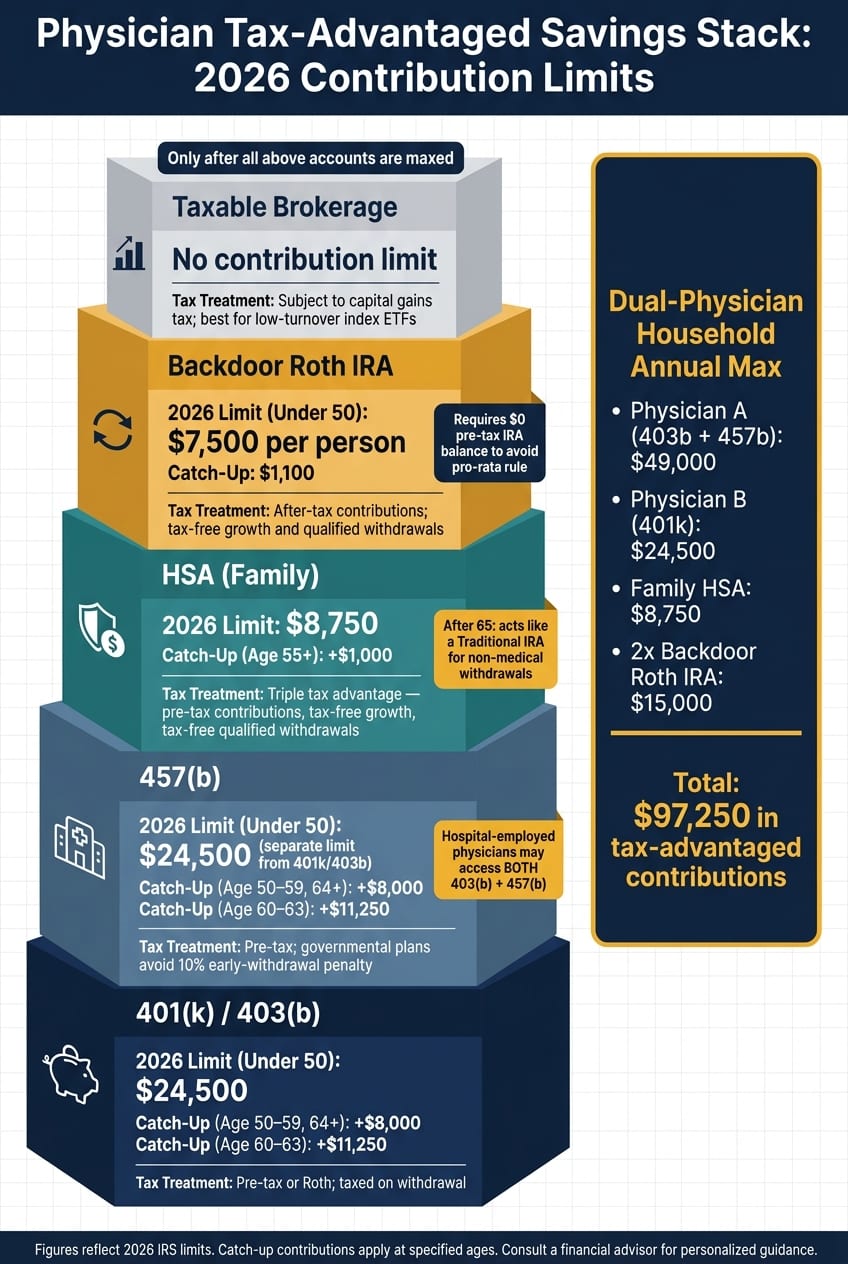
With debt and spending under control, the next dollar may go to tax-advantaged accounts first. Physicians are often short on years, not income, and each tax shelter used early may make that gap smaller.
The physician savings stack: 401(k), 403(b), 457(b), HSA, and backdoor Roth
Late-start physicians may need every tax shelter available.
401(k)s and 403(b)s share one employee limit, while a 457(b) adds a separate limit. The 2026 employee elective deferral limit is $24,500, with an added $8,000 catch-up for ages 50–59 and 64+, or $11,250 for ages 60–63. Hospital-employed physicians at non-profit or academic centers often have access to both a 403(b) and a 457(b). That means a hospitalist may defer $24,500 into the 403(b) and another $24,500 into the 457(b) in the same year. That creates far more tax-deferred room than a peer with only a 401(k).
One detail matters here. A governmental 457(b) allows penalty-free withdrawals after separation from service at any age, while a non-governmental 457(b) may carry employer-creditor risk and stricter distribution rules.
The HSA is often underused by physicians who treat it like a short-term spending account. But used a different way, it may function more like a retirement account with a rare tax setup: contributions are pre-tax, growth is tax-free, and qualified medical withdrawals are tax-free. The 2026 family contribution limit is $8,750. Some households keep the deductible in cash, invest the rest, and treat the HSA like retirement money. After age 65, non-medical withdrawals are taxed as ordinary income with no penalty, so the HSA may start to behave like a traditional IRA with an added medical angle. After the HSA, the next step for some physicians may be the backdoor Roth.
The backdoor Roth may add tax-free retirement savings. Because many attending physicians exceed the income threshold for direct Roth contributions, the backdoor method - making a non-deductible traditional IRA contribution of up to $7,500 per person under 50, or $8,600 with catch-up, and then converting it to Roth - is a common workaround. Pre-tax IRA balances may need to be at $0 before year-end to avoid the pro-rata rule. If a pre-tax IRA balance exists, a reverse rollover into the current employer plan may clear the way.
Why account order matters when peak earnings start late
Each year's contribution limit is permanent. Starting at 36 or 38 may mean missed contribution space compounds for decades.
For many attending physicians, the funding order often looks like this:
- Contribute enough to get the full employer match
- Max the HSA
- Do the backdoor Roth IRA
- Finish maxing the 401(k) or 403(b)
- Add 457(b) deferrals if available
- Only then send surplus to a taxable brokerage account
Pre-tax workplace contributions may make the most sense during peak-earning years, when marginal federal rates may sit in the 32%–37% range. The backdoor Roth may add tax diversification by building a pool of funds that may be withdrawn tax-free in retirement, regardless of where future tax rates end up.
How dual-physician households can raise the savings rate faster
A dual-attending household may have a built-in edge: two full sets of workplace plans, two backdoor Roth IRAs, and one family HSA. When coordinated well, the annual tax-advantaged savings capacity may be substantial.
Consider a hypothetical couple. Physician A is a hospitalist employed by a non-profit health system with access to a 403(b) and a governmental 457(b). Physician B is an employed internist with a 401(k). Both are under 50.
In a single year, Physician A may defer $24,500 into the 403(b) and another $24,500 into the 457(b). Physician B maxes the 401(k) at $24,500. The household maxes the family HSA at $8,750 and executes two backdoor Roth IRAs at $7,500 each. That totals $97,250 in tax-advantaged contributions before a single dollar reaches a taxable brokerage account.
Two salaries filling two complete account stacks may compress the FI timeline in a way one income may not match.
Once the household fills these accounts, the next challenge is where taxable money belongs.
Use taxable accounts efficiently and manage all accounts in one view
After the savings stack is full, the next place some physicians may look for a return lift is asset location. In high tax brackets, taxable investing may be less about picking new funds and more about putting each asset in the account that may fit it best.
How to invest in taxable accounts without unnecessary tax drag
Three rules may cover most of the decision:
- Low-tax assets may fit taxable accounts. Broad, low-turnover index ETFs - like total U.S. market or total international funds - may work well here because a large share of their returns may come from long-term capital gains and qualified dividends.
- High-tax assets may fit tax-deferred accounts. High-yield bond funds, REITs, and actively managed funds with high turnover may be better placed inside a 401(k), 403(b), or 457(b).
- Municipal bonds may fit taxable accounts when a physician wants fixed-income exposure there, since their interest may be exempt from federal income tax.
Rebalancing in taxable accounts takes a bit of care. One common approach is to direct new contributions to underweight asset classes first, before selling anything, which may avoid extra capital gains. If sales are unavoidable, specific lot identification may offer more control over which shares are sold and may reduce the realized gain.
The hidden cost of scattered accounts
Many physicians may not keep everything in one place. Old training accounts, a new attending plan, IRAs, an HSA, and a taxable account may all sit on different platforms. That split setup may create three common risks.
First, fund overlap. Holding an S&P 500 index fund in one account and a large-cap growth ETF in another may create an unplanned tilt toward U.S. large-cap stocks, even if each account looks diversified on its own.
Second, wash-sale risk. If a physician harvests a loss in a taxable account while an automatic contribution buys the same or a nearly identical fund in an IRA or employer plan within 30 days, the loss may be disallowed.
Third, allocation drift. When each account is managed on its own instead of at the household level, the combined portfolio may drift away from the intended risk mix over time.
How Mezzi helps physicians see the full picture without moving assets
This is where a household-level view may matter most. Mezzi is an SEC-registered fiduciary platform that connects to 401(k), 403(b), 457(b), IRA, HSA, and brokerage accounts through read-only access via Plaid and Finicity. It shows all accounts together, which may make it easier for physicians to rebalance, harvest losses, and spot overlap without moving assets.
From that single view, Mezzi's AI flags overlapping holdings across ETFs and mutual funds, asset-location mismatches, and wash-sale risk across accounts before a physician may trigger one by accident. If a loss is harvested, Mezzi tracks the 30-day wash-sale window before the fund is bought back.
For a dual-physician household managing multiple retirement plans, backdoor Roth IRAs, an HSA, and a joint taxable account, Mezzi's X-Ray feature shows hidden overlap across all of those accounts at once. That way, rebalancing decisions may reflect the actual combined portfolio, not a pile of separate snapshots.
Build a realistic physician FI timeline
Once the savings stack is full, the next step is figuring out how much wealth may count as FI.
Start with spending, then calculate your FI number
Start with 12 months of actual spending, not salary. Remove expenses that may end in FI, such as loan payments, CME travel, licensing, and other work costs. Then add back costs that may remain, like health insurance, housing, family support, and any practice exit costs, such as malpractice tail coverage.
For physicians, the FI target may need to reflect delayed earnings, loan drag, and a shorter compounding runway.
That adjusted number becomes your FI target. Divide it by your chosen withdrawal rate. A more conservative 3.5% withdrawal rate may make sense instead of the classic 4% rule, given longer retirement horizons and higher healthcare exposure. A physician expecting to spend $180,000 per year in FI may need roughly $5.1 million ($180,000 ÷ 0.035). Adding a 10–20% buffer for irregular costs, such as a practice transition, support for aging parents, or a major home repair, may give you a more grounded target to build toward.
If Social Security or a pension may cover part of that spending, subtract it first. A physician expecting $40,000 per year from Social Security may only need their portfolio to cover $140,000 per year, which may bring the required portfolio down to about $4 million at 3.5%.
That formula may turn an abstract savings goal into a number you can actually work with for the two physician FI paths below.
2 physician paths: the catch-up attending and the dual-physician household
Hypothetical Path 1 - The Catch-Up Attending
A late-start specialist may narrow the gap by pairing a 40–45% savings rate with aggressive loan payoff early, then redirecting freed-up cash flow into investing once debt is gone. At a 4.5% inflation-adjusted return, this path may build an FI portfolio of $5–6 million within the estimated timeline.
Hypothetical Path 2 - The Dual-Physician Household
A dual-physician household may reach FI faster by stacking two full account suites - two 401(k)s, two 457(b)s, a family HSA, and two backdoor Roth IRAs - and pushing a much higher savings rate before taxable investing begins.
Conclusion: high income can still beat a late start
A late start may not have to mean a late finish. Some physicians narrow the gap by sequencing cash flow well, paying down debt without stalling compounding, maxing tax-advantaged accounts, and managing taxable investing with care. The result may be a realistic FI path, even after residency and delayed investing.
FAQs
How much should a physician save in the first attending years?
A physician’s savings rate may be best set with a personal strategy based on income, expenses, and goals, not a one-size-fits-all rule.
AI-powered tools may track your full financial picture, including student debt, employer matches, and rising income, to guide priorities like the 401(k) match first, then tax-advantaged accounts such as IRAs, HSAs, and possibly the Mega Backdoor Roth.
Should I pay off student loans first or invest first?
It may depend on your loan rates, tax situation, and job security.
If your loans carry a lower rate, such as 3%, investing may offer better long-term return potential for some people. If your loans have a higher rate, such as 7% or more, paying them down more aggressively may make more sense in some cases.
Federal programs may matter too. Options like Public Service Loan Forgiveness or Income-Driven Repayment may make early payoff less useful for some borrowers.
Mezzi may help analyze the right balance for your timeline.
What is a realistic FI age for physicians who start late?
There’s no fixed FI age for physicians who start investing late. The timeline may depend on savings rate, debt management, and the use of tax-advantaged accounts and strategies.
Progress may move faster for some people who maximize accounts such as 401(k), 403(b), 457(b), and HSA plans. Some also use backdoor Roth and mega backdoor Roth strategies, and after age 50, catch-up contributions may add more room to save.
Disclosures:
- This content is for informational purposes only and does not constitute investment, tax, or financial advice.
- Past performance is not indicative of future results. Financial strategies that work for some physicians may not be appropriate for others.
- Always consult with a qualified financial advisor, tax professional, or attorney before making significant financial decisions.
Related Blog Posts
- How to find a financial advisor for physicians
- Late Start Retirement: Catch-Up Contribution Strategies
- How physicians should track and manage their investment portfolio
- Chubby FIRE: Comfortable Early Retirement Between Lean and Fat
A physician’s savings rate may be best set with a personal strategy based on income, expenses, and goals, not a one-size-fits-all rule.
AI-powered tools may track your full financial picture, including student debt, employer matches, and rising income, to guide priorities like the 401(k) match first, then tax-advantaged accounts such as IRAs, HSAs, and possibly the Mega Backdoor Roth.
It may depend on your loan rates, tax situation, and job security.
If your loans carry a lower rate, such as 3%, investing may offer better long-term return potential for some people. If your loans have a higher rate, such as 7% or more, paying them down more aggressively may make more sense in some cases.
Federal programs may matter too. Options like Public Service Loan Forgiveness or Income-Driven Repayment may make early payoff less useful for some borrowers.
Mezzi may help analyze the right balance for your timeline.
There’s no fixed FI age for physicians who start investing late. The timeline may depend on savings rate, debt management, and the use of tax-advantaged accounts and strategies.
Progress may move faster for some people who maximize accounts such as 401(k), 403(b), 457(b), and HSA plans. Some also use backdoor Roth and mega backdoor Roth strategies, and after age 50, catch-up contributions may add more room to save.