
Two paths, two tradeoffs: Coast FIRE may let me ease up on retirement saving once my portfolio hits a set number, while Chubby FIRE may mean saving much more so I may leave full-time work earlier with a higher spending level.
If I want a simple way to think about it, here it is:
- Coast FIRE = I keep working for current bills, but my investments may grow on their own toward a later retirement target.
- Chubby FIRE = I keep saving until my portfolio may cover a more comfortable early retirement, often around $80,000 to $150,000 a year.
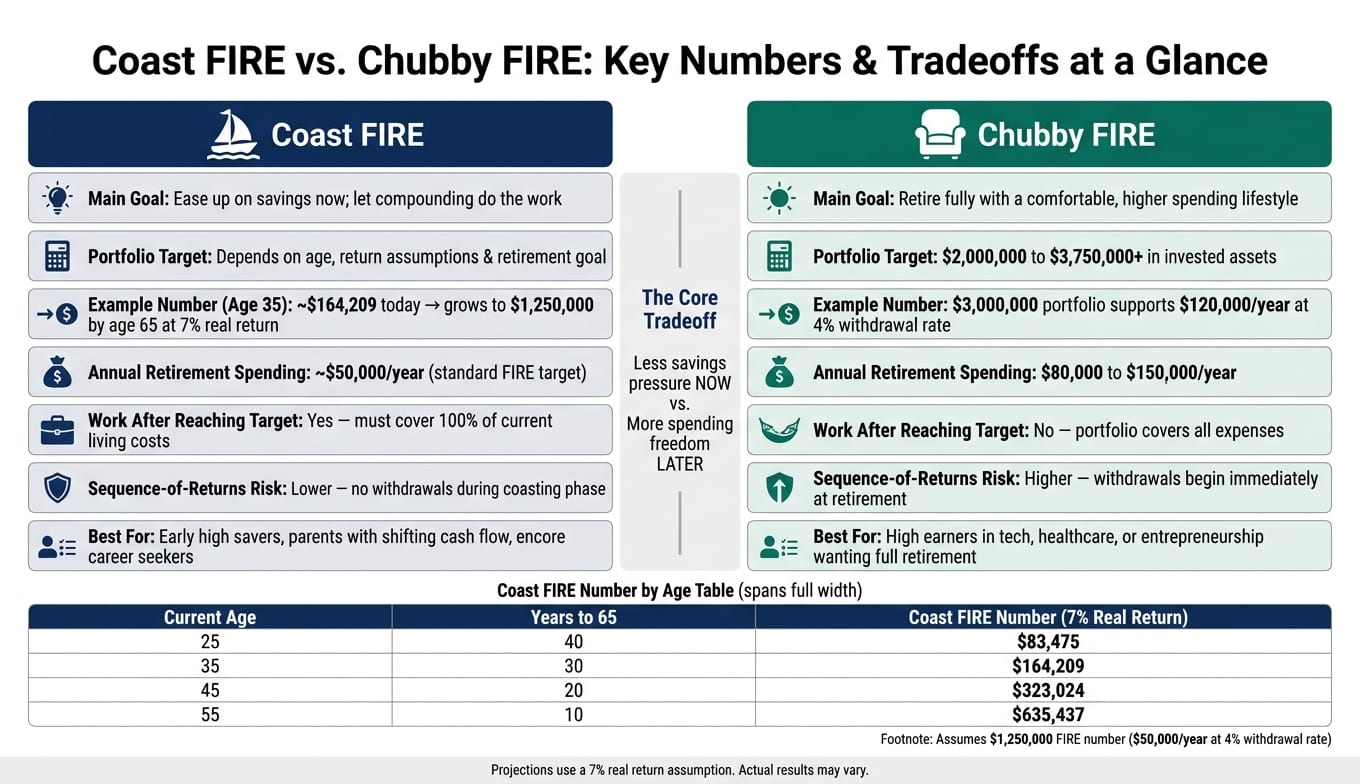
- A Coast FIRE target for someone age 35 with a $1,250,000 retirement goal at 65 may be about $164,209 using a 7% real return assumption.
- A Chubby FIRE lifestyle at $120,000 a year may point to about $3,000,000 at a 4% withdrawal rate.
- The main choice may come down to this: less saving pressure now vs. more spending room later.
This article may help me check three things fast:
- Whether I may already be close to my Coast FIRE number
- Whether Chubby FIRE may fit my income, savings pace, and spending target
- How taxes, account types, healthcare costs, and market swings may change the picture
Types of FIRE: 5 Paths to Financial Independence and Early Retirement
Quick Comparison
If I’m trying to decide between flexibility today and a larger cushion later, this comparison may give me a clean starting point.
Coast FIRE: when compounding can carry most of the load
Coast FIRE focuses on building a portfolio balance that may grow to your retirement target without much more heavy saving. The basic idea is simple: save hard early, let compounding do more of the work later, and keep working mainly to cover current living costs. It answers one narrow question: when may you ease up on aggressive saving without stepping away from long-term financial progress?
The next step is figuring out the balance that may get you there.
How to calculate your Coast FIRE number
You only need two starting inputs: your retirement target and your years to retirement.
First, calculate your FIRE number. To do that, divide your expected annual retirement spending by your safe withdrawal rate. Using a 4% withdrawal rate, a retirement lifestyle with $50,000 in annual spending may call for a $1,250,000 portfolio. Then discount that future number back to today using your expected real return and the number of years until retirement.
The formula looks like this:
Coast FIRE Number = FIRE Number ÷ (1 + Real Return Rate)^Years to Retirement
Here’s a simple example. Say you’re 35, targeting $50,000 per year in retirement at age 65, and using a 7% real return assumption. Your FIRE number would be $1,250,000. Divide that by (1.07)^30, and your Coast FIRE number today comes out to about $164,209. That figure may show whether you’re in a position to slow your savings now or may want a few more years of contributions.
Lower real returns may push the Coast number up fast. A 35-year-old targeting $1,500,000 at 65 may need about $197,000 today at a 7% real return. If the real return drops to 5%, that figure may jump to $347,000.
Assumes $1,250,000 FIRE number ($50,000/year spending at 4% withdrawal rate). Source: [[2]](https://coastfirehub.com/blog/2026-coast-fire-benchmark-report)
One thing to watch: stopping contributions entirely may put more pressure on long-term return assumptions. Some people choose to keep contributing a smaller amount instead. That approach may shorten the path to full financial independence and may reduce exposure to return variance.
Once you know the number, the next question is more practical: does your work and spending setup support it?
Who Coast FIRE fits best
Coast FIRE may fit best when your income, age, and savings rate already place you near the threshold.
Coast FIRE can produce many of the benefits of retirement (more free time, less burnout) while also providing many of the benefits of continuing to work (ongoing income, sense of purpose).
Coast FIRE may work best when your spending goal feels steady and you want more freedom now. If Coast FIRE feels too lean, the next section shows how Chubby FIRE may offer more spending room with a higher portfolio target.
Chubby FIRE: early retirement with room to spend
Chubby FIRE aims for a more comfortable version of early retirement, with annual spending in the $80,000 to $150,000 range. That often points to a portfolio of about $2 million to $3.75 million at a 4% withdrawal rate. If retirement may last 40 to 50 years, some planners use 3.25% to 3.5% instead, with the goal of lowering the chance that the portfolio runs out too early.
The idea here is breathing room, not extravagance. And unlike Coast FIRE, Chubby FIRE assumes you may stop relying on work income and live off the portfolio instead. From there, the math shifts to a simple question: how much spending may your portfolio need to support?
Chubby FIRE may stand out because of its built-in discretionary cushion. Travel, dining out, and other nice-to-have expenses may be trimmed first, while core costs stay in place.
How to estimate your Chubby FIRE number
A common way to estimate the number is to divide annual spending by the withdrawal rate you want to test. At 4%, a lifestyle priced at $120,000 per year would point to a $3,000,000 portfolio.
Healthcare may shift the target more than people expect. Before Medicare, private insurance or ACA premiums may run $12,000 to $24,000 per person per year, and medical costs are often associated with annual increases of 5% to 7%. So a more realistic Chubby FIRE budget may build those costs in from the start, instead of treating them like a side note.
Where Chubby FIRE gives you more room and where it costs more time
The tradeoff is pretty plain: more spending flexibility usually means a larger portfolio target. And a larger target may mean a longer saving period, a higher income, or both. For example, a household aiming for $150,000 per year at a 3.5% withdrawal rate would need $4,285,714, versus $3,750,000 at 4%.
That larger portfolio may also give more protection against sequence-of-returns risk. That's the risk that a market drop early in retirement is associated with lasting pressure on the portfolio before it has time to recover. With Chubby FIRE, a bigger discretionary budget may give you more room to cut back on travel or dining during a rough patch without changing rent, groceries, or insurance.
That extra margin may matter more once taxes, withdrawal order, and market timing start to shape the picture. The next question is whether that added cushion may be worth the longer accumulation phase.
Coast FIRE vs. Chubby FIRE: direct tradeoffs
The main difference comes down to when the pressure shows up.
Coast FIRE may ease the pressure to save hard right now. Chubby FIRE may ease the pressure to live more carefully later in retirement. Neither path is better across the board. They just address different problems.
Here’s the tradeoff in plain English: savings pressure now vs. spending pressure later.
Which path fits modest spenders, strong savers, and high earners
Coast FIRE may fit early high savers who want less savings pressure. Chubby FIRE may fit high earners who want a larger retirement budget.
Coast FIRE often lines up with people who want to keep working, but with less strain around saving. The basic idea is simple: income may keep covering current expenses while the portfolio keeps compounding in the background.
Chubby FIRE may be a closer match for high earners in fields like tech, healthcare, or entrepreneurship who want to stop working entirely without giving up a more comfortable lifestyle.
How taxes, withdrawals, and sequence risk affect each path
Coast FIRE may keep taxes simpler because wages continue and withdrawals wait. During the coasting years, some people still use tax-advantaged accounts like a 401(k) or IRA. Sequence-of-returns risk may also stay lower because the portfolio is not being drawn down yet. If markets drop during the coasting phase, that may be easier to absorb because withdrawals have not started.
Chubby FIRE may bring more tax complexity once retirement begins. Larger portfolios may generate dividend income, and Required Minimum Distributions starting at age 73 may push retirees into higher tax brackets and may trigger Medicare Part B IRMAA surcharges. For 2026, those surcharges begin above $109,000 for single filers and $218,000 for joint filers.
That’s why withdrawal planning may matter more here. Pulling from taxable, traditional, and Roth accounts in different ways may affect taxes and Medicare premiums. Account type, withdrawal order, and tax location may end up being part of the choice from the start, not something to deal with later.
A common Chubby FIRE risk is lifestyle creep. When “comfortable” spending turns into fixed spending, the extra cushion in the plan may shrink or disappear. Some people try to keep travel, dining, and upgrades discretionary so the plan may stay more flexible.
The next step is testing your accounts, contribution rate, and tax mix against the path you want.
How to pick your path and check it against your actual accounts
Once you know the two targets, compare them with your actual balances and spending.
A step-by-step decision process for U.S. households
Start with a simple inventory. Add up every investable account balance you have - 401(k), traditional IRA, Roth IRA, HSA, and taxable brokerage. That total may be your starting point for everything that follows.
Then use your target spending, withdrawal rate, and current balances to test whether you may already be on track.
If your current balance already covers the Coast FIRE threshold, you may decide to slow new contributions. If not, you may keep building toward it.
Before you run the math, add pre-Medicare healthcare to your annual spending target.
If the numbers are close, the next check may be your account types and their tax treatment.
How Mezzi helps you validate a Coast FIRE or Chubby FIRE plan
The real test may come down to whether your balances, account mix, and tax setup support the plan.
Mezzi connects your 401(k), Roth IRA, taxable brokerage, and HSA through read-only access, so you may see your actual combined balance in one place without moving any assets.
Beyond the balance check, Mezzi may help you look at tax and account-location choices tied to both paths. It may flag Roth conversion timing during the years before required minimum distributions begin, identify wash sale risk across multiple accounts if you're considering tax-loss harvesting, and point out which holdings may fit better in tax-advantaged accounts versus taxable ones. Mezzi may also answer planning questions as they come up.
Because Mezzi is an SEC-registered fiduciary with read-only access, it may see your full financial picture and provide guidance based on the accounts you connect.
Conclusion: the simpler path is not always the right fit
Coast FIRE and Chubby FIRE address different goals. Coast FIRE is about reaching a compounding threshold early so you may ease off aggressive saving while still working. Chubby FIRE is about building a large enough portfolio to retire fully without giving up a comfortable lifestyle.
The right path may depend on five things:
- Your current account balances
- Your target annual spending
- Your tax account mix
- How much market volatility you may absorb without changing plans
- Whether you'd rather have flexibility today or a larger cushion later
FAQs
How do I know if Coast FIRE is enough for me?
Coast FIRE may be enough if you want to move into lower-stress or part-time work that covers your current living costs, instead of leaving work altogether.
You may have reached Coast FIRE when your current investments, left alone, may grow through compound interest to your target retirement amount by your chosen retirement age. To check that, discount your target nest egg by your expected annual growth rate over the years until retirement.
What withdrawal rate should I use for Chubby FIRE?
A common starting point for Chubby FIRE may be the 4% rule, which means saving about 25x your annual expenses.
But early retirement may last 40+ years. Because of that, some people use 3.5% instead, which works out to roughly 28–29x annual expenses.
Some also aim for 30x expenses to add a bit more cushion. The right withdrawal rate may depend on your comfort level and whether you may be willing to cut spending during down markets.
How do I factor healthcare and taxes into my FIRE number?
Treat healthcare and taxes as core, variable parts of your annual spending before applying a 25x or 30x multiplier.
Before age 65, healthcare may cost $12,000–$20,000 per year if ACA subsidies don't apply. That line item alone may shift your annual number more than people expect.
Some people try to lower those costs by managing Modified Adjusted Gross Income, using HSAs, or taking Roth withdrawals. Taxes may also vary from year to year, which is why some investors use tax-advantaged accounts, capital gains harvesting, and Roth conversions as part of their planning.
To account for changes in both healthcare and taxes, some people add a 10%–15% buffer to their spending estimate.
Disclosures:
• This content is for informational purposes only and does not constitute investment advice or a recommendation to buy or sell any security.
• Past performance is not indicative of future results. No guarantee of future performance or outcomes is implied.
• Savings and performance examples are hypothetical and for illustrative purposes only. Actual results will vary based on individual circumstances, portfolio composition, market conditions, and fees.
• Registration does not imply a certain level of skill or that the SEC has approved the company or its services.
Related Blog Posts
- Which investments can help me retire comfortably within the next few years?
- What portfolio value and withdrawal strategy would generate a specific monthly after-tax income?
- Coast FIRE: Saving Enough to Stop Contributing Early
- Chubby FIRE: Comfortable Early Retirement Between Lean and Fat
Coast FIRE may be enough if you want to move into lower-stress or part-time work that covers your current living costs, instead of leaving work altogether.
You may have reached Coast FIRE when your current investments, left alone, may grow through compound interest to your target retirement amount by your chosen retirement age. To check that, discount your target nest egg by your expected annual growth rate over the years until retirement.
A common starting point for Chubby FIRE may be the 4% rule, which means saving about 25x your annual expenses.
But early retirement may last 40+ years. Because of that, some people use 3.5% instead, which works out to roughly 28–29x annual expenses.
Some also aim for 30x expenses to add a bit more cushion. The right withdrawal rate may depend on your comfort level and whether you may be willing to cut spending during down markets.
Treat healthcare and taxes as core, variable parts of your annual spending before applying a 25x or 30x multiplier.
Before age 65, healthcare may cost $12,000–$20,000 per year if ACA subsidies don't apply. That line item alone may shift your annual number more than people expect.
Some people try to lower those costs by managing Modified Adjusted Gross Income, using HSAs, or taking Roth withdrawals. Taxes may also vary from year to year, which is why some investors use tax-advantaged accounts, capital gains harvesting, and Roth conversions as part of their planning.
To account for changes in both healthcare and taxes, some people add a 10%–15% buffer to their spending estimate.