
If you work in the U.S. on a visa, one RSU vest may end up in two tax systems. That usually comes down to three things: when the shares vest, where you worked between grant and vest, and whether the U.S. treats you as a resident or nonresident for tax purposes.
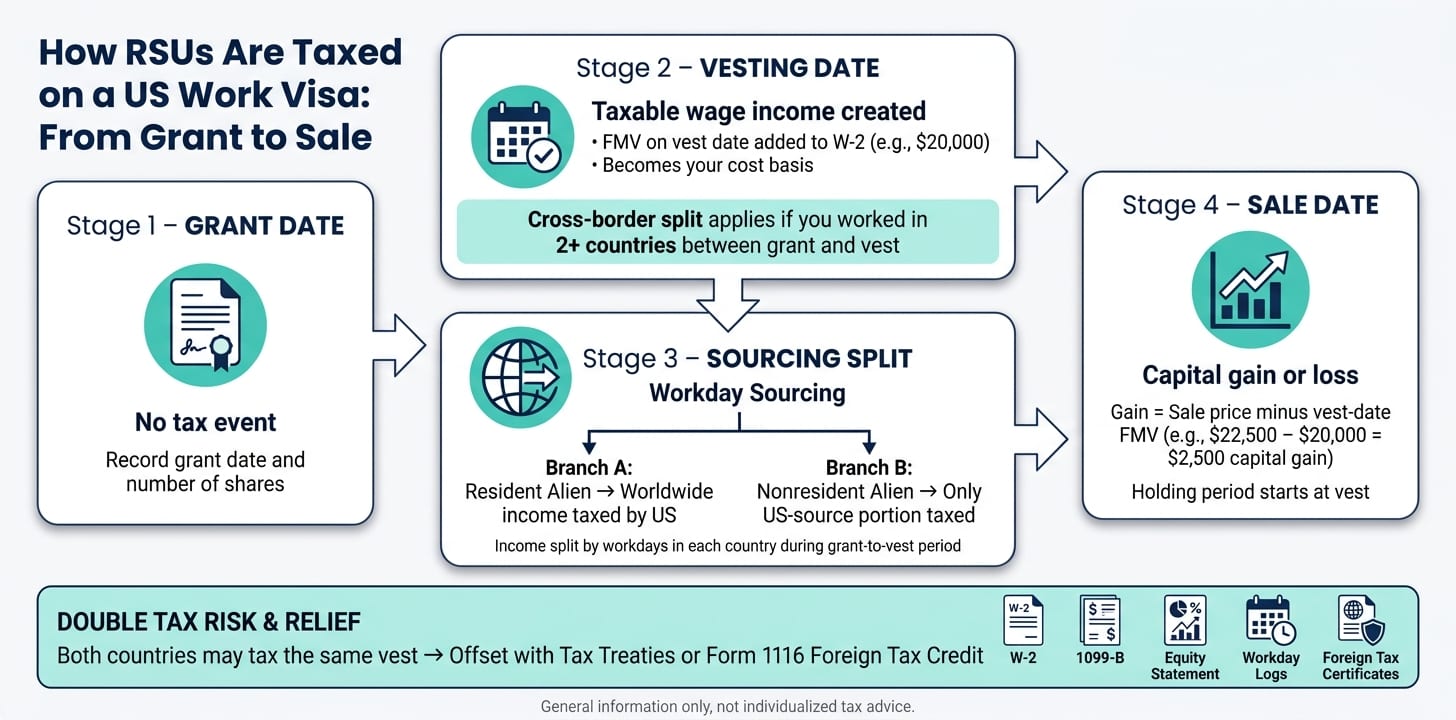
Here’s the short version:
- Grant usually has no tax event
- Vesting may create wage income based on the share value on the vest date
- A later sale may create capital gain or loss
- A move before vesting may split income across countries
- Double tax may happen, though treaties or foreign tax credits may sometimes reduce it
- W-2, 1099-B, and equity records may not match, which may lead to basis errors if you don’t reconcile them
A simple example: if shares worth $20,000 vest on 08/25/2026, that amount may be added to wages. If you later sell for $22,500, the extra $2,500 may be a capital gain. If part of the grant-to-vest period was outside the U.S., some of that $20,000 may also be taxed by another country.
The core idea is simple: RSUs on a visa may look like normal payroll income, but cross-border moves may turn one vest into a sourcing, withholding, and recordkeeping issue.
This article walks through vesting, residency status, workday sourcing, double-tax risk, tax forms, and the sell-or-hold choice in plain English.
U.S. Tax Basics for RSUs: Vesting, Withholding, and Residency Status
How RSUs show up on Form W-2 and why the vest-date value matters
Once your RSUs vest, the fair market value (FMV) at vesting is added to wages on Form W-2. That same vest-date value also becomes your tax basis if you sell the shares later.
For the RSU details, it may help to check both your W-2 and your equity statement. And the vest-date FMV does more than support your U.S. filing. If you report the same income in another country, foreign tax authorities may ask for that number too. So clean records may make both filings easier.
Resident alien vs. nonresident alien: how residency status changes how much the U.S. can tax
For visa holders, the W-2 amount may be only part of the story. Your residency status determines whether the U.S. may tax the full vest value or only the U.S.-source portion.
This split tends to matter most when you worked in more than one country during the vesting period. In that case, tracking workdays may help support the sourcing allocation reported on your return. It may also help you spot where double-tax exposure may come up.
Sell-to-cover, net share settlement, and withholding mismatches
Employers often handle withholding through sell-to-cover or share withholding. But the amount withheld may still come in below your final tax bill.
That gap may be larger when vesting spans more than one country. Payroll withholding often does not fully reflect sourcing splits, tax owed outside the U.S., or later true-ups. Some people deal with that by updating Form W-4 or making estimated tax payments to reduce the shortfall.
That mismatch sets up the next issue: sourcing rules may split one vest between two countries.
RSU Tax Tips for 2026: Taxes, Withholding, and Grants Explained
Cross-Border RSU Tax Issues: Sourcing, Moves, and Double Tax Risk
Once vesting creates income, the next issue may be how that income gets split across countries.
How workday sourcing splits one RSU vest between the U.S. and another country
If you worked in more than one country before vesting, the RSU income may be split based on workdays in each country. That split may shape both withholding and the records you may need to keep.
Think of one vest as a pie. Each country may tax the slice tied to the days you worked there during the period between grant and vesting.
Moving before vesting vs. moving after vesting: what changes
Move before vesting, and the award may be prorated across both countries. Move after vesting, and the sourcing may already be fixed.
For example, if you worked in Canada for two years after grant and then transferred to the U.S. before your shares vested, both countries may claim a portion of that vest based on where you worked during the period between grant and vesting. If you had already vested before the transfer, the sourcing would generally stay with Canada.
Where double taxation happens and how treaties and foreign tax credits may reduce it
Double taxation may happen when both countries tax the same vest. Tax treaties and foreign tax credits may offset tax already paid in the other country. Each country may also have its own country-specific foreign tax credit rules that govern how and when relief may be available.
That’s why records matter. The same workday logs, vest dates, grant details, payroll records, and tax forms may support treaty relief and foreign tax credit claims.
What to Track: Forms, Brokerage Records, and Country-Specific Proof
Keep the records that show where your RSU income may belong, what your cost basis may be, and what tax may already have been paid. For visa holders who may have tax exposure in more than one country, those records may support workday sourcing, foreign tax credits, and treaty claims.
The U.S. forms that matter: W-2, 1099-B, and employer equity statements
Your Form W-2 reports the fair market value (FMV) of your RSUs at vesting as ordinary income. At the same time, brokerages often show $0 basis on Form 1099-B, even when that vest-date income already appeared on the W-2. If the basis isn’t adjusted, the same income may end up being taxed twice.
That’s why it makes sense to compare all three records side by side:
- Form W-2
- Form 1099-B
- Your employer's equity statement
Your employer’s equity statement ties together the grant date, vest date, shares withheld, and net shares delivered. Cross-checking those records may help reconcile shares, basis, and sale proceeds.
Cost basis, vest-date records, and sale confirmations
Save the vest confirmation and every sale confirmation. In many cases, the vest-date FMV may be used as basis, then matched to Form 1099-B.
Proof of work location, foreign tax paid, and treaty claims
Once basis is reconciled, those same records may also support sourcing and foreign tax relief. If you’re trying to support sourcing or a foreign tax credit, keep proof of where you worked during the grant-to-vest period. That may include travel logs, payroll records, visa dates, workday calendars, and assignment letters.
For foreign tax credits, you may also need official proof of what was paid abroad: foreign tax withholding certificates, tax assessments, and payment receipts from the relevant tax authority. These records may support your Form 1116 filing. If you're invoking a specific tax treaty provision, Form 8833 is required to disclose that position to the IRS.
Planning Decisions: How Visa Holders Can Avoid Costly RSU Mistakes
Sell or hold after vesting when residency may change again
Once vesting and sourcing are clear, the next call is whether to sell the shares or keep them.
Selling at vesting may limit cross-border friction. Your cost basis may be the fair market value on the vest date, so an immediate sale may leave little or no capital gain. Holding the shares may add post-vest capital-gain exposure based on where you live when you sell. It may also leave you with single-stock concentration risk.
If another move may happen soon, selling at vesting may be the simpler path from a tax standpoint. If you hold instead, it may make sense to be clear on how a later move may affect the tax treatment of any gain after vesting.
Using Mezzi to organize RSU decisions across accounts and tax exposures
When residency may change again, RSU decisions may stop being a one-account issue.
Mezzi connects brokerage, 401(k), Roth IRA, and taxable accounts in one view. That may make it easier to spot RSU concentration, tax-loss harvesting openings, and wash sale risk. For visa holders, that broader view may matter when a move may change where future gains are taxed.
Key takeaways for cross-border RSUs on a visa
After vesting, three things may drive most outcomes: sell timing, sourcing, and records.
- RSUs are taxed as wages at vesting, reported on Form W-2.
- Sourcing follows workdays, so moving before vs. after vesting may split one vest between countries.
- Treaties and foreign tax credits may reduce double tax, but only with solid records.
- Reconcile Form W-2, Form 1099-B, and your equity statement before filing.
Records, move timing, and the sell-or-hold choice may shape the tax result.
This is general information, not individualized tax advice.
FAQs
How do I know if I’m a resident or nonresident for RSU taxes?
Your U.S. tax residency for RSU taxes may depend on whether you’re treated as a resident alien or nonresident alien. In many cases, you may be treated as a resident alien if you have a green card or meet the substantial presence test.
If you’re a dual resident, you may need to file Form 1040-NR or 1040-NR-EZ with Form 8833 to claim treaty benefits. Nonresident aliens usually report only U.S.-sourced income, while resident aliens report worldwide income.
What if my RSUs vested after I worked in two countries?
If you worked in two countries during the vesting period, your RSU income may be split between them using a pro-rata workday calculation from the grant date to the vesting date.
Because RSUs are generally taxed as ordinary income at vesting, each country may tax part of that income. That’s why it may make sense to track your workdays with care. In some cases, foreign tax credits or tax treaty provisions may help reduce double taxation.
How do I avoid paying tax twice on the same RSUs?
Separate the tax paid at vest from any gain that may happen after vest.
RSUs are taxed as ordinary income at vest based on the fair market value at that time. Your employer usually withholds shares or cash to cover that tax.
When you sell, use the correct cost basis. That basis may be the fair market value at vest, including withheld shares, so the sale doesn't appear to show extra gain. It also may make sense to keep records of:
- the vest-date value
- shares withheld
- each sale
Disclosures:
- This content is for informational purposes only and does not constitute investment advice or a recommendation to buy or sell any security.
- Past performance is not indicative of future results. No guarantee of future performance or outcomes is implied.
Related Blog Posts
- Equity Compensation in High-Tax States: Key Tax Rules
- RSUs: How Restricted Stock Units Work
- Different Types of Equity Compensation: RSUs, ISOs, NSOs, ESPP
- Moving States to Save on Taxes: The Residency Rules That Trip Up Founders
Your U.S. tax residency for RSU taxes may depend on whether you’re treated as a resident alien or nonresident alien. In many cases, you may be treated as a resident alien if you have a green card or meet the substantial presence test.
If you’re a dual resident, you may need to file Form 1040-NR or 1040-NR-EZ with Form 8833 to claim treaty benefits. Nonresident aliens usually report only U.S.-sourced income, while resident aliens report worldwide income.
If you worked in two countries during the vesting period, your RSU income may be split between them using a pro-rata workday calculation from the grant date to the vesting date.
Because RSUs are generally taxed as ordinary income at vesting, each country may tax part of that income. That’s why it may make sense to track your workdays with care. In some cases, foreign tax credits or tax treaty provisions may help reduce double taxation.
Separate the tax paid at vest from any gain that may happen after vest.
RSUs are taxed as ordinary income at vest based on the fair market value at that time. Your employer usually withholds shares or cash to cover that tax.
When you sell, use the correct cost basis. That basis may be the fair market value at vest, including withheld shares, so the sale doesn't appear to show extra gain. It also may make sense to keep records of:
- the vest-date value
- shares withheld
- each sale