
A move to Florida, Texas, or Nevada may not cut your state tax bill if your old state says you never left. For founders, that risk may show up in three places: domicile, 183-day residency tests, and income sourcing for equity tied to pre-move work.
Here’s the short version:
- A new address alone may not be enough.
- Keeping a home in the old state may keep tax exposure alive.
- More than 183 days in the old state may trigger resident treatment in some states.
- RSUs, ISOs, and NSOs may still be taxed by the old state if they relate to work done before the move.
- Timing may matter most 12 to 24 months before an exit, when a state may look more closely at the facts.
- Partial days may count as full days in some residency tests.
- Clean records may shape the outcome in an audit - day logs, leases, utility bills, school records, and business records may all be part of the file.
A recent court result in Massachusetts points to the core issue: even after a move, stock-sale income may still be taxed by the former state when the shares are tied to earlier in-state work.
Quick comparison
If you’re a founder near vesting, exercise, or a sale, the main point is simple: the move may need to look like a full life change, not a paper change.
How States Decide Whether You Really Left
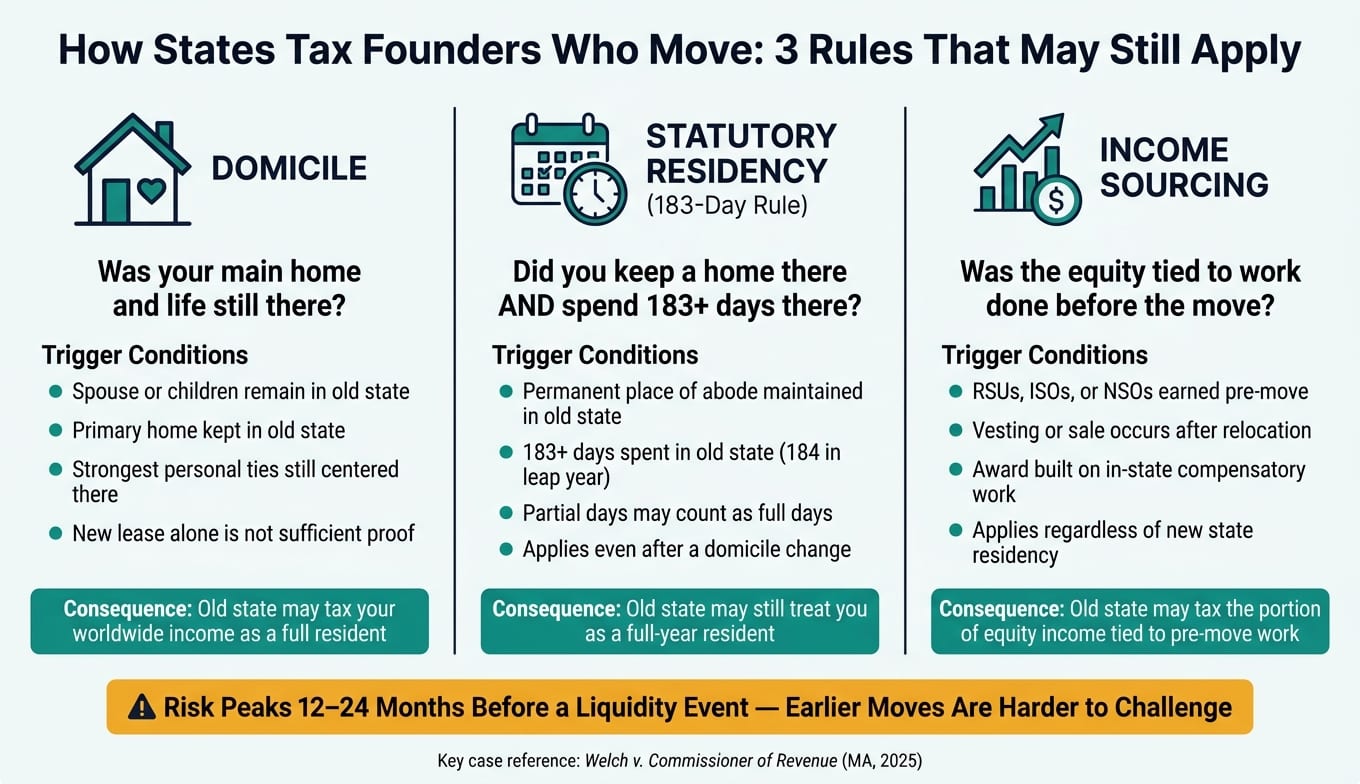
States audit moves, not addresses. If you claim a new residency - especially when equity, vesting, or a sale may be near - you may need to show that the old one ended and the new one began.
States usually look at two things: where your permanent home may be, and whether you may have spent too many days in the old state.
Domicile: Your Permanent Home, Not Your Mailing Address
Domicile refers to your permanent home - the place you intend to return to and where your strongest personal ties may be centered. A forwarding address or a new lease, by itself, may not change that.
States may look at where your spouse or children live, where your main home may be, whether you keep a home available, and where your personal ties may be centered. No single factor decides the issue on its own. If your family and main home remain in California, a Florida lease may not be enough to show a domicile change.
Statutory Residency: The 183-Day Rule and a Permanent Place of Abode
Even if you change domicile, a separate day-count test may still make you taxable in the old state. After a domicile change, the old state may still treat you as a resident if you keep a permanent place of abode there and spend more than 183 days in the state during the tax year - 184 in a leap year. Partial days may count.
Why Timing Matters 12 to 24 Months Before a Liquidity Event
For founders, the timing risk may rise as vesting, a tender offer, or a sale gets closer. The 2025 Massachusetts case Welch v. Commissioner of Revenue shows how this may play out: Craig Welch had moved to New Hampshire, but Massachusetts still taxed the sale because the shares were compensatory for work he did while a Massachusetts resident.
That practical takeaway may be simple: the earlier the move happens, and the more thoroughly it is documented, the harder it may be for a state to challenge it.
Founder-Specific Traps That Create Surprise Tax Bills
Keeping a Home and Spending Too Many Days in the Old State
The most common audit triggers may be pretty simple: keeping a home and spending too many days back in the old state.
A house, apartment, or even a room in your former state may keep tax exposure alive. If that place stays available and lived-in, it may still count against you. A new lease by itself rarely proves you left.
Frequent weekend trips back and long stays in the old state may also support a residency case. If your day count goes past 183, that state may treat you as a resident for the full year.
And day count isn't the only issue. Equity earned there may also stay taxable there.
Equity Compensation Sourced to Work Done Before the Move
The second trap may involve equity earned before the move.
Changing states does not, by itself, move equity income. RSUs, NSOs, and ISOs may still be taxed by the old state if part of the award was earned before you relocated. If vesting or a sale is close, old-state sourcing may still lead to a tax bill after the move.
If the award was built on pre-move work, the old state may still tax that share.
What to Do Before and After the Move
Residency-Risk Checklist for Founders
Once residency risk looks clear enough, the next step may be proving the move with clean records. If you're a founder getting close to vesting or a liquidity event, a new address alone may not do much. The record needs to show the move was real from day one. That same paper trail may also make it easier to separate pre-move and post-move compensation.
A few records may matter more than others:
- Establish a primary home in the new state - keep a purchase or lease agreement, plus utility bills that show active use.
- Keep proof of personal ties and community ties - club memberships and school enrollment records for children may help show the move.
- Keep old-state days under 183 - partial days may count as full days.
- Maintain a running day log - track where you were each day starting on the move date.
- Keep business records consistent across addresses, travel, and meetings - signed agreements, agendas, and minutes may carry more weight than informal notes.
Records to Keep in Case of Audit
If an audit starts, the records may need to prove three things: where you lived, where you were each day, and when equity-related work occurred. Keep the original records from the move itself. Notes rebuilt later may be harder to defend.
Planning Around Vesting, Exercise, and Liquidity Timing
It may help to record the move date next to each vesting, exercise, and sale date. If questions come up later, that timeline may make it easier to show which events happened before the move and which happened after.
Conclusion: Lower Taxes Require a Real Move and a Clean Record
For founders, lower taxes may only work when the move is real and documented well. A domicile change may mean your life is centered in the new state, not just that your mailing address changed. States may also track days closely, and even partial days may matter. And if you still have a home available in the old state, that may point to ongoing ties.
A clean paper trail may make a big difference: day logs, utility bills, and membership records that point to the new state. When the facts and filings line up from day one, the move may be easier to defend.
FAQs
What proves I changed my residency?
You may need a clear, documented break from your former state, plus records that suggest you now live in the new one. In plain English: it may help to show both intent and the day-to-day facts of the move.
That often means updating your driver’s license, voter registration, and vehicle registration right away. It may also help to keep records of your daily movements, local utility use, and property ownership so there’s a paper trail showing where your strongest personal, social, and professional ties may now be.
Can my old state still tax equity after I move?
Yes. Your old state may still tax equity after you move, especially RSUs and NSOs.
States often allocate equity compensation based on where you worked or lived during the vesting or exercise period. So if you spent part of that time in a high-tax state, that state may still tax part of the payout even after you relocate.
How do states count days for the 183-day rule?
States generally base the 183-day residency threshold on the days you’re physically present in the state during the period in question, not just the days tied to work or payroll.
That detail may matter more than people expect. In some states, even a partial day may count as a full day. So if you arrive late or leave early, that time may still be included in your total.
Because of that, some people keep close records of:
- Arrival and departure dates
- Travel logs
- Calendars
Those records may help support your day count if it’s ever reviewed.
Disclosures:
- This content is for informational purposes only and does not constitute investment advice or a recommendation to buy or sell any security.
- Past performance is not indicative of future results. No guarantee of future performance or outcomes is implied.
Related Blog Posts
- Equity Compensation in High-Tax States: Key Tax Rules
- QSBS: 0% Federal Tax on Startup Equity Explained
- 83(b) Election: Should You File One? Tax Timing Explained
- State Tax Optimization: Moving for Tax Savings (Florida, Texas, Nevada)
You may need a clear, documented break from your former state, plus records that suggest you now live in the new one. In plain English: it may help to show both intent and the day-to-day facts of the move.
That often means updating your driver’s license, voter registration, and vehicle registration right away. It may also help to keep records of your daily movements, local utility use, and property ownership so there’s a paper trail showing where your strongest personal, social, and professional ties may now be.
Yes. Your old state may still tax equity after you move, especially RSUs and NSOs.
States often allocate equity compensation based on where you worked or lived during the vesting or exercise period. So if you spent part of that time in a high-tax state, that state may still tax part of the payout even after you relocate.
States generally base the 183-day residency threshold on the days you’re physically present in the state during the period in question, not just the days tied to work or payroll.
That detail may matter more than people expect. In some states, even a partial day may count as a full day. So if you arrive late or leave early, that time may still be included in your total.
Because of that, some people keep close records of:
- Arrival and departure dates
- Travel logs
- Calendars
Those records may help support your day count if it’s ever reviewed.