
A move to Florida, Texas, or Nevada may lower your state income tax bill, but that alone may not mean you come out ahead. If I were looking at this move, I’d focus on three things first: how much income may still be taxed by my old state, how much housing and insurance may change, and whether the savings may still look good over *5 to 10 years*.
Here’s the short version:
- A high earner moving from California or New York City to a no-income-tax state may see a large drop in state tax on wages, bonuses, and investment income.
- But property taxes, homeowners insurance, sales tax, and moving costs may shrink that gap.
- Florida, Texas, and Nevada all have 0% personal income tax, but they do not have the same cost profile.
- Residency proof may matter just as much as tax rates. A weak move record may leave part of your income taxable in the old state.
- RSUs, stock options, pass-through income, rental income, and remote-work pay may still create state tax after a move.
If I wanted the fastest way to think about it, I’d use this rule of thumb: the move may make more sense when income is high, income is mobile, and the old state ties are cleanly cut. For some households, a headline tax saving of $50,000+ per year may look large at first, but the net gain may be much smaller after a full cost check.
Quick Comparison
So the core question may not be, “Which state has no income tax?”
It may be, “After tax, housing, insurance, sourcing, and audit risk, where may I keep more money?”
How to Estimate Your Real Tax Savings
How State Income Tax Affects Wages, Business Income, and Investment Income
To estimate real savings, split the math into three buckets: recurring tax savings, recurring cost increases, and one-time moving costs.
For W-2 workers, Florida, Texas, and Nevada each have a 0% state income tax on wages and bonuses. Capital gains, dividends, and interest are also generally taxed at 0% in those states. But the final number may depend on the type of income, sourcing rules, and where the work was done. A remote worker, for example, may still owe tax to the employer's state under convenience rules.
A New York City physician earning $500,000 may save closer to $65,000 per year after moving to a no-income-tax state. And for investors with large taxable portfolios, the gap may add up fast. California taxes capital gains as ordinary income, so a $300,000 gain may come with a state tax bill near $40,000.
Business owners have a messier setup. Pass-through income takes more work to model. Self-employment income and K-1 income may still be taxed by the prior state if the business keeps a taxable presence there. Texas also has a 0.75% franchise tax on business margins above $2.47 million.
One trap people miss: RSUs and stock options. California may tax part of an RSU vest based on the share of workdays spent there between grant and vest. So if most of the vesting window happened in California before the move, part of that vest may still be taxable there.
Costs That Can Offset the State Income Tax Win
Lower state income tax doesn't always mean lower total cost of living. Housing, insurance, and property taxes may eat into the gap.
Property taxes deserve a close look. The clean way to model them is by home value and county, because they may wipe out part of the income-tax savings. Nevada's effective property tax rate sits around 0.55% to 0.60%, which may make it the most homeowner-friendly option of the three on this line item.
Homeowners insurance catches a lot of people off guard, especially in Florida. The statewide average reached $5,600 per year in 2026, and South Florida often runs above $7,000. That's more than double the Texas average of $2,400 to $2,800. Sales tax also moves around by state: Nevada is at 8.23%, Texas at 8.20%, and Florida at 7.08%. For high spenders, that may matter, even if it isn't always the main factor in the move.
One-time costs belong in the model too. Real estate commissions, closing costs, and moving expenses may easily top the first year's tax savings, especially when someone sells one home and buys another.
Why You Need a 5- to 10-Year After-Tax Wealth Model
A one-year snapshot may miss the point. Year one often takes the hit from moving costs. The payoff, if there is one, may show up later as annual savings stack over time.
Take a $500,000 earner moving from California to Texas. If that person saves about $50,000 per year, the cumulative savings may reach $500,000 over 10 years before factoring in any return earned on the money kept.
Florida's "Save Our Homes" cap limits annual property assessment increases to 3% for homesteaded properties. Over a long holding period, that may make the property tax gap look better as market values climb. Texas reassesses at full market value each year, so the property tax bill may rise with the market. Over time, that difference may change the math more than people expect.
Build the model only after checking that the move may hold up under residency rules. Here's the basic input list for a more realistic multi-year model:
The next step is proving domicile, because the tax math may fall apart if the former state still treats you as a resident.
Moving for Lower Taxes? Don't Make This Mistake First
Florida vs. Texas vs. Nevada: Tax Differences That Matter
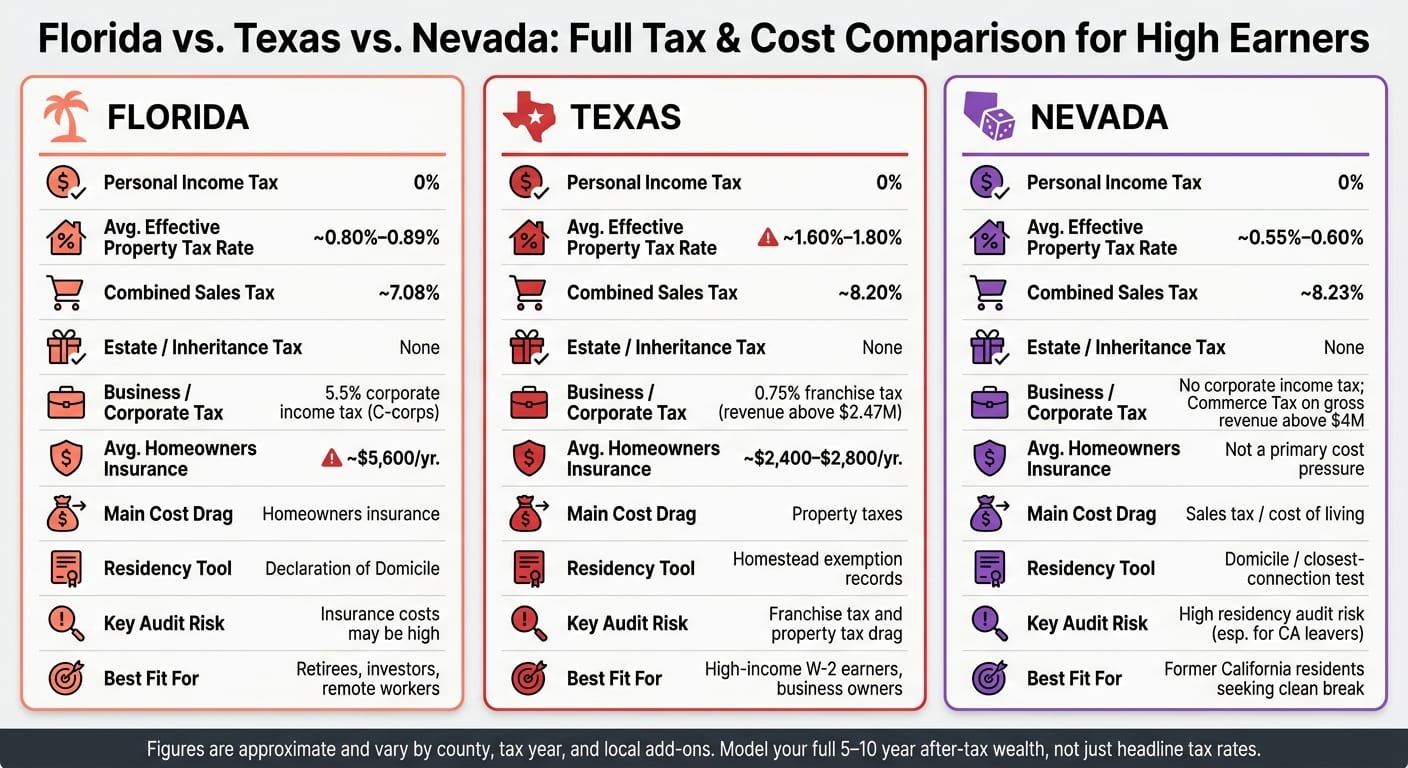
All three states have 0% personal income tax. But that doesn't mean the math looks the same. The differences that may matter most often come down to property tax, business tax, insurance costs, and how easy it may be to defend your residency if a former state asks questions.
Once a five- to ten-year model shows a likely savings gap, these state-level details may help narrow the choice.
Figures are approximate and vary by county, tax year, and local add-ons.
Use the table to line up each state with your income mix, housing costs, and likely audit exposure.
Florida: A Strong Fit for Retirees, Remote Workers, and Investors
Florida has no personal income tax and no state estate or inheritance tax. It also offers a homestead exemption that reduces assessed value by $50,000, and the Save Our Homes cap limits annual assessment increases to 3%.
For retirees and investors drawing down portfolios, that mix may look attractive. The main tradeoff is homeowners insurance, which may reduce part of the tax savings. On the residency side, residents may file a Declaration of Domicile with the county circuit court. That creates a timestamped public record, which may help support the move if a former state challenges residency.
Florida may line up well for retirees and investors. Texas may fit high-income workers who are comfortable with higher property taxes.
Texas: No Personal Income Tax, but Watch Property Taxes and Business Rules
Texas may appeal to high-income W-2 earners who can absorb higher property taxes. Effective property tax rates often run 1.60%–1.80%, and that may offset a large share of the savings, especially in higher-value metro areas.
Business owners may also need to look closely at the franchise tax. Texas charges 0.75% on business margins for entities with annualized revenue above $2.47 million. Pass-through entity owners and sole proprietors may want to confirm whether a personal move is enough to shift the tax result, because it often may not be if the business still has nexus or management ties in the former state.
Nevada often gets the most attention from former California residents who may want the cleanest possible residency record.
Nevada: Attractive for California Leavers, but Residency Audit Risk Is High
Nevada has no personal income tax and no corporate income tax. It also has the lightest property tax burden of the three, with effective rates around 0.55%–0.60%.
The tradeoff may show up in residency scrutiny. The California Franchise Tax Board completed 520 residency audits on out-of-state individuals in 2023, up from 230 audits in 2019. Former Californians may need especially strong documentation, and California-sourced income may still remain taxable after a move. Equity compensation may be sourced back to California based on workdays during the vesting period, no matter where someone lives when the shares settle.
Residency, Source Income, and Audit Risk
A mailing address does not establish domicile. States like California and New York tend to look at the full picture - where your main home and day-to-day ties may be, not just where you sleep.
How to Establish and Defend a New Domicile
Once the savings look real on paper, the next test is whether your move may hold up under residency scrutiny.
Domicile refers to your true permanent home. Statutory residency refers to a day-count test. In New York, spending 183 or more days in the state may make you a statutory resident even if your domicile may be elsewhere, and any part of a day counts as a full day.
To defend a new domicile, a lease or deed in Florida, Texas, or Nevada may not be enough on its own. States often look at where your driver's license was issued, where you're registered to vote, where your vehicles are titled, and where your doctors, dentists, accountants, and the people and routines tied to your daily life may be.
Auditors tend to focus on where your main home and daily ties may be, not just where you sleep.
Some people update their driver's license, voter registration, and vehicle titles as soon as possible, and file any state-specific domicile declaration right away. Tracking your days with an app or log may also matter. Auditors may subpoena cell phone tower records, EZ-Pass records, credit card statements, and utility bills to test whether your claimed residence matches your actual pattern of life.
Source-Income Rules That Can Still Create Tax Bills After You Move
Income may remain taxable where it is sourced. Wages are generally taxed where the work was physically performed, rental income is taxed where the property sits, and business or pass-through income may remain taxable where operations, employees, or other nexus may stay behind.
Equity compensation follows an allocation rule. States like California may allocate RSU or stock option income based on the portion of the vesting period spent working in the state, even if you live somewhere else when the shares vest or are exercised.
Some states tax remote work based on the employer's location, even when the employee works from another state. So a Florida move may not eliminate New York tax on a New York-based remote salary.
Common Mistakes That Undermine a Tax Move
These are the mistakes that most often turn a tax move into a tax audit.
Moving right before a sale or major vesting event may invite closer review, and California's Franchise Tax Board looks closely at moves that happen just before major income events.
If the move passes these tests, the final step may be deciding whether the tax savings outweigh the long-term tradeoffs.
Decision Framework and Conclusion
A Go/No-Go Checklist Before You Move
If the residency and source-income rules still seem to support a move, this checklist may help you judge whether the tax difference still looks worth it.
Use it to test two things:
- Whether the move may still leave you ahead after tax
- Whether your facts may hold up under residency review
Day count alone may not be enough; domicile may still control.
How Mezzi Helps You Model the Move Without Moving Your Accounts
If the checklist still points toward a move, you may model it in Mezzi using your actual accounts.
Mezzi connects read-only to your brokerage, retirement, and other accounts, so you may model RSU vesting, capital gains, dividends, and account types in one place. From there, you may ask Mezzi specific questions - like what a move to Florida versus Nevada may mean for your after-tax wealth over five to 10 years - and get answers based on your connected data. No assets move. No trades are executed.
That kind of side-by-side view may make it easier to compare states on net after-tax wealth, not tax rates alone.
Key Takeaways
A $500,000 California earner may save about $51,000 a year, but property taxes, insurance, and source-income exposure may shrink that gain pretty fast.
Florida may fit homeowners well because of lower property taxes and the Save Our Homes cap. Texas may work for active business owners, but its effective property tax rate is still around 1.75%. Nevada has the lowest property taxes at roughly 0.55%, but residency records still matter.
The better comparison may be five- to 10-year after-tax wealth, not headline tax rates.
FAQs
How do I prove I really changed residency?
Show a real move, not just paperwork. Auditors may focus on where you actually live, so it may help to establish a home in the new state, put utilities in your name, and cut ties to your old state.
They may look at your day count, where your family and valuables are, and records such as credit card activity, cell phone location data, and toll history. Many people make these changes before major taxable events and file a final part-year resident return in their old state.
Which income can still be taxed after I move?
Even after moving to a no-income-tax state, you may still owe tax to your former state if you keep strong ties there or earn income that state treats as sourced within its borders.
That may include income from work physically performed there, business or event income earned there, some remote work, and deferred compensation like bonuses or stock options tied to work done before the move. And if your former state still treats you as a resident, it may tax your worldwide income.
How long does it take for a move to pay off?
For households earning under $200,000, a move may rarely be worth the cost. Moving expenses, lifestyle shifts, and cost-of-living differences may offset much or all of the tax savings.
For higher earners above $300,000, the math may look very different. In some cases, the payoff may be immediate and may amount to $50,000 or more per year.
That said, the move may only pay off if you make a complete change of domicile. Without a clean break from your former state, you may be treated as a statutory resident and may owe taxes in both states.Disclosures:
- This content is for informational purposes only and does not constitute investment advice or a recommendation to buy or sell any security.
- Past performance is not indicative of future results. No guarantee of future performance or outcomes is implied.
- Savings and performance examples are hypothetical and for illustrative purposes only. Actual results will vary based on individual circumstances, portfolio composition, market conditions, and fees.
Related Blog Posts
- Equity Compensation in High-Tax States: Key Tax Rules
- QSBS: 0% Federal Tax on Startup Equity Explained
- Opportunity Zone Investing: Tax Deferral and Step-Up in Basis
- FAANG FIRE: High-Income Tech Worker Early Retirement
Show a real move, not just paperwork. Auditors may focus on where you actually live, so it may help to establish a home in the new state, put utilities in your name, and cut ties to your old state.
They may look at your day count, where your family and valuables are, and records such as credit card activity, cell phone location data, and toll history. Many people make these changes before major taxable events and file a final part-year resident return in their old state.
Even after moving to a no-income-tax state, you may still owe tax to your former state if you keep strong ties there or earn income that state treats as sourced within its borders.
That may include income from work physically performed there, business or event income earned there, some remote work, and deferred compensation like bonuses or stock options tied to work done before the move. And if your former state still treats you as a resident, it may tax your worldwide income.
For households earning under $200,000, a move may rarely be worth the cost. Moving expenses, lifestyle shifts, and cost-of-living differences may offset much or all of the tax savings.
For higher earners above $300,000, the math may look very different. In some cases, the payoff may be immediate and may amount to $50,000 or more per year.
That said, the move may only pay off if you make a complete change of domicile. Without a clean break from your former state, you may be treated as a statutory resident and may owe taxes in both states.Disclosures:
- This content is for informational purposes only and does not constitute investment advice or a recommendation to buy or sell any security.
- Past performance is not indicative of future results. No guarantee of future performance or outcomes is implied.
- Savings and performance examples are hypothetical and for illustrative purposes only. Actual results will vary based on individual circumstances, portfolio composition, market conditions, and fees.