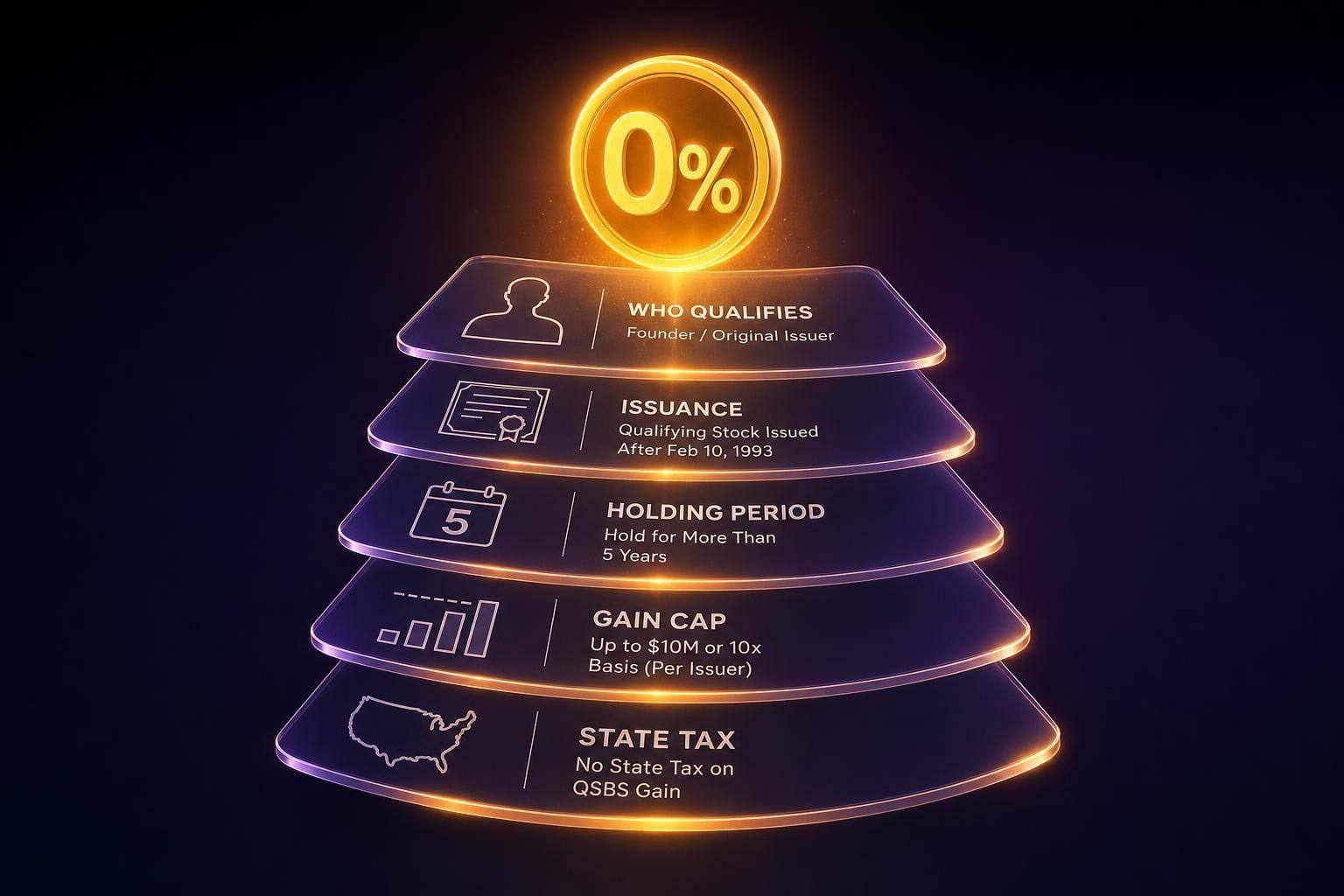
Some startup stock gains may qualify for 0% federal tax - but only if a few narrow rules line up.
If I boil this down to the shortest version, here’s the story: QSBS under Section 1202 may let some noncorporate holders exclude up to 100% of federal gain on eligible startup stock. But that treatment may depend on three things: the company, how the shares were acquired, and how long they were held.
Here’s the fast read:
- The stock may need to come from a domestic C corporation
- The shares may need to be bought at original issuance, not from another shareholder
- The holder may need to meet the holding-period rule
- The federal gain exclusion may be capped at $10,000,000 for stock issued on or before July 4, 2025
- That cap may be $15,000,000 for stock issued after July 4, 2025
- The company’s gross assets may need to stay at or below $50,000,000 before the rule change, or $75,000,000 after it
- Some stock-linked instruments - like SAFEs, options, warrants, and convertible notes - may not start the clock until they turn into actual shares
- State tax may still apply, even if federal tax does not; California is one common example
A few small details may change the result: an 83(b) election, an option exercise date, a company redemption, or an LLC-to-C-corp conversion date.
Think of QSBS like a tax rule with a short checklist and a long list of traps. If even one fact is off, the gain may fall back into normal capital gains treatment.
Qualified Small Business Stock Explained (IRC section 1202)
The 3 tests startup equity must pass to qualify
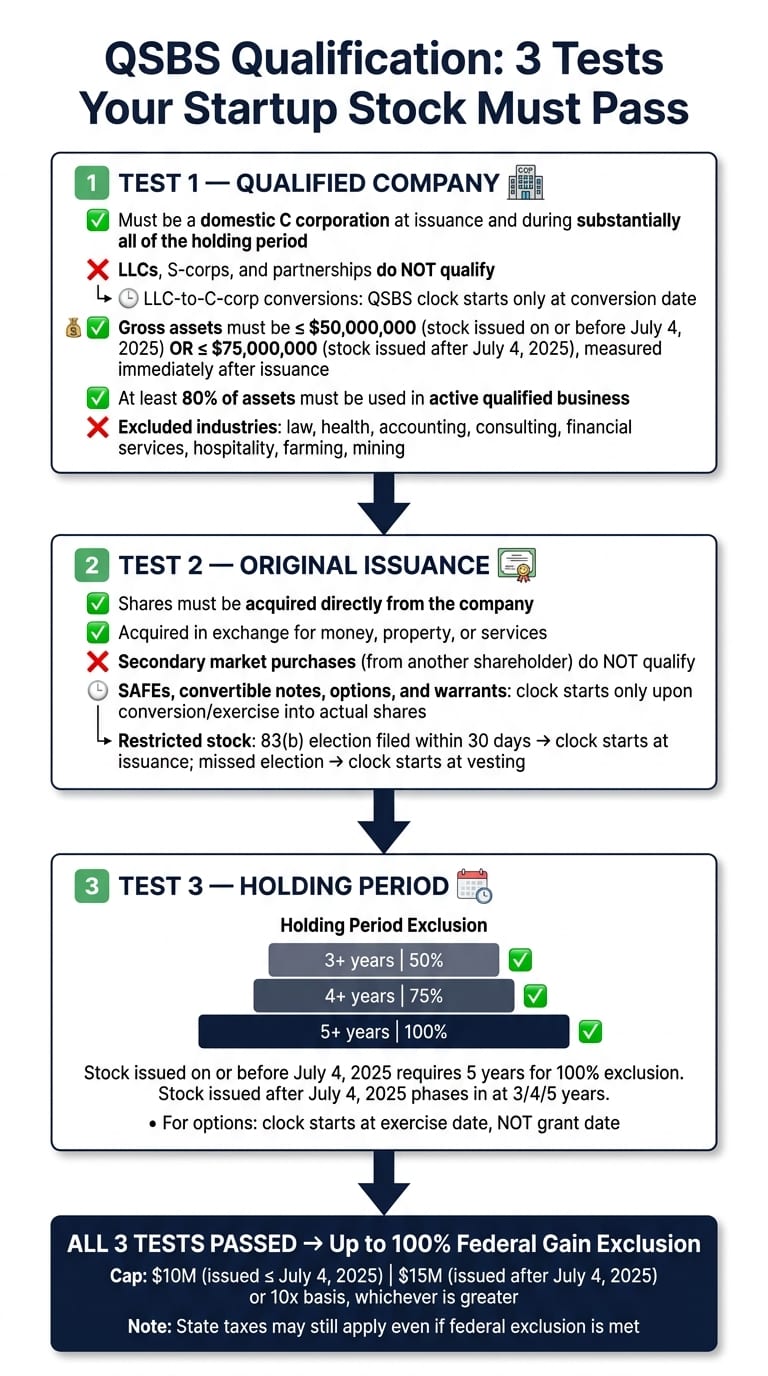
QSBS generally turns on three tests: the issuer may need to qualify, the shares may need to be acquired at original issuance, and the holder may need to meet the holding-period rule. The company test comes first. If the issuer doesn't qualify, the later steps usually don't change that result.
Qualified C corporation status and active business rules
The issuing company must be a domestic C corporation when the shares are issued and for substantially all of the holding period. LLCs, S corporations, and partnerships don't qualify. If a startup begins as an LLC and later converts to a C corporation, the QSBS clock may start only on the conversion date. Time spent as an LLC does not count.
The company also needs to meet the gross assets test. Gross assets means cash plus the tax basis of property. For stock issued through July 4, 2025, gross assets must be $50,000,000 or less. For stock issued starting July 5, 2025, the limit moves to $75,000,000 or less. This test is measured immediately after issuance, not later.
There’s also an active-business rule. At least 80% of the company's assets, by value, must be used in the active conduct of one or more qualified trades or businesses during substantially all of the holding period. Some industries are excluded, including law, health, accounting, consulting, financial services, hospitality, farming, and mining. A business may also fail this test if its principal asset is the reputation or skill of one or more employees.
Original issuance, who can benefit, and when the clock starts
Once the company clears those rules, the next issue is how the shares were received.
QSBS must be acquired directly from the company, in exchange for money, property, or services. Shares purchased from another shareholder on the secondary market - like buying out a co-founder or an angel investor - do not qualify.
A few common startup instruments don't count as QSBS by themselves:
- SAFEs
- Convertible notes
- Stock options
- Warrants
They may become QSBS only after they convert or are exercised into actual shares of stock. The holding-period clock may start at that point, not when the original instrument was signed or granted.
For restricted stock, timing may depend on whether a Section 83(b) election was filed. File it within 30 days of the grant, and the clock may start at issuance. Miss that window, and the clock may not start until the shares vest. In some cases, that filing may move the start date by years.
The five-year holding period and common timing mistakes
If the first two tests are met, the last gate is time.
Stock issued through July 4, 2025 may need a five-year holding period for a 100% exclusion. Stock issued starting July 5, 2025 may phase in at 50% after 3 years, 75% after 4 years, and 100% after 5 years.
One common mistake is mixing up the grant date and the acquisition date. For stock options, the clock starts on the date of exercise, not when the options were granted. Some founders and employees exercise vested options earlier to start the five-year clock sooner.
How the exclusion works in dollars
100% exclusion, historical percentages, and federal tax limits
Once the stock clears the ownership and timing tests, the next step is simpler: how much of the gain may be left out of federal tax under Section 1202.
The basic math looks like this:
tax-free gain = qualifying gain × the exclusion percentage
That amount is then limited by a per-issuer cap. For current stock, the exclusion percentage depends on the issue date and the holding period. But the main limit here is the cap tied to each issuer.
Excluded QSBS gain is not subject to the 3.8% Net Investment Income Tax. Any gain that does not qualify for the exclusion may be taxed at a special 28% federal rate, plus the 3.8% NIIT where it applies.
The exclusion does not go on forever. Section 1202 caps excluded gain at the greater of:
- a flat dollar amount
- 10 times your adjusted basis in the stock
That cap is measured per taxpayer, per issuer.
For stock issued on or before July 4, 2025, the flat cap is $10,000,000. For stock issued after July 4, 2025, the One Big Beautiful Bill Act increased that cap to $15,000,000, with inflation adjustments set to start in 2027. The 10x basis rule stays the same under both sets of rules.
Here’s a concrete example. In August 2025, an angel investor put $500,000 into qualifying QSBS in a SaaS company. By August 2030, after a five-year hold, the company was acquired for $6,000,000 in proceeds, which meant a $5,500,000 gain. Because the $15,000,000 cap applied, the full $5,500,000 gain was excluded. In that case, the investor owed no federal capital gains tax or NIIT on that gain.
When a Section 1045 rollover may apply
If qualifying QSBS is sold before the five-year mark, there may still be another path. Under Section 1045, gain may be deferred instead of recognized right away. If the shares were held for at least six months, and the proceeds are reinvested into new qualifying QSBS within 60 days of the sale, the deferral rules may apply.
The difference is easy to miss:
- Section 1045 may defer gain
- Section 1202 may exclude gain
If the reinvestment happens within that 60-day window after at least a six-month holding period, the gain may roll into replacement QSBS, and the original holding period may tack onto the new shares.
Even if the dollar limits line up, company-level or holder-level mistakes may still cause QSBS treatment to fail before the sale.
What breaks QSBS status
Even startup stock that looks eligible may lose QSBS treatment before a sale if the company or the shareholder misses a few key rules.
Company-level disqualifiers: business type, redemptions, and restructurings
QSBS may fail at the company level even if the shareholder did everything by the book. Some business types are excluded, including professional services, financial services, hospitality, farming, and mining.
The active-business test may also create problems. If a company has a large amount of consulting or implementation revenue, it may not meet the test. The same issue may come up if the business holds too much idle cash or passive investments, because that may break the 80% active-business rule.
Company stock repurchases may also taint QSBS. That may happen if the company buys shares from the taxpayer or related persons during the lookback window, or if broader redemptions go over the 5% threshold. Small redemptions under $10,000 that involve less than 2% of the stock are generally treated as de minimis.
Entity changes bring another set of problems. Pre-conversion equity does not qualify, and the QSBS holding period starts only when qualifying corporate stock is issued. If a company elects S-corporation status after issuing stock, QSBS eligibility may be lost from that point forward.
After issuer-level issues, the next trouble spots usually come down to timing and paperwork.
Holder-level mistakes: option timing, missing records, and wrong assumptions
A common and expensive mistake is assuming the QSBS clock starts on the option grant date. It doesn't. For options, the clock starts at exercise.
Restricted stock has its own trap. If an 83(b) election is missed, the holding period may not start until vesting. And shares bought on the secondary market - from another shareholder instead of directly from the corporation - do not qualify for QSBS treatment.
In a lot of cases, documentation may decide the outcome. If there are no issuance-date financials showing the company stayed under the asset cap - $50,000,000 for stock issued through July 4, 2025, or $75,000,000 after - the IRS may disallow the exclusion.
It may help to keep:
- The stock purchase agreement
- Board approval
- Issuance-date financials
Even if the federal rules are met, state tax may still be in play.
Federal exclusion does not mean state tax exclusion
Federal QSBS exclusion does not wipe out state tax in nonconforming states. If you live in one of those states, it may make sense to check that state's rules and any residency-change timing well before the transaction closes.
How to review your shares now and where Mezzi fits
A QSBS review checklist before any liquidity event
Before any sale or financing event, it may make sense to review each grant or share block on its own. The goal is simple: confirm whether that specific block may still qualify.
Run these six checks on each grant or share block:
- Was the company a domestic C corporation when the shares were issued?
- Did you acquire the shares directly from the company for money, property, or services?
- Were gross assets at or below $50 million immediately after issuance for stock issued on or before July 4, 2025, or $75 million for stock issued after that date?
- What is your exact issuance date, and have you cleared the applicable holding period?
- If the shares were restricted, did you file an 83(b) election within 30 days?
- Are there any redemptions in the cap table that may taint your grant?
The table below maps common fact patterns to a quick eligibility signal:
If the status isn't clear, it may help to review the equity alongside the rest of your portfolio before taking action.
Using Mezzi to place QSBS inside your full wealth plan
QSBS doesn't sit on its own. A large startup position may also leave you with concentration risk.
Mezzi brings startup equity into your full financial picture, so you may see how concentrated you are, track holding-period milestones, and spot whether your gain may be getting close to the QSBS cap. It may also surface issues to review with a CPA or tax attorney.
Conclusion: The few facts that decide the tax outcome
Once the checklist is done, a small set of facts may shape the tax outcome: the issuance date, the holding period, and the records that back them up. Tiny details may change everything. An unfiled 83(b) election, a missed issuance date, or a company redemption may change the exclusion entirely.
State taxes may still apply even when the federal exclusion does. Confirm both with a qualified CPA or tax attorney before any liquidity event closes.
Tax laws change. This article reflects rules as of June 27, 2026, including changes under the One Big Beautiful Bill Act signed July 4, 2025. This article is for informational purposes only and does not constitute tax or legal advice.
FAQs
Does my SAFE or option count yet?
No. A SAFE or stock option does not count as QSBS yet.
QSBS must be actual stock acquired directly from a domestic C corporation. A SAFE is a right to receive stock later, and an option is a right to buy stock later. Neither may count for Section 1202 until conversion or exercise happens and the shares are actually issued.
What records should I keep for QSBS?
Keep a clear, up-to-date paper trail showing that each QSBS requirement may have been met. That usually includes your stock subscription agreement or share certificates, which may help show the acquisition date and the amount paid.
It may also make sense to keep corporate records such as:
- Capitalization history
- Redemption analyses
- Records showing the company may have stayed below the gross-asset limit at the time of issuance
- Records showing at least 80% of the company's assets may have been used in an active, qualified business
This kind of documentation may matter if those facts are ever reviewed later.
Can I still use QSBS if I move states?
Yes. Moving states does not affect your federal QSBS eligibility, because the exclusion is governed by federal tax law.
State tax treatment may vary, though. States such as California, New York, and New Jersey may still tax the gain, even if it’s excluded at the federal level. Moving to a no-income-tax state generally may require a real change of domicile, not just a new address.Disclosures:
- This content is for informational purposes only and does not constitute investment advice or a recommendation to buy or sell any security.
- This article is for informational purposes only and does not constitute tax or legal advice.
- Tax laws and regulations are subject to change. Readers should consult their own tax or legal advisors regarding their specific situation.
Related Blog Posts
- QSBS: the tax break most startup employees don't know about
- QSBS and 83(b) Elections: 0% Tax on Startup Equity
- Secondary Market Sales: Selling Private Stock Before IPO
- Founder Liquidity: Secondary Rounds, Tender Offers, Structured Sales
No. A SAFE or stock option does not count as QSBS yet.
QSBS must be actual stock acquired directly from a domestic C corporation. A SAFE is a right to receive stock later, and an option is a right to buy stock later. Neither may count for Section 1202 until conversion or exercise happens and the shares are actually issued.
Keep a clear, up-to-date paper trail showing that each QSBS requirement may have been met. That usually includes your stock subscription agreement or share certificates, which may help show the acquisition date and the amount paid.
It may also make sense to keep corporate records such as:
- Capitalization history
- Redemption analyses
- Records showing the company may have stayed below the gross-asset limit at the time of issuance
- Records showing at least 80% of the company's assets may have been used in an active, qualified business
This kind of documentation may matter if those facts are ever reviewed later.
Yes. Moving states does not affect your federal QSBS eligibility, because the exclusion is governed by federal tax law.
State tax treatment may vary, though. States such as California, New York, and New Jersey may still tax the gain, even if it’s excluded at the federal level. Moving to a no-income-tax state generally may require a real change of domicile, not just a new address.Disclosures:
- This content is for informational purposes only and does not constitute investment advice or a recommendation to buy or sell any security.
- This article is for informational purposes only and does not constitute tax or legal advice.
- Tax laws and regulations are subject to change. Readers should consult their own tax or legal advisors regarding their specific situation.