
An 83(b) election may lower taxes for some people - or may lock in a tax bill too early for others. The core tradeoff is simple: pay tax now at today’s value or pay tax later as shares vest at whatever they may be worth then.
If I had to boil the article down fast, I’d say this:
- The election may make sense when stock value at grant or early exercise is very low, the upfront tax may be small, and future growth may be high.
- The election may hurt if shares never vest, the stock price falls, or cash is tight.
- The deadline is strict: you generally must file within 30 days of the grant or transfer date.
- RSUs generally do not qualify. Restricted stock and some early-exercised options may qualify.
- The choice is generally hard to undo, and prepaid tax on forfeited shares may not come back.
A simple way to think about it:
- File 83(b): you may pay ordinary income tax early, often on a low value, and later growth may be taxed as capital gain.
- Don’t file: you may pay ordinary income tax as shares vest, based on value at each vesting date.
That timing gap may be huge. If shares start at $1,000 and later vest at $50,000, filing may mean tax on $1,000 now instead of $50,000 later. But if you leave before vesting after prepaying tax - like the article’s example of $750,000 of income and about $300,000 of upfront tax - that money may be gone even if the shares are forfeited.
83(b) Election - Tax planning with options, RSUs, and company stock
Quick Comparison
So the article’s main point may be this: an 83(b) election does not change the stock itself - it only changes when tax may hit, and that timing may change the outcome a lot.
What an 83(b) election does and who it applies to
An 83(b) election tells the IRS to tax certain startup equity now, not later as it vests. Put simply, the main issue is timing: when the IRS treats those shares as taxable.
The default rule: you're taxed when shares vest, not when you receive them
Under Section 83(a), restricted stock or early-exercised shares are usually taxed when they vest, not when you first get them. That means tax may apply once the shares are no longer subject to a forfeiture risk. At that point, ordinary income may be measured based on the fair market value, minus what you paid.
If the company's value goes up before vesting, you may owe tax on paper gains tied to shares you still may not be able to sell. Those gains may be taxed at ordinary income rates.
An 83(b) election changes that timing. Instead of waiting for each vesting date, ordinary income may be measured once at the grant date, when the value may be lower. The long-term capital gains holding period may also start right away at grant, instead of starting over with each vesting tranche.
When this decision comes up
This election may come up for advisors, consultants, and executives who receive equity subject to vesting, most often RSAs or early-exercised options.
A couple of cases don't fit:
- RSUs do not qualify because no property transfers at grant.
- If you exercise vested options, the election does not apply because the shares are already unrestricted.
That distinction sets up the next section's side-by-side tax comparison.
Filing vs. not filing: how the tax outcomes compare
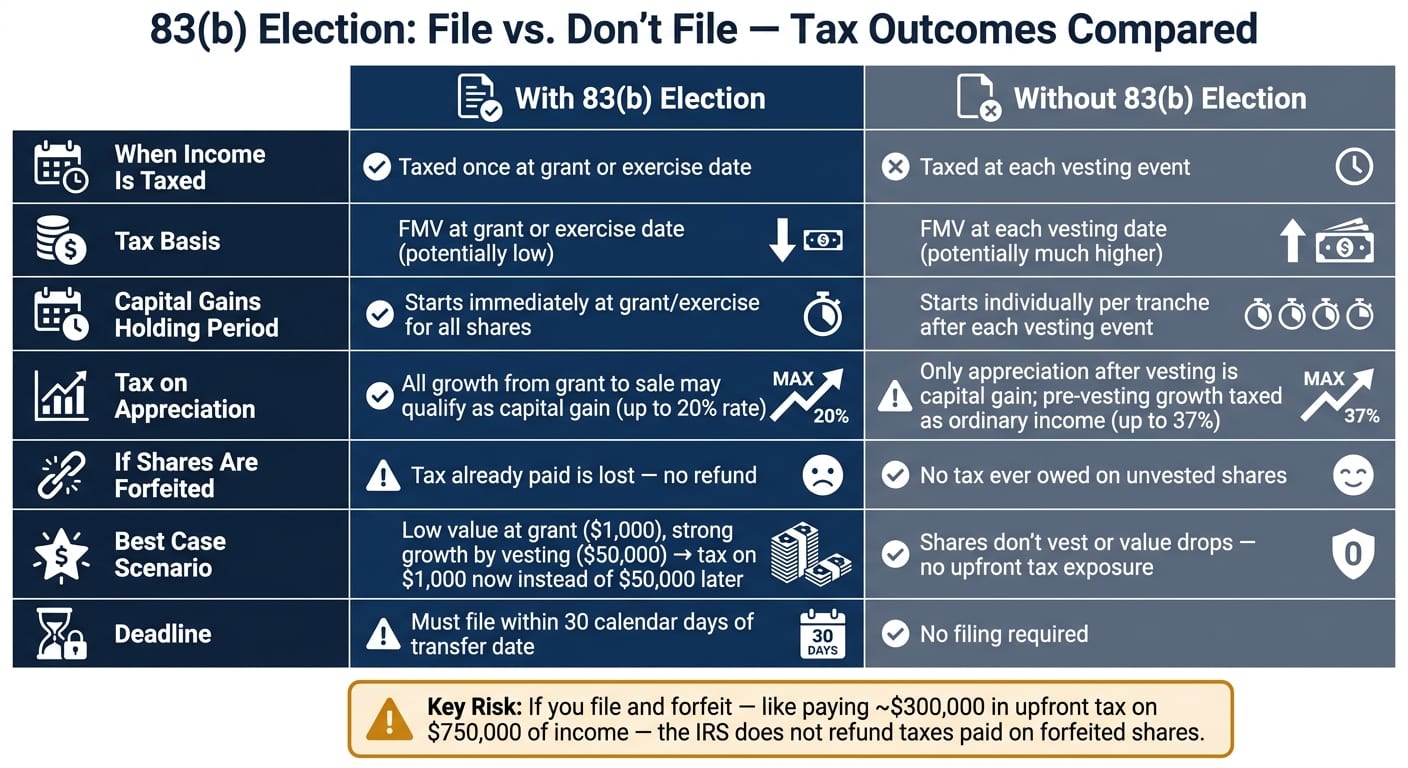
Filing an 83(b) election moves the tax event earlier. Not filing keeps the tax event tied to each vesting date.
The same rule may look great in one case and painful in another. A lot may depend on two things: how much the stock grows and whether you stay long enough to vest.
Example 1: low value at grant, strong growth by vesting
Say shares are worth $1,000 at grant or exercise and later grow to $50,000 by vesting. In that setup, the timing gap may be huge.
Without the election: You may owe ordinary income tax on the $50,000 value at vesting, even if the shares are still illiquid. That's the classic phantom income problem: tax on stock you may still not be able to sell.
With the election: You report $1,000 of ordinary income at grant or exercise. The other $49,000 may be treated as capital gain when you sell, which may make it eligible for long-term capital gains treatment if the timing lines up.
Example 2: forfeiture or a drop in share value
Now flip the script.
Consider Priya, an employee who received a restricted stock award of 50,000 shares in a company valued at $15.00 per share. At $15.00 per share, Priya recognizes $750,000 of ordinary income and about $300,000 of upfront tax. If she leaves before vesting, she loses the shares and generally may not recover that tax. If the stock later falls, the prepaid tax still reflects the earlier, higher value.
That’s why 83(b) elections may look attractive when the starting value is low and future growth seems possible. But if vesting never happens - or the share price drops - the early tax payment may turn into a costly bet.
When filing makes sense and when it can hurt you
Who is a good candidate for filing
Filing may make more sense when the upfront tax is small and the future upside may be large.
That often happens when the stock's fair market value at grant is low, sometimes close to nominal. In that setup, the upfront tax cost may be minimal. If the stock later gains value, some of that future appreciation may be taxed as long-term capital gains instead of ordinary income, and the holding period may start earlier. The gap in rates may be meaningful: ordinary income may reach 37%, while long-term capital gains may top out at 20%.
That upside may fade fast if vesting is uncertain or cash is tight.
Ways the election can go wrong
The biggest risk may be leaving before vesting. Startup turnover may be high: 43.4% of employees hired in 2021 left their jobs within two years. If you file and later forfeit unvested shares, the upfront tax payment may generally be lost.
A drop in value may create a similar problem. If the company's stock falls after you file, the IRS generally does not refund tax paid on the earlier value.
Liquidity may matter just as much as valuation. Many startups may take 10 to 12 years to reach liquidity, so filing may mean paying tax long before any sale is possible.
"The real cost of an 83(b) election is not just the tax payment. It is what that money could have done elsewhere... reserved for future tax obligations, used to reduce concentration risk, or deployed toward more liquid opportunities." - Christopher Stroup, Silicon Beach Financial
A five-factor checklist for making the call
These five questions may help frame the tradeoff:
- Current valuation: Is the FMV at or near your purchase price? If the spread is zero or nominal, the tax cost to file may be negligible.
- Vesting risk: How likely are you to stay through the full vesting period?
- Growth potential: Is there a realistic case that the share price may rise in a meaningful way before vesting?
- Liquidity: Do you have enough cash on hand to cover the upfront tax without tapping emergency savings?
- Tax consequences: Do the possible tax savings justify prepaying tax on a company that may not succeed?
No single factor settles the issue on its own. Someone with low-priced startup stock, strong confidence in staying through vesting, and enough cash to cover a small upfront tax bill may be in a very different spot from someone facing a meaningful spread, uncertain tenure, or limited liquidity.
The 30-day deadline, how filing works, and key takeaways
What to do before the 30-day window closes
If the earlier checklist points toward filing, the next thing to look at may be the deadline. The 30-day clock starts on the transfer date, which may usually be the board-approval date for restricted stock or the exercise date for early-exercised options. You get 30 calendar days, weekends included. If day 30 lands on a weekend or legal holiday, the deadline moves to the next business day.
Before that window closes, confirm three things right away:
- the transfer date
- the current fair market value
- the upfront tax cost
That may give you what you need to make the call while there’s still time.
You may file Form 15620 electronically through the IRS portal for instant confirmation, or mail it by Certified Mail with Return Receipt Requested and a manual USPS postmark. You also need to give your employer a copy so payroll may handle withholding and reporting. Keep proof of filing indefinitely.
Conclusion: the election shifts tax earlier and adds present risk
Once the valuation, vesting risk, and liquidity tradeoff point toward filing, the basic logic may be pretty simple. An 83(b) election may shift future appreciation from ordinary income tax rates, which may go up to 37%, to long-term capital gains rates, which may go up to 20%. It also starts the capital gains holding period at the grant date instead of at each vesting event.
But the other side of the tradeoff matters too. If you forfeit the shares, you lose the stock, and the IRS does not refund taxes already paid. If the stock drops, you may have paid tax on value that no longer exists. And if liquidity may be years away, you may be writing a check today for gains you may not be able to realize anytime soon.
The election does not create value. It only changes when you’re taxed, and which tax rate may apply, on value that may never materialize.
FAQs
How do I know if my stock qualifies for an 83(b) election?
An 83(b) election applies only to property that remains subject to a substantial risk of forfeiture, such as unvested restricted stock or stock received from an early-exercised option. Put simply, you generally need to have received actual shares that are still vesting.
It doesn't apply to RSUs or standard, unexercised stock options, because no actual property has been transferred. To qualify, you must file with the IRS within 30 days of the transfer date.
What happens if I file 83(b) and leave before my shares vest?
If you file an 83(b) election and leave before your shares vest, you may forfeit the unvested shares and generally may not recover the taxes you already paid on them.
The main catch is that the election is irrevocable. So if you already reported compensation income, you typically may not get a refund for that amount later. In some cases, you may be able to claim a capital loss for what you originally paid for the stock, but usually not for the compensation income you reported earlier.
Can an 83(b) election help you start long-term capital gains sooner?
Yes. An 83(b) election may start your long-term capital gains holding period on the grant date for restricted stock, instead of starting it as each portion vests.
If you file with the IRS within 30 days of receiving the equity, any later increase in value may qualify for the more favorable long-term capital gains tax rates when you sell. That may apply if you hold the shares for at least one year from the grant date.
Related Blog Posts
- QSBS: the tax break most startup employees don't know about
- QSBS and 83(b) Elections: 0% Tax on Startup Equity
- Should You Sell RSUs When They Vest? Timing and Tax Analysis
- Different Types of Equity Compensation: RSUs, ISOs, NSOs, ESPP
An 83(b) election applies only to property that remains subject to a substantial risk of forfeiture, such as unvested restricted stock or stock received from an early-exercised option. Put simply, you generally need to have received actual shares that are still vesting.
It doesn't apply to RSUs or standard, unexercised stock options, because no actual property has been transferred. To qualify, you must file with the IRS within 30 days of the transfer date.
If you file an 83(b) election and leave before your shares vest, you may forfeit the unvested shares and generally may not recover the taxes you already paid on them.
The main catch is that the election is irrevocable. So if you already reported compensation income, you typically may not get a refund for that amount later. In some cases, you may be able to claim a capital loss for what you originally paid for the stock, but usually not for the compensation income you reported earlier.
Yes. An 83(b) election may start your long-term capital gains holding period on the grant date for restricted stock, instead of starting it as each portion vests.
If you file with the IRS within 30 days of receiving the equity, any later increase in value may qualify for the more favorable long-term capital gains tax rates when you sell. That may apply if you hold the shares for at least one year from the grant date.