
When you come into unexpected money - a windfall from an inheritance, business sale, or other sources - it’s easy to feel overwhelmed. Without a plan, many people lose their newfound wealth within a few years. The first 90 days are critical for setting up safeguards and making thoughtful choices. Here’s a quick overview of what to focus on:
- Secure your funds first: Move the money into a safe, separate account like a high-yield savings account or Treasury bills to avoid impulsive spending.
- Pause big decisions: Take 90 days to process the situation before making major purchases or investments.
- Understand taxes: Determine what tax obligations apply to your windfall and set aside funds to cover them.
- Address debt and savings: Pay off high-interest debt and strengthen your emergency fund before spending or investing.
- Plan for long-term growth: Define your goals, create an investment strategy, and avoid risky or illiquid investments like real estate without careful consideration.
Using tools like Mezzi can help you organize your finances, track your accounts, and make informed decisions. The key is to prioritize stability and long-term planning over quick, emotional choices.
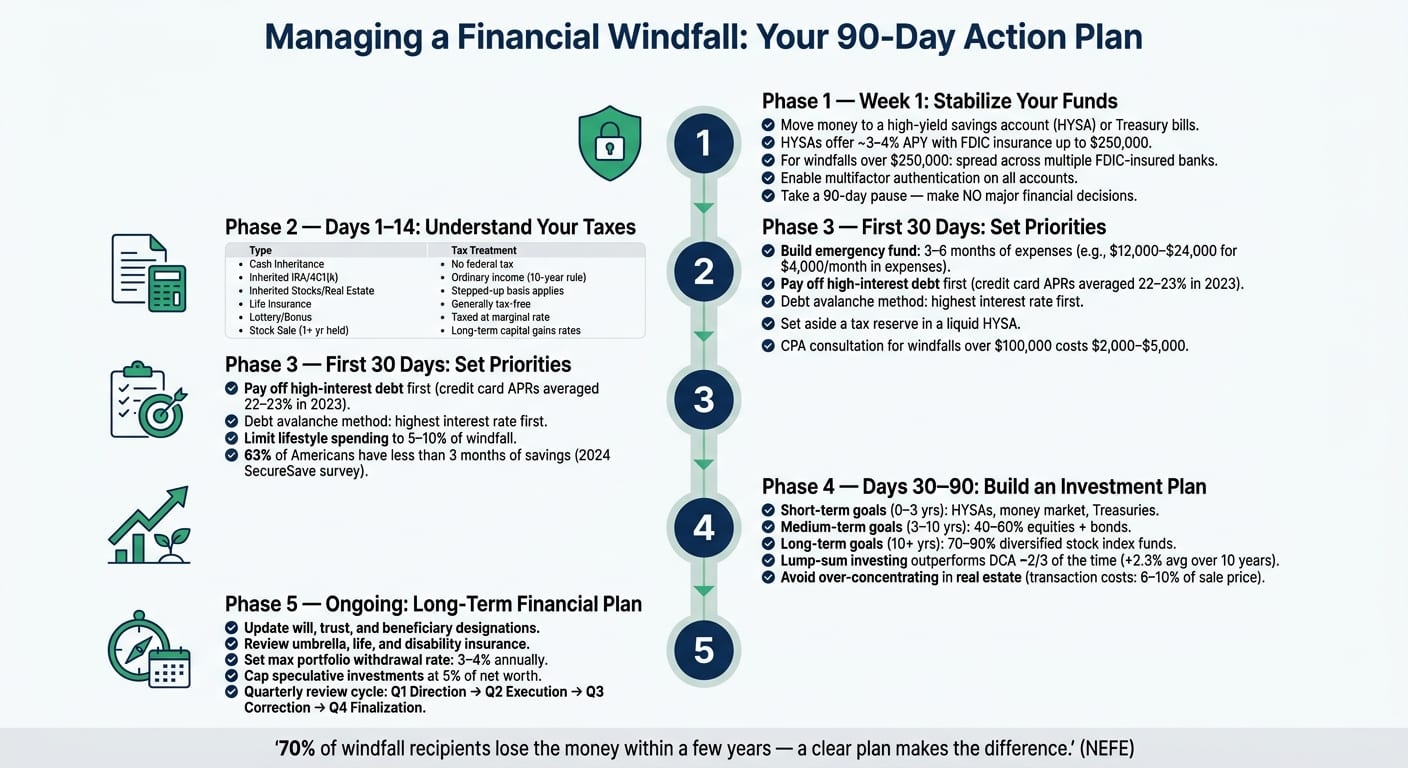
Navigating Financial Windfalls: Planning for the Unexpected
Phase 1: Stabilizing Your Finances in the First Week
The first week after a financial windfall can be tricky. Excitement and outside influences may lead to hasty decisions, so the focus during this time should be on safeguarding your funds rather than growing them.
Move Your Money to a Secure Account
Start by transferring your funds into a dedicated account that's separate from your regular checking account. This creates a boundary between your windfall and your day-to-day spending, reducing the temptation to splurge.
Consider options like high-yield savings accounts (HYSAs), money market funds, or short-term U.S. Treasury bills. HYSAs often provide annual yields of around 3–4%, are fully liquid, and include FDIC insurance up to $250,000. Treasury bills, on the other hand, come with zero default risk and can sometimes offer comparable or better returns.
If your windfall exceeds $250,000, a single HYSA might not provide enough coverage. In this case, you could distribute your funds across multiple FDIC-insured banks or explore brokerage cash management accounts for added security.
Be aware that large deposits can attract scams or phishing attempts. Strengthen your account protections by enabling multifactor authentication and confirming wire transfers through independent channels.
Take a 90-Day Pause Before Big Decisions
Avoid making any major financial moves during the first three months. This includes postponing significant purchases or investments. Allow yourself time to process the situation and approach decisions with a clear, calm perspective.
"The best financial decision you can make immediately after receiving unexpected money is to make no decision at all." - FrugalRise Editorial Team
Once the pause ends, revisit your financial plans with a fresh outlook and a more measured approach.
Use Mezzi to See Your Complete Financial Picture
After giving yourself time to settle, take stock of your entire financial situation. Consolidate all your accounts - 401(k), brokerage, Roth IRA, taxable accounts, and more - into one platform for a comprehensive overview. Scattered accounts can make it harder to see the big picture, but pulling everything together ensures clarity.
Mezzi offers secure, read-only access to connect your accounts without moving your funds. This tool provides insights into your net worth, asset allocation, and potential risks in your portfolio.
As Mezzi explains, "Asset location - which holdings sit in which accounts - can be worth more than stock picking over time". Understanding what you own and where it’s held is a crucial step before deciding how to manage your newfound wealth.
Phase 2: Understanding Your Tax Obligations
Once you've secured your windfall, it's crucial to figure out your tax responsibilities before making any financial moves. Tax rules can vary significantly depending on the type of windfall, and the potential liabilities might be more than you expect.
Know How Your Windfall Will Be Taxed
How your windfall is taxed depends entirely on its source. Here's a quick breakdown of common scenarios:
One often-overlooked tax benefit is the stepped-up basis for inherited assets. For example, if you inherit stock purchased for $10,000 but worth $50,000 at the time of inheritance, the cost basis resets to $50,000. Selling the stock immediately means you owe no capital gains tax on the appreciation before the inheritance.
State taxes also play a role. For instance, Oregon's estate tax applies to estates valued over $1 million - far below the federal exemption of $13.99 million for 2025. Similarly, Massachusetts imposes a 4% surtax on certain high-value windfalls. Depending on your state, your tax bill might rival or even exceed your federal liability.
Understanding these rules helps you prepare to set aside funds for taxes.
Set Aside a Tax Reserve
It's important to calculate your tax liability and set aside funds right away. For windfalls exceeding $100,000, consulting a fee-only CPA is advisable. While their services might cost $2,000 to $5,000, they can help you accurately estimate your tax obligations. To keep these reserved funds safe and accessible, consider placing them in a high-yield savings account where they can earn interest while remaining liquid.
"A settlement that doesn't specify what each portion compensates for gives the IRS room to treat ambiguous amounts as taxable income." - Ayesha Kapoor
If your windfall involves a legal settlement, pay close attention to the wording. The IRS differentiates between tax-free compensation for physical injuries and taxable punitive damages. Vague language in settlement agreements can lead to unexpected tax bills.
Use Mezzi to Spot Tax Optimization Opportunities
Once your tax reserve is in place, Mezzi can help you identify opportunities to reduce your tax burden further. Mezzi provides a comprehensive view of your accounts, helping you with strategies like tax-loss harvesting and avoiding wash sale risks. It also offers guidance on asset placement to minimize taxes over time. For example, if you sell a position, Mezzi will notify you when the 30-day wash sale window has passed, allowing for a tax-efficient repurchase.
Mezzi provides insights traditionally associated with high-cost advisory services, giving you the tools to make informed decisions without the hefty $10,000 annual fee often charged by financial advisors.
Phase 3: Setting Your Priorities in the First 30 Days
With your tax responsibilities outlined, the next step is to put your windfall to work in an organized way. By focusing on stability and addressing key financial priorities, you can create a solid foundation before diving into lifestyle spending or investments. The aim here isn’t perfection - it’s about tackling the most pressing financial needs first.
Build or Strengthen Your Emergency Fund
Start by ensuring you have a reliable safety net. An emergency fund should ideally cover 3–6 months of essential expenses - think rent or mortgage, utilities, groceries, insurance, transportation, and minimum debt payments. For example, if your monthly expenses are $4,000, you’d need roughly $12,000 to $24,000 set aside. Discretionary spending doesn’t count in this calculation.
To keep this fund secure and accessible, use a high-yield savings account with FDIC insurance. Keeping these funds separate from your daily checking account can also reduce the temptation to spend them impulsively. In fact, behavioral studies show that assigning money a specific purpose makes it less likely to be spent on unrelated items. According to a 2024 SecureSave survey, 63% of Americans have less than three months of expenses saved. If your windfall can fill this gap, it’s a smart first step.
Focus on High-Interest Debt
If you’re carrying high-interest debt, paying it off can be one of the most effective uses of your windfall. For example, eliminating credit card debt with a 22% APR essentially gives you a 22% return - a figure that’s hard to beat with most investments. In 2023, U.S. credit card APRs averaged 22–23%, meaning a $10,000 balance could cost thousands in interest over just a few years.
Start by listing all your debts, including balances, interest rates, and minimum payments. Prioritize any revolving debt with an interest rate above 10% APR. Using the debt avalanche method - paying off the highest-rate debt first while making minimum payments on the rest - can lower the total interest you pay. If staying motivated is more important to you, the debt snowball method, which tackles the smallest balance first, might be a better fit, though it may cost more in interest overall.
Once you’ve addressed high-interest debt, you can evaluate how to allocate remaining funds between lower-rate debt and investing.
Balancing Debt Payoff and Investing
For lower-interest debt, the decision between paying it off and investing becomes more nuanced. For example, a federal student loan at 5% or a fixed mortgage at 3.5% doesn’t carry the same urgency as high-interest credit card debt. Historically, diversified investments have delivered average annual returns of 7–10% over the long term, making the choice less straightforward.
As a general guideline, if a debt’s interest rate is above 8–9%, prioritizing payoff may make sense. For debts with lower rates, a balanced approach might work better - allocating, say, 50% of your windfall to debt reduction and 50% to investments. However, your personal comfort with debt is just as important as the numbers.
This is where tools like Mezzi can help. By linking your accounts, you can compare scenarios - such as focusing on debt payoff, splitting funds, or prioritizing investments - and see how each option could impact your net worth over 10, 20, or even 30 years. Having a clear, data-driven view can turn a tough decision into a manageable plan.
While these decisions shape your financial future, setting boundaries on immediate spending ensures your windfall doesn’t lose its impact.
Limit Lifestyle Spending
It’s easy to feel tempted to upgrade your lifestyle after a windfall, but setting a spending cap can protect you from future financial stress. According to a National Endowment for Financial Education (NEFE) report, about 70% of people who receive a large sum of money end up losing it within a few years, often due to unchecked spending.
To avoid this, decide in advance how much you’ll allow yourself to spend on non-essential items, and write it down. A common rule of thumb is to limit lifestyle spending to 5–10% of the windfall. For example, if you receive $150,000, you might allocate $7,500 to $15,000 for a vacation, a splurge, or something meaningful, while committing the rest to your financial plan.
Be cautious about adding permanent new expenses, like leasing a car or moving to a pricier apartment, as these can create ongoing costs that outlast your windfall. A simple way to curb impulsive spending is to enforce a 24–72-hour waiting period before making large discretionary purchases. This approach helps you avoid rash decisions while still allowing for some enjoyment.
Phase 4: Building an Investment Plan for Long-Term Growth
Once you've managed your immediate financial needs and tackled high-interest debt, it's time to make the most of your remaining windfall. The goal here is to create an investment strategy that aligns with your personal objectives and helps grow your wealth over time.
Set Your Goals and Time Horizons
Before diving into specific funds or accounts, take a step back and define what you're investing for. Your time horizon - how long you have until you need the money - plays a major role in shaping your approach. A short-term goal requires a very different strategy than one that's decades away.
Consider breaking your goals into three categories based on time frames:
- Short-term (0–3 years): These might include saving for a car, a wedding, or a home down payment. For such goals, focus on preserving your capital rather than chasing high returns. Options like high-yield savings accounts, money market funds, or short-term U.S. Treasuries can offer stability and liquidity.
- Medium-term (3–10 years): This could involve planning for a home upgrade, graduate school, or even a sabbatical. A balanced portfolio with a mix of stocks and investment-grade bonds (e.g., 40–60% equities) may provide growth potential while managing risk.
- Long-term (10+ years): Goals like retirement or building wealth for future generations often call for a higher allocation to stocks - typically 70–90% in diversified U.S. and international stock index funds. While this approach involves more short-term volatility, it has historically delivered stronger returns over longer periods.
With tools like Mezzi, you can assign specific dollar targets and timelines to each goal. Mezzi can then recommend an asset allocation for each "bucket", helping you divide your windfall between conservative accounts and growth-focused portfolios.
Once your goals are clear, the next step is to assess your current investments and ensure they're working efficiently.
Review Your Portfolio with Mezzi's X-Ray Tool
Mezzi simplifies portfolio analysis by offering a consolidated view of all your accounts - brokerage, retirement, and bank accounts included. This makes it easier to spot overlaps and inefficiencies that might be holding you back.
For example, owning an S&P 500 ETF, a total market ETF, and a large-cap mutual fund might seem diversified, but these funds often hold many of the same stocks. This means you could be paying multiple layers of fees for essentially the same investments. Mezzi's X-Ray tool can identify such redundancies, as well as highlight risks like over-concentration (e.g., having a large portion of your portfolio tied to your employer's stock) or tax inefficiencies (e.g., holding high-turnover funds in taxable accounts instead of tax-advantaged ones like IRAs).
Addressing these issues might involve consolidating into low-cost index ETFs, capping individual stock exposure (e.g., no more than 5–10% of your portfolio in a single stock), or repositioning assets to improve tax efficiency.
Lump-Sum Investing vs. Dollar-Cost Averaging: Which to Choose
When deciding how to invest your windfall, you’ll need to weigh two common approaches: lump-sum investing or dollar-cost averaging (DCA).
Historical data suggests lump-sum investing has outperformed DCA about two-thirds of the time, with an average advantage of roughly 2.3% over 10-year periods for a balanced portfolio. This is because markets tend to rise over time, giving lump-sum investments a longer runway for compounding.
However, emotions play a big role. If markets drop sharply soon after a large investment, it can lead to panic selling, which may hurt your returns. If you think you'd struggle to stay calm during a downturn, spreading your investment over 6–12 months through DCA could help reduce anxiety.
Mezzi can simulate both approaches, showing potential outcomes for your specific situation. This allows you to evaluate the trade-offs and choose the method that feels right for you.
Think Carefully Before Putting Windfall Funds Into Real Estate
Real estate can offer potential rewards, but it also comes with unique challenges. Properties are illiquid, meaning it can take months to sell, and transaction costs - such as agent fees, closing costs, and transfer taxes - can eat up 6–10% of the sale price.
For many U.S. homeowners, equity in their primary residence already accounts for a significant portion of their net worth. Using a large part of your windfall to purchase another property could further concentrate your wealth and limit financial flexibility. Beyond the purchase, ongoing costs like property taxes, insurance, and maintenance (typically 1–4% of the home's value annually) can add up.
Mezzi can help you evaluate how a real estate purchase might impact your overall financial picture. By modeling different down payment sizes and their effects on your net worth and liquidity, you can decide whether this type of investment fits your broader goals.
Phase 5: Creating a Long-Term Financial Plan
A windfall can reshape your financial future, but only if managed with a high-net-worth financial planning strategy. With your immediate financial needs addressed, this phase focuses on maintaining and growing your wealth over the long haul. Key areas to focus on include estate planning, insurance, and creating structured financial guidelines.
Update Your Estate Plan and Beneficiaries
Receiving a windfall often requires revisiting your estate plan to address new complexities. Take David, for example - a 60-year-old business owner who sold his company in April 2026 for $18 million, netting $13 million after taxes. His estate grew from $5 million to $15 million, exposing issues like outdated tax provisions and insufficient creditor protections.
"The out-of-date trust, the unfunded account, the deceased trustee and the stale beneficiary designation are avoidable problems." - Samuel M. DiPietro, Senior Associate, Spencer Fane
Start by reviewing your will or trust, ensuring it reflects your updated financial situation. Double-check beneficiary designations on accounts like IRAs, 401(k)s, and life insurance policies, as these override your will. Also, verify that assets are properly titled within your trust. Keep in mind that the federal estate tax exemption in 2026 is $15 million per person, meaning a substantial windfall could push your estate into taxable territory for the first time.
Review Your Insurance Coverage
Greater wealth often comes with increased liability risks. This makes it crucial to reevaluate your insurance policies. Ensure your umbrella, life, and disability insurance provide adequate coverage for your new net worth, and adjust limits to account for any significant assets you've recently acquired.
Write Down Rules for Spending and Investing
Without clear financial guidelines, it's easy for a windfall to disappear faster than expected. A written spending and investing policy can help preserve your wealth over time. For instance, consider a hypothetical $5 million windfall. Spending $2 million on a home and $500,000 annually on lifestyle expenses would deplete the funds in about eight years. However, reducing the home purchase to $1 million and capping annual spending at $300,000 could stretch the funds to last over 27 years.
"The windfall is the same – but spending drives the outcome." - Kristin McKenna, CFP®
Key steps include setting a maximum withdrawal rate for your portfolio - typically 3–4% annually - and limiting private or speculative investments to no more than 5% of your net worth. Additionally, establish a thoughtful process for charitable giving. By defining these rules, you can better manage your wealth for the long term.
Use Mezzi for Ongoing Monitoring and Adjustments
Mezzi offers tools to help you adapt your financial plan as your life evolves. With quarterly reviews, Mezzi ensures your strategy stays aligned with your goals:
Conclusion: Turning a Windfall into Lasting Wealth
A financial windfall can feel like a once-in-a-lifetime opportunity, but without a clear plan, it may disappear just as quickly. The first 90 days are crucial in setting the stage for long-term financial stability.
"A windfall is a gift - a compressed opportunity to do in one moment what might take years of careful saving." - FrugalRise Editorial Team
Taking a thoughtful and measured approach can turn initial excitement into lasting financial discipline. Steps like securing your funds, addressing tax obligations, paying off high-interest debt, making intentional investments, and updating your financial plans all play a role in reinforcing stability and building a solid foundation.
The real shift happens when the focus moves from simply growing wealth to actively preserving and managing it. This means protecting your capital, assessing risks carefully, and making informed, data-backed decisions. With this mindset, tools like Mezzi can offer valuable support. Mezzi provides continuous oversight tailored to your evolving financial situation, helping you manage your windfall effectively. From consolidating accounts and identifying potential tax savings to modeling long-term outcomes, Mezzi delivers advisor-level insights without the traditional 1% AUM fee, ensuring more of your windfall remains invested and working for you.
FAQs
How much of my windfall should I set aside for taxes?
Not every dollar of your windfall will end up in your pocket - taxes may take a considerable chunk. To get a clearer picture, calculate your potential tax liability based on where the money came from, whether it’s a bonus, inheritance, or something else. Once you have an estimate, consider setting that amount aside in a separate account to avoid accidentally spending it. Since tax laws differ depending on your state and the type of income, reaching out to a CPA or tax professional early on can be a wise move. The amount left after taxes is what you can treat as your actual investable funds, helping you stay within your financial limits.
Where should I park a large windfall safely if it’s over $250,000?
If your windfall is over $250,000, prioritizing capital preservation and liquidity during the first 90 days is key. FDIC insurance generally protects up to $250,000 per depositor, per bank, so consider distributing your funds across several banks to stay within coverage limits. To keep your money secure and accessible, look into conservative options such as money market funds or short-term Treasury securities. Tools like Mezzi can assist in monitoring your accounts, streamlining tax considerations, and managing assets while you work on a long-term financial strategy.
Should I invest the windfall all at once or spread it out over time?
You don’t have to decide between putting all your money into investments right away or holding onto it in cash. While history shows that investing a lump sum often yields better results, it can also be nerve-wracking, especially during volatile market periods. Taking a gradual approach may ease the stress, helping to minimize regret and avoid impulsive choices. With Mezzi’s AI tools, you can work toward balancing your windfall with a steady, long-term plan, steering clear of rushed decisions and focusing on thoughtful financial growth.
Disclosures:
- This content is for informational purposes only and does not constitute investment advice or a recommendation to buy or sell any security.
- Past performance is not indicative of future results. No guarantee of future performance or outcomes is implied.
- Always consult with a qualified financial advisor before making investment or financial planning decisions.
Related Blog Posts
- What to do with your finances after selling a business
- How to organize your investments after a liquidity event
- Sudden wealth syndrome: what it is and how to manage it
- How to manage wealth after a company acquisition or IPO exit
Not every dollar of your windfall will end up in your pocket - taxes may take a considerable chunk. To get a clearer picture, calculate your potential tax liability based on where the money came from, whether it’s a bonus, inheritance, or something else. Once you have an estimate, consider setting that amount aside in a separate account to avoid accidentally spending it. Since tax laws differ depending on your state and the type of income, reaching out to a CPA or tax professional early on can be a wise move. The amount left after taxes is what you can treat as your actual investable funds, helping you stay within your financial limits.
If your windfall is over $250,000, prioritizing capital preservation and liquidity during the first 90 days is key. FDIC insurance generally protects up to $250,000 per depositor, per bank, so consider distributing your funds across several banks to stay within coverage limits. To keep your money secure and accessible, look into conservative options such as money market funds or short-term Treasury securities. Tools like Mezzi can assist in monitoring your accounts, streamlining tax considerations, and managing assets while you work on a long-term financial strategy.
You don’t have to decide between putting all your money into investments right away or holding onto it in cash. While history shows that investing a lump sum often yields better results, it can also be nerve-wracking, especially during volatile market periods. Taking a gradual approach may ease the stress, helping to minimize regret and avoid impulsive choices. With Mezzi’s AI tools, you can work toward balancing your windfall with a steady, long-term plan, steering clear of rushed decisions and focusing on thoughtful financial growth.