
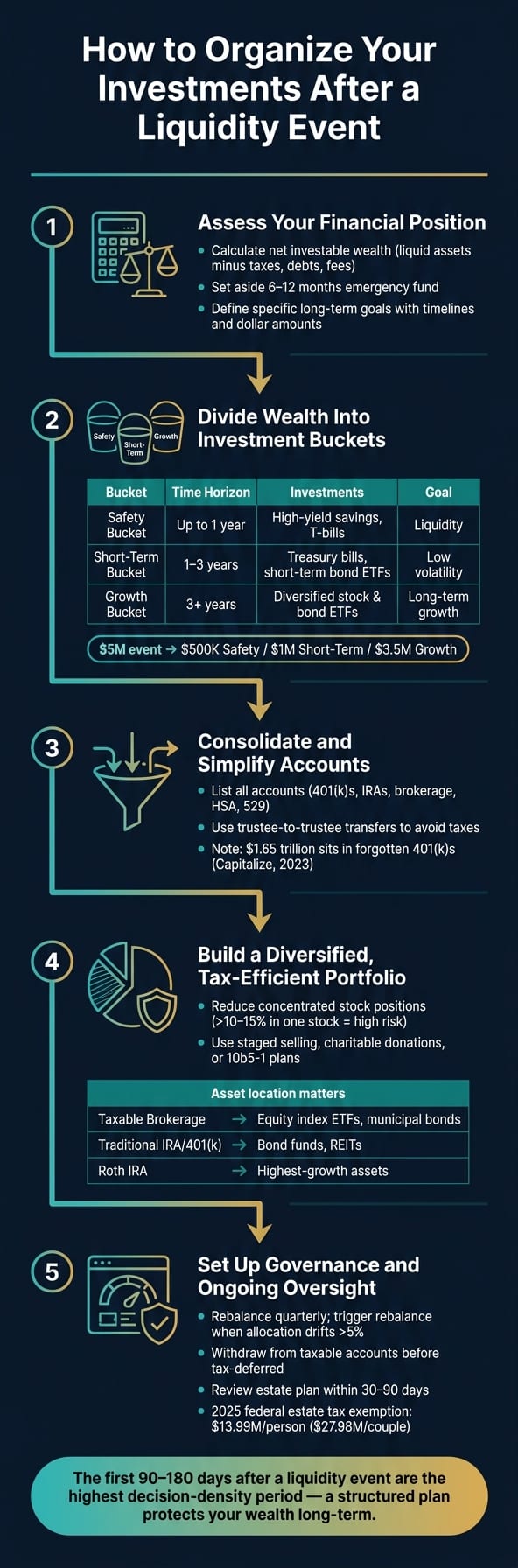
When you experience a liquidity event - like selling a business, IPO proceeds, or stock option exercises - you may suddenly have significant cash or marketable assets. But managing this wealth effectively is critical to protect it from taxes, market risks, and hasty decisions. Here's a quick guide to help you get started:
- Understand your high-net-worth investing strategies: Calculate your net investable wealth by subtracting taxes, debts, and immediate obligations from your liquid assets.
- Set aside for short-term needs: Reserve funds for taxes, emergencies (6–12 months of expenses), and near-term goals in low-risk accounts.
- Define long-term goals: Write specific financial objectives, like retirement targets or college savings, with timelines and priorities.
- Allocate investments by time horizon: Use a "bucket" strategy - safety (1 year), short-term (1–3 years), and growth (3+ years) - to balance liquidity, risk, and growth potential.
- Simplify and consolidate accounts: Combine duplicate accounts, but be cautious about tax implications or unique account rules.
- Diversify and manage taxes: Reduce concentrated stock positions, set a target asset allocation, and optimize which investments go into taxable vs. tax-advantaged accounts.
- Maintain ongoing oversight: Use tools to monitor your portfolio, rebalance regularly, and update your estate plan as needed.
Key Tip: The first 90–180 days after a liquidity event are decision-heavy. Tools like Mezzi can help you organize your accounts, reduce risks, and focus on long-term planning without requiring asset transfers.
How Business Owners Create Passive Income After an Exit
Step 1: Assess Your Financial Position and Goals
After a liquidity event, the first step is to evaluate your financial position. This sets the stage for a more structured and informed approach to investing.
Calculate Your Net Investable Wealth
Before diving into investments, figure out your net investable wealth - essentially, the funds you have available after addressing taxes, debts, and immediate financial obligations.
Start by tallying up your liquid assets. This includes cash from the liquidity event, balances in brokerage accounts, retirement accounts like 401(k)s or IRAs, and any vested equity valued at the current market price. From this total, subtract what you owe. Account for federal long-term capital gains taxes, the Net Investment Income Tax (NIIT) if applicable, and state taxes, which can climb above 30% in high-tax states. If you exercised incentive stock options (ISOs), consider whether you may face Alternative Minimum Tax (AMT). Also, deduct debts you plan to pay off immediately, such as high-interest credit card balances, margin loans, or business-related obligations, along with any transaction costs like legal or advisory fees. The remaining amount is your net investable wealth - essentially, the funds you have available to invest.
Once you've calculated this, you can move on to setting aside money for more immediate needs.
Set Aside Funds for Short-Term and Emergency Needs
Before investing, make sure to allocate funds for short-term and emergency needs. This safeguards you from having to sell investments under unfavorable conditions to cover taxes or planned expenses.
Create a short-term bucket for expenses expected within the next 0–3 years. This bucket should include cash and low-risk, low-volatility assets like U.S. Treasury bills or a high-yield FDIC-insured savings account. Use this to cover upcoming tax payments, large purchases, or other known expenses. Additionally, maintain an emergency fund that can cover 6–12 months of living expenses. Opt for the higher end of this range if your income is less predictable due to a business sale or career transition.
With your short-term safety net in place, the next step is to define your long-term financial objectives.
Define Your Long-Term Financial Goals
Take the time to write down your long-term financial goals. Research from Vanguard suggests that households with written financial plans are more likely to stay invested, rebalance their portfolios consistently, and achieve better outcomes over time.
Be as specific as possible. Instead of a vague goal like "retire comfortably", set a concrete target - such as retiring at 60 with $200,000 in annual after-tax spending, adjusted for inflation. If you have children, decide whether you want to fully cover their college expenses and at what level. For those interested in philanthropy, consider whether you want to establish a donor-advised fund (DAF), make annual charitable contributions, or allocate a portion of your estate to charitable causes. Each goal should include a time horizon, a dollar amount, and a priority level. These details will guide your risk tolerance and portfolio design, laying the foundation for a diversified and tax-efficient investment plan in the steps to come.
Step 2: Divide Your Wealth Into Investment Buckets
After calculating your net investable wealth and setting clear goals, the next logical step is to allocate your funds based on when you’ll need them and how much risk you’re comfortable taking. This approach, often called a bucket strategy, organizes your investments by time horizon and risk tolerance.
Create Three Buckets: Safety, Short-Term, and Growth
Think of your wealth as serving three main purposes. The safety bucket is for emergencies and immediate expenses - anything you might need within the next 12 months. The short-term bucket is for funds you'll use in the next 1–3 years, such as for a home down payment, tuition, or other planned expenses. Finally, the growth bucket is for money you won’t touch for at least 3–5 years, giving it time to grow through long-term investments.
Here’s an example: If you sell a business and net $5 million, you might allocate $500,000 to the safety bucket for taxes, fees, and living expenses for the next year. Then, $1 million could go into the short-term bucket for upcoming family obligations or a home purchase. The remaining $3.5 million would be placed in the growth bucket for retirement or legacy planning. Your exact allocation will depend on your spending needs and tax circumstances - there’s no one-size-fits-all formula.
Match Account Types to Each Bucket
The type of account or investment you choose for each bucket should align with its purpose. For the safety bucket, liquidity and stability are key, while the short-term bucket requires low volatility to avoid losses when you need the money. The growth bucket, on the other hand, can handle more market fluctuations since you won’t need the funds for years.
One important note: Interest from Treasury bills is exempt from state and local income taxes, which can be advantageous if you live in a high-tax state. For the growth bucket, where to hold specific investments - such as taxable brokerage accounts, IRAs, or trusts - matters as much as the investments themselves. As Mezzi puts it:
"Asset location - which holdings sit in which accounts - can be worth more than stock picking over time." - Mezzi
Once your funds are allocated and the right account types are chosen, the next step is to define a risk budget for your growth investments.
Define a Risk Budget for the Growth Bucket
After filling the safety and short-term buckets, your focus shifts to structuring the growth bucket. A risk budget is essentially a pre-set limit on how much volatility you’re willing to accept without deviating from your plan. This ensures your portfolio’s ups and downs align with your comfort level, rather than simply chasing returns by choosing a higher proportion of stocks or bonds.
For instance, a 45-year-old with no immediate cash needs and 20 years until retirement might allocate 80–90% of their growth bucket to equities. On the other hand, someone closer to retirement or who has experienced anxiety during past market downturns might prefer a more balanced 60/40 split. The growth bucket should primarily consist of diversified stock and bond ETFs, with alternatives like private credit or real assets used sparingly. While these alternatives can add diversification, they often come with higher fees, complexity, and reduced liquidity. The ultimate goal is to create a portfolio you can stick with, even during challenging market conditions.
Step 3: Consolidate and Simplify Your Accounts
With your financial buckets defined and your risk budget in place, it’s time to tackle a practical challenge: managing the maze of accounts that often follow a liquidity event. These may include a new brokerage account from the sale, stock plan accounts, old 401(k)s, IRAs, and various bank accounts. Keeping them all separate can make it tough to get a clear view of your overall financial situation.
List All Your Accounts
Start by listing every account you own. This includes taxable brokerage accounts, checking and savings accounts, old 401(k)s or 403(b)s, traditional and Roth IRAs, HSAs, 529 plans, trust accounts, and equity compensation accounts. For each account, note the institution, account type, tax status, current balance, and designated beneficiaries.
This step is essential because certain account actions can have unintended consequences. For example, rolling a traditional 401(k) into a Roth IRA counts as a taxable conversion. While this may be intentional in some cases, it can be costly if done by mistake. Additionally, some accounts offer specific protections or benefits worth preserving, such as creditor protections available to ERISA-covered 401(k) plans that IRAs might not provide in certain states.
Combine Duplicate Accounts Without Triggering Taxes
Once you’ve cataloged all your accounts, look for duplicates that serve the same purpose and share the same tax status. For instance, multiple traditional IRAs held at different institutions can often be consolidated into a single account through a trustee-to-trustee transfer, avoiding taxes, penalties, and the stress of meeting a 60-day deadline. Similarly, old 401(k)s from previous employers can typically be rolled into a single rollover IRA or your current employer’s plan.
When consolidating, always use direct rollovers to avoid issues like tax withholding or missing the 60-day window. A 2023 study by Capitalize revealed that Americans collectively hold about $1.65 trillion in forgotten or abandoned 401(k) accounts, with the average account holding approximately $55,400. These funds are often stuck in high-fee, limited-investment plans, missing the opportunity to grow more effectively elsewhere.
However, not all accounts should be combined. For example, inherited IRAs must remain separate from your own IRAs to avoid tax complications. Similarly, trust accounts and irrevocable structures should only be adjusted in accordance with the trust’s terms and your estate plan. If you’re unsure about an account, it’s best to flag it for professional review before making changes.
After consolidating, managing your accounts collectively can make it easier to monitor and optimize your financial strategy.
Use Mezzi to See All Your Accounts in One Place
Before consolidating, you can gain a complete view of your finances by connecting all your accounts to Mezzi. Using read-only access through Plaid and Finicity, Mezzi aggregates your accounts - including 401(k)s, IRAs, and taxable brokerage accounts - into a single dashboard. This process doesn’t require you to move assets or share login credentials.
This unified view is crucial because many traditional advisors can only see the accounts they directly manage. Mezzi, on the other hand, provides a comprehensive view of everything, helping to identify potential issues like overlapping investments across accounts or assets that may not be optimized for tax efficiency. With all your accounts connected, you’ll have the clarity needed to make informed consolidation decisions and confidently move forward with building your portfolio. This foundation will be key for creating a diversified, tax-efficient portfolio in the next step.
Step 4: Build a Diversified, Tax-Efficient Portfolio
With your accounts consolidated and financial goals clearly defined, the next step is to structure your portfolio. The aim is to create a diversified, tax-conscious investment plan that aligns with your long-term objectives while managing risk across various asset classes.
Reduce Concentrated Stock Positions
If your liquidity event included company stock, a large portion of your wealth may now be tied to a single company. A concentrated stock position often means more than 10–15% of your investable net worth is in one stock, and in some cases, it could exceed 50%.
This level of concentration carries significant risk. Even successful companies can face sharp declines of 50–90% due to unexpected factors like lawsuits, regulatory shifts, or market competition. Historically, single-stock portfolios have shown volatility levels two to three times higher than diversified index portfolios.
Here are three strategies to address this risk:
- Staged selling: Gradually sell portions of the stock over 3–5 years to spread capital gains across multiple tax years. Focus on selling shares held for more than 12 months to benefit from lower long-term capital gains tax rates.
- Charitable donations of appreciated stock: Donating shares directly to a donor-advised fund allows you to avoid capital gains taxes on those shares and may qualify you for a charitable deduction. This works particularly well for shares with a low cost basis.
- 10b5-1 trading plans: If you're a corporate insider subject to trading restrictions, a Rule 10b5-1 plan enables you to pre-schedule stock sales during open trading windows. These plans execute automatically, helping you avoid timing decisions while offering legal safeguards.
Each approach has its pros and cons. Staged selling extends your exposure to the stock, charitable donations are permanent, and 10b5-1 plans limit your flexibility. Often, a combination of these strategies is the most practical way to manage larger positions.
Once you've reduced concentration risk, you can focus on setting an asset allocation that reflects your goals and risk tolerance.
Set a Target Asset Allocation
After addressing concentrated holdings, the next step is to define how your assets should be distributed across stocks, bonds, and cash. A clear allocation plan helps you stay disciplined during market fluctuations.
A helpful framework ties your allocation to your time horizon and financial goals. For instance:
- Keep 1–3 years of planned spending in cash or short-term Treasuries.
- Use high-quality bonds for needs 3–10 years out.
- Allocate to diversified equities - both U.S. and international - for goals beyond 10 years.
Your personal situation will further refine this allocation. For example, someone in their early 40s with steady income and long-term goals might aim for 70% stocks, 25% bonds, and 5% cash. On the other hand, someone in their late 50s approaching retirement might lean toward 50% stocks, 40% bonds, and 10% cash. The key is to have a written plan that matches your specific circumstances, so you're less tempted to make emotional decisions based on market conditions.
Place Assets in the Right Account Types
Where you hold your investments can be just as important as what you invest in. Asset location - the practice of placing investments in the most tax-efficient accounts - can make a meaningful difference in your portfolio's performance.
Here’s a breakdown of how to match investments to account types:
By tracking holding periods and prioritizing long-term capital gains, you can further enhance tax efficiency.
Use Mezzi's X-Ray to Find Overlapping Holdings
After a liquidity event, it's common to find multiple funds spread across different accounts that appear distinct but hold many of the same stocks. For instance, a target-date fund in your 401(k) and an S&P 500 index ETF in your taxable account might both be heavily weighted toward large-cap tech stocks. This duplication means you're paying fees for the same exposure without gaining additional diversification.
Mezzi's X-Ray tool can help. It analyzes the underlying holdings across all your connected accounts, including 401(k)s, IRAs, and taxable brokerage accounts. This tool identifies hidden overlaps in stocks, sectors, or asset classes that might not be apparent when viewing each account individually. It also checks correlations between holdings to confirm whether your portfolio is genuinely diversified or just spread across similar investments.
Because Mezzi connects to all your accounts through read-only access, it can detect overlaps invisible to someone reviewing accounts separately. The result? A streamlined portfolio where every holding serves a purpose, and you're not paying extra for redundancy.
Step 5: Set Up Governance and Ongoing Oversight
With your portfolio now structured and consolidated, the next step is maintaining disciplined oversight. Even a well-organized portfolio may shift over time, so consistent monitoring is essential. After a liquidity event, decisions about rebalancing, withdrawals, estate planning, and ongoing portfolio management become just as crucial as the initial setup.
Create a Rebalancing and Withdrawal Policy
Establishing a written policy for rebalancing and withdrawals can help you stay on track. Market fluctuations will naturally cause your portfolio to deviate from its target allocation. By reviewing your portfolio quarterly and rebalancing when any asset class drifts more than 5% from its target, you can maintain alignment with your goals. For instance, if your target allocation is 70% stocks and a strong market performance pushes it to 76%, reallocating funds to underweighted areas ensures balance is restored. This systematic approach supports the broader strategies outlined earlier, keeping your wealth management plan cohesive.
When it comes to withdrawals, decide in advance which accounts to prioritize. Drawing from taxable accounts before tapping into tax-deferred accounts like IRAs and 401(k)s can help preserve the tax-sheltered growth of those retirement assets. A clear, written withdrawal policy ensures consistency and reduces the risk of impulsive decisions over time.
Update Your Estate Plan and Charitable Giving Strategy
A liquidity event often requires a reassessment of your estate plan. As Croak Capital explains:
The question is no longer, 'Do I have a will?', but instead 'Is my estate plan fully integrated with how my capital is invested, taxed, and ultimately transferred?'
Within 30–90 days of the liquidity event, review and update your estate documents. Key actions include transferring taxable investment accounts and real estate into the name of your trust (instead of holding them individually) and verifying that beneficiary designations for retirement accounts and life insurance policies align with your current strategy.
In 2025, the federal estate and gift tax exemption is set at $13.99 million per person ($27.98 million for married couples), with a 40% federal tax rate applying to assets above this limit. The One Big Beautiful Bill Act will increase this exemption to $15 million per person in 2026. If your net worth approaches these thresholds, you might explore tools like a Grantor Retained Annuity Trust (GRAT) to shift future asset growth out of your taxable estate, or a Charitable Remainder Trust (CRT) to diversify concentrated holdings while generating income and supporting philanthropic goals. Revisiting your estate plan every 3 to 5 years - or sooner after major life events - ensures it remains aligned with your financial and personal goals.
Use Mezzi to Monitor Your Portfolio Over Time
Once your strategy is set, the challenge is staying on top of it without excessive manual effort. Mezzi simplifies this by continuously monitoring your connected accounts. It flags allocation drifts, identifies tax-loss harvesting opportunities throughout the year, and alerts you when holdings transition from short-term to long-term capital gains status - timing that could affect your tax bill significantly if acted on promptly.
With read-only access to all your accounts - whether taxable, traditional IRAs, Roth IRAs, or 401(k)s - Mezzi also helps identify potential wash-sale risks across household accounts before they occur. While you retain full control over decisions, Mezzi’s comprehensive oversight helps ensure your strategy stays aligned with your goals, saving you time and reducing the risk of missed opportunities.
Conclusion: Take Control of Your Post-Liquidity Wealth
A liquidity event is a major financial milestone. The choices you make during the first 90 days - often described as the period of highest "decision density" in a business owner's financial journey - can have a lasting impact on your wealth. Taking a structured approach can help you navigate this critical time with clarity.
As the Wiss Team explains:
Selling a business is a transaction. Building lasting wealth from the proceeds is a discipline, and it starts the moment the wire clears.
This discipline is the foundation for turning liquidity into enduring wealth.
Following a clear framework is a practical way to transition sudden capital into long-term financial stability. However, the real challenge lies in staying consistent over time. That’s where Mezzi steps in. As an SEC-registered fiduciary, Mezzi links all your accounts - including taxable accounts, Roth IRAs, traditional IRAs, and 401(k)s - through read-only access. It provides advisor-level insights without the traditional 1% AUM fee, ensuring you stay informed and in control as your strategy adapts.
For $299 per year, Mezzi offers advisor-level oversight on your terms.
FAQs
How much cash should I keep aside right after a liquidity event?
After a liquidity event, it’s wise to set aside 6 to 12 months of personal and business expenses in liquid assets. This can help you manage unexpected costs or take advantage of new opportunities. Additionally, map out your cash needs for the next 12 to 18 months, factoring in obligations like taxes. To maintain accessibility while aiming for some returns, consider cash alternatives such as money market funds or short-term Treasuries. These options are designed to offer both security and liquidity.
What’s the smartest way to reduce a big single-stock position without a huge tax hit?
When it comes to selling investments, spreading the process over several years rather than doing it all at once may help reduce immediate tax obligations. This approach can ease the tax burden by distributing gains over time.
With Mezzi, you can monitor your portfolio in real time to identify opportunities for more tax-efficient timing. Additionally, using AI tools to harvest losses can help offset gains, all while adhering to IRS wash sale rules. This method aims to improve your after-tax results without running afoul of compliance requirements.
Which investments should go in taxable vs. IRA vs. Roth accounts?
To make the most of your portfolio, it's important to align your investments with the tax rules of each account type:
- Use taxable brokerage accounts for investments that are naturally tax-efficient. These might include municipal bonds, index funds, and stocks with low dividend payouts. These assets tend to generate less taxable income, making them a better fit for accounts subject to annual taxes.
- For traditional IRAs or 401(k)s, consider holding tax-inefficient investments. Examples include REITs, taxable bonds, and actively managed mutual funds. These accounts allow you to defer taxes on income and gains, reducing the immediate tax burden.
- Reserve Roth IRAs and HSAs for investments with high growth potential, such as small-cap stocks. These accounts provide the advantage of tax-free compounding and withdrawals, making them ideal for assets expected to grow significantly over time.
Matching your investments to the tax characteristics of each account can help reduce tax drag and potentially improve the overall efficiency of your portfolio.
Disclosures:
- This content is for informational purposes only and does not constitute investment advice or a recommendation to buy or sell any security.
- Past performance is not indicative of future results. No guarantee of future performance or outcomes is implied.
- Always consult with a qualified financial advisor before making investment or financial planning decisions.
Related Blog Posts
- If I add a lump sum to my portfolio, how would it change my annual investment income?
- Concentrated stock position: when and how to diversify
- How to manage wealth after a company acquisition or IPO exit
- Post-IPO Wealth Management: Lock-Up Periods, 10b5-1 Plans, Diversification
After a liquidity event, it’s wise to set aside 6 to 12 months of personal and business expenses in liquid assets. This can help you manage unexpected costs or take advantage of new opportunities. Additionally, map out your cash needs for the next 12 to 18 months, factoring in obligations like taxes. To maintain accessibility while aiming for some returns, consider cash alternatives such as money market funds or short-term Treasuries. These options are designed to offer both security and liquidity.
When it comes to selling investments, spreading the process over several years rather than doing it all at once may help reduce immediate tax obligations. This approach can ease the tax burden by distributing gains over time.
With Mezzi, you can monitor your portfolio in real time to identify opportunities for more tax-efficient timing. Additionally, using AI tools to harvest losses can help offset gains, all while adhering to IRS wash sale rules. This method aims to improve your after-tax results without running afoul of compliance requirements.
To make the most of your portfolio, it's important to align your investments with the tax rules of each account type:
- Use taxable brokerage accounts for investments that are naturally tax-efficient. These might include municipal bonds, index funds, and stocks with low dividend payouts. These assets tend to generate less taxable income, making them a better fit for accounts subject to annual taxes.
- For traditional IRAs or 401(k)s, consider holding tax-inefficient investments. Examples include REITs, taxable bonds, and actively managed mutual funds. These accounts allow you to defer taxes on income and gains, reducing the immediate tax burden.
- Reserve Roth IRAs and HSAs for investments with high growth potential, such as small-cap stocks. These accounts provide the advantage of tax-free compounding and withdrawals, making them ideal for assets expected to grow significantly over time.
Matching your investments to the tax characteristics of each account can help reduce tax drag and potentially improve the overall efficiency of your portfolio.