
Non-Qualified Stock Options (NSOs) let you buy company shares at a fixed "strike price", often below market value, offering a potential way to benefit from your company's growth. However, timing, taxes, and risks play a major role in maximizing their value. Here's what you need to know:
- Key Components: NSOs include a strike price, vesting schedule, and expiration date (usually 10 years).
- Taxes: The spread (difference between market value and strike price) is taxed as income when you exercise. Selling after holding shares for a year may qualify for lower long-term capital gains tax rates.
- Risks: If the stock price drops below the strike price, options may lose value. Poor timing can also lead to unexpected tax burdens.
- Strategies: Early exercise may reduce taxes, but it requires upfront cash. Alternatively, waiting may increase costs and risks. Diversifying your portfolio and planning for taxes are critical steps.
NSOs can be a financial opportunity if managed carefully. Tools like Mezzi AI can help track timelines, reduce tax burdens, and align NSOs with your overall financial goals.
Non-Qualified Stock Options: Basics | Taxes | When Should You Exercise?
The NSO Lifecycle: From Grant to Sale
Grant and Vesting: How You Build Ownership
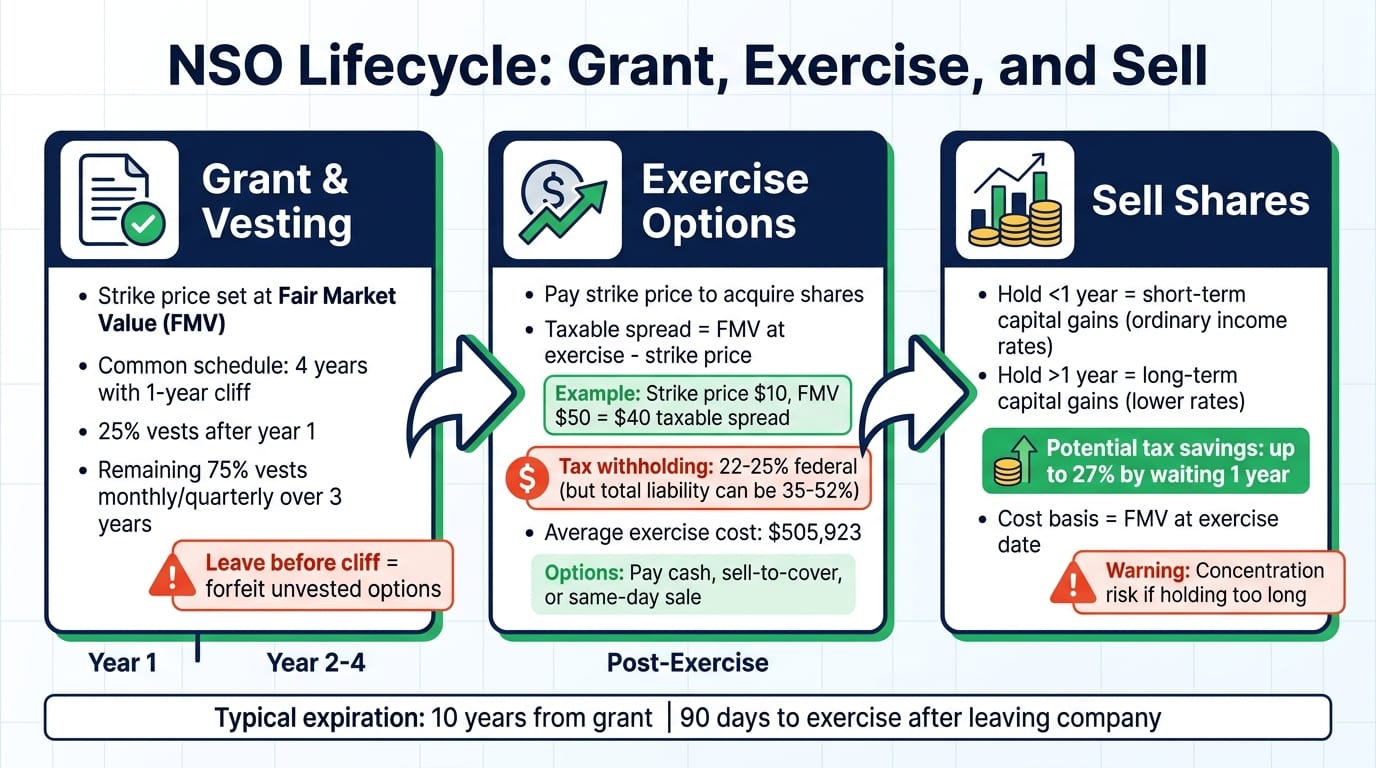
An NSO grant gives you the right to purchase shares, but it doesn’t mean you own them outright. The grant specifies the strike price, which is typically set at the fair market value (FMV) on the date the grant is issued. For private companies, this FMV is determined through a 409A valuation, which is conducted either annually or when specific events occur.
NSOs aren't actual shares - they're simply the right to buy shares. You must exercise these options to become a shareholder.
Isabel Contreras, Writer, Range
The process of vesting determines when you can exercise these options. A common vesting schedule spans four years and often includes a one-year "cliff." This means you earn 25% of your options after the first year, with the rest vesting incrementally - either monthly or quarterly - over the remaining three years. If you leave the company before the cliff period ends, you forfeit any unvested options. This structure often serves as an incentive for employees to stay with the company, sometimes referred to as "golden handcuffs".
Once your options vest, the next step is deciding when and how to exercise them, which involves both costs and tax considerations.
Exercising Options: When and How Much It Costs
Exercising NSOs involves paying the strike price to acquire the shares, but it also comes with tax implications. Specifically, you may owe ordinary income tax on the "spread" - the difference between the FMV at the time of exercise and your strike price. For example, if your strike price is $10 per share and the FMV is $50, the $40 spread per share is taxable as income.
The spread (difference between value at exercise and the exercise price) will be taxable on the exercise date.
CJ Stermetz, Founder, Equity For The Win
Employers typically withhold 22–25% of the spread for federal taxes. However, your total tax liability, including state and payroll taxes, can climb as high as 35–52%. According to some reports, the average cost to exercise NSOs for users of certain equity platforms is $505,923. If paying out of pocket isn't feasible, you might consider strategies like sell-to-cover - selling enough shares to pay for the strike price and taxes while keeping the rest. Another option is a same-day sale, where you exercise and immediately sell all shares. This approach avoids any upfront costs.
Understanding these costs is essential, but it’s equally important to think about how your sale timing can influence your overall tax liability.
Selling Your NSOs
Once you’ve exercised your options, they convert into shares that you can sell. The tax treatment of the sale largely depends on how long you hold the shares after exercising. If you sell within one year, any profits are taxed as short-term capital gains, which are subject to ordinary income tax rates. However, holding the shares for more than a year qualifies you for long-term capital gains rates, which are generally lower.
If you exercise your NSOs at least a year prior to selling, you get a discount on your sale tax.
Vieje Piauwasdy, Senior Director, Secfi
This difference in tax rates can potentially increase your net return by up to 27%. On the flip side, waiting to sell can expose you to concentration risk - tying too much of your wealth to the performance of a single company. Timing your sales strategically helps balance tax efficiency with risk management, making NSOs a more effective part of your overall financial plan. Keeping track of these timelines is crucial to preserving the value of your equity.
Tax Implications of NSOs
Taxes When You Exercise
When you exercise non-qualified stock options (NSOs), the IRS treats the difference between the market value and the strike price - known as the "spread" - as ordinary income, even if you don't sell the shares at that time. This amount is reported on your W-2 and is subject to federal, state, local, and FICA taxes, including Social Security and Medicare.
The problem is your NSO phantom gain counts as income on top of your salary... This will push you into the higher tax brackets.
Secfi
In states with high taxes, like California, the effective tax rate on exercising NSOs can range from 35% to 52%. The timing of your exercise plays a big role in how much tax you'll owe. For instance, exercising before a funding round or a 409A valuation update can lock in a lower fair market value (FMV), reducing your tax liability. On the other hand, waiting until after a valuation increase means you'll pay more taxes because the spread will be larger.
Once you've exercised, the timing of when you sell your shares will further impact your tax obligations.
Taxes When You Sell
After exercising NSOs, your cost basis is set at the FMV on the exercise date. When you eventually sell the shares, any gain above this cost basis is taxed as capital gains.
If you exercise your NSOs at least a year prior to selling, you get a discount on your sale tax.
Secfi
This approach - holding shares for at least a year after exercising - may reduce your tax rate, potentially increasing your net gain by up to 27% compared to selling immediately. However, holding onto shares comes with market risk, as the stock price could drop. Balancing potential tax savings with the risks of volatility is a key part of managing NSOs within your broader financial strategy.
Planning for Tax Withholding
Proper planning for tax withholding is essential when dealing with NSOs. While your employer withholds taxes at the time of exercise, this amount often falls short of your total tax liability. Federal, state, and FICA taxes can push your marginal tax rate to 37% or higher, leaving a gap between what is withheld and what you owe.
Your employer usually only charges you the bare minimum, say 25%. Many employees think that's all they owe. But you still owe the other ~20%, and it's up to you to pay this to the IRS.
Secfi
To avoid surprises, calculate your full tax liability ahead of time. You can cover any shortfall through quarterly estimated payments, adjusting your W-4 withholding, or using a sell-to-cover strategy. Without proper planning, you may face underpayment penalties and a large tax bill when you file your return.
Strategies to Get the Most from Your NSOs
When to Exercise Your NSOs
Deciding when to exercise your NSOs involves weighing multiple factors. Most NSOs have a 10-year expiration window, and exercising them within the last 1–2 years can help ensure you capture their value before they expire worthless. Leading up to that deadline, it’s important to monitor your company’s 409A valuation. For private companies, this valuation generally rises as the company grows, so exercising when the valuation is lower may reduce both your immediate tax burden and the cash needed for the exercise.
Another key factor is concentration risk. If your company stock makes up more than 20% of your total investable assets, it may be time to prioritize diversification and monitoring. Tom Lo, Financial Advisor at Vested Financial Planning, advises: "If you own more than a 20% concentration in your company stock... I suggest focusing more on reducing your excessive concentration risk over minimizing taxes". Additionally, if you’re leaving your company, keep in mind that you typically have just 90 days to exercise vested NSOs before they are forfeited.
For private companies where exercising requires significant cash, non-recourse financing can be a practical solution. This option allows you to exercise NSOs without using personal funds, as repayment is only required if the company achieves a successful exit. Once you’ve decided on the right timing, the next step is to align these actions with your broader financial goals.
Fitting NSOs Into Your Investment Portfolio
The timing of your NSO exercise has direct implications for taxes and costs, so integrating them into your overall investment strategy is essential. Start by calculating your exposure - compare the value of your vested NSOs and other company equity to your total investable assets, which include investments, 401(k)s, and cash. If this ratio exceeds 20%, your portfolio may be overly concentrated, making diversification a higher priority. Proceeds from selling NSOs could be directed toward financial goals like strengthening emergency savings, paying off debt, or funding a major purchase, such as a home.
It’s also important to coordinate your NSOs with other forms of equity compensation to manage taxable income effectively. For instance, you might stagger NSO exercises, RSU vesting, ESPP purchases, and bonuses across different tax years or quarters. This phased approach may help smooth your tax liability and maintain liquidity. Avoid exercising all your options at once; instead, consider a multi-year plan to better manage cash flow and taxes. If you decide to hold onto exercised shares, ensure you have enough funds to cover both the exercise cost and taxes, while still maintaining at least 12 months’ worth of living expenses.
Understanding the Risks of Waiting
Delaying the exercise of your NSOs introduces several risks. For one, as your company’s 409A valuation increases, the gap between the strike price and market value widens, raising both exercise costs and taxable gains. If the cost becomes too high, you may find yourself unable to exercise your options.
Waiting until a liquidity event for a cashless exercise could result in the entire gain being taxed at ordinary income rates - up to 52% in states like California. Exercising at least a year before selling your shares may allow future gains to qualify for lower long-term capital gains rates, potentially improving net returns by as much as 27%.
Additionally, NSOs lose their leverage as the stock price climbs. Harmony Wagner, CFP®, CPWA® at Bouchey Financial Group, explains: "Exercising and selling NSOs to invest in a diversified, or less correlated investment, can help control exposure to concentration risk to within the desired parameters".
As the expiration date approaches, the time value of your options - essentially, their potential for further growth - diminishes. To maximize value, consider exercising your options when they are within one year of expiration. This ensures you don’t miss out on the benefits they offer while still managing risk effectively.
Using Mezzi AI for Better NSO Decisions
How Mezzi Tracks Market Conditions
Mezzi monitors your portfolio daily, tracking the timeline of your positions, and notifies you when your NSOs may become eligible for long-term capital gains treatment. This timing can be important for tax planning purposes, as holding shares for more than a year may qualify for lower tax rates.
"Sell a stock at 11 months and you pay your ordinary income tax rate. Wait one more month and you pay the long-term rate - often half as much. Tax Optimization shows you exactly when each position crosses the threshold." - Mezzi
When markets experience a downturn, Mezzi also identifies opportunities for tax-loss harvesting. These harvested losses can offset future gains from NSO exercises, creating a more tax-efficient strategy. This kind of real-time monitoring aligns with the goal of maximizing tax benefits.
Tax Optimization with Mezzi
Mezzi takes a comprehensive look at your tax situation by linking all your accounts - whether it’s a 401(k), IRA, or taxable brokerage account. This holistic approach is especially important because NSO exercises, combined with your salary, RSU vesting, and bonuses, can push you into the highest tax brackets - sometimes exceeding 50% in states like California. The platform reviews asset placement across different accounts, such as Roth, traditional, and taxable accounts, ensuring that growth-focused assets like NSO shares are in tax-efficient locations. It also helps you manage the gap between the standard 22% supplemental withholding rate and your actual tax liability, which could reach as high as 48–52% for high earners.
"Asset location - which holdings sit in which accounts - can be worth more than stock picking over time." - Mezzi
By simulating various NSO exercise scenarios across multiple tax years, Mezzi can help you explore ways to manage the timing of income from NSOs. This approach may help optimize your tax burden while fitting seamlessly into your broader financial plans.
Connecting NSOs to Your Complete Financial Picture
To make the most of your NSOs, Mezzi integrates all aspects of your financial situation to uncover potential tax savings. The platform uses a full view of your assets and liabilities to identify opportunities that might otherwise be missed. By linking your accounts with read-only access, Mezzi can pinpoint inefficiencies - like low-yield bonds sitting in a Roth account - and recommend adjustments to improve your portfolio.
This level of integration ensures that your NSO decisions align with your larger financial goals, whether that's building an emergency fund, paying down debt, or saving for a major expense. Additionally, Mezzi collaborates with your CPA, providing year-round insights to ensure your NSO strategy supports your overall wealth-building efforts.
Conclusion: Making Smart NSO Decisions
NSOs may increase wealth when approached with thoughtful planning. Choosing the right time to exercise could mean as much as 27% more in net gains, largely through potential tax savings. This becomes especially impactful when exercise costs average over $500,000.
As discussed earlier, timing your exercise, planning for taxes, and diversifying your portfolio are key factors. Early exercise can secure lower tax rates but requires significant cash upfront and comes with risks, such as the company not meeting expectations. On the other hand, delaying too long might result in higher taxes or a limited window to act after leaving the company.
For managing these complexities, having the right tools can make a difference. Mezzi integrates with your accounts - like 401(k)s, IRAs, and taxable brokerage accounts - to monitor NSO positions daily. It highlights when shares transition from short-term to long-term capital gains and flags opportunities for tax-loss harvesting during market downturns, potentially reducing tax burdens that can reach 52%.
Deciding when to exercise stock options is not about finding the perfect moment. It is about building a resilient strategy that balances opportunity with risk, taxes with cash flow, and ambition with stability.
Christopher Stroup, Financial Advisor, Silicon Beach Financial
With Mezzi’s AI-powered insights, you can manage NSOs with greater clarity and control. It delivers advisor-level insights through daily tracking - without the typical 1% annual fee - so you stay informed and in charge.
FAQs
How do I estimate the total taxes I’ll owe before I exercise my NSOs?
To figure out taxes before exercising NSOs, start by calculating the bargain element - this is the difference between the stock's fair market value at exercise and the exercise price. This amount is treated as ordinary income and may be subject to your personal tax rate, FICA taxes, and applicable state taxes. Tools like Mezzi can provide insights into exercise timing and tax strategies, helping you estimate your overall tax liability more effectively.
What’s the best way to cover exercise costs if I don’t have enough cash on hand?
If you don’t have the cash to cover the costs of exercising stock options, a cashless exercise might be worth considering. This method involves selling enough shares during the transaction to cover both the exercise price and any taxes, which can help minimize out-of-pocket expenses.
Another option could be exploring financing methods, such as a stock option loan or a sell-to-cover transaction, where your shares serve as collateral. However, it’s essential to carefully evaluate the tax implications and potential risks tied to these approaches to ensure they align with your broader financial objectives.
How should I decide between holding shares for long-term gains vs selling to diversify?
Deciding whether to hold onto shares for potential long-term gains or sell them to diversify your investments depends on several factors, including your financial objectives, tax considerations, and comfort with risk. For instance, selling NSOs (Non-Qualified Stock Options) as they approach expiration may help you reduce an overconcentration in a single stock and spread your investments across different assets. On the other hand, holding shares for the long term might lead to higher potential returns if the company performs well, though this choice also introduces more tax complexity and exposes you to risks tied specifically to that company. To make a decision that aligns with your broader wealth strategy, it may be helpful to explore tools like Mezzi, which are designed to provide valuable insights.
Disclosures:
- This content is for informational purposes only and does not constitute investment advice or a recommendation to buy or sell any security.
- Past performance is not indicative of future results. No guarantee of future performance or outcomes is implied.
- The use of artificial intelligence and algorithmic tools does not guarantee investment results. These tools are subject to limitations, errors, and market conditions that may affect performance.
Related Blog Posts
- NSO and ISO Tax Timing Strategies
- ISO vs NSO: What’s the Difference?
- Different Types of Equity Compensation: RSUs, ISOs, NSOs, ESPP
- Incentive Stock Options and AMT: Exercise Strategy to Minimize Tax
To figure out taxes before exercising NSOs, start by calculating the bargain element - this is the difference between the stock's fair market value at exercise and the exercise price. This amount is treated as ordinary income and may be subject to your personal tax rate, FICA taxes, and applicable state taxes. Tools like Mezzi can provide insights into exercise timing and tax strategies, helping you estimate your overall tax liability more effectively.
If you don’t have the cash to cover the costs of exercising stock options, a cashless exercise might be worth considering. This method involves selling enough shares during the transaction to cover both the exercise price and any taxes, which can help minimize out-of-pocket expenses.
Another option could be exploring financing methods, such as a stock option loan or a sell-to-cover transaction, where your shares serve as collateral. However, it’s essential to carefully evaluate the tax implications and potential risks tied to these approaches to ensure they align with your broader financial objectives.
Deciding whether to hold onto shares for potential long-term gains or sell them to diversify your investments depends on several factors, including your financial objectives, tax considerations, and comfort with risk. For instance, selling NSOs (Non-Qualified Stock Options) as they approach expiration may help you reduce an overconcentration in a single stock and spread your investments across different assets. On the other hand, holding shares for the long term might lead to higher potential returns if the company performs well, though this choice also introduces more tax complexity and exposes you to risks tied specifically to that company. To make a decision that aligns with your broader wealth strategy, it may be helpful to explore tools like Mezzi, which are designed to provide valuable insights.