
Higher rates may shift the math fast: a pension lump sum may get smaller, while monthly annuity income may look stronger. If I were comparing the two on August 5, 2026, I’d usually look past the headline offer and focus on after-tax income, inflation, survivor coverage, estate goals, and rollover rules.
Here’s the short version:
- A lump sum may offer more control, more access to the money, and a balance that may go to heirs.
- An annuity may offer monthly income for life and may shift market and longevity risk away from me.
- Higher discount rates may reduce the lump-sum value of future checks.
- A direct rollover to an IRA may avoid the 20% federal withholding that may apply if cash is taken instead.
- Fixed annuity payments without a COLA may lose buying power over time.
- Joint-and-survivor options, such as 50% or 100% continuation, may matter if a spouse depends on the income.
- IRA assets may be subject to RMDs starting at age 73, while pension payments are already paid out over time.
- PBGC limits and plan funding status may affect how some people view pension safety.
If I wanted a fast way to frame the decision, I’d ask:
- Do I want income I may not outlive, or money I may control myself?
- How may taxes change the result?
- Do I need spouse income or want to leave money to heirs?
- How much inflation risk am I taking if payments stay flat?
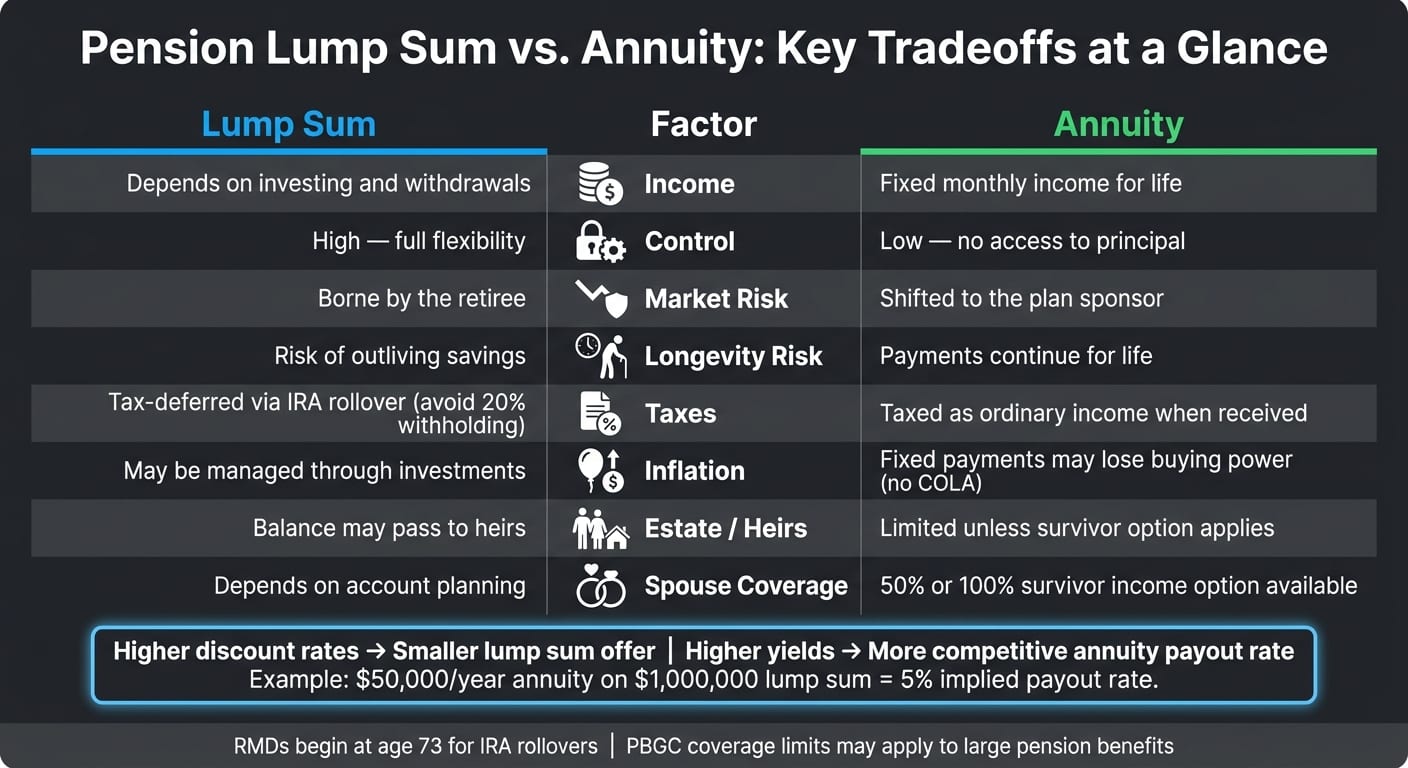
Quick Comparison
The core tradeoff is simple: one option may protect flexibility, while the other may protect lifetime income.
Should I Take My Pension as an Annuity or Lump Sum?
Pension annuity vs. lump sum: what each option gives up and protects
Higher rates may make the tradeoff feel sharper. The annuity is built to protect lifetime income. The lump sum is built to protect flexibility and control. In a higher-rate setting, the payout and the income promise may move in opposite directions.
Each option solves a different problem. The annuity gives up control in exchange for income that may continue for life. The lump sum gives up guaranteed income in exchange for control of the money. So the next step is pretty direct: what does each option protect, and what does it give up?
Annuity: lifetime income, less flexibility
A pension annuity pays a monthly amount for life. Its main appeal may be the income stream. Its main drawback may be reduced control over the asset itself.
You usually don't get access to the principal. And if the annuity doesn't include a COLA, inflation may reduce purchasing power over time. That means the monthly check may stay the same while your costs change around it.
Lump sum: less guaranteed income, more control
A lump sum turns future pension checks into cash today. That may give you more say over how the money is invested, when it is used, and what may be left to heirs.
But that control comes with tradeoffs. The balance may rise or fall with markets. Withdrawals may need care over time. And there may be a risk that the money doesn't last through retirement.
The right mix may depend on income needs, risk tolerance, and how much guaranteed income you already have.
Once the basic tradeoff is clear, the next step is to test taxes, inflation, survivor needs, and rollover rules.
What a higher-rate environment changes in the math
The tradeoff may come into focus once you look at the payout math. Higher rates may change pension math, not just market returns.
Why higher discount rates usually mean a smaller lump sum
A higher discount rate lowers the present value of future pension checks, which usually reduces the lump-sum offer.
Why annuity income can look more competitive when yields are higher
There’s another side to this. When yields are higher, the annuity’s implied payout rate may look more competitive.
One simple way to compare the two is the implied payout rate: annual annuity income divided by the lump-sum offer. If the annuity pays $50,000 per year on a $1,000,000 lump sum, the implied payout rate is 5%. That may make annuity income look more appealing, but mainly for retirees who place more weight on guaranteed cash flow than on flexibility.
Those numbers may matter in different ways depending on how much income you need and how much flexibility you want.
3 hypothetical retiree scenarios with different income needs
A few examples make the tradeoff easier to picture:
- A retiree with little outside savings may favor the annuity for a larger income floor.
- A retiree with substantial investments may favor the lump sum for flexibility and legacy value.
- A couple that needs survivor income may prefer the annuity if the pension includes that option.
Next, weigh taxes, inflation, survivor needs, and rollover rules before you make the election.
Decision checklist: taxes, inflation, survivor needs, and rollover options
Higher rates may change the payout math. But price isn't the whole story. These other factors may still shape the decision.
Income floor, life expectancy, and inflation risk
If Social Security alone may not cover your basic expenses, a guaranteed annuity payment may fill part of that gap. For people who expect a long retirement, that guarantee may matter more over time.
Inflation adds a wrinkle. If your plan has no COLA, each payment may buy less later on. In that case, a lump sum invested for growth may offset some inflation risk.
Taxes, IRA rollover rules, and withdrawal flexibility
Taxes may tilt the choice more than people expect.
Annuity payments are taxed as ordinary income in the year you receive them. That may leave less room to manage your tax bracket from one year to the next. A direct rollover to a traditional IRA keeps the money tax-deferred and may give you more control over withdrawals, Roth conversions, and charitable gifts.
If you take cash instead of using a direct rollover, the plan withholds 20% for federal taxes, and you may owe more when you file. IRA balances are also subject to required minimum distributions (RMDs) starting at age 73, while annuity payments are already built into the payment stream.
Then there’s flexibility. Some households may want a fixed paycheck. Others may want more room to adjust withdrawals as life changes.
Spouse protection, heirs, and plan-strength questions
If a spouse depends on the income, the annuity’s joint-and-survivor option may deserve a close look. You can usually elect a benefit that continues at 50% or 100% of your payment after your death. A single-life annuity ends at your death. A lump sum rolled to an IRA may pass to a spouse or other heirs.
It also may make sense to check the annual funding notice and PBGC coverage limits. Benefits above the limit may not be fully guaranteed.
After that, compare the election across all accounts, not in isolation.
How to compare after-tax outcomes across all accounts with Mezzi
Once you know the pension rules, the next step may be to compare each election across your full household balance sheet. A pension choice may not sit on its own. Your 401(k), traditional IRA, Roth accounts, and taxable brokerage holdings may all shape the outcome.
Use a full household view
Looking at the pension by itself may miss a big part of the picture. For example, your other assets may already cover much of your income floor. Mezzi connects your 401(k)s, traditional IRAs, Roth accounts, and taxable brokerage accounts through read-only Plaid and Finicity access. That broader view may matter even more when higher rates change the lump-sum offer and the value of guaranteed income.
The main question may be how each option affects taxes, withdrawal timing, and flexibility across your accounts. Mezzi shows the after-tax tradeoff across taxable, traditional, and Roth accounts, along with the estate and inflation impact, when higher rates change the value of the lump-sum offer.
FAQs
How do higher interest rates change my pension lump-sum offer?
Higher interest rates may reduce a pension lump-sum offer.
Here’s the basic idea: pension plans use a discount rate to estimate the present value of future monthly payments. That rate often has some link to current interest rates.
When interest rates rise, the discount rate may rise too. And when that happens, the lump sum offered today may be lower.
That may make the lump sum look less appealing at first glance. But the tradeoff may shift at the same time, because a lump sum may be invested when rates are higher.
When does an annuity make more sense than a lump sum?
An annuity may make more sense when your main goal is reliable lifetime income and lowering the chance that you outlive your savings.
It may also fit if you're in good health, expect a long retirement, or want to cover basic living costs with steady income that may not change with market swings. Consolidated financial tools may help you compare those tradeoffs against your income needs.
What tax mistakes should I avoid with a pension payout?
The biggest mistake may be not using a direct rollover when moving a pension lump sum into an IRA or an employer-qualified plan.
Here’s why that matters: if the payout goes straight to you, the plan administrator generally must withhold 20% for federal taxes. That distribution may also increase your taxable income for the year, which may place you in a higher tax bracket.
There’s another issue if you’re under 59½. If the funds aren’t rolled over, you may also owe a 10% early withdrawal penalty.
And timing gets tight fast. If you receive the money yourself, you may have only 60 days to roll over the full amount.
Disclosures:
- This content is for informational purposes only and does not constitute investment advice or a recommendation to buy or sell any security.
- Past performance is not indicative of future results. No guarantee of future performance or outcomes is implied.
- Savings and performance examples are hypothetical and for illustrative purposes only. Actual results will vary based on individual circumstances, portfolio composition, market conditions, and fees.
Related Blog Posts
- What portfolio value and withdrawal strategy would generate a specific monthly after-tax income?
- Why Dollar-Cost Averaging Beats Lump Sum Investing (And When It Doesn't)
- Should I Take My Pension as a Lump Sum or Monthly Payments?
- Bucket Strategy vs. Total-Return: Which Decumulation Model Actually Wins
Higher interest rates may reduce a pension lump-sum offer.
Here’s the basic idea: pension plans use a discount rate to estimate the present value of future monthly payments. That rate often has some link to current interest rates.
When interest rates rise, the discount rate may rise too. And when that happens, the lump sum offered today may be lower.
That may make the lump sum look less appealing at first glance. But the tradeoff may shift at the same time, because a lump sum may be invested when rates are higher.
An annuity may make more sense when your main goal is reliable lifetime income and lowering the chance that you outlive your savings.
It may also fit if you're in good health, expect a long retirement, or want to cover basic living costs with steady income that may not change with market swings. Consolidated financial tools may help you compare those tradeoffs against your income needs.
The biggest mistake may be not using a direct rollover when moving a pension lump sum into an IRA or an employer-qualified plan.
Here’s why that matters: if the payout goes straight to you, the plan administrator generally must withhold 20% for federal taxes. That distribution may also increase your taxable income for the year, which may place you in a higher tax bracket.
There’s another issue if you’re under 59½. If the funds aren’t rolled over, you may also owe a 10% early withdrawal penalty.
And timing gets tight fast. If you receive the money yourself, you may have only 60 days to roll over the full amount.