Roth IRA conversions can help you save on taxes long-term, but timing and planning are key. By moving funds from pre-tax accounts like a Traditional IRA or 401(k) to a Roth IRA, you pay taxes upfront, but enjoy tax-free growth and no required minimum distributions (RMDs). However, converting too much can push you into higher tax brackets, increase Medicare premiums, or make more of your Social Security taxable.
Key Takeaways:
- Tax Brackets Matter: Convert up to the limit of your current tax bracket to avoid higher tax rates.
- 2026 Standard Deduction: $16,100 (single) or $32,200 (married filing jointly), plus $6,000 extra per person if 65+.
- Medicare Premiums (IRMAA): Avoid surcharges by staying under income thresholds ($109,000 for singles, $218,000 for couples in 2026).
- Social Security Impact: Conversions can increase the taxable portion of your benefits.
- Market Timing: Converting during market downturns can reduce upfront taxes.
To maximize benefits, plan conversions during lower-income years, pay taxes with outside funds, and use tools like Mezzi to calculate the ideal conversion amount.
Watch This Before You Do A Roth Conversion
Roth Conversions vs. Roth Contributions
Understanding how Roth conversions differ from Roth contributions is crucial for crafting a strong retirement strategy. Both methods move money into a Roth IRA, but they operate differently and suit distinct financial goals. Let’s break down these two approaches to help you decide which aligns better with your retirement plan.
What is a Roth Conversion?
A Roth conversion involves transferring pre-tax balances from accounts like a Traditional IRA or 401(k) into a Roth IRA. When you do this, the converted amount is treated as taxable income for that year. However, once the funds are in the Roth IRA, they grow tax-free moving forward. To complete a conversion, it must be finalized by December 31 of the given tax year.
One standout feature of conversions is their lack of income or dollar limits. This makes them especially appealing to high-income earners who are ineligible for direct Roth contributions due to income restrictions.
"A Roth IRA conversion is not just a tax transaction. It is a strategic decision that requires thoughtful planning, valuation awareness, income forecasting, and precise coordination with the tax code." – Adam Bergman, Tax Attorney and Founder, IRA Financial
A key detail to note is that conversions must be completed by the end of the calendar year - you can’t wait until the April tax filing deadline.
2026 Roth IRA Contribution Limits and Income Caps
Direct Roth contributions, on the other hand, have strict annual limits and income restrictions. These contributions must come from after-tax earned income, and the IRS sets clear boundaries on how much you can contribute each year.
For 2026, the standard contribution limit is $7,500. If you’re 50 or older, you can add a $1,100 catch-up contribution, increasing your total to $8,600.
Income caps further restrict who can make direct contributions. Here’s how the limits break down:
If your income exceeds these thresholds, direct Roth contributions are off the table. However, you can still take advantage of Roth conversions, which allow unlimited transfers from pre-tax accounts. This is why many high earners turn to the "Backdoor Roth" strategy: they contribute non-deductible funds to a Traditional IRA and then convert those funds into a Roth IRA.
The main distinction lies in flexibility. Contributions are capped and restricted by income, while conversions are open to everyone and have no limits - but you’ll owe taxes on the converted amount. Understanding the Roth vs. Traditional IRA tax implications can help you optimize your retirement strategy for tax efficiency and long-term growth. Tools like Mezzi can help streamline this planning process.
How to Calculate Your Roth Conversion Amount
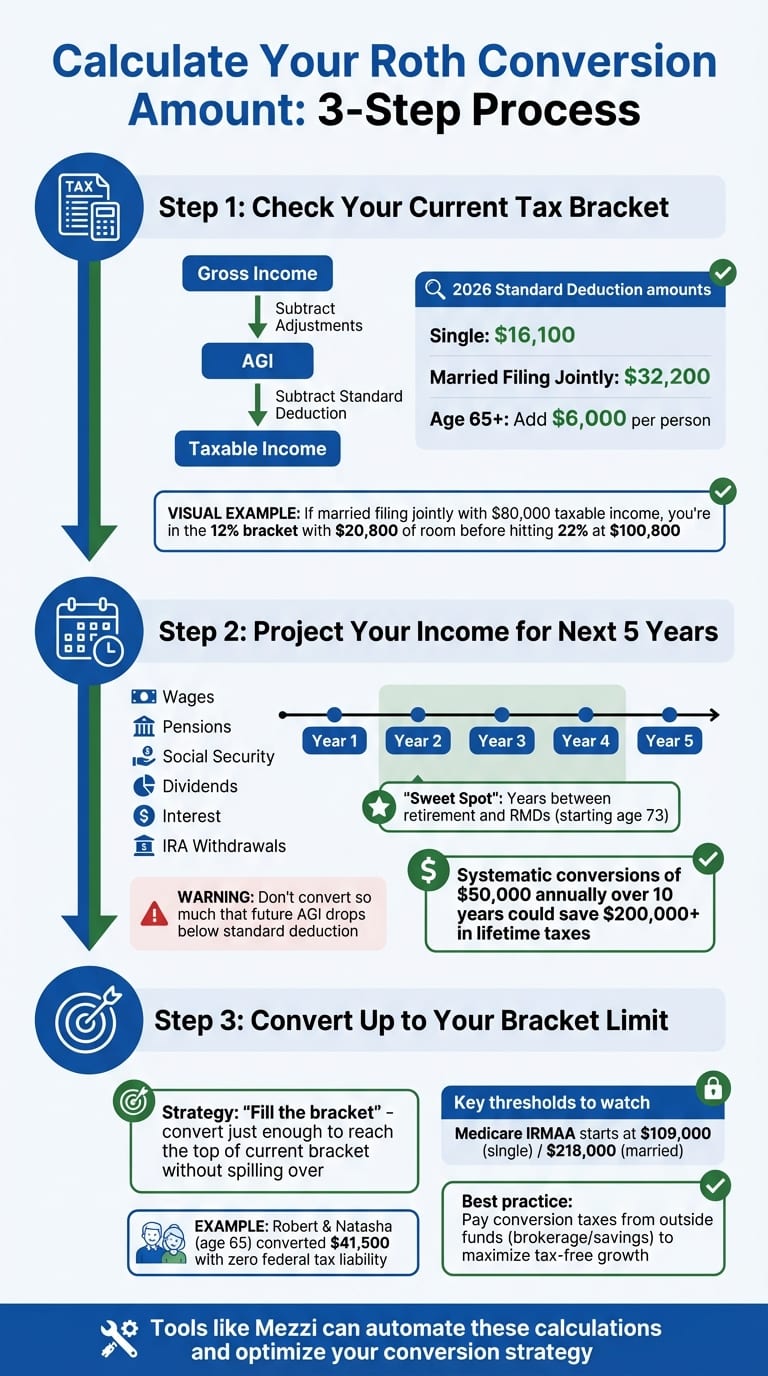
Figuring out how much to convert to a Roth IRA might sound tricky, but it’s actually a step-by-step process. The goal? Move as much as you can from your Traditional IRA to a Roth IRA while keeping taxes and other financial surprises, like Medicare surcharges, in check. Let’s break it down.
Check Your Current Tax Bracket
Start by identifying your 2026 tax bracket. The U.S. tax system is progressive, meaning only the income within each bracket is taxed at that rate - not your entire income.
To figure out your taxable income:
- Start with your gross income.
- Subtract any above-the-line adjustments to calculate your Adjusted Gross Income (AGI).
- Then, subtract the standard deduction.
For 2026, the standard deduction is set at $16,100 for single filers and $32,200 for married couples filing jointly. If you’re 65 or older, you can claim an extra $6,000 deduction per person (or $12,000 for married couples), giving you even more room for conversions.
"Financial advisers who help clients with Roth-conversion strategies typically look at the person's current income and see where they are in that particular tax bracket. Then they see if there's 'room' to get right up to the edge of the next tax bracket - without going over." – Beth Pinsker, Financial Columnist
Here’s a quick look at the 2026 tax brackets to help you find your "bracket room" - the gap between your taxable income and the top of your current bracket:
For example, if you’re married filing jointly with $80,000 in taxable income, you’re in the 12% bracket. You’d have $20,800 of room before hitting the 22% bracket at $100,800. That’s your conversion target zone.
Project Your Income for the Next 5 Years
The best time to consider Roth conversions is often during those "quiet" years - after retirement but before Social Security or Required Minimum Distributions (RMDs) kick in. To spot these opportunities, map out your income sources - like wages, pensions, Social Security, dividends, interest, and IRA withdrawals - and look for lower-income years.
"RMDs are a common bracket-buster - forcing you to take taxable income from your IRAs or 401(k)s even if you don't need it, often bumping people into higher brackets." – Patrick Huey, CFP and Owner, Victory Independent Planning
RMDs start at age 73 (rising to 75 after 2033), so if you’re nearing that age, factor in how these mandatory withdrawals might push you into higher tax brackets later. A systematic conversion - like $50,000 annually over 10 years - can help you avoid higher future taxes and RMDs. For some retirees, this approach could save over $200,000 in lifetime taxes.
But don’t convert so much that your future AGI drops below the standard deduction. That could mean missing out on tax-free withdrawals from your Traditional IRA during low-income years. And if charitable giving is part of your plan, leave enough in your Traditional IRA to use Qualified Charitable Distributions (QCDs) starting at 70½. These are tax-free and count toward satisfying your RMDs.
Convert Up to Your Bracket Limit
The trick is to convert just enough to fill your current tax bracket without spilling into the next one. This strategy, often called "filling the bracket", ensures you maximize your Roth conversions while keeping your tax rate steady.
Here’s an example: In October 2025, Robert and Natasha, both 65, converted $41,500 to a Roth IRA with zero federal tax liability by staying within their deduction threshold.
"The high standard deduction in 2026 presents a great opportunity to consider Roth conversions, including those that cause no additional federal income tax." – Cody Garrett, Financial Planner
Be mindful of Medicare premium surcharges. These start at a Modified Adjusted Gross Income (MAGI) of $109,000 for single filers and $218,000 for married couples in 2026. A large conversion that pushes you over these limits could lead to significant premium hikes based on income from two years prior.
Lastly, always pay your conversion taxes from outside funds - like a taxable brokerage or savings account. This way, 100% of your converted money can grow tax-free, and you avoid potential early withdrawal penalties. Tools like Mezzi can help refine these calculations and optimize your strategy.
What Affects Your Roth Conversion Amount
Roth conversions are influenced by more than just tax brackets. Factors like Medicare premiums, Social Security taxation, and market trends can all play a role in shaping your decisions.
Medicare Premiums and IRMAA Thresholds
If you're on Medicare or nearing age 65, Income-Related Monthly Adjustment Amounts (IRMAA) should be on your radar. These surcharges kick in when your Modified Adjusted Gross Income (MAGI) exceeds specific levels, potentially adding thousands to your annual Medicare costs.
Keep in mind that Medicare uses a two-year lookback period. For example, a Roth conversion in 2026 will impact your Medicare premiums in 2028. IRMAA thresholds function like cliffs - exceeding a threshold by even $1 triggers the full surcharge for that bracket.
"Cross one of those income thresholds by even a single dollar, and your premiums jump for the entire year. That's why precision matters." – Mike Thornton, The Multiplier
In 2026, the base Medicare Part B premium is $202.90 per month. However, if your 2024 MAGI exceeded $109,000 as a single filer (or $218,000 for joint filers), you could face additional surcharges ranging from $81.20 to $487.00 per month. For someone in the highest IRMAA bracket, these costs could exceed $6,000 annually.
Married couples face double the expense since each spouse pays the surcharge individually. To avoid surprises, calculate your "headroom" - the gap between your current MAGI and the next IRMAA threshold. Experts recommend keeping $5,000 to $10,000 below the threshold to account for unexpected income, such as dividends or capital gains. If your income drops due to a major life event like retirement or divorce, you can appeal the surcharge using Form SSA-44.
Beyond Medicare, Roth conversions can also affect how much of your Social Security benefits are taxed.
Social Security Taxation
Roth conversions may increase the taxable portion of your Social Security benefits. Social Security taxation is based on "combined income", which includes your AGI, nontaxable interest, and 50% of your Social Security benefits. Depending on your combined income, up to 85% of your benefits could become taxable.
In certain income ranges, every additional $1 of Roth conversion income can cause $0.50 or $0.85 of Social Security benefits to become taxable. This creates a compounding effect, potentially raising the effective tax rate on a $1 conversion to 18% (in the 12% tax bracket) or 40.7% (in the 22% bracket).
"Every dollar of traditional IRA balance you convert to Roth before claiming SS is a dollar that will never generate this compound tax effect." – Benefora
Roth withdrawals, however, don’t count toward combined income, helping you preserve lower Social Security taxation later on. That’s why many experts suggest completing conversions during the "gap years" - the period between retirement and age 73, when Required Minimum Distributions (RMDs) begin.
Market performance is another factor that can impact the timing and benefits of your Roth conversion.
Market Conditions and Account Balances
Market downturns can present prime opportunities for Roth conversions. When your IRA balance declines during a market correction, you can convert the same number of shares but pay taxes on a smaller total dollar amount. Future growth in the Roth account then becomes tax-free. For instance, converting $100,000 worth of shares that were valued at $150,000 the prior year saves you taxes on the $50,000 difference.
The S&P 500® has experienced significant swings over the years, with a 12-month high of 61% (1982-1983) and a 12-month low of -43% (March 2008 to March 2009). If your IRA balance drops by 20-30% during a market crash, consider converting immediately to lock in the lower tax liability. Waiting for a recovery could mean paying higher taxes on the regained value.
How Mezzi Helps You Plan Roth Conversions
Planning a Roth conversion can feel like navigating a maze of tax brackets, IRMAA thresholds, Social Security considerations, and long-term growth forecasts. Mezzi steps in to simplify this process, combining your account data with AI to create tailored conversion scenarios.
AI-Powered Tax Optimization
Mezzi's AI reviews your 2026 marginal tax bracket to estimate the federal tax impact of various conversion amounts. It pinpoints your conversion "sweet spot" while tracking your MAGI to avoid IRMAA surcharges, which start at $103,000 for single filers and $206,000 for married couples filing jointly. The tool also determines your break-even point - when the benefits of tax-free growth outweigh the upfront tax cost - and explores spreading conversions over several years through a Roth conversion ladder.
Since Roth conversions are permanent under the Tax Cuts and Jobs Act of 2017, this type of advance modeling is critical. Mezzi even suggests obtaining a USPAP-compliant fair market value appraisal for alternative assets to ensure IRS compliance. After tackling the tax implications, Mezzi refines your strategy further with a detailed review of your asset allocation.
Portfolio X-Ray for Asset Location After Conversion
Once you've converted to a Roth IRA, Mezzi's Portfolio X-Ray tool steps in to help you allocate assets efficiently across your accounts. This feature provides a unified view of your holdings, eliminating the need for manual tracking and highlighting any overlapping stock exposures.
"Mezzi's X-Ray feature allowed me to uncover exposure to stocks I didn't realize I had." – Shuping, Founder of Summer AI
X-Ray evaluates the tax characteristics of each account and suggests optimal asset placement. For example, high-growth stocks are ideal for Roth IRAs, where they can grow tax-free, while dividend-paying stocks may be better suited for taxable accounts. These strategies could potentially boost annual returns by 1% to 2%, which translates to an extra $10,000–$20,000 annually on a $1M portfolio.
Long-Term Savings Projections
With tax and asset strategies optimized, Mezzi projects the long-term benefits of Roth conversions. It compares the fully tax-free value of a Roth IRA at retirement with the after-tax value of a Traditional IRA. These projections also factor in the absence of required minimum distributions (RMDs), which typically begin at age 73 (or 75 after 2033) for Traditional IRAs but don't apply to Roth IRAs during the owner's lifetime.
Mezzi pinpoints the break-even point when the cumulative tax-free growth of a Roth IRA surpasses the upfront tax cost of conversion. It calculates how many years of compounding are needed to offset the initial tax hit.
"The longer your Roth has to grow tax-free, the more the upfront tax cost is offset by decades of untaxed compounding." – RothIRAConversionCalculator.com
How to Complete Your Roth Conversion
Once you've fine-tuned your conversion strategy with Mezzi, it's time to carry out the steps to complete your Roth conversion.
Conversion Process Steps
After determining the amount you want to convert, the actual process is fairly simple. The funds will move from a Traditional, SEP, or SIMPLE IRA - or even an employer-sponsored plan like a 401(k) - into a Roth IRA. Unlike regular Roth IRA contributions, there are no income limits or yearly caps on how much you can convert.
Here’s how to proceed:
- Make sure both your Traditional and Roth IRAs are active with your custodian.
- Start the conversion through your custodian’s online tools, phone service, or by submitting a signed form.
- Your custodian will directly transfer the specified amount from your Traditional IRA to your Roth IRA.
To maximize growth, use non-retirement funds to cover the tax bill. This ensures the entire converted amount remains in your Roth IRA, growing tax-free. If you’re under 59½, avoid having taxes withheld from the conversion, as this could reduce your Roth balance and trigger a 10% penalty.
For assets like business interests, LLC units, or real estate, you’ll need a Fair Market Value (FMV) appraisal from a qualified independent professional to determine the taxable amount.
Once your conversion is complete, the final step is to handle the tax reporting to stay in line with IRS rules.
IRS Compliance: Form 8606 and Tax Reporting
Your Roth conversion must be reported on Form 8606 when you file your tax return. This form tracks the basis of IRA distributions and ensures that after-tax contributions aren’t taxed again. Your custodian will supply two key forms for this process: Form 1099-R (showing the Traditional IRA distribution) and Form 5498 (confirming the Roth IRA contribution).
If you’ve made non-deductible contributions to your Traditional IRA, Form 8606 will calculate the taxable portion of your conversion using the pro-rata rule. This rule combines the balances of all your Traditional, SEP, and SIMPLE IRAs as of December 31 to determine how much of the conversion is taxable. Be sure to keep your year-end statements for accurate record-keeping.
Conversions are irreversible. Under the Tax Cuts and Jobs Act of 2017, once you complete a conversion, it cannot be undone. The converted amount is added to your taxable income for the year and taxed at your federal and state marginal rates.
"The IRS may treat the entire conversion as taxable if Form 8606 is missing." – TaxSpecialty
While Mezzi can help you understand conversion amounts and tax implications, it doesn’t handle tax filings. If you’ve missed filing Form 8606 in the past, consult a tax professional. In many cases, you can submit the form late or include it in an amended return to avoid having the entire conversion taxed.
Conclusion: Plan Your Roth Conversions Carefully
Roth conversions can offer tax-free growth when handled thoughtfully. But overdoing it can lead to higher taxes, Medicare surcharges, and increased Social Security taxation. A carefully designed "Roth conversion ladder", spread out over several years, can help retirees save over $100,000 in lifetime taxes.
The benefits can be substantial when approached with a clear strategy.
"Converting $50,000 annually could save you $285,237 in retirement taxes - that's 21.1x your conversion tax cost!" – The Money Pocket
To maximize the advantages, aim to fill your current tax bracket without exceeding it, and pay conversion taxes using non-retirement funds. Align your conversions with your broader financial plan, factoring in Required Minimum Distributions (RMDs), Medicare rules, and market conditions to avoid surprise tax hits. For instance, converting $55,000 annually between ages 60 and 67 could eliminate future RMDs of $28,000+ per year from a $500,000 Traditional IRA.
To make this process easier, Mezzi's AI-powered platform streamlines the planning by linking tax planning with investment tools to analyze your current tax bracket, forecasting future income, and identifying the ideal conversion amount each year. Its Portfolio X-Ray tool ensures your asset allocation stays tax-efficient after conversions, while long-term projections highlight potential savings across your retirement. Whether it's 1 a.m. or midday, Mezzi can provide tailored insights based on your connected accounts, offering a seamless way to implement the detailed strategies discussed above.
FAQs
How do I decide if a Roth conversion is worth it for me?
To figure out if a Roth conversion makes sense for you, start by examining your current income, tax bracket, and long-term financial objectives. Since conversions trigger taxes, it’s important to decide if paying those taxes now fits with your overall plan. Think about where your income and tax rates might be in the future - if you believe taxes will rise, converting now could help you save in the long run. You can also use tools like online calculators to figure out how much to convert without pushing yourself into a higher tax bracket.
How can I avoid Medicare IRMAA surcharges when converting?
If you're considering Roth conversions, it's crucial to plan carefully to avoid triggering Medicare IRMAA (Income-Related Monthly Adjustment Amount) surcharges. These surcharges are tied to your modified adjusted gross income (MAGI) from two years prior. That means a large conversion today could lead to higher Medicare premiums down the road.
Here are a few strategies to help you manage this:
- Spread conversions over multiple years: Instead of doing one large conversion, break it into smaller amounts across several years to keep your MAGI below key thresholds.
- Time conversions during lower-income years: For example, the years between retiring and starting Social Security - often called "retirement gap years" - can be ideal for conversions.
- Monitor MAGI thresholds: Keep a close eye on the income limits that trigger IRMAA surcharges. Staying just under these thresholds can save you from additional premiums.
With thoughtful planning, you can work toward minimizing or even avoiding these extra Medicare costs.
What’s the smartest way to spread conversions over multiple years?
The best strategy is to convert amounts that ensure your income stays within your existing tax bracket each year. This helps you avoid higher tax rates and limits potential increases in Medicare premiums and Social Security taxes.
By spacing out conversions over multiple years - particularly during lower-income "gap years" - you can reduce your tax burden while boosting long-term growth potential. Paying taxes with funds outside of your Roth IRA also allows you to keep more money in the account, enabling it to grow tax-free.
Disclosures:
- This content is for informational purposes only and does not constitute investment advice or a recommendation to buy or sell any security.
- Past performance is not indicative of future results. No guarantee of future performance or outcomes is implied.
- Savings and performance examples are hypothetical and for illustrative purposes only. Actual results will vary based on individual circumstances, portfolio composition, market conditions, and fees.
- Registration does not imply a certain level of skill or that the SEC has approved the company or its services.
Related Blog Posts
- Why should I avoid pushing into a higher tax bracket when doing Roth conversions?
- Roth Conversion Before Tax Day: Deadline, Rules, and Calculator
- Should I Do a Roth Conversion in a Low-Income Year?
- How to do a Roth conversion without triggering IRMAA
To figure out if a Roth conversion makes sense for you, start by examining your current income, tax bracket, and long-term financial objectives. Since conversions trigger taxes, it’s important to decide if paying those taxes now fits with your overall plan. Think about where your income and tax rates might be in the future - if you believe taxes will rise, converting now could help you save in the long run. You can also use tools like online calculators to figure out how much to convert without pushing yourself into a higher tax bracket.
If you're considering Roth conversions, it's crucial to plan carefully to avoid triggering Medicare IRMAA (Income-Related Monthly Adjustment Amount) surcharges. These surcharges are tied to your modified adjusted gross income (MAGI) from two years prior. That means a large conversion today could lead to higher Medicare premiums down the road.
Here are a few strategies to help you manage this:
- Spread conversions over multiple years: Instead of doing one large conversion, break it into smaller amounts across several years to keep your MAGI below key thresholds.
- Time conversions during lower-income years: For example, the years between retiring and starting Social Security - often called "retirement gap years" - can be ideal for conversions.
- Monitor MAGI thresholds: Keep a close eye on the income limits that trigger IRMAA surcharges. Staying just under these thresholds can save you from additional premiums.
With thoughtful planning, you can work toward minimizing or even avoiding these extra Medicare costs.
The best strategy is to convert amounts that ensure your income stays within your existing tax bracket each year. This helps you avoid higher tax rates and limits potential increases in Medicare premiums and Social Security taxes.
By spacing out conversions over multiple years - particularly during lower-income "gap years" - you can reduce your tax burden while boosting long-term growth potential. Paying taxes with funds outside of your Roth IRA also allows you to keep more money in the account, enabling it to grow tax-free.