
If you’re age 65 or older, 2026 may bring a new federal tax deduction worth up to $6,000 per person - but income may trim it or wipe it out.
Here’s the short version: OBBBA added a temporary above-the-line Senior Deduction for 2025 through 2028. In 2026, a single filer age 65+ may claim up to $6,000, and a married couple filing jointly may claim up to $12,000 if both spouses qualify. The deduction may stack on top of the standard deduction and the extra age-65 standard deduction amount. But it may start phasing out once MAGI goes above $75,000 for single filers and $150,000 for joint filers.
That means your 2026 tax picture may depend less on whether the deduction exists and more on how much of it you may keep.
- Best-case amount: $6,000 single / $12,000 joint
- Who may qualify: Taxpayers who turn 65 by December 31, 2026 and meet SSN rules
- Phaseout starts at: $75,000 single / $150,000 joint MAGI
- Phaseout ends at: $175,000 single / $250,000 joint MAGI
- Still unchanged: Social Security tax formulas and RMD rules
- Other 2026 OBBBA items: charity deduction for non-itemizers, car-loan interest deduction, and a stricter gambling-loss rule
A few income sources may make the biggest difference: IRA withdrawals, Roth conversions, capital gains, dividends, and taxable Social Security. So for many retirees, the main issue may be timing.
Quick Comparison
So if you’re trying to estimate your 2026 tax bill, the headline may be simple: the new senior deduction may lower income on paper, but MAGI may decide how much you actually get.
Seniors: Cut Your Tax Bill by Up to $46,700 Using These 3 Deductions
How the 2026 senior deduction works
For 2026, each qualifying taxpayer age 65 or older may claim a $6,000 deduction. Married couples filing jointly may claim $12,000 if both spouses qualify. If only one spouse qualifies, the couple may claim only that spouse’s $6,000 deduction. You claim it on your return, and it may lower AGI before other deductions apply.
For many retirees, the main question may be how much of that deduction remains after the phaseout, especially once IRA withdrawals, Social Security, and other income are included.
The table below shows how the new deduction stacks with the regular standard deduction and the existing age-65 add-ons.
Regular standard deduction and existing additional standard deduction amounts are subject to annual inflation adjustments [[4]](https://meridianpioneer.com/what-is-the-one-big-beautiful-bill/)\[*\[5\]*\](https://financeband.com/how-does-the-additional-deduction-for-seniors-work).
Who qualifies: age, filing status, and ID requirements
To claim the deduction for the 2026 tax year, you must turn 65 on or before December 31, 2026. You also need a Social Security number (SSN). For married couples filing jointly, each spouse must separately meet the age and SSN rules to claim that spouse’s deduction.
How the new deduction stacks with the existing senior standard deduction
The new deduction adds to the existing age-65 standard deduction. It does not replace it. In plain English: the deductions stack.
The actual tax effect may still depend on MAGI and the phaseout range, which the next section covers.
Income limits and phaseouts that affect your actual benefit
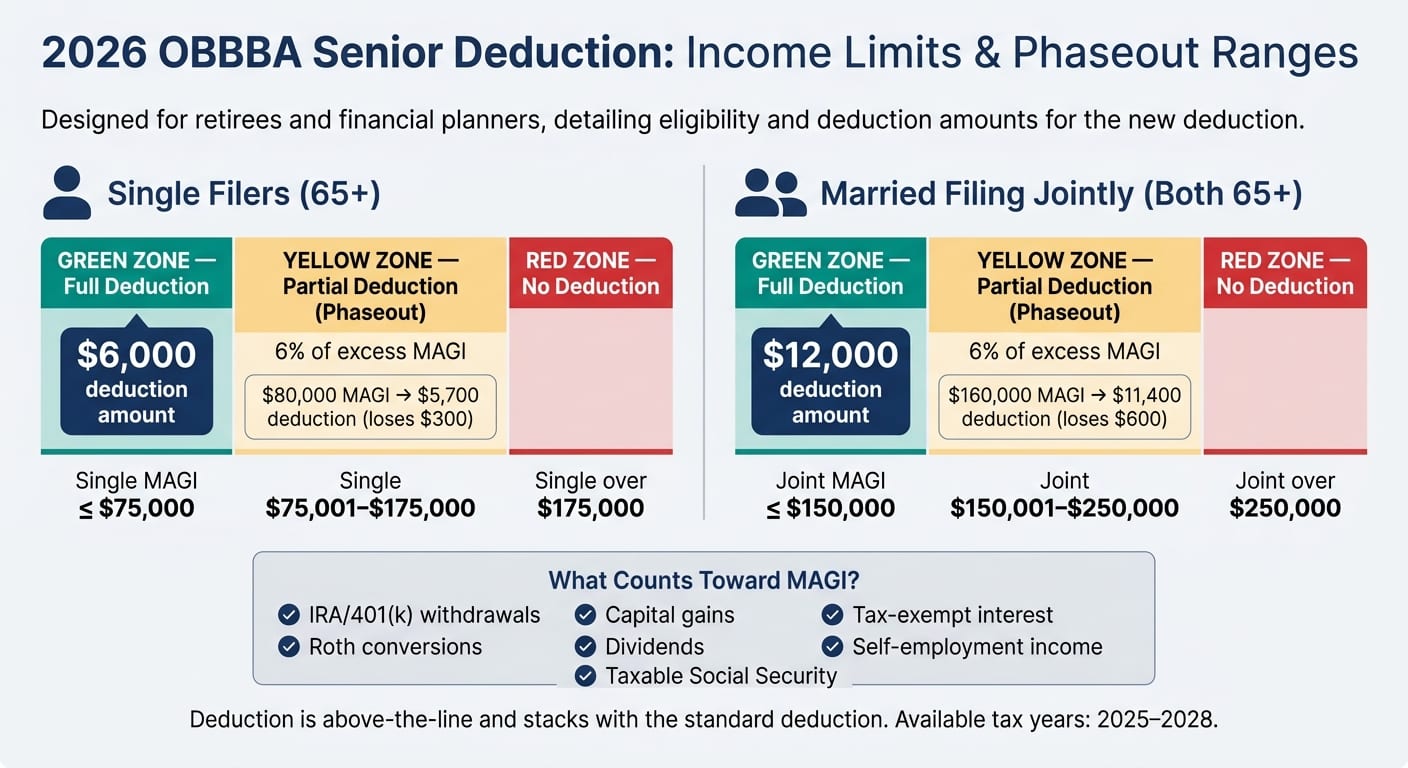
Age and filing status may get you in the door. But MAGI may still cut the deduction.
Even seniors who qualify may lose part, or all, of the $6,000 deduction. For married couples filing jointly, that amount may be $12,000. Once MAGI goes above $75,000 for single filers and $150,000 for joint filers, the deduction phases out by 6% of the excess income.
Here’s what that may look like in practice:
- A single filer with $80,000 of MAGI may lose $300 of the deduction, leaving $5,700.
- A joint filer with $160,000 of MAGI may lose $600, leaving $11,400.
The deduction is fully phased out at $175,000 for single filers and $250,000 for joint filers.
What counts toward MAGI for retirees
For retirees, MAGI generally starts with AGI, then adds back a few items. Income sources that may reduce the deduction, or wipe it out, include traditional IRA and 401(k) withdrawals, taxable interest, dividends, realized capital gains, self-employment income, and tax-exempt interest.
Social Security may also matter here. If part of your benefit becomes taxable, that amount may increase AGI, which may then affect MAGI too.
Why income timing matters across 2025 through 2028
The timing of income may shape how much of the deduction you keep. A Roth conversion, IRA withdrawal, or capital gain in one year instead of another may change where you land relative to the MAGI thresholds.
Because of that, some retirees may spread those moves across 2025–2028 to stay under the phaseout ranges in more than one tax year. For a single retiree in the 22% bracket, the full $6,000 deduction may be worth about $1,254 in tax savings. That may be enough to make timing part of the discussion.
These rules may hit retirees in different ways depending on where their income comes from. Here’s how that may look for a few common retiree profiles.
Other OBBBA provisions retirees should know about in 2026
Beyond the senior deduction, 2026 brings a few smaller retiree tax changes that may still affect your return. These are the other 2026 rules that may change a retiree's tax bill.
For non-itemizers, the changes that may stand out most are the new charitable deduction and the auto-loan interest deduction.
What did not change: Social Security taxation and RMD rules
OBBBA did not change the rules for taxing Social Security benefits. The combined income formula - AGI plus nontaxable interest plus half your Social Security benefit - still determines whether 0%, 50%, or 85% of your benefits are taxable.
The senior deduction may lower AGI, but it does not change Social Security's combined-income formula or RMD timing. Core RMD rules also remain the same.
The gambling-loss rule may work against retirees with wagering income. Starting in 2026, only 90% of wagering losses are deductible, and the deduction is still capped at the amount of winnings. That may increase AGI, which may in turn make more Social Security benefits taxable and may lead to higher Medicare premiums.
Where OBBBA still creates planning opportunities
These smaller changes may still matter because they may shift bracket space, Roth conversion room, and withdrawal timing. For example, a retiree near a bracket threshold may have more room to take a larger IRA withdrawal or realize a capital gain without moving into a higher bracket. Because the senior deduction expires after 2028, the 2026–2028 tax years may be a limited window to use it.
In plain English, this may give some retirees a bit more breathing room. The tax code didn't get rewritten from top to bottom, but a few lines moved - and those lines may affect how income shows up on a return.
Next, these rules become more useful when you map them to real retiree income patterns.
How the rules play out for 3 common retiree profiles
The senior deduction may land very differently depending on where retirement income comes from, not just how much shows up on the return.
Social Security households with modest additional income
Consider a married couple, both 68, with $28,000 in Social Security benefits plus a $12,000 pension. Their income may stay well below the $150,000 joint threshold, so they may receive the full $12,000 senior deduction. Added to the $32,200 standard deduction and the additional senior standard deduction of about $1,600 per spouse, that may push taxable income quite low.
For some modest-income retirees, the full deduction may also keep more Social Security benefits untaxed.
The main thing to watch here is simple: part-time wages and interest may push MAGI into the phaseout range.
Retirees drawing from traditional IRAs and 401(k)s
Now take a single 70-year-old with $80,000 in MAGI, mostly from IRA withdrawals and a small pension. MAGI is $5,000 above the $75,000 single threshold, so the $6,000 deduction may be reduced by $300 ($5,000 × 6%), leaving a $5,700 deduction. At a 22% bracket, that may mean $1,254 in tax savings.
This is where RMDs often enter the picture. They may raise MAGI fast, especially when paired with other income. A QCD may satisfy an RMD without increasing MAGI, which may help preserve the deduction.
Higher-income retirees with large portfolio or business income
As income rises, the deduction may disappear faster. At that point, timing may become one of the main moving parts.
Say a married couple has $260,000 in MAGI from dividends, rental income, and Roth conversions. In that case, the senior deduction may be fully phased out. Their MAGI is above the $250,000 joint cutoff, so the $12,000 deduction may be gone.
That doesn't mean OBBBA stops mattering for this group. Some retirees may size Roth conversions more carefully to keep future MAGI lower in years when the deduction may still apply. Tax-loss harvesting may also offset capital gains and keep income lower overall. And even if the senior deduction is out of reach, MAGI may still matter for Medicare surcharges.
These examples point to the documents and year-end decisions to review next.
What to review now and how Mezzi can help
After the examples above, the next step may be a year-end review of income, receipts, and account timing. If you're eligible, the senior deduction must be claimed on your return. Here are the main items to review:
- IRA and 401(k) withdrawals and RMDs - these may push MAGI above the $75,000 single or $150,000 joint threshold
- Capital gains and Roth conversions - both count toward MAGI and may reduce the deduction
- Donation receipts - if you plan to claim the non-itemizer charitable deduction, keep records for cash, check, or credit card contributions made in 2026
A Roth conversion during a lower-income year may reduce future RMDs, and tax-loss harvesting may offset capital gains to keep MAGI closer to the threshold across 2025–2028
Mezzi is designed to help with that planning by connecting your accounts - IRA, 401(k), brokerage, and Roth - through read-only access and showing how each account may affect your MAGI. It also points out tax-loss harvesting candidates throughout the year, flags wash-sale risk across accounts, and lets you model how different withdrawal amounts or Roth conversion sizes may affect your position relative to the OBBBA thresholds.
Mezzi doesn't execute trades or move money. It surfaces the information, and you decide what to do with it.
FAQs
How do I figure out my MAGI for the senior deduction?
Start with your adjusted gross income (AGI) from your federal tax return. Then add back any tax-exempt interest, like interest from municipal bonds.
For this deduction, AGI is figured before the standard deduction. A rough estimate may include the total of your wages, pensions, annuities, taxable Social Security, dividends, capital gains, and distributions from retirement accounts.
Can a Roth conversion reduce or eliminate my senior deduction?
Yes. A Roth conversion may reduce or even wipe out your senior deduction because the converted amount may increase your modified adjusted gross income (MAGI).
Under OBBBA, the deduction may begin to phase out once MAGI goes above $75,000 for single filers and $150,000 for married couples filing jointly. A larger conversion that pushes MAGI closer to $175,000 or $250,000 may reduce the deduction and, at some point, may eliminate it.
What records should I keep to claim the 2026 retiree deductions?
You may not need special records or extra forms to claim the 2026 senior deduction under OBBBA. It may be calculated automatically on your federal tax return based on your date of birth and reported income.
You may just need your usual tax documents, such as income statements and records related to your adjusted gross income, so the calculation may be accurate.
Disclosures:
- This content is for informational purposes only and does not constitute investment advice or a recommendation to buy or sell any security.
- Past performance is not indicative of future results. No guarantee of future performance or outcomes is implied.
Related Blog Posts
- 7 Tax-Saving Strategies for High-Income Earners in 2025
- The SALT Cap Jumped to $40K - Then the Phaseout Claws It Back
- The RMD Tax Bomb: Why Your 70s Could Be Your Highest-Tax Decade
- The Retirement Tax Torpedo: How Provisional Income Taxes Your Social Security
Start with your adjusted gross income (AGI) from your federal tax return. Then add back any tax-exempt interest, like interest from municipal bonds.
For this deduction, AGI is figured before the standard deduction. A rough estimate may include the total of your wages, pensions, annuities, taxable Social Security, dividends, capital gains, and distributions from retirement accounts.
Yes. A Roth conversion may reduce or even wipe out your senior deduction because the converted amount may increase your modified adjusted gross income (MAGI).
Under OBBBA, the deduction may begin to phase out once MAGI goes above $75,000 for single filers and $150,000 for married couples filing jointly. A larger conversion that pushes MAGI closer to $175,000 or $250,000 may reduce the deduction and, at some point, may eliminate it.
You may not need special records or extra forms to claim the 2026 senior deduction under OBBBA. It may be calculated automatically on your federal tax return based on your date of birth and reported income.
You may just need your usual tax documents, such as income statements and records related to your adjusted gross income, so the calculation may be accurate.