
A big sale may trigger NIIT faster than many people expect. In 2026, the 3.8% surtax may apply when your MAGI goes above $200,000 if you file single or head of household, $250,000 if you file married filing jointly, or $125,000 if you file married filing separately.
Here’s the short version: I’d look at two numbers first - your modified adjusted gross income (MAGI) and your net investment income (NII). In a liquidity year, a stock sale, IPO sale, business sale, real estate gain, or post-vest RSU sale may push both numbers up in the same tax year. That mix may expose part of the gain to the 3.8% NIIT.
If I wanted the article in one quick list, it would be this:
- Map the event before selling. Split wages from investment income.
- Check the tax date. For example, stock sales often use trade date, RSUs use vest date, and business or real estate deals often use closing date.
- Run a simple forecast. Include salary, bonus, RSU income, gains, losses, dividends, interest, rental income, loss carryforwards, and charitable gifts.
- Test timing. Some people split sales between December and January when timing is under their control.
- Use offsets. Tax-loss harvesting and specific-lot selection may trim taxable gains.
- Consider gifting appreciated shares. A charity gift or donor-advised fund contribution may remove built-in gain from the return.
- Watch portfolio income. Dividends, interest, REIT payouts, and fund distributions may still add to NII later in the year.
- Track everything in one place. A cross-account view may make wash sale issues and threshold risk easier to spot.
A few details matter here. RSU vesting may increase MAGI but may not count as NII by itself. A later sale at a gain may count as NII. A business sale may have both ordinary-income and capital-gain pieces, and only the capital side may feed NIIT. A real estate sale may also land differently depending on the facts.
How to Avoid the Net Investment Income Tax (NIIT)
Quick comparison
The core idea is simple: a liquidity year may become a NIIT year if income and gains hit together. I’d treat this article as a short playbook for spotting that line early, testing timing, and keeping an eye on totals through December 31, 2026.
Step 1: Map the Transaction Before You Sell
Start by splitting compensation from investment income. That gives you a cleaner view of what may increase MAGI and what may also count as NII. From there, you may get a better sense of trade size before the transaction settles.
Separate Wage Income from Investment Income
MAGI may include wages, bonuses, RSUs, gains, dividends, and interest. NII refers to the income that the NIIT may apply to.
RSU vesting adds compensation to MAGI. If you sell later at a gain, that gain may also count as NII. A business sale may include both ordinary-income and capital-gain pieces. Payments tied to a non-compete agreement or inventory are ordinary income, while goodwill and other capital assets may create capital gain. Only the capital-gain portion feeds into net investment income.
Build a Simple Pre-Trade NIIT Forecast
Before you trade, it may help to run through a short set of inputs:
- Base salary and bonus
- RSU vesting income
- Realized gains and losses already booked year-to-date
- Estimated sale gain
- Dividends, interest, and rental income
- Prior-year capital loss carryforwards
- Charitable gifts, including appreciated stock or a DAF contribution
If a transaction may move from late December into early January, model both tax years. In some cases, splitting the gain across years may help keep income below the threshold.
A Transaction-Risk Table for Common Liquidity Events
The table below shows which events may affect MAGI, NII, or both. It may also help frame whether a sale is better handled now, split across tax years, or offset before year-end.
Use the controlling tax date for each event:
- Trade date for stock
- Vest date for RSUs
- Closing date for business and real estate sales
Once you know what counts and when it counts, timing decisions may become easier, and offsets may be easier to test before year-end.
Step 2: Use the Main Levers to Stay Under the NIIT Threshold
Use the forecast to pick the lever that may trim gains, lower MAGI, or both. Start with timing. For a known liquidity event, timing may be the cleanest lever.
Spread Sales Across Tax Years When the Math Supports It
If projected MAGI may land near the threshold, some people split a sale between December and January so each tax year may stay under the line. This setup may work best when you control the sale date, like with publicly traded stock. It may be tougher when timing is locked in by a business sale, though installment sales may sometimes spread gains across tax years.
Offset Gains with Losses and Specific-Lot Selection
Tax-loss harvesting may directly reduce capital gains that count as net investment income. Specific-lot selection may give you more control because it lets you choose the shares with the highest cost basis first, which may reduce the gain you realize. One watchout: repurchasing the same exposure inside the wash-sale window may limit the tax result. Some investors use lot selection and harvested losses to cut realized gains.
Use Charitable Giving to Remove Appreciated Gains from Your Return
Donating appreciated shares directly to charity or funding a donor-advised fund may remove the gain from taxable income and may avoid capital gains tax on the donated shares. Appreciated shares may also generate a charitable deduction. And a donor-advised fund may fit well in a high-income year if someone wants to front-load giving.
Once you've used these levers, keep watching what settles. Late-reported income may still push MAGI over the line.
Step 3: Reduce Reportable Investment Income and Monitor the Threshold Year-Round
After the sale, portfolio income may still push MAGI over the NIIT threshold. Dividends, interest, and capital gain distributions from funds may keep adding up during the year, and they may all count toward net investment income.
Cut Ongoing Net Investment Income in Your Taxable Portfolio
One of the steadiest ways to lower year-round NIIT exposure may be to look at what you hold and where you hold it. Tax-inefficient assets - taxable bond funds, REITs, high-turnover actively managed funds, and high-dividend strategies - may produce ordinary income that flows into your net investment income calculation. Holding those assets in tax-deferred or tax-free accounts, such as a traditional IRA, 401(k), or Roth IRA, may keep that income out of the current-year NIIT calculation.
Some investors place tax-inefficient assets in tax-deferred or Roth accounts, while keeping broad-market index ETFs or municipal bond funds in taxable accounts. In a year when MAGI may already be higher due to an RSU vest or business sale, that difference may affect whether NIIT applies at all.
One practical note: shift assets gradually. Selling taxable positions to make the change may trigger gains, which may work against you in the same high-income year.
Use Mezzi to Track MAGI, Gains, and Wash Sale Risk Before Transactions Settle
Monitoring NIIT exposure by hand across linked accounts may be hard. Mezzi connects those accounts through read-only access and gives you one view of wages, dividends, interest, realized gains, and vesting income as they build up. That may make it easier to estimate how close you may be to the $200,000 single or head of household, $250,000 married filing jointly or qualifying surviving spouse, or $125,000 married filing separately thresholds as income posts.
Mezzi also flags tax-loss harvesting candidates and wash sale risk across linked accounts. The wash sale rule applies across accounts, so that kind of cross-account view may matter when the goal is to preserve losses for NIIT planning. Mezzi does not execute trades or move money; it surfaces the signal and timing, and you place the order through your broker if the window appears clear.
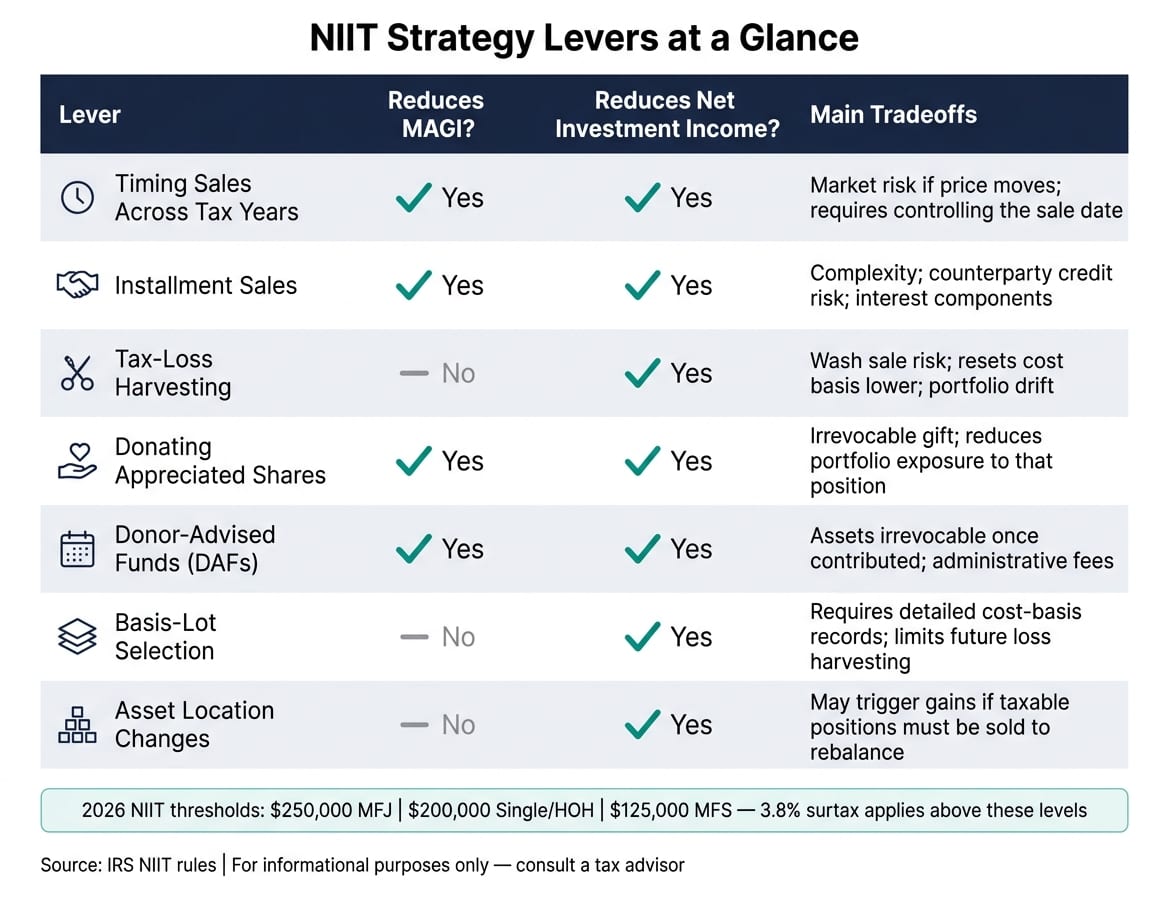
NIIT Strategy Tradeoffs at a Glance
These levers differ in what they may reduce and what they may cost. The table below ties back to the planning choices in Step 2 and sums up the main differences:
Use the table to match the lever to your income mix, then keep monitoring through year-end.
Conclusion: A Simple Process for Staying Under the NIIT Threshold
Once you map the event and test the numbers, NIIT planning may work best before the transaction closes. The earlier you spot the trigger, the more control you may have over timing and lot selection.
The process may come down to a short set of decisions:
- Identify the event early. An IPO lockup expiration, business sale, RSU vesting wave, or concentrated stock sale gives you a known trigger. Use that date as your planning anchor.
- Separate your income drivers. Wages and self-employment income may increase MAGI, but they aren't net investment income. Capital gains, dividends, and interest are net investment income, so knowing which bucket may be driving the issue tells you which lever you may want to focus on.
- Model MAGI against the 2026 thresholds before you trade: $250,000 for married filing jointly, $200,000 for single or head of household, and $125,000 for married filing separately.
- Match the lever to the income source: timing, lot selection, loss harvesting, or charitable giving. Then monitor through year-end. Connecting all of your accounts in Mezzi gives you one running view, which may make it easier to spot a threshold breach before year-end.
For a liquidity year, the sequence may be simple: identify the trigger, model the tax, act on timing or offsets, and watch the totals through year-end.
FAQs
How is NIIT calculated in a liquidity year?
NIIT is a 3.8% tax that may apply to the lesser of:
- your net investment income
- the amount by which your MAGI may exceed the threshold
The thresholds are $200,000 for single filers and $250,000 for married couples filing jointly.
In a liquidity year, passive income like capital gains, dividends, interest, and rental profits may increase NIIT or trigger it in the first place. The final amount may be reconciled on IRS Form 8960.
What income counts toward NIIT but not wages?
NIIT may apply to investment and passive income. That may include:
- Interest
- Dividends
- Capital gains
- Royalties
- Rental profits
It does not apply to earned income, such as wages or self-employment income. It also does not apply to Social Security benefits or distributions from tax-advantaged retirement accounts like IRAs and 401(k) plans.
When should I model a sale to avoid crossing the threshold?
Model a sale before it settles, and ideally fold that into year-round planning instead of waiting until December.
Scenario modeling may help you estimate MAGI and the tax impact of a sale ahead of time. That may give you a clearer way to compare options like:
- splitting gains across tax years
- harvesting losses
- timing sales during lower-income periods
The main idea is simple: look at the numbers before you place the trade, not after. That way, you may have a better sense of how different timing choices are associated with taxes before you commit to the sale.
Disclosures:
- This content is for informational purposes only and does not constitute investment advice or a recommendation to buy or sell any security.
- Past performance is not indicative of future results. No guarantee of future performance or outcomes is implied.
Related Blog Posts
- 2025 Tax Planning Checklist for Independent Investors
- Year-end tax planning checklist for investors with $500K+
- The AMT Came Back for High Earners in 2026 - Here's the Phaseout Math
- NIIT Bracket Creep: The 3.8% Tax Now Hits 7M+ Households
NIIT is a 3.8% tax that may apply to the lesser of:
- your net investment income
- the amount by which your MAGI may exceed the threshold
The thresholds are $200,000 for single filers and $250,000 for married couples filing jointly.
In a liquidity year, passive income like capital gains, dividends, interest, and rental profits may increase NIIT or trigger it in the first place. The final amount may be reconciled on IRS Form 8960.
NIIT may apply to investment and passive income. That may include:
- Interest
- Dividends
- Capital gains
- Royalties
- Rental profits
It does not apply to earned income, such as wages or self-employment income. It also does not apply to Social Security benefits or distributions from tax-advantaged retirement accounts like IRAs and 401(k) plans.
Model a sale before it settles, and ideally fold that into year-round planning instead of waiting until December.
Scenario modeling may help you estimate MAGI and the tax impact of a sale ahead of time. That may give you a clearer way to compare options like:
- splitting gains across tax years
- harvesting losses
- timing sales during lower-income periods
The main idea is simple: look at the numbers before you place the trade, not after. That way, you may have a better sense of how different timing choices are associated with taxes before you commit to the sale.