
A $1 income difference may be tied to a premium jump of thousands of dollars in 2026. If I retire before 65 and use ACA Marketplace coverage, my subsidy may end once household income goes above 400% of the federal poverty level (FPL). That may turn a partly subsidized plan into a full-price premium that may run from about $14,000+ for one person to $20,000–$30,000+ for a couple in their 60s, based on local rates and plan choices.
Here’s the short version:
- The 400% FPL subsidy cliff returned for 2026 Marketplace coverage
- ACA MAGI may include more than many people expect, such as:
dividends
- realized capital gains
- Roth conversions
- tax-exempt interest
- Some spending sources may not add to ACA MAGI, such as:
Roth contribution withdrawals
- taxable account basis
- HSA reimbursements for qualified medical costs
- A bridge plan may focus on income timing
use non-MAGI cash flows first
- size conversions and gains around the cliff
- keep a cash buffer for high-income years
- Two MAGI check-ins each year may lower the odds of crossing the line by accident
For 2026, the estimated 400% FPL cutoff may be about:
The core idea: if I need a health care bridge from early retirement to Medicare, the bridge may depend as much on income control as on portfolio size.
The 2026 ACA Subsidy Cliff: 3 Strategies to Protect Your Early Retirement
What changed in 2026 and where the cliff hits
For 2026 Marketplace coverage, the rule went back to the original ACA setup: premium tax credits are available only up to 400% of the federal poverty level, or FPL. For early retirees, that puts a lot of weight on one number: 400% FPL.
The return of the 400% FPL cutoff
At 400% FPL, the subsidy ends. If income goes even $1 over the limit, the full credit may disappear. That's why people often call it a cliff.
Here's what that may look like in practice. A single early retiree with $62,600 of MAGI may pay about $6,200 per year for benchmark Silver coverage. At $62,601, the subsidy may vanish, and the premium may jump to $14,000+.
Estimated 2026 income thresholds by household size
These thresholds use the 2025 federal poverty guidelines for the 48 contiguous states and D.C. Alaska and Hawaii use separate, higher limits.
Final eligibility may depend on your 2026 MAGI, household size, state marketplace, and local benchmark premium.
The 400% FPL column is the one many early retirees may want to track most closely. The 250% FPL column also matters for people watching cost-sharing reductions on Silver plans, since those phase out at lower income levels.
These are the income ceilings the bridge strategy may need to stay under.
What counts toward ACA MAGI
ACA MAGI is based on income, not on how large your accounts are. That's where early retirees may get tripped up. MAGI starts with federal AGI, then adds back tax-exempt interest, non-taxable Social Security, and excluded foreign income. In other words, some cash flows that don't feel like "income" may still count for ACA purposes.
One detail catches a lot of people: long-term capital gains still count toward MAGI even if they fall in the 0% tax bracket. So a gain may create no federal tax and still affect ACA subsidy eligibility.
How the cliff raises pre-Medicare healthcare costs
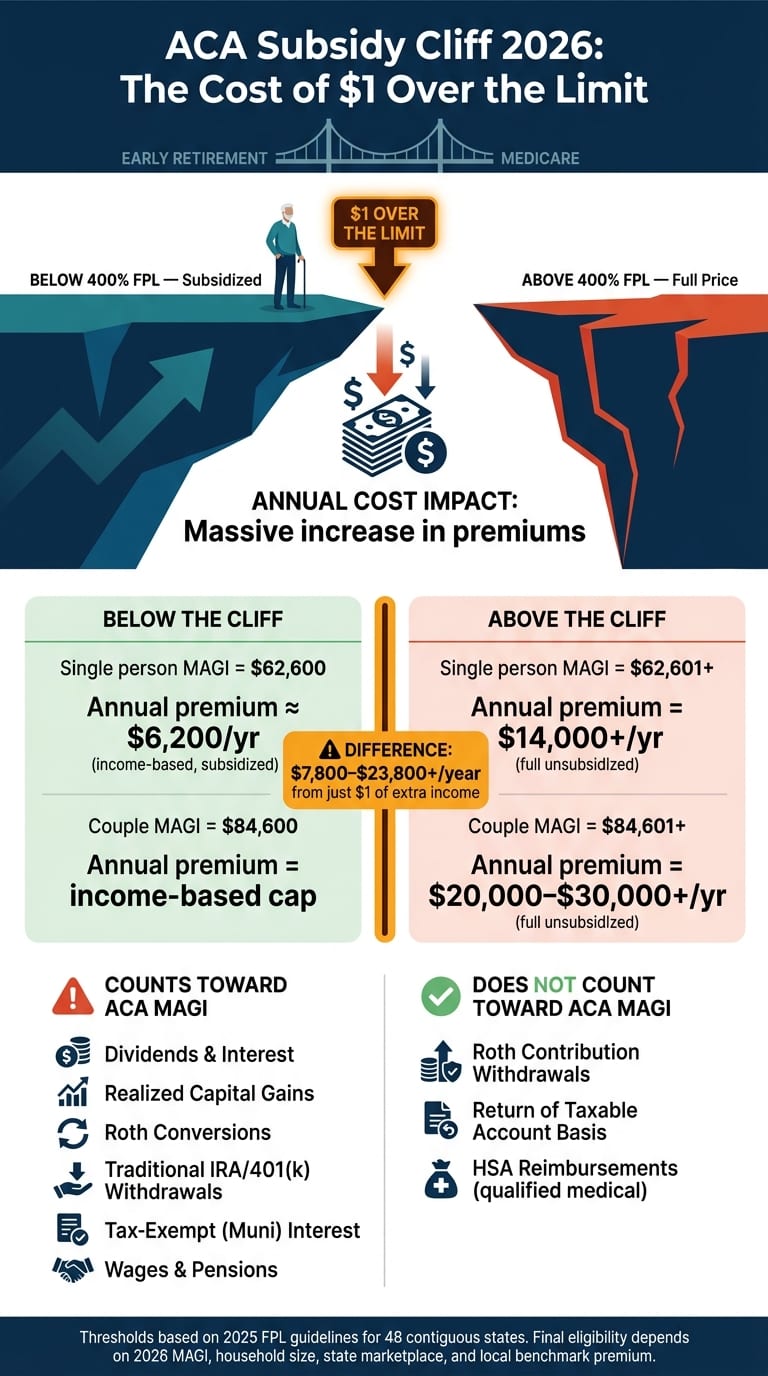
Once you know which income counts, the next question is cost: what happens if MAGI goes over the line? For early retirees, this cliff may matter a lot. A small bump in MAGI may wipe out subsidies and turn a manageable premium into a much bigger budget item.
How $1 over the limit can cost thousands per year
Take a married couple in their early 60s sitting just under the 400% FPL cliff for a two-person household. They may qualify for a premium tax credit that keeps their monthly premium capped at a share of household income. Go just $1 over the cutoff, and that credit may disappear in full.
At that point, the couple may be on the hook for the full unsubsidized premium. For a couple in their 60s, that amount may easily run above $20,000–$30,000 per year in premiums alone.
Annual premium comparison: below the cliff versus above it
The difference is easier to see side by side:
Income spikes that can erase subsidies
A lot of early retirees may not lose subsidies because they meant to spend more. The issue may come from taxable income showing up at the wrong time.
Capital-gains distributions or asset sales, an oversized Roth conversion, and stock compensation or bonuses may all add income with little warning and push a household over the line. These may look like tax events, but they may also affect healthcare costs.
That’s why income timing may matter before year-end. And it’s why surprise income events are exactly the kind of thing the healthcare bridge may need to account for.
How to build the early-retiree healthcare bridge
When income timing puts you near the subsidy cliff, the fix may be a multi-year MAGI plan. The basic idea is simple: cover spending from sources that don't add to MAGI first, then use taxable income only if room still remains under the subsidy line.
Draw from accounts that do not raise MAGI first
Non-MAGI withdrawals are the base of the bridge. They may cover spending without moving the subsidy needle.
After spending is covered, any MAGI room left may be used for Roth conversions or realized gains.
Size Roth conversions and capital gains around the subsidy line
It may make sense to plan Roth conversions around the subsidy line, not only around tax brackets. Before converting, estimate the gap between projected MAGI and the 400% FPL cutoff. That gap may act as the conversion budget - the adjustable span of the bridge.
The same test may apply to realized long-term capital gains. In 2026, the 0% federal rate applies if taxable income is below $49,450 for single filers or $98,900 for married couples filing jointly. If room remains under both limits, gains may be realized without giving up subsidies.
Hold a cash buffer for high-income years
When income timing is uncertain, liquidity may matter as much as tax planning. Unexpected capital-gains distributions, portfolio rebalancing, or self-employment income may push MAGI higher than planned. In those years, a cash buffer may give an early retiree more flexibility to cover spending without selling appreciated assets or taking withdrawals from a Traditional IRA.
That reserve may help protect subsidy eligibility when income shows up at the wrong time. It may also give someone a way to get through a high-MAGI year without forced sales or a full year of lost subsidies.
A planning process to avoid accidental subsidy loss
Run a midyear and year-end MAGI check
Once you know where the cliff sits and which income counts toward MAGI, the next step may be spotting income drift before year-end. A capital gain or Roth conversion may push MAGI past the threshold before you notice. A simple two-checkpoint habit - one review around midyear and another near year-end - may help catch issues while there may still be time to adjust.
Track these inputs, then compare the total with your limit:
Include every income source that adds to ACA MAGI. Then compare your projected MAGI with your household limit before making year-end trades or conversions.
Plan across all accounts, not in silos
A cliff test may work best when you look at every account together. The cliff is a whole-portfolio issue. A Roth conversion decision made without knowing what the taxable brokerage account may generate in dividends that year is only part of the picture. The same applies to HSA withdrawals, capital-gains timing, and cash reserve use.
A portfolio-wide view may make this easier. Mezzi's read-only, whole-portfolio view shows brokerage, IRA, Roth, HSA, and cash accounts together, surfacing the withdrawal and conversion tradeoffs tied to staying under the subsidy line.
Conclusion: estimate the gap before Medicare and protect the subsidy
Estimate the gap to Medicare, then use account order, timing, and reserves with the goal of staying under the subsidy line.
FAQs
How does ACA MAGI differ from regular taxable income?
For ACA subsidy purposes, MAGI starts with your AGI and then adds back certain non-taxable income. Regular taxable income, by contrast, is figured after standard or itemized deductions.
That difference matters. ACA MAGI is not reduced by those deductions, and it may include income that isn't fully shown in taxable income, such as tax-exempt interest, untaxed foreign income, and non-taxable Social Security benefits.
What income mistakes can push me over the 400% FPL cliff?
The main mistake may be letting your household MAGI go above the 400% FPL limit for ACA premium tax credits. Even a small overage may wipe out subsidies and may lead to a sharp jump in yearly health insurance costs.
A few things may push income over the line faster than people expect. Common triggers include large Roth conversions, one-time income events, capital gains distributions, and higher dividends, interest, or consulting income. Because of that, some households estimate MAGI with extra care and leave a buffer to reduce the chance of an unwelcome surprise at year-end.
How should I fund early retirement without losing ACA subsidies?
Manage your MAGI with care, since ACA subsidies may depend on your total income. Some people coordinate withdrawals with the goal of keeping income below the point where premium tax credits may phase out or be lost.
A common approach may look like this: start with taxable brokerage withdrawals, then draw from a Roth IRA, where qualified withdrawals may be tax-free. If Roth conversions are part of the plan, some people keep them within a target MAGI range and leave a $2,000 to $5,000 buffer in case income lands higher than expected. Some also let an HSA stay invested and hold onto old receipts for future tax-free reimbursement.
Disclosures:
- This content is for informational purposes only and does not constitute investment advice or a recommendation to buy or sell any security.
- Past performance is not indicative of future results. No guarantee of future performance or outcomes is implied.
- Savings and performance examples are hypothetical and for illustrative purposes only. Actual results will vary based on individual circumstances, portfolio composition, market conditions, and fees.
Related Blog Posts
- How to Do a Roth Conversion Ladder in Early Retirement
- How to do a Roth conversion without triggering IRMAA
- IRMAA's Two-Year Lookback: The 2026 Income You Set Today Bills You in 2028
- Roth Conversions vs. IRMAA vs. the ACA Subsidy: The Three-Way Squeeze
For ACA subsidy purposes, MAGI starts with your AGI and then adds back certain non-taxable income. Regular taxable income, by contrast, is figured after standard or itemized deductions.
That difference matters. ACA MAGI is not reduced by those deductions, and it may include income that isn't fully shown in taxable income, such as tax-exempt interest, untaxed foreign income, and non-taxable Social Security benefits.
The main mistake may be letting your household MAGI go above the 400% FPL limit for ACA premium tax credits. Even a small overage may wipe out subsidies and may lead to a sharp jump in yearly health insurance costs.
A few things may push income over the line faster than people expect. Common triggers include large Roth conversions, one-time income events, capital gains distributions, and higher dividends, interest, or consulting income. Because of that, some households estimate MAGI with extra care and leave a buffer to reduce the chance of an unwelcome surprise at year-end.
Manage your MAGI with care, since ACA subsidies may depend on your total income. Some people coordinate withdrawals with the goal of keeping income below the point where premium tax credits may phase out or be lost.
A common approach may look like this: start with taxable brokerage withdrawals, then draw from a Roth IRA, where qualified withdrawals may be tax-free. If Roth conversions are part of the plan, some people keep them within a target MAGI range and leave a $2,000 to $5,000 buffer in case income lands higher than expected. Some also let an HSA stay invested and hold onto old receipts for future tax-free reimbursement.