
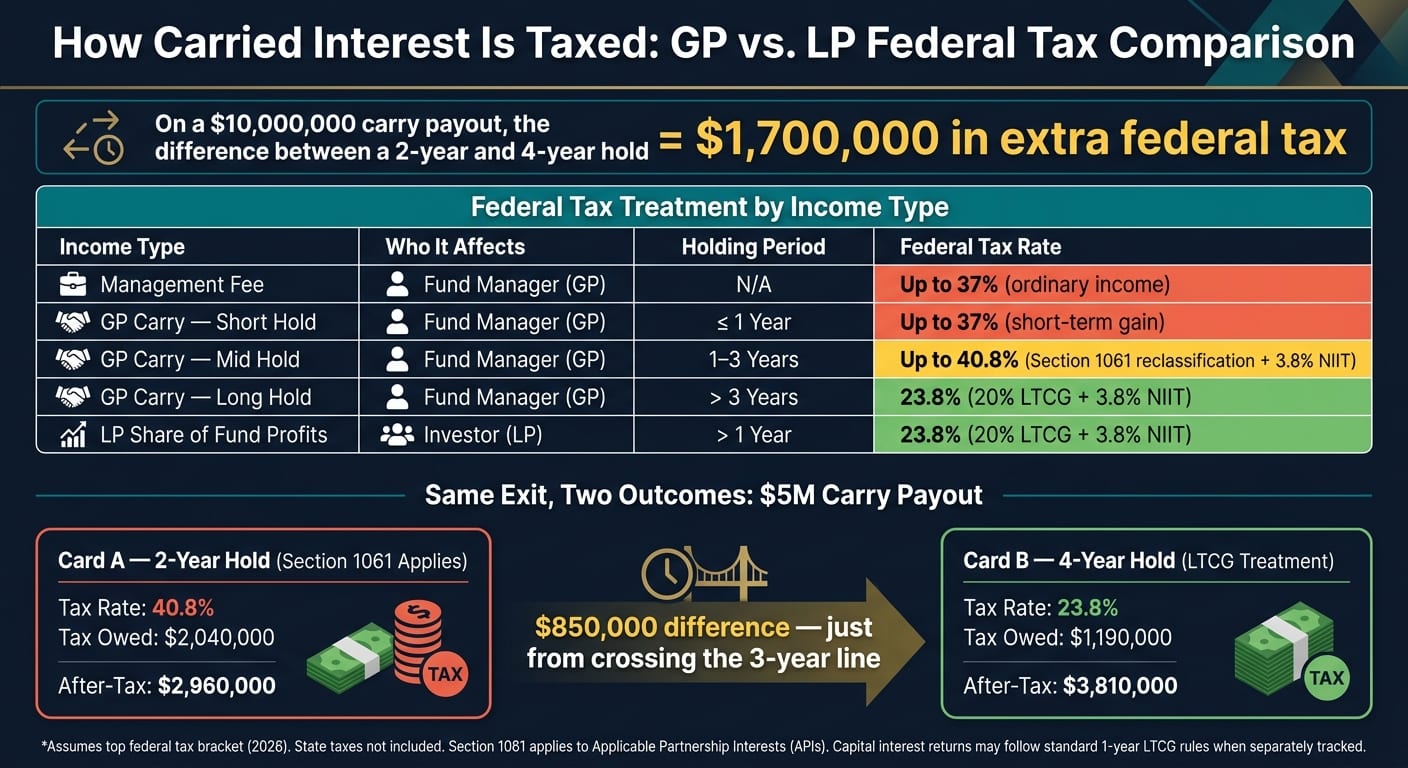
A private equity gain may face very different tax treatment based on what it is and how long the fund held the asset. For 2026, carry that clears the Section 1061 hold-period test may be taxed at up to 23.8% federally, while carry that fails that test may face up to 40.8% when the 3.8% NIIT applies. On a $10,000,000 carry payout, that spread may be about $1,700,000 in extra federal tax.
Here’s the short version:
- Management fees may be taxed as ordinary income, up to 37%
- Carried interest may keep the fund’s gain character, but Section 1061 may reclassify some gains
- For many GP carry allocations, the key test may be more than 3 years
- LPs generally are not subject to Section 1061 on their fund profit share
- A GP’s co-invested capital may follow different rules from carry if it is tracked apart
- The tax result may depend on the LPA, Schedule K-1, Box 20 codes, and asset-level hold dates
This article breaks down the core split between fees, carry, LP allocations, and co-invest returns, then shows how the 3-year API rule may change after-tax proceeds.
Carried Interest: What Most Investors Get Wrong About This "Loophole"
Quick Comparison
If you’re trying to figure out why the same exit may produce one tax result for an LP and another for a GP, this is the framework.
How carried interest is taxed under U.S. federal rules
Private equity funds are usually set up as partnerships. Under U.S. federal tax rules, that often means the fund itself may not pay federal income tax. Instead, income and gains may pass through to each partner, and those items generally keep their original tax character. So if the fund realizes a long-term capital gain, that gain may flow through to a partner as long-term capital gain rather than ordinary income. The end result may depend on the type of income, the holding period, and the partner's status.
That’s why the same fund exit may lead to very different tax results. It may depend on which income stream a partner receives and how long the fund held the asset behind that gain.
Carried interest vs. management fees: the tax difference
Management fees and carried interest may both come from the same fund, but the IRS generally treats them as separate items.
A management fee is a fixed payment for services rendered, often 1–2% of committed capital per year, and it is taxed as ordinary income. No holding period changes that result.
Management fees are taxed as ordinary income because they are payments for services. Carry, by contrast, generally keeps the tax character of the fund’s underlying gains unless Section 1061 reclassifies it. Section 1061 may reclassify some carry gains when the relevant holding period is three years or less.
Key tax terms to know
These terms show up often in partnership agreements, tax memos, and Schedule K-1 footnotes:
- Applicable Partnership Interest (API): A partnership interest transferred to a manager in connection with performing substantial services in an investment business. Carry is almost always an API, and APIs are the main focus of Section 1061’s three-year rule.
- Long-term capital gain (LTCG): Gain from an asset held for more than one year, taxed at a maximum federal rate of 20%. For API holders, the holding period may be raised to more than three years.
- Short-term capital gain (STCG): Gain from an asset held one year or less, taxed at ordinary income rates up to 37%.
- Capital interest: A GP’s share of the fund tied to the GP’s own cash investment, not services. Capital interests are generally exempt from Section 1061’s three-year rule when they are proportional to the capital contributed.
- Net Investment Income Tax (NIIT): A 3.8% surtax on investment income for single filers with modified adjusted gross income above $200,000 and married couples above $250,000. It may apply on top of both the 20% LTCG rate and ordinary income rates.
Tax outcomes by income type: comparison table
That three-year test may determine whether carry keeps long-term treatment or gets pushed into a less favorable result. The next section walks through when carry may qualify for long-term treatment and when Section 1061 may change the outcome.
When carry qualifies for long-term capital gains and when Section 1061 changes the result
The rate gap starts to matter when Section 1061 changes the holding-period rule. For API holders, Section 1061 may reclassify carry unless the fund held the underlying asset for more than three years.
The more-than-three-year rule for applicable partnership interests
Under Section 1061, carry allocated to an API holder may be reclassified as short-term gain and taxed at ordinary rates if the fund held the underlying asset for three years or less. A limited partner receiving gain from the same exit generally keeps long-term capital gains treatment. The three-year clock starts when the fund acquires the asset, not when the fund is formed.
For the API itself, the three-year clock starts when the interest is formally transferred to the service provider.
That rule does not apply to every dollar a manager receives.
The capital interest exception and where Section 1061 does not apply
Returns on the manager's own invested capital generally may follow the standard one-year capital gains rule, if they are separately tracked and aligned with LP capital allocations. The Limited Partnership Agreement and the fund's books must clearly identify capital interest allocations as separate and apart from carried interest allocations.
A few other gain types also fall outside Section 1061's reach regardless of holding period, including:
- Section 1231 gains
- Section 1256 contracts
- Qualified dividends
Tax outcomes after a 2-year vs. 4-year hold: examples
Here is the same exit under two holding periods.
Source: [[1]](https://legalclarity.org/carried-interest-taxation-and-the-three-year-holding-period/)\[*\[9\]*\](https://financial-advisors-for-private-equity.com/guides/carried-interest-taxation/). Assumes top federal tax bracket and no state taxes.
In this example, the $850,000 gap may come entirely from crossing the three-year line. That spread may be larger once state tax is added. For deal teams near the threshold, the 36-month cutoff may change the result in a very direct way.
Next, the tax result changes again when you compare the manager's carry, fees, and co-investment with an LP's share.
Fund managers vs. investors: why the same exit produces different tax results
The same exit may lead to very different tax bills because the tax code may treat fees, carry, and LP allocations in different ways. That gap may show up most clearly when you compare the GP's carry, the GP's own capital, and the LP's distributive share.
How fund managers are taxed on carry, fees, and invested capital
A fund manager's economics often come from three places, and each one may be taxed differently.
Management fees are taxed as ordinary income, at rates of up to 37% in 2026.
Carried interest is subject to Section 1061. Gains from assets held for less than three years are generally recharacterized as short-term.
Co-invested capital is generally taxed separately from carry when the LPA clearly segregates it and allocates it on the same terms as LP allocations.
How limited partners are taxed on fund allocations
Passive LPs generally receive allocations that follow the character of the fund's underlying income: long-term capital gains, short-term gains, dividends, or interest, based on what the fund actually earned. They are generally not subject to Section 1061 recharacterization. For gains from investments held for more than one year, the combined federal rate may be 23.8% when the 20% long-term capital gains rate is paired with the 3.8% NIIT.
That said, LPs still need to watch the details. Realized short-term gains and interest income may show up on a Schedule K-1 and may create unexpected ordinary income.
The side-by-side view below shows how the same sale may produce different tax character depending on the holder's role.
GP carry holder vs. LP investor: side-by-side tax comparison
Rates shown assume the top federal bracket and include 3.8% NIIT where applicable. State taxes not included.
An LP and a GP carry holder may receive value from the exact same exit and still face a 17-percentage-point difference in their federal tax rate. Those allocations only matter if the LPA and K-1s match the economics, which the next section covers.
What to review in partnership documents, K-1s, and realized gains
The tax outcome may hinge on three items: the Limited Partnership Agreement (LPA), the Schedule K-1, and the realized-gain report.
LPA clauses and allocation provisions that affect tax treatment
Start with the Limited Partnership Agreement (LPA). It may control how gains are split, when carry gets paid, and whether co-invest capital sits in a separate bucket from carry.
The first thing to check is the distribution waterfall. An American waterfall pays carry deal by deal. A European waterfall waits until fund-level hurdles are met. That choice may affect timing and clawback exposure.
Then look at clawback provisions and any fee waiver terms. A clawback may require a GP to return excess carry. Fee waivers tied to extra carry need real entrepreneurial risk, or they may be taxed as ordinary income.
Next, find the profits interest definition and any wording that separates "carried interest" from "capital interest." Carry and co-invested capital may need to stay separate in both the LPA and the books. If those amounts get mixed, co-investment may end up in API treatment.
It also makes sense to confirm that the LPA tracks the API three-year holding period in a clear way. Vague wording may create reporting risk.
What to look for on Schedule K-1 and realized gain reports
After the LPA sets the allocation rules, the K-1 may show whether the reported tax character lines up with them.
Your Schedule K-1 is where the fund's income character flows through to your personal return. For carried interest, these boxes may matter most:
If you hold an API, check whether the partnership attached Worksheet A to your K-1. This worksheet reports the one-year and three-year distributive share amounts used to calculate any recharacterization. If Worksheet A is missing, the partnership should treat the holding period as under three years.
On gain reports, compare the acquisition date and sale date for each underlying asset. Any asset held for 12 to 36 months may be a Section 1061 recharacterization item.
Conclusion: A short checklist for understanding your carry tax exposure
Use this check before a distribution or tax filing:
- LPA: Confirm the waterfall structure, clawback terms, fee waiver language, and whether carry and co-invested capital are tracked separately.
- Allocation provisions: Verify that the LPA tracks the API three-year holding period in explicit terms.
- Schedule K-1: Review Box 1, Box 8, Box 9a, and Box 20 (Code AH/AM). Confirm that Worksheet A is attached if you hold an API.
- Gain reports: Check acquisition and sale dates for each underlying asset. Flag any 12-to-36-month hold for possible Section 1061 recharacterization.
FAQs
Does Section 1061 apply to every type of GP profit?
No. Section 1061 applies only to applicable partnership interests (APIs) received for substantial services in an investment business.
It does not apply to profits from a GP’s own invested capital under the Capital Interest Exception. Those gains may be taxed like a limited partner’s investment and are not subject to the three-year holding-period rule. Qualified dividends and Section 1256 contract gains are also excluded.
How can I tell from my K-1 if carry was recharacterized?
Review your Schedule K-1 for short-term capital gain that may otherwise have been treated as long-term. Under Internal Revenue Code Section 1061, gain from an asset held for three years or less may be recharacterized as short-term capital gain.
This amount is reported on Line 8 of your K-1 and may be taxed at ordinary income rates, up to 37%. One way to check it is to compare the disposed asset’s holding period with the three-year requirement.
What mistakes can cause co-invest returns to be taxed like carry?
The main mistake may be combining co-investment and carry in a single partnership interest. If GPs don't clearly separate their own capital from performance-based carry, the entire interest may be treated as an Applicable Partnership Interest (API) under Section 1061.
That treatment may subject the GP's invested capital to the three-year holding-period rule instead of the standard one-year rule. To reduce that risk, some firms set up co-investment and carry as separate interests from the start.Disclosures:
- This content is for informational purposes only and does not constitute investment, tax, or legal advice. Readers should consult their own tax advisors regarding their specific situation.
- Tax laws and rates are subject to change. The examples provided are illustrative only and may not reflect all individual circumstances.
Related Blog Posts
- Capital Gains Tax Calculator for Your Investment Portfolio
- Capital Call: Private Equity and Capital Call Lines and How They Work
- Tax-Loss Harvesting for Alternative Investments: Real Estate, Crypto, PE
- Concentrated Position Management: Collars, Prepaid Forwards, Exchange Funds
No. Section 1061 applies only to applicable partnership interests (APIs) received for substantial services in an investment business.
It does not apply to profits from a GP’s own invested capital under the Capital Interest Exception. Those gains may be taxed like a limited partner’s investment and are not subject to the three-year holding-period rule. Qualified dividends and Section 1256 contract gains are also excluded.
Review your Schedule K-1 for short-term capital gain that may otherwise have been treated as long-term. Under Internal Revenue Code Section 1061, gain from an asset held for three years or less may be recharacterized as short-term capital gain.
This amount is reported on Line 8 of your K-1 and may be taxed at ordinary income rates, up to 37%. One way to check it is to compare the disposed asset’s holding period with the three-year requirement.
The main mistake may be combining co-investment and carry in a single partnership interest. If GPs don't clearly separate their own capital from performance-based carry, the entire interest may be treated as an Applicable Partnership Interest (API) under Section 1061.
That treatment may subject the GP's invested capital to the three-year holding-period rule instead of the standard one-year rule. To reduce that risk, some firms set up co-investment and carry as separate interests from the start.Disclosures:
- This content is for informational purposes only and does not constitute investment, tax, or legal advice. Readers should consult their own tax advisors regarding their specific situation.
- Tax laws and rates are subject to change. The examples provided are illustrative only and may not reflect all individual circumstances.