
If I want income from a charitable gift, a CRT may fit better. If I want a simpler giving account and no income back, a DAF may fit better. That’s the main split.
Here’s the short version:
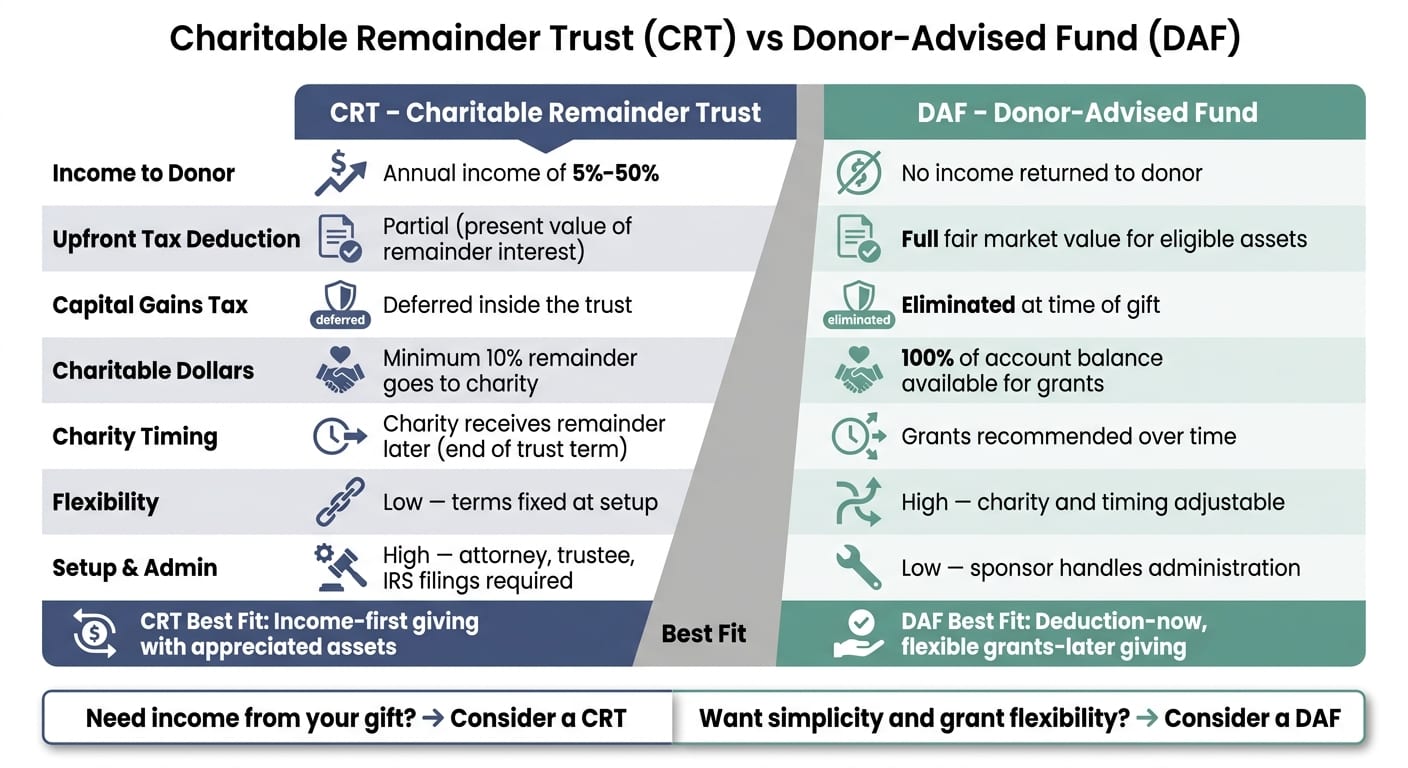
- A CRT may let me donate appreciated assets, sell inside the trust without an immediate capital gains tax event, and receive annual income of 5% to 50% under trust rules.
- A DAF may let me make an irrevocable gift, claim an immediate deduction, and recommend grants to charities over time.
- A CRT usually means a partial deduction, more legal setup, a trustee, and annual filings.
- A DAF usually means a full fair market value deduction for eligible appreciated assets, lighter admin, and no income to me.
- In a CRT, at least 10% of the initial value generally must be projected to pass to charity.
If I boil it down even more:
- Income now, charity later → CRT may fit
- Deduction now, grants later → DAF may fit
- One fixed charitable remainder plan → CRT may fit
- Giving to many charities over time → DAF may fit
Quick Comparison
For many readers, the choice may come down to three things: income, deduction size, and admin load. The rest is mostly structure.
Donor Advised Fund vs Charitable Trust - Tax Planning Considerations When Giving to Charity
2. How each option works in practice
The mechanics get to the heart of the tradeoff: a CRT may provide income, while a DAF turns assets into money that may later be granted to charity.
How a Charitable Remainder Trust works
You transfer cash or appreciated assets, such as publicly traded stock or real estate, into an irrevocable trust. The trust may sell those appreciated assets without an immediate capital gains tax event, then reinvest the proceeds. After that, the trust pays you or another named beneficiary an annual income stream for life or for a set term. You may claim an immediate deduction for the present value of the charity's remainder interest, not for the full amount contributed.
There are two main structures:
- A CRAT pays a fixed dollar amount.
- A CRUT pays a fixed percentage of the trust's value and may accept later contributions.
A CRT usually involves more setup and upkeep. That may include an attorney, a trustee, and annual tax filings for as long as the trust remains in place.
How a Donor-Advised Fund works
With a DAF, you contribute cash or long-term appreciated securities to an account run by a sponsoring public charity. You may claim an immediate deduction, and appreciated assets may be contributed without triggering capital gains tax at the time of the gift. The account balance may grow tax-free, and you recommend grants to qualified charities over time.
The sponsor controls the account, while you keep advisory rights. There is no trust document, no annual trust filing, and no trustee. Compared with a CRT, a DAF is usually simpler to open and may involve much less day-to-day administration.
Next, compare the tax, income, and flexibility tradeoffs side by side.
3. CRT vs. DAF: taxes, income, flexibility, and complexity compared
Tax deductions and appreciated asset treatment
On taxes, the core tradeoff may come down to deduction size vs. income.
A DAF may offer the larger upfront deduction. A CRT may give up some of that upfront tax break in exchange for an income stream. That’s the big split.
Capital gains treatment is different too. With a DAF, contributed appreciated assets may avoid capital gains tax at the time of the gift. With a CRT, those gains may be deferred, and the trust may reinvest the full sale proceeds.
That tradeoff may matter most when the vehicle matches the goal of the gift. If the main aim is a larger upfront deduction, a DAF may line up better. If the aim includes lifetime income, a CRT may fit that pattern more closely.
Income, charitable control, and ongoing administration
This is where the contrast gets pretty clear.
- CRT: income, fixed remainder, heavier administration
- DAF: no income, grant flexibility, lighter administration
A CRT names the charitable remainder beneficiary up front. A DAF lets you direct grants over time as priorities change.
In practice, CRTs may fit income-first gifts. DAFs may fit flexibility-first gifts.
Those differences may show up most often in three gift situations: ways to donate equity compensation, lifetime income, and family giving.
4. Which fits your gift strategy
The goal of the gift may narrow the choice pretty fast.
If you are donating appreciated stock
The better fit may depend on what you want most: income, tax treatment, or room to give over time.
A DAF may offer the cleanest path if your main goal is a deduction now and grants later. A CRT may fit better only if income from the stock is also part of the plan.
If you want income from the gift
A CRT may be the only fit when income is part of the plan.
That said, it usually comes with more moving parts: legal setup, annual filings, and an irrevocable structure with fixed terms. For some people, that tradeoff may make sense when income comes first.
If you want a flexible family giving fund
A DAF may be the better fit in many cases. It may let a family support more than one charity over time and shift grant priorities as needs change.
A CRT may give you less control over grant timing and charity selection. If your main priority is a simple giving process with room to adjust later, a DAF may feel more practical.
The final choice may come down to what matters most to you: the size of the deduction, income from the gift, or flexibility around grants.
5. How to make the final call
Start with two questions: Do you need income from the gift? And how much complexity are you willing to take on?
A CRT may fit better if income from the gift matters. A DAF may fit better if you want something simpler and more flexible. The checklist below may help you test that fit.
The key questions to ask yourself
Before you choose, look at these fit factors:
- Do you need income from the gift? If yes, a CRT may be the better match. If no, a DAF may be simpler.
- Does the asset have unrealized capital gains? That may affect the tax result for either option.
- One charity or many? A DAF may make it easier to spread grants across multiple organizations over time.
- How much complexity can you manage? A CRT requires more legal setup, including an attorney and an IRS tax ID. A DAF is simpler to implement.
- How important is a current-year deduction? A DAF often provides a larger current deduction, while a CRT deducts only the present value of the future gift.
What to check before moving forward
Start with the asset’s size and type, along with any unrealized capital gains, your expected deduction timing, and your charitable goals. That may matter even more if the gift involves appreciated stock, a need for income, or a family giving plan.
Then check your AGI and deduction limits for the year. For a CRT, confirm the payout rate you’d need. It must fall between 5% and 50% annually. For a DAF, review each sponsor’s minimums, fees, and grant rules before opening the account.
If you want a final pass using your own numbers, you may run the analysis in Mezzi. Mezzi is designed to compare tradeoffs across your holdings, tax exposure, and retirement income assumptions.
FAQs
Can I use both a CRT and a DAF?
Yes. A CRT may turn appreciated assets into a lifetime or term income stream while potentially deferring capital gains taxes. A DAF may let you take a tax deduction now, subject to limits, and distribute to charities over time.
In short, a DAF offers flexible future grants, while a CRT follows a required income payout schedule and gives the remainder to charity.
What assets work best for a CRT or a DAF?
Both Charitable Remainder Trusts and Donor-Advised Funds may work well with appreciated assets, such as stocks or real estate, because they may help limit immediate capital gains tax.
With a CRT, the assets move into the trust, and the trust may sell them without triggering immediate capital gains tax at the time of sale. A DAF may also accept appreciated securities, often with a fair market value deduction. In some cases, CRTs may also be funded with a one-time Qualified Charitable Distribution from an IRA.
How do fees affect the choice?
Fees matter because they may reduce the assets available for charitable growth.
DAFs usually come with ongoing administrative or investment fees, often tied to assets under management. That said, tax-free growth may offset part of those costs over time.
CRTs often involve higher setup costs, plus more legal or administrative work along the way. Because of that added complexity, they may be a better fit in cases where the income and tax features may justify the higher overhead.
Disclosures:
- This content is for informational purposes only and does not constitute investment advice or a recommendation to buy or sell any security.
- Past performance is not indicative of future results. No guarantee of future performance or outcomes is implied.
Related Blog Posts
- Donor-advised fund: how to donate appreciated stock tax-efficiently
- Charitable Remainder Trusts: Tax Deductions and Income Strategies
- Tax-Efficient Giving: CRUTs, CLATs, and Private Foundations
- Donor-Advised Funds: Bunching Two Years of Giving Into One
Yes. A CRT may turn appreciated assets into a lifetime or term income stream while potentially deferring capital gains taxes. A DAF may let you take a tax deduction now, subject to limits, and distribute to charities over time.
In short, a DAF offers flexible future grants, while a CRT follows a required income payout schedule and gives the remainder to charity.
Both Charitable Remainder Trusts and Donor-Advised Funds may work well with appreciated assets, such as stocks or real estate, because they may help limit immediate capital gains tax.
With a CRT, the assets move into the trust, and the trust may sell them without triggering immediate capital gains tax at the time of sale. A DAF may also accept appreciated securities, often with a fair market value deduction. In some cases, CRTs may also be funded with a one-time Qualified Charitable Distribution from an IRA.
Fees matter because they may reduce the assets available for charitable growth.
DAFs usually come with ongoing administrative or investment fees, often tied to assets under management. That said, tax-free growth may offset part of those costs over time.
CRTs often involve higher setup costs, plus more legal or administrative work along the way. Because of that added complexity, they may be a better fit in cases where the income and tax features may justify the higher overhead.