
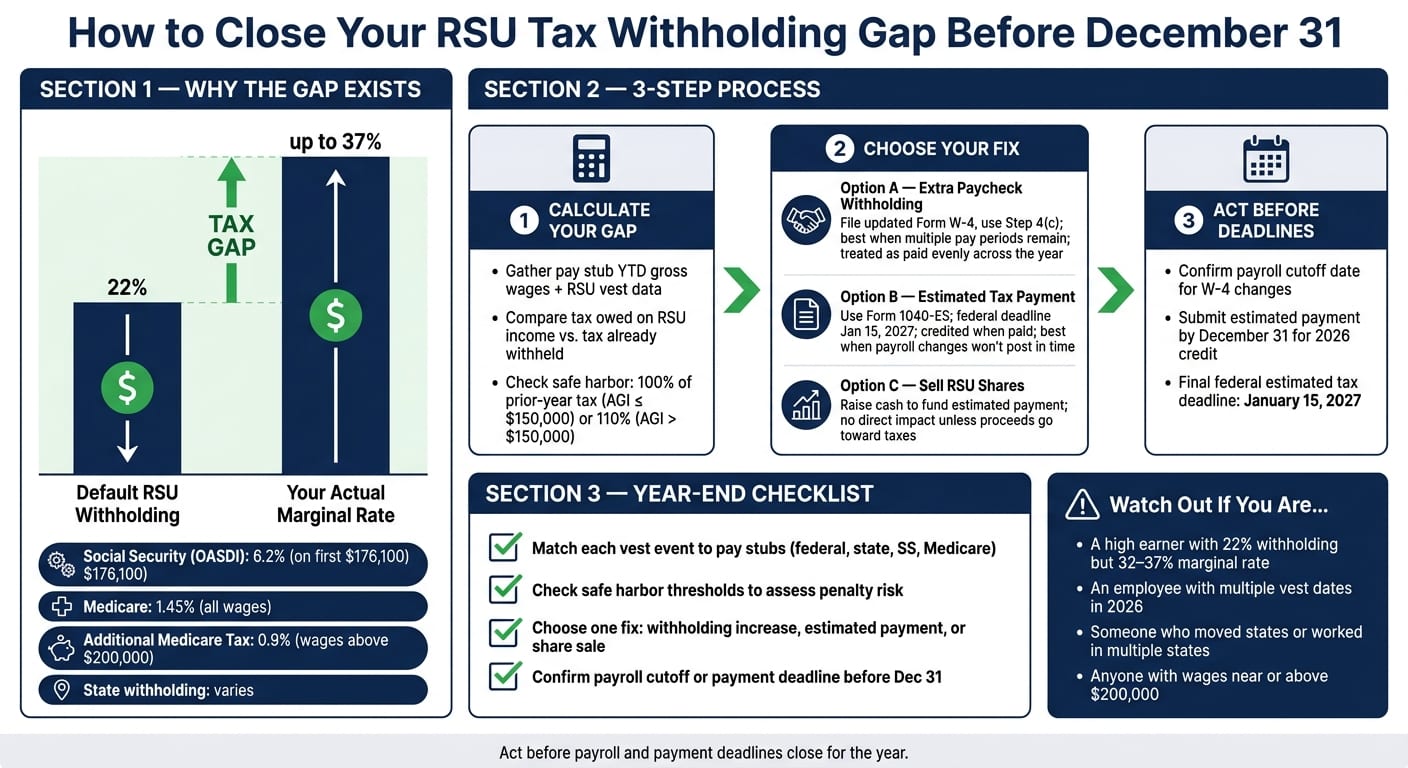
If your RSUs vested in 2026, your tax withholding may be too low even if shares were already sold for taxes. That gap may happen when federal withholding stays at 22%, while your marginal rate may be 32%, 35%, or 37%. Add state tax, 6.2% Social Security up to $176,100, 1.45% Medicare, and the extra 0.9% Medicare tax above $200,000, and the shortfall may get larger.
Here’s the short version:
- I may estimate the gap by comparing tax on RSU income with tax already withheld
- I may check whether a safe harbor may lower penalty risk
- I may close the gap in one of 3 ways:
Add extra withholding through Form W-4
- Make an estimated payment with Form 1040-ES
- Sell RSU shares to fund that payment
- Timing may matter, because payroll cutoffs and December 31, 2026 deadlines may affect what counts for this tax year
A few cases may need more review:
- High earners with RSU withholding stuck at 22%
- People with more than one vest date
- Employees who moved states or worked in more than one state
- Anyone near or above $200,000 in wages
How a $200K RSU Vest Turned Into a $20,000 Surprise Tax Bill?
Quick Comparison
Bottom line: if I wait until filing season, I may just be measuring the bill. If I check the numbers before December, I may still have time to deal with it.
Step 1: Calculate Your RSU Withholding Gap
Gather Your Pay Stub and RSU Vest Data
The RSU withholding gap may be the difference between the tax owed on vested RSUs and the tax already withheld. To work it out, start with two documents: your most recent pay stub and your equity compensation portal statement.
From your pay stub, pull your year-to-date (YTD) gross wages. That may include salary, bonuses, and earlier RSU vests. You’ll also want your federal withholding, state withholding, Social Security (OASDI), and Medicare amounts. From your RSU pay stub, find the vest date, fair-market value at vest, and total shares vested.
Those numbers may give you a rough sense of how much extra tax may still be due before year-end.
Estimate Your Federal, State, Social Security, and Medicare Shortfall
A common way to estimate the gap is to project tax on your full 2026 income, subtract the tax on salary alone, and then compare that result with what has already been withheld from RSU vests. The difference may be your extra tax due.
Once your wages reach $176,100, OASDI withholding may stop for the rest of the year. If wages go above $200,000, add the extra 0.9% Additional Medicare Tax to your estimate.
For example, one employee had 441 shares vest at $324,871.47 in a single event. That vest crossed both the $176,100 Social Security wage base and the $200,000 Additional Medicare Tax threshold at once. In cases like that, year-end withholding and Medicare checks may deserve a closer look.
Check Safe Harbor Rules Before Worrying About Penalties
Before assuming a penalty may apply, check whether you may qualify for a federal safe harbor. Safe harbor may apply if you have paid 100% of your prior-year tax liability when AGI was $150,000 or less, or 110% if AGI was above $150,000.
If safe harbor doesn’t apply, or if you may still owe tax, Step 2 may help you close that gap before December 31.
Step 2: Choose the Best Way to Close the Gap
If your math shows a gap, pick the fix that may work best before year-end: more withholding, an estimated payment, or cash from sold shares. Once you know the shortfall, the next step may come down to how much time is left in the year.
Increase Withholding on Your Remaining Paychecks
This may be the simplest option. You may submit an updated Form W-4 to your employer and use Step 4(c) to add a set dollar amount to each paycheck.
Here’s why people often start here: withholding is generally treated as if it was paid evenly across the year. So even a late-2026 W-4 change may still reduce a shortfall. Just make sure your employer processes the new W-4 before your final 2026 pay period closes. This route may fit best if you still have several pay periods left.
Make a Federal or State Estimated Payment
If payroll timing is too tight, or the gap may be more than one paycheck can cover, a direct estimated tax payment may be the better path. For federal taxes, use Form 1040-ES. For 2026, the federal due date is January 15, 2027.
Most states use their own estimated tax deadlines, so it may make sense to check your state's rules as soon as possible. Estimated payments are generally credited when made, which means a December payment may do more for 2026 than waiting until January. This option may make sense if payroll changes may not post in time.
Sell RSU Shares to Raise Cash
Selling shares may help you raise the cash for the tax payment, but selling by itself does not close the gap. If you use the proceeds to make an estimated tax payment, that may help cover the shortfall without waiting for the next paycheck.
Step 3: Handle the Cases Where the Gap Gets Larger
Large RSU gaps may show up more often with higher income or when more than one state is in the mix. The same basic fixes may still apply. But once higher brackets and state sourcing enter the picture, the math may change.
High Earners with 22% Federal Withholding on a Higher Marginal Rate
If your Step 1 estimate still looks short, the gap may get larger in higher tax brackets. For a late-year vest, compare the default 22% federal withholding with your expected marginal rate. If the difference looks meaningful, some employees increase paycheck withholding or make an estimated payment before year-end.
Once wages go above $200,000, the 0.9% Additional Medicare Tax may add to the gap too.
Employees Who Moved States or Worked in More Than One State
Here, the key issue may not be the vest date. It may be where the RSU income is sourced.
Many states source RSU income based on workdays during the vesting period. New York may also tax remote work under the convenience-of-the-employer rule.
If withholding missed the former state, some employees make an estimated payment there before year-end and then claim a credit on their resident-state return. That result may help you figure out whether added withholding or an estimated payment may still be made before December 31.
Comparing Your Three Main Fixes
When the gap gets large, speed may matter more than simplicity.
- A W-4 change may work only if several paychecks remain.
- An estimated payment may close the gap faster.
- Selling shares may matter only if you need cash to fund the payment.
Year-End Checklist and Next Steps
Your RSU Tax Checklist for the Rest of 2026
Once you've estimated your gap, this checklist may help you close it before year-end.
Use it to find the gap and deal with it before December 31, 2026.
- Match each 2026 vest event to your pay stubs and check federal, state, Social Security, and Medicare withholding.
- Check safe harbor thresholds to sort out possible penalty risk versus a balance due in April.
- Choose one fix: increase withholding, make an estimated tax payment, or sell shares to fund it.
- Confirm the payroll cutoff or payment deadline before December 31.
Use your payroll portal or a tax calculator to verify the numbers before you act.
How Mezzi Can Help You Check the Numbers
If you want one place to review the numbers, Mezzi may help. Mezzi brings your payroll, brokerage, and cash accounts into one view so you may check RSU vest income, withholding, and available cash before year-end. As an SEC-registered fiduciary, Mezzi shows tax insights across your connected accounts so you may see where your RSU-related tax picture may stand before December 31.
Mezzi advises and guides; it does not move money or place trades. If it identifies a gap or opportunity, you decide how and when to act.
Key Takeaways Before December Closes
The fastest fixes may often be extra withholding or an estimated payment, with share sales used as a cash source. If your year includes multiple states or other moving parts, it may make sense to leave extra time to confirm the numbers before December 31.
Act before payroll and payment deadlines close for the year.
FAQs
How do I know if my RSU withholding was too low?
Compare your total tax liability with the tax withheld at vesting. For many employees, RSUs are withheld at a flat 22% federal rate at vesting. That amount may be too low if your total income puts you in a higher tax bracket.
Take a look at your vesting statements. Confirm how many shares were withheld, then estimate your marginal tax rate based on your full annual income. If your federal and state tax due may be higher than the amount withheld, you may have an RSU withholding gap.
Is extra paycheck withholding better than an estimated tax payment?
It may depend on your situation and how much control you want.
Increasing W-4 withholding may be the simpler option for some people because it happens automatically through payroll. It’s also generally treated as if it were paid evenly throughout the year, which may help lower the chance of underpayment penalties.
Estimated tax payments may offer more flexibility. That may matter more if you have irregular income or multi-state tax obligations that your employer’s withholding may not fully cover.
Both approaches may help close the withholding gap.
What changes if I moved or worked in more than one state?
Moving between states may make your tax picture a bit messier, especially with RSUs. In many cases, RSUs may be taxed based on where you worked during the vesting period, not just where you live when the shares vest or when you sell. So even after a move, you may owe state tax in more than one place.
There’s another wrinkle too. Some states may apply employer-convenience rules tied to the company’s location. That may affect how income gets sourced, even if you were working from a different state.
In some cases, you may be able to claim a credit in your home state for taxes paid to another state. That may reduce double taxation, but it may not cover every gap. Because of that, some people make quarterly estimated payments to cover any shortfall that payroll withholding may not catch.
Disclosures:
- This content is for informational purposes only and does not constitute investment advice or a recommendation to buy or sell any security.
- Past performance is not indicative of future results. No guarantee of future performance or outcomes is implied.
- Registration does not imply a certain level of skill or that the SEC has approved the company or its services.
Related Blog Posts
- Should you sell RSUs when they vest? A tax-aware framework
- Sell RSUs at Vest or Hold? The Concentration-vs-Tax Tradeoff
- Double-Trigger RSUs at a Pre-IPO Company: The Tax Time Bomb at Liquidity
- Cross-Border Equity Comp: RSUs When You Work in the US on a Visa
Compare your total tax liability with the tax withheld at vesting. For many employees, RSUs are withheld at a flat 22% federal rate at vesting. That amount may be too low if your total income puts you in a higher tax bracket.
Take a look at your vesting statements. Confirm how many shares were withheld, then estimate your marginal tax rate based on your full annual income. If your federal and state tax due may be higher than the amount withheld, you may have an RSU withholding gap.
It may depend on your situation and how much control you want.
Increasing W-4 withholding may be the simpler option for some people because it happens automatically through payroll. It’s also generally treated as if it were paid evenly throughout the year, which may help lower the chance of underpayment penalties.
Estimated tax payments may offer more flexibility. That may matter more if you have irregular income or multi-state tax obligations that your employer’s withholding may not fully cover.
Both approaches may help close the withholding gap.
Moving between states may make your tax picture a bit messier, especially with RSUs. In many cases, RSUs may be taxed based on where you worked during the vesting period, not just where you live when the shares vest or when you sell. So even after a move, you may owe state tax in more than one place.
There’s another wrinkle too. Some states may apply employer-convenience rules tied to the company’s location. That may affect how income gets sourced, even if you were working from a different state.
In some cases, you may be able to claim a credit in your home state for taxes paid to another state. That may reduce double taxation, but it may not cover every gap. Because of that, some people make quarterly estimated payments to cover any shortfall that payroll withholding may not catch.