
For many people, the main RSU choice may start after vesting, not at vesting. The vest-date value may already be taxed as ordinary income on your W-2. So selling right away may often create little or no extra tax, while holding may mean more exposure to one stock in exchange for a possible long-term capital gains rate on any future gain.
Here’s the short version:
- At vest: the share value may be taxed as wage income.
- If you sell right away: extra capital gain may be $0 or close to it.
- If you hold: any move after vest may become a capital gain or loss later.
- If you hold more than 1 year: future gains may qualify for 0%, 15%, or 20% federal long-term capital gains rates.
- The bigger issue for many employees: employer stock may already be a large part of net worth, paycheck risk, and even a 401(k).
Put another way: holding vested RSUs may be similar to taking cash and choosing to buy your employer’s stock. That framing may make the choice easier.
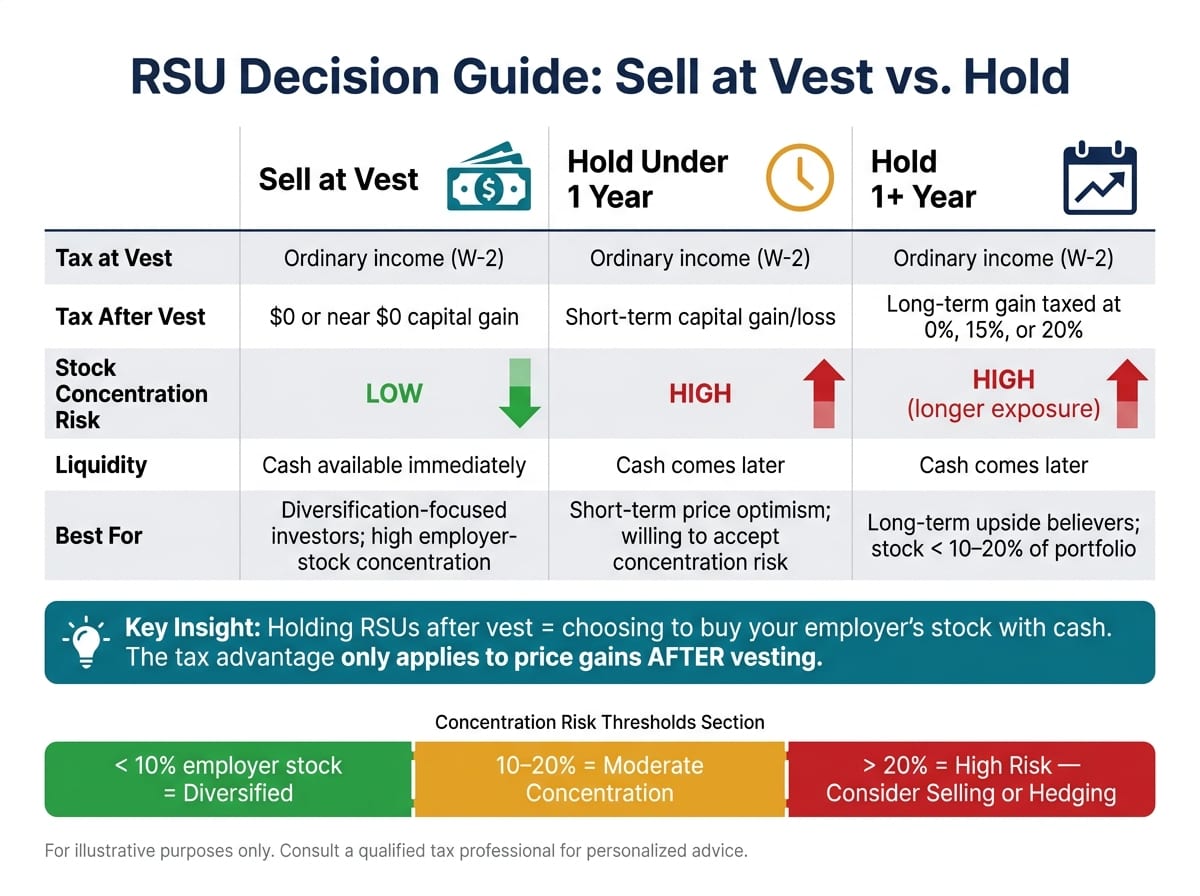
Quick Comparison
A simple way to think about it: the tax edge from holding may apply only to price changes after vesting, while the stock risk may start right away.
How RSUs are taxed at vest and why selling immediately is often tax-neutral
Once RSUs vest, the tax on the vest value is generally set. After that, the main choice may be whether to sell or keep the shares.
Ordinary income at vest is reported on your W-2
When your RSUs vest, the IRS treats their value as ordinary wage income. That amount shows up on your W-2 whether you sell the shares right away or hold them. Your company takes the fair market value on the vest date, multiplies it by the number of shares that vested, and adds that dollar amount to your W-2 Box 1 wages. That income may be taxed like wages, along with payroll taxes and any state or local tax that applies.
Say 1,000 RSUs vest when your company’s stock trades at $50. You would recognize $50,000 of compensation income for that year. That starting point matters. Selling at vest may change your stock exposure, but it usually doesn’t change the tax already tied to the vest value.
Companies also usually withhold at the federal supplemental withholding rate, often 22%, which may understate the tax due for high earners.
Your cost basis resets to the vest-date price
That vest-date value becomes your cost basis. This is the key detail behind why an immediate sale is often close to tax-neutral. If you sell the shares the same day they vest at $50 per share, and your basis is also $50 per share, your capital gain would be $0.
Here’s how the tax treatment works at each step:
If the stock price changes after vest, that later price move may create a capital gain or loss. But the income from vest itself has already been set. That’s why this decision is often more about risk than about changing the original tax bill.
Brokerage 1099-B forms sometimes show a $0 basis, so it’s worth checking that the reported basis matches the vest-date FMV before filing.
Tax note
The mechanics described here reflect general U.S. federal tax principles and are meant to help explain the framework - not replace personal advice. Your actual outcome may depend on filing status, total income, other investment activity, and state and local tax rules. High earners, multi-state filers, and anyone with large RSU sales may want to confirm the tax impact with a qualified tax professional.
With the tax mechanics set, the real decision may be whether to sell or hold after vest.
Sell now or hold: what changes after vest
Once RSUs vest, the tax is set. After that, the choice may come down to sell or hold.
Selling at vest usually creates little or no additional capital gain or loss
Because vesting has already created taxable income, the next issue may be whether to diversify now or keep more company risk. Selling at or near vest usually leaves little or no capital gain or loss, and it ends your employer-stock exposure.
Put another way: holding RSUs after vest may be the same as taking cash and using it to buy your employer's stock.
Holding creates a later capital gain or loss
If you keep the shares, any price move after vest becomes a separate taxable event when you eventually sell. Hold for more than a year, and future gains may qualify for long-term capital gains treatment at rates of 0%, 15%, or 20%.
Holding can reduce tax, but only if the stock rises and you hold long enough
Long-term capital gains rates are lower than ordinary income rates, but that tax edge may show up only if the stock rises and you hold for more than a year. If the stock falls while you're waiting for the long-term clock to run out, the tax edge may not outweigh the added concentration risk.
That's the trade-off in plain English: lower long-term capital gains rates may be the tax upside of taking on more single-stock risk.
The real question may not be whether holding may reduce taxes, but how much employer-stock concentration you may be comfortable carrying.
How much employer stock is too much?
If you already hold employer stock in more than one account, your concentration may be higher than it first appears. And if selling at vest may be close to tax-neutral, the next step may be pretty simple: figure out how much company stock you already own.
Add up employer-stock exposure across all accounts
A simple way to start: employer stock value ÷ total investable assets.
That gives you your concentration percentage. To avoid undercounting, include every form of employer exposure you hold:
- Vested RSUs
- Unvested RSUs
- Company stock in your 401(k)
- ESPP shares
Rules of thumb: 10%, 20%, and the salary-and-stock exposure problem
Once you have that percentage, these thresholds may be a useful starting point:
Employer stock often gets viewed differently from other single-stock positions because your income may already be tied to the same company. If the stock drops, both your portfolio and your paycheck may be affected at the same time.
A concentration-risk checklist for deciding how much to sell
Before deciding how much to sell at vest, it may help to run through a few inputs:
That concentration score may be the next input when comparing sell-now and hold outcomes.
Sell at vest or hold: side-by-side outcomes and a Mezzi workflow
With concentration and tax basics covered, the next step may be to compare the tradeoffs side by side.
Hypothetical scenarios: $50,000 of vested RSUs across three choices
A partial sale may reduce concentration while still leaving some upside in place. The examples below show what may change after vest, not the tax due at vest itself.
If concentration may already be high, selling most or all at vest may look stronger unless there’s a clear reason to hold. If you do hold, some people set an exit rule before holding the shares so the decision isn’t driven by emotion later.
Decision rules of thumb for high-income employees
The concentration level from the checklist in the prior section may be the key input here. If employer stock already makes up more than 10% to 20% of investable assets, the sell-at-vest case may look stronger even if long-term capital gains treatment seems appealing.
That’s because the tax edge from holding applies only to post-vest price movement. And even then, it may matter only if the stock rises and the holding period goes past one year.
Using Mezzi to see concentration and plan RSU sales
A clear view of your total employer-stock exposure may make this choice easier. Mezzi shows employer-stock exposure across linked accounts in one place, with read-only access.
That view may make it easier to decide how much to sell, how much to hold, and when to act.
Conclusion: default to diversification unless you have a deliberate reason to hold
RSUs are taxed as ordinary income at vest. After that, holding the shares only changes the tax treatment on any price movement that happens after vesting. In many cases, selling right away may add little or no extra tax because your cost basis typically resets to the vest-date price.
That upside is conditional. The stock may need to rise after vesting, and you may also need to accept added concentration risk while you wait.
Once you weigh concentration risk against the fairly limited tax upside of holding, the decision may often lean toward diversification. If employer stock already makes up a meaningful share of your portfolio, the case for selling at vest may look stronger, even when lower long-term capital gains rates seem appealing.
A common default may be to sell at vest and diversify. Holding may make more sense only if you have a clear investment reason to keep the stock. Some people look at their full employer-stock exposure and their tax situation to decide how much, if any, they may want to keep.
FAQs
Should I always sell RSUs as soon as they vest?
No. Whether it may make sense to sell or hold may depend on your risk tolerance and financial goals.
One simple test some people use: if you received the same amount in cash today, would you buy your company’s stock?
If the answer may be no, selling may reduce concentration risk. If the answer may be yes, holding may still make sense for some people. One tax detail often comes up here: selling within one year of vesting may create short-term capital gains. After one year, gains may qualify for long-term capital gains rates.
How do I know if I own too much employer stock?
Add up your employer stock across every account, including any indirect exposure through funds or ETFs. A good first check is concentration: if one stock makes up about 10%–20% or more of your portfolio, that position may be more concentrated than some people are comfortable with.
Much larger stakes, such as 40%, may make sharp drawdowns affect your wealth much faster. It may make sense to review your allocation and any unrealized gains or losses on a regular basis, and some investors set alerts in case that concentration starts to climb.
When does holding vested RSUs save taxes?
Holding vested RSUs may reduce taxes in some cases if the shares are held for more than one year after vesting.
At vest, the shares’ fair market value is taxed as ordinary income.
Any gain after vest is taxed when you sell. If you sell more than one year after vesting, that gain may qualify for the lower long-term capital gains rate instead of ordinary income tax.
Disclosures:
- This content is for informational purposes only and does not constitute investment advice or a recommendation to buy or sell any security.
- Past performance is not indicative of future results. No guarantee of future performance or outcomes is implied.
- The mechanics described here reflect general U.S. federal tax principles and are meant to help explain the framework - not replace personal advice. Your actual outcome may depend on filing status, total income, other investment activity, and state and local tax rules. High earners, multi-state filers, and anyone with large RSU sales may want to confirm the tax impact with a qualified tax professional.
Related Blog Posts
- Should you sell RSUs when they vest? A tax-aware framework
- Concentrated stock position: when and how to diversify
- How to avoid a concentrated position in your own employer's stock
- Should You Sell RSUs When They Vest? Timing and Tax Analysis
No. Whether it may make sense to sell or hold may depend on your risk tolerance and financial goals.
One simple test some people use: if you received the same amount in cash today, would you buy your company’s stock?
If the answer may be no, selling may reduce concentration risk. If the answer may be yes, holding may still make sense for some people. One tax detail often comes up here: selling within one year of vesting may create short-term capital gains. After one year, gains may qualify for long-term capital gains rates.
Add up your employer stock across every account, including any indirect exposure through funds or ETFs. A good first check is concentration: if one stock makes up about 10%–20% or more of your portfolio, that position may be more concentrated than some people are comfortable with.
Much larger stakes, such as 40%, may make sharp drawdowns affect your wealth much faster. It may make sense to review your allocation and any unrealized gains or losses on a regular basis, and some investors set alerts in case that concentration starts to climb.
Holding vested RSUs may reduce taxes in some cases if the shares are held for more than one year after vesting.
At vest, the shares’ fair market value is taxed as ordinary income.
Any gain after vest is taxed when you sell. If you sell more than one year after vesting, that gain may qualify for the lower long-term capital gains rate instead of ordinary income tax.