
If your double-trigger RSUs settle at IPO or acquisition, years of vested value may hit your W-2 in one tax year. That may mean a tax bill based on the settlement-day stock price, even if you may not be able to sell right away.
Here’s the short version:
- Tax may start at settlement, not at time-based vesting
- A large RSU batch may push income into higher tax brackets
- Federal withholding may start at 22% on supplemental wages up to $1 million, which may be too low
- Lockups may delay sales, even though taxes may already be due
- If the stock drops later, your tax bill may still be tied to the earlier price
- Some employees look at cash reserves, W-4 changes, and estimated payments before the second trigger
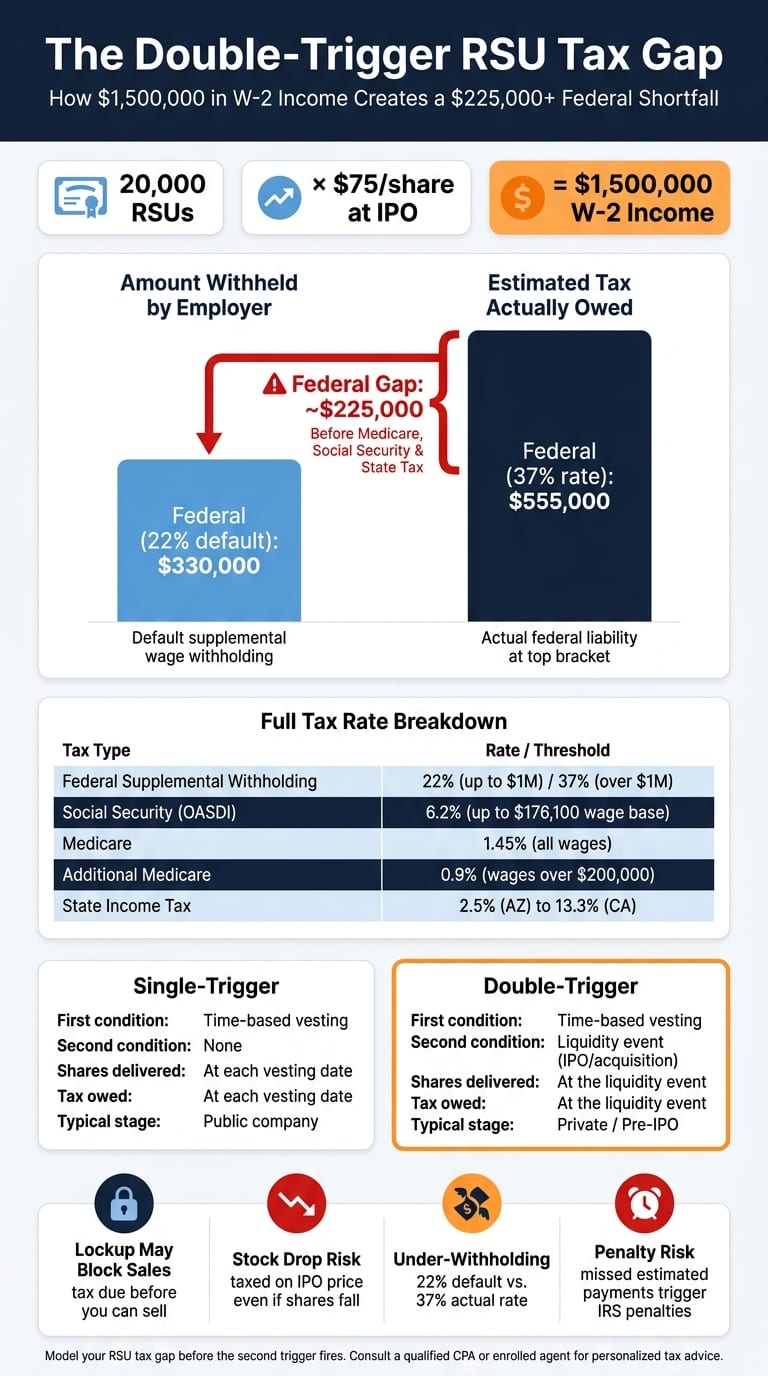
One example from the article shows 20,000 RSUs at $75 per share, or $1,500,000 of W-2 income in one day. At 22% federal withholding, about $330,000 may be withheld. If the final federal rate lands closer to 37%, federal tax alone may be about $555,000. That may leave a gap of about $225,000, before Medicare, Social Security, and state tax.
The core issue is simple: double-trigger RSUs may delay taxes for years, then compress them into one liquidity year. I’d read this article as a warning to model the gap early, check withholding, and look at cash before the second trigger arrives.
What Double-Trigger RSUs Are at a Pre-IPO Company
An RSU is a promise to deliver shares after vesting. At a pre-IPO company, those shares often don't settle on each vesting date. Instead, they may wait for a second trigger, such as an IPO or acquisition. That delay may mean the tax bill arrives all at once when liquidity finally happens.
Single-Trigger vs. Double-Trigger: What Has to Happen for Each
The table below shows the core difference:
As Andre Nader of FAANG FIRE puts it:
RSUs are taxed as income when they vest. This is true whether or not you sell. They receive the exact same tax treatment as if your company gave you the amount of the vest in cash.
With double-trigger RSUs, that taxable moment may simply be pushed forward until the second trigger happens. That timing gap may set up a liquidity-driven tax shock.
Why Private Companies Use This Structure
Private companies often use this structure for a simple reason: employees may not have a way to sell private stock to cover tax. Double-trigger RSUs defer settlement - and, with it, the tax event - until a second trigger fires, usually an IPO or acquisition. That may give employees time to earn shares without facing an immediate tax bill on stock they may not sell yet.
The tradeoff is pretty clear. Years of vested RSUs may settle in one tax year, which may create a concentrated income event.
How a Liquidity Event Turns Deferred RSUs Into W-2 Income
From Time Vesting to Settlement on the Liquidity Date
With double-trigger RSUs, the units may vest over time, but they don't settle until a second trigger happens. That second trigger may be an IPO, an acquisition, or another liquidity event. When it happens, the time-vested units settle into shares on that date. That's when the tax clock may start.
The shares' fair market value may become ordinary wage income on your Form W-2 for that year. The IRS may tax the shares when they settle, even if you may not be able to sell them yet.
Why 22% Withholding Often Falls Short
Your employer may withhold taxes at settlement, but the default rates may come up short. Default withholding for supplemental wages is 22% on amounts up to $1 million and 37% on amounts above $1 million in a single payment. Social Security, Medicare, and state income taxes may stack on top.
Default withholding rarely matches the full bill. Once a large RSU payout hits, the amount withheld may not cover your full federal liability.
Example: 20,000 RSUs Settling at $75 Per Share
A large grant makes the gap easier to see. Say you have 20,000 double-trigger RSUs that all settle on the IPO date at a fair market value of $75 per share. That may mean $1,500,000 of ordinary income recognized in a single day.
At the default 22% federal withholding rate, your employer may withhold $330,000 in federal tax. If your federal tax on that income ends up closer to 37%, the tax may be about $555,000. That may leave a $225,000 federal gap, before Social Security, Medicare, Additional Medicare Tax, and any state income tax.
A lockup may block sales for months. So you may owe tax based on the settlement-day fair market value even if you may not be able to turn those shares into cash right away.
The Real Risks at IPO or Acquisition
Under-Withholding, Estimated Payments, and Penalty Risk
Once the RSUs settle, three risks may show up at the same time: a tax shortfall, cash pressure, and share-price risk. That gap may turn into a real problem when liquidity arrives, but access to cash still lags behind the tax deadline.
If payroll withholding doesn't cover your full tax bill, the IRS may expect the difference to be paid through estimated tax payments. If those payments are missed, delayed, or too small, you may owe an underpayment penalty on top of the tax itself. Some people try to map out the full tax bill before payroll runs, especially when the shares may be locked up and harder to use for cash.
Lockups Create a Cash Problem Even When Shares Are Worth a Lot
The tax bill is based on the settlement date, not the date you're free to sell. So the shares may look valuable on paper, but that paper value may not pay the IRS.
If you don't have enough liquid savings set aside before the lockup starts, you may end up in a tight cash spot. And if the stock price drops later, the tax bill may stay tied to the earlier settlement value.
You Can Owe Tax on a Higher Price Than You Actually Receive
If the stock falls before you can sell, your tax bill still uses the higher settlement price. That means you may be taxed on value that disappears before you ever get cash in hand.
It's a simple but painful timing mismatch: the second trigger fires, the tax clock starts, and the stock price may move before you're allowed to sell.
How to Prepare Before the Second Trigger Hits
Because the tax bill may start when shares settle, not when you’re able to sell, it makes sense to model the gap before liquidity shows up.
Build an RSU Tax Model Before the Event
Build a one-page model with your grant size, vesting schedule and past sales, expected liquidity date, lockup period, salary, bonus, and share-price range. Then run low, base, and high price cases so you may plan for the worst-case outcome.
The tax gap is the difference between payroll withholding and total tax owed. At higher share prices, that gap may reach six figures even before state tax. Once that number is clear, some people choose to fund it before settlement.
Set Aside Cash for the Tax Bill
A common starting point is updating your Form W-4 to increase payroll withholding on regular wages. From there, some people build a liquid cash reserve - kept in cash or cash-like instruments - sized to cover the worst-case gap.
It also may help to map your liquidity event timing against the quarterly estimated tax due dates:
- April 15
- June 15
- September 15
- January 15
That way, payments may reach the IRS before penalties accrue.
Use Mezzi to See Your Full Exposure Before It Gets Expensive
A model only tells part of the story if it leaves out accounts that affect liquidity. Mezzi’s read-only aggregation pulls your equity, brokerage, retirement, and bank accounts into one view. That consolidated picture may make it easier to see your total liquidity-year exposure - RSU income, available cash, and diversified assets - across settlement scenarios.
If your only real liquidity may be company stock sitting behind a lockup, that concentration risk may be worth addressing early. Mezzi is read-only, does not trade or file taxes, and its insights are planning tools, not tax or legal advice. For guidance tied to your income, filing status, and state tax situation, consult a qualified CPA or enrolled agent.
Conclusion: The Tax Bill Is Usually Set Before Liquidity Arrives
After vesting, withholding, and lockup mechanics, the takeaway may be pretty simple: double-trigger RSUs may feel like a windfall, but the tax bill may arrive at the same time.
At liquidity, vested RSUs may settle all at once, and their fair market value may become W-2 income. Default withholding at 22% may fall short of the actual tax liability. That’s why a grant that looks manageable on paper may still lead to a surprise bill at filing.
The issue may get worse if shares are locked up after an IPO. If the stock falls during the lockup period, you may still owe tax based on the IPO-day price. That mismatch may turn liquidity into a cash-flow problem.
Some people try to get ahead of that by:
- modeling the tax gap before the event
- setting aside cash for the higher-price case
- planning estimated tax payments early if withholding may not cover the bill
Mezzi's account aggregation shows your equity, cash, and other assets in one view, which may make the tax gap easier to spot before settlement.
Your only real leverage may be preparation before settlement.
FAQs
When do my double-trigger RSUs become taxable?
Double-trigger RSUs become taxable only after both triggers are met. In many cases, that means time-based vesting happens first, and a liquidity event, like an IPO or acquisition, happens later.
Once the second trigger occurs and the shares formally settle, the fair market value of those vested shares may be treated as ordinary income. If that happens all at once, it may lead to a concentrated tax bill.
What if I owe tax before I can sell my shares?
If you owe taxes before you’re able to sell your shares, such as AMT tied to ISOs, you may need to pay cash out of pocket based on paper gains before any liquidity event.
Since you may not be able to sell shares to cover that bill, it may make sense to model your tax exposure across a few exit scenarios. Some people also exercise early in the year, because selling before December 31 may reduce or avoid that AMT liability.
How can I estimate my RSU tax shortfall before an IPO?
Compare your expected total tax rate with the standard 22% federal supplemental withholding often used for RSUs. Since RSUs are generally taxed as ordinary income at vesting, people in the 32% to 37% federal brackets may face under-withholding.
To estimate the gap, look at your federal rate, state rate, and any FICA that may apply. Then compare those with the shares’ fair market value at vesting and any state sourcing rules that may affect how the income is taxed. Based on that review, some people adjust their W-4 withholding, while others plan for estimated tax payments.
Disclosures:
- This content is for informational purposes only and does not constitute investment advice or a recommendation to buy or sell any security.
- Past performance is not indicative of future results. No guarantee of future performance or outcomes is implied.
- Mezzi is a planning tool and does not provide tax or legal advice. For guidance tied to your income, filing status, and state tax situation, consult a qualified CPA or enrolled agent.
Related Blog Posts
- Should you sell RSUs when they vest? A tax-aware framework
- Should You Sell RSUs When They Vest? Timing and Tax Analysis
- Your RSUs Withheld 22% - You're in the 35% Bracket. Meet the April Surprise
- Sell RSUs at Vest or Hold? The Concentration-vs-Tax Tradeoff
Double-trigger RSUs become taxable only after both triggers are met. In many cases, that means time-based vesting happens first, and a liquidity event, like an IPO or acquisition, happens later.
Once the second trigger occurs and the shares formally settle, the fair market value of those vested shares may be treated as ordinary income. If that happens all at once, it may lead to a concentrated tax bill.
If you owe taxes before you’re able to sell your shares, such as AMT tied to ISOs, you may need to pay cash out of pocket based on paper gains before any liquidity event.
Since you may not be able to sell shares to cover that bill, it may make sense to model your tax exposure across a few exit scenarios. Some people also exercise early in the year, because selling before December 31 may reduce or avoid that AMT liability.
Compare your expected total tax rate with the standard 22% federal supplemental withholding often used for RSUs. Since RSUs are generally taxed as ordinary income at vesting, people in the 32% to 37% federal brackets may face under-withholding.
To estimate the gap, look at your federal rate, state rate, and any FICA that may apply. Then compare those with the shares’ fair market value at vesting and any state sourcing rules that may affect how the income is taxed. Based on that review, some people adjust their W-4 withholding, while others plan for estimated tax payments.